The Peripatetic Reviewer
by Edward Weeks
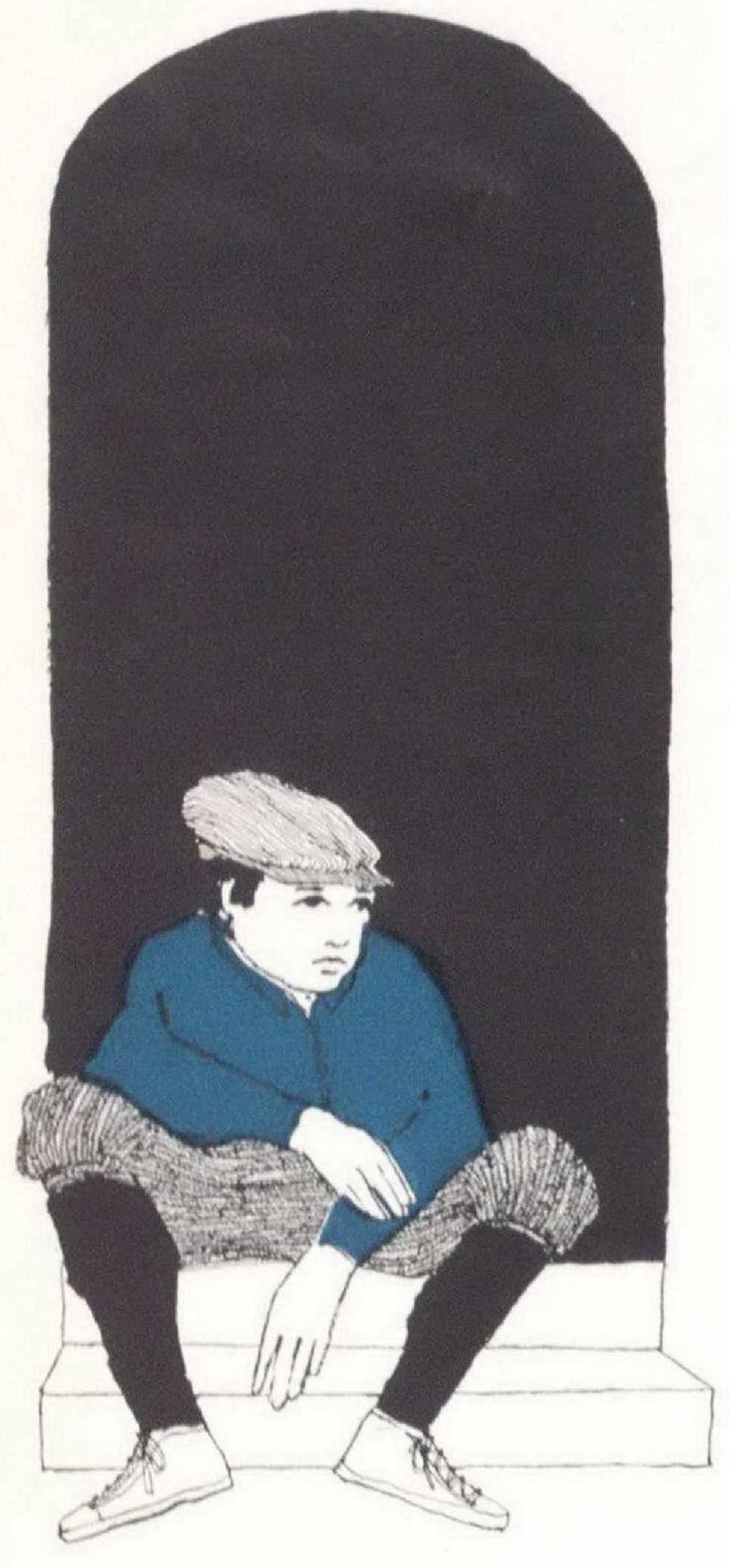
Like the Bronx, Brooklyn is one of the five boroughs of New York City, but from its cinders and pavements there springs a different spirit. Brooklyn Bridge, with its glorious high arch, has been a perennial temptation for those who like to jump; and the moment one puts foot on a Brooklyn street one is aware of a different vernacular, Brooklynese, of a sense of comedy that produced in the old Dodgers the daffiest team in baseball, and of a native pride that somehow has blended the bloodstreams into a hotly competitive community.
TO BROOKLYN WITH LOVE by GERALD GREEN (Trident Press, $5.95) is a reminiscent novel of what went on in Longview Avenue during one roaring hot summer of the Depression when the priorities of that poverty-ridden neighborhood were divided between the Jews, the Poles, and the Negroes. It is the story of a doting father and a repressive mother and an only son, with the son speaking. The father, Solomon Abrams, M.D., is a huge barrel of a man, with a dark Mohawk head, big biceps, and an irascible temper, His practice has been slipping, and he is driven to profanity by the disloyalty and nonpayment of his patients. The boy, twelve-year-old Albert, is the apple of his father’s eye and a weakling with the best brain in his class. A spindly, sickly kid, with ankles too weak for rollerskating, Albert stands far down in the peeking order of his gang, the Raiders. He lives in daily dread of the bullying he gets from Bimbo Wexler, in fear of what will happen to him if he is ever cut off from the others and beaten up by Lee Roy, the most menacing of the jeering Negroes.
Albert’s salvation in the jungle of the streets, as at home, is his wits; the Raiders need him because his is the new softball and his is the best glove; but they need him also because he is a faultless scorekeeper, with the courage to confront the Hawks when they deliberately mix up their batting order. These games in the crowded street, cheered on by the loafers, are ferocious, and it disgusts Albert that he can never play the hero, but he compensates in his imagination, and the sarcasm with which he defends himself is a sharp weapon.
At home his struggle is a more sensitive one, for he is more mature than either parent will allow. He resists his mother’s mollycoddling and never confides to her his own fears, which are much more realistic than hers; his heart goes out to his father when the old man is working in the cindery garden and even more when he bursts into fury; and Albert’s dreams, derived as they are from his omnivorous reading of the classics and the sports page, of how he will make the old man proud, speak for all of us who were miscast in adolescence. Mr. Green has a musician’s ear for the Brooklyn vocabulary, and this is necessary, for his story is told largely in dialogue. I feel it is softened somewhat by being cast in the form of nostalgia, and I realize that the strife on the pavements in the 1930s, when all were feeling the pinch, did not have the vindictiveness which lurks so close to the surface today.
Alexis and Rasputin
The disintegration of Russia under the rule of the last Czar, Nicholas II, was a tragedy so overwhelming in its change, so pitiable in its destructiveness that it will be told and retold for succeeding generations. The most comprehensive political picture, The Fall of the Monarchy,was written by Sir Bernard Pares, who as the British ambassador at St. Petersburg took note of what was happening at close range. The most poignant and sympathetic account of the royal couple, the grand duchesses, and of Alexis, the pathetic little Czarevitch, is NICHOLAS AND ALEXANDRA by ROBERT MASSIE (Atheneum, $10.00). What gives this book its singular pathos is that the author, Mr. Massie, is himself the father of a hemophiliac son. Hemophilia is still a severe though more manageable disease; transfusions of fresh blood plasma are applied at the first sign of bleeding, and non-habit-forming drugs are used to alleviate the waves of pain as they were not with the Czarevitch. If the patient survives childhood, he may live a relatively normal life. Mr. Massie’s natural curiosity led him to wonder how Alexis’ vulnerability may have affected his parents and whether it accelerated the fall of the dynasty.
I find the author’s study of the royal household understanding, admirably documented, and full of short but fascinating portraits. Many unusual details turned up in his research. It is strange to think that Queen Victoria, the famous matchmaker of her century and “Granny” to most of Europe’s royalty, was unknowingly a hemophiliac carrier. The youngest of her four sons, Prince Leopold, had hemophilia; two of her five daughters, Princess Alice and Princess Beatrice, were hemophiliac carriers, and two of their daughters transmitted the dread disease to the royal houses of Russia and Spain. The Queen naturally was shocked to discover the illness in her family, and Leopold, who was lively and willful, gave her a hard time with his accidental hemorrhages. But in England no effort was made to conceal his affliction, whereas in Russia Alexis’ suffering, which came from the slightest bruise or sprain and was excruciating, was kept a state secret.
At Spala, the hunting lodge in Poland, in 1912 Alexis almost died from the hemorrhaging in his thigh and groin; his screams could not be stifled; the last sacrament was administered, and in her desperation the Empress had a telegram sent to Gregory Rasputin in Siberia, a mystic with a foul reputation who was believed to be a healer. His reply ended with the words: “The Little One will not die. Do not allow the doctors to bother him too much.” The hemorrhaging stopped the next day, and from that moment the Czar and his wife reposed trust in the monk whose influence as he came into the inner circle eventually prompted Kerensky to say, “Without Rasputin, there could have been no Lenin.”
In its very human detail this is a book of alternating sunlight and sorrow. Mr. Massie believes that Nicholas II was “at least as intelligent as any European monarch in his day or ours,” and indeed the Czar’s tastes were surprisingly similar to those of King George V, whom physically he so much resembled. Nicholas’ visits to England were always sunny affairs; he was one of Granny’s favorites; and his courtship of Alix, whom he passionately loved, was not long resisted by his parents. But in his English exposure he did not learn the benefits of constitutional monarchy. Nicky at thirteen had witnessed the horrible assassination of his father; he was never to forget that death bed, nor the lessons instilled in him by his reactionary and brilliant tutor Pobedonostsev that he was born to be an autocrat.
The life of the royal household at Tsarskoe Selo, in the Peterhof palace, and aboard the royal yacht is charmingly described, and stands in honest contrast to the frivolity of St. Petersburg and the marriage shambles and dissolute behavior of the Grand Dukes. The pathetic efforts of the eleven-year-old Alexis to play his part as the war approached are touching, and the determination of the Empress to accept Rasputin’s prophecies and not to believe in the police reports of his drunken orgies is fateful. History is full of “ifs.”Nicholas’ absolutism could never have survived the First World War, but if Rasputin in 1914 had not recovered from the knife wound that so nearly finished him, the future of Russia might have been very different.
“People we visit”
STEPHEN BIRMINGHAM is a novelist who has made a most successful venture into social history; in “OUR CROWD” (Harper & Row, $8.95) he has brought together a composite, warmly human picture of the great Jewish families of New York. The first Jew to settle in Manhattan, Jacob Barsimson, arrived early in 1654, and later that year the bark St. Charles, known as “the Jewish Mayflower,” landed twenty-three more Jewish immigrants, all of them Sephardim, who, in Mr. Birmingham’s words, “consider themselves the most noble of all Jews because they claim . . . the longest unbroken history of unity and suffering.” But most of the families he writes about, the pivotal names, Belmont, Loeh, Lehman, Lewisohn, Straus, Schiff, Seligman, Goldman, Warburg, Guggenheim, came to us in the early and mid nineteenth century, and it is surprising how closely they followed a single pattern of success. They came from Germany; they had the hardihood to penetrate the rough country of the Midwest and South as itinerant peddlers, those who had the capital to afford a horse being a notch higher than those who traveled on foot; they sent money back to the old country to import their younger brothers or a wife; and by working harder than gentiles, with Horatio Alger celerity they acquired property and transformed themselves into bankers even before they had reached middle life. They gravitated to New York, the wealthiest of them living in luxurious houses between East Sixtieth and East Eightieth Streets, and they formed a closed society where the values were fixed and immutable. There were, according to Mrs. Philip J. Goodhart, two kinds of people. There were “people we visit" and “people we wouldn’t visit.”This book is about those Mrs. Goodhart would welcome.
Not all of them were impecunious; the Warburgs had money, and August Belmont, born August Schönberg, was sent to America as the agent for the Rothschilds and had their huge reserves behind him. Mr. Birmingham acutely appraises the big man of each clan, his capacity, his taste, his idiosyncrasies; and able citizens they were: Joseph Seligman; Jacob Schiff, who by force and finesse placed Harriman on the Burlington Board despite the stubborn opposition of J. P. Morgan; Otto Kahn in his Italian Renaissance palace on Fifth Avenue; Felix Warburg; and Adolph Lewisohn.
The comedy in the book is most often supplied by the more erratic, less responsible juniors, and there is plenty of it . What is so impressive is the generosity of the giants: the grace with which Otto Kahn sustained the Metropolitan Opera simply blew away the banality of antiSemitism. Occasionally the author finds it difficult to check or judge the family hearsay. Thus in his account of August Belmont, who lived in great style and who was easily the most pretentious figure in the book, there is the apocryphal story of how Belmont would occasionally use his father-in-law, Commodore Perry, as his butler: “There’s a good fellow,” the story has it, “run down to the cellar and see if there are six more bottles of the Rapid Madeira.” Well, the Commodore, who topped his son-in-law by six inches, was known in the Navy as “Old Bruin,” and although he owed the young man money, his answer to such nonsense would probably have been “The hell I will.”
In Frank Crowninshield’s Vanity Fair the portrait-photograph acquired the distinction of a good painting, and his best craftsman was a Hungarian, NICKOLAS MURAY, who landed in New York the summer of 1913 with twenty-five dollars and fifty words of English. Muray had the eye of an artist and such friendly charm that he could relax his subject, pose him, and with his silent shutter take the picture while the sitter was still unaware. When he was sent abroad to make studies of the eighty-six-year-old Claude Monet, the artist, who was old and tired, asked, “Eh bien, my friend, and when are you going to start taking the pictures?", to which Muray replied, “But I have already taken half a dozen, Maitie.”THE REVEALING EYE (Atheneum, $25.00) is an assortment of a hundred and fifty photographs of the men and women who made the 1920s memorable, each picture enlivened by a thumbnail portrait by PAUL GALLICO. A handsome book and a revealing one.
Muray was not interested in the pores of the skin; gregarious and a good talker, he made converts of his subjects and then portrayed them as they wanted to appear. He never hesitated to touch up a rough complexion, as in the case of Sinclair Lewis, and he stressed the lines and wrinkles only when they were a determined part of a man’s individuality, as they were with Humphrey Bogart and Clarence Darrow. The results can be astonishingly lovely, as in the duet of Joan Crawford and Douglas Fairbanks, Jr., the magical study of Greta Garbo, the lithe and lovely Martha Graham, the incredibly youthful Harold Ross, the dark loveliness of Katharine Cornell, the forthrightness of John Galsworthy, and the unforgettable eyes of Jed Harris. Or through too much smoothing out they can be as vapid as the shots of Scott Fitzgerald, Lillian Gish, Helen Hayes, and Herbert Hoover.
The single-page characterizations by Paul Gallico are deft, amusing, and in most cases, pertinent. I particularly liked his sketch of Doug Fairbanks and Mary Pickford, and what he says of Jean Harlow, but I think he protests too much in his admiration of Joseph Hergesheimer and Frank Crowninshield. Mr. Gallico tells us that Mr. Crowninshield “discovered” Robert Benchley, Dorothy Parker, and Robert Sherwood, which I don’t believe, and he does not tell us that Crowninshield fired Parker and that the other two resigned in protest when Flo Ziegfield complained about Miss Parker’s acid reviews.