Why Learn the Language?
David MacNeil Doren is a native of Syracuse, New York, who sojourned in Sweden after living for six years in Crete.
by David MacNeil Doren
I came across a little story recently about a retired Englishman who prefers not to learn the language of the country he is living in. On those few occasions when he started to learn a language, he found that his life became complicated, and he was forced to move on.
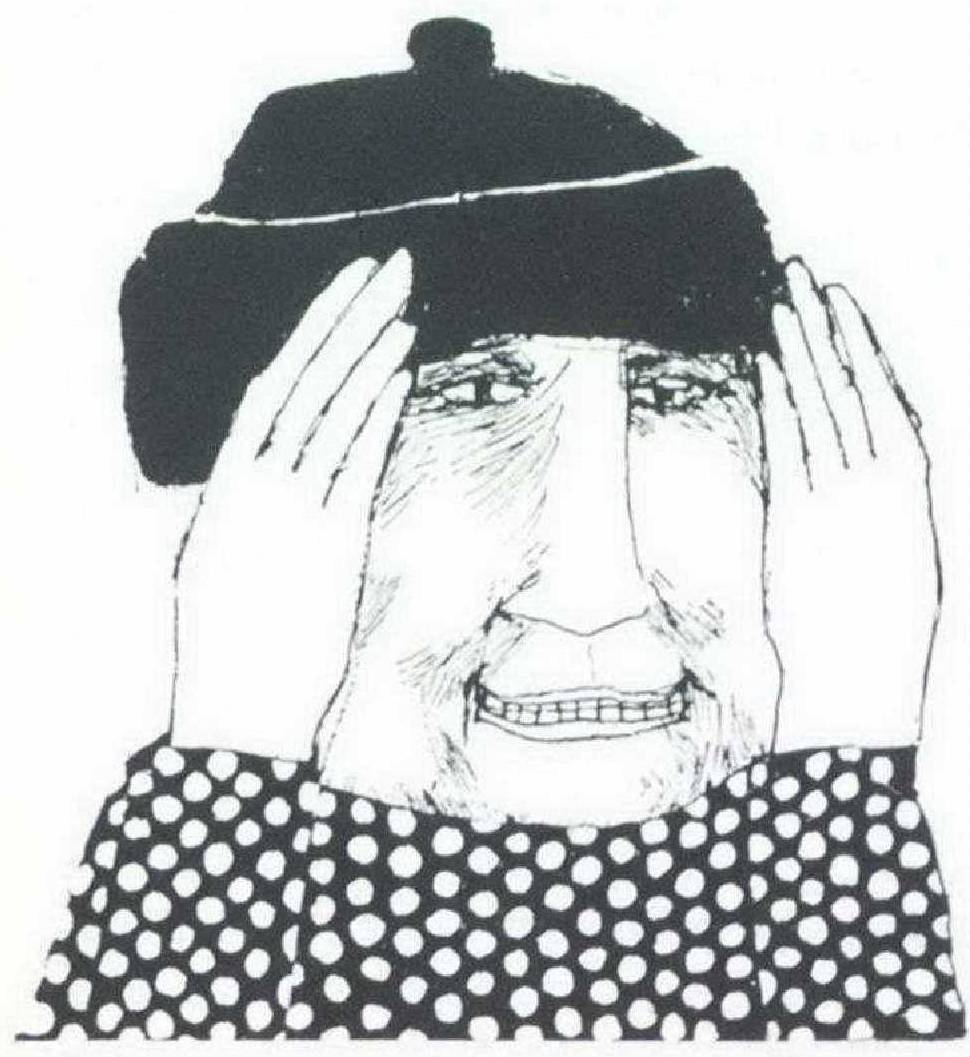
This reminded me of a college classmate I had once. He was a war veteran whose ears had been damaged in a plane crash, so that he always had to wear a hearing aid. He used to sit at the back of the room during lectures, and when the professor had droned on a bit too long, he would simply switch off the gadget and sit there musing idly in a pool of silence in his own world.
I always envied that student, but it was not until I started to live abroad most of the time that I discovered another way of duplicating his act of retirement from an intrusive world. Like the retired Englishman, I prefer to live in countries whose languages I do not know. When others’ words become a mere blur of incomprehensible syllables, one’s own thoughts sail on undisturbed.
When I went to live in Greece some years ago, I decided not to learn the language — or languages, rather, for in that confusing country there are at least two separate languages: the katharevusa. or “purified” speech of orators and other snobs, and the demotiki, or popular tongue of the masses. There is also the newspaper language, which is a mixture of the two; not to mention all the local dialects. I decided not to learn any of them.
For the first three years my efforts, or lack of them, met with complete success: I did not learn enough Greek to be disturbed by it. I picked up just enough to get by in shops and restaurants, and to hold simple colloquies with shepherds and fishermen whom I met in my rambles. Those were three of the most tranquil years of my life — mainly, I believe, because I had never had so much time for my own thoughts. During those years there was a succession of political crises, in Cyprus and elsewhere, and some of my foreign friends who had learned fluent Greek complained bitterly about all the bombast and rhetoric they were forced to listen to from every kafeneion orator they met. I never heard a word of all that: confronted with my linguistic stone wall, even the gabbiest Greeks had to throw up their hands and admit defeat.
While my friends who had thoughtlessly picked up the language had to undergo this martyrion (to use a Greek expression that I did not learn), I would just sit there, with my hearing aid off, as it were, observing the life around me. For I had made a remarkable discovery: my powers of observation had improved when I became free to not listen. I learned to prefer the eyes to the ears. “Believe what you see, not what you hear,” says a Muslim proverb. (This was especially true in Crete, where I spent most of my time. Saint Paul complained that “all Cretans are liars,” and the tradition goes back even farther, to Epimenides, a sixth-century-B.c. Cretan philosopher and verbal trickster who posed the riddle: “All Cretans are liars; Epimenides is a Cretan; is Epimenides a liar?”) But even the Cretans, with over 2500 years of experience behind them, could not lie without their language. It takes a very great actor to lie without using words: commonly people’s movements and the expression of their eyes will give them away to a keen observer.
Sometimes friends from America, and other foreigners, would come to see me. They would say, “Of course, you speak Greek fluently by now?”
“No,” I would answer matter-offactly, “I hardly know a word.”
“But you have been here for years!”
“It hasn’t been easy, but then I am a complete linguistic idiot.”
And then (especially if they were Europeans) they would start to look down on me. Language snobbery is endemic throughout Europe; competition is keen, and many fall by the way. One woman I knew, whose Greek was quite good, confessed that she became absolutely tongue-tied in the presence of any of her countrymen who happened to speak a little better Greek than she did. I provided them with an easy victory.
Sometimes I would tell people, “How can I start learning Greek when I still haven’t learned English?”
They nearly always regarded this remark, which I made in all sincerity, as either a flippancy or a piece of incomprehensible stupidity. Yet it is quite true: hardly anyone learns his own language properly, let alone a foreign tongue as complex as Greek. After all, English is the world’s leading language now — I can read anything I want in it — so why should I sweat and strain to learn (imperfectly) another language in which to be bombarded with additional trivialities?
No sense at all in several languages,
Will pass for learneder than he that’s known
To speak the strongest reason in his own.
Samuel Butler knew.
I would not wish to impose my method upon everyone — far be it from me to deprive anyone of the undoubted pleasure of learning languages — any more than I would wish to prohibit the reading of mysteries or the solving of puzzles. To each his own. For my part, I would rather keep my pool of silence.
However, it didn’t work out quite as I had hoped. After three years something totally unexpected began to happen. I found that I was speaking and understanding Greek in spite of myself. I had picked it up by sheer osmosis — as a child learns a language.
From that day on, my peace of mind suffered. My life began to change; complications entered in. The tangled grapevine of village gossip and intrigue wrapped itself around my once simple life. I had to listen to political discussions, and to offer my own opinions on such distressing matters as Vietnam, Cyprus, the Church versus the State.
Finally it was too much. Like the retired Englishman, I had to move on. I am now in Sweden. There is little danger that I will learn enough of this vowel-crazy speech to disturb my inner repose — at least not for several years, by which time the climate will probably have driven me out anyway. I have learned the barest minimum necessary to get by in this formalistic land. I can say “Thank you” four different ways: Tack tack, Tack so mycket, Tusen tack, and Manga tack. It makes a very good impression. They have no word for “Please.”