Passion From Poland
The trouble with avant-garde composers, as more than one observer has pointed out, is that they seem to write mostly for other avant-garde composers. Within this framework they manage to achieve successes and failures, and to set off some spirited controversies among the initiated. But they remain cut off from the broad mass of the musical public, which either totally ignores their works or walks out when they are confronted with them, as happened a few years ago when Leonard Bernstein undertook an avant-garde series before the regular subscription audiences of the New York Philharmonic.
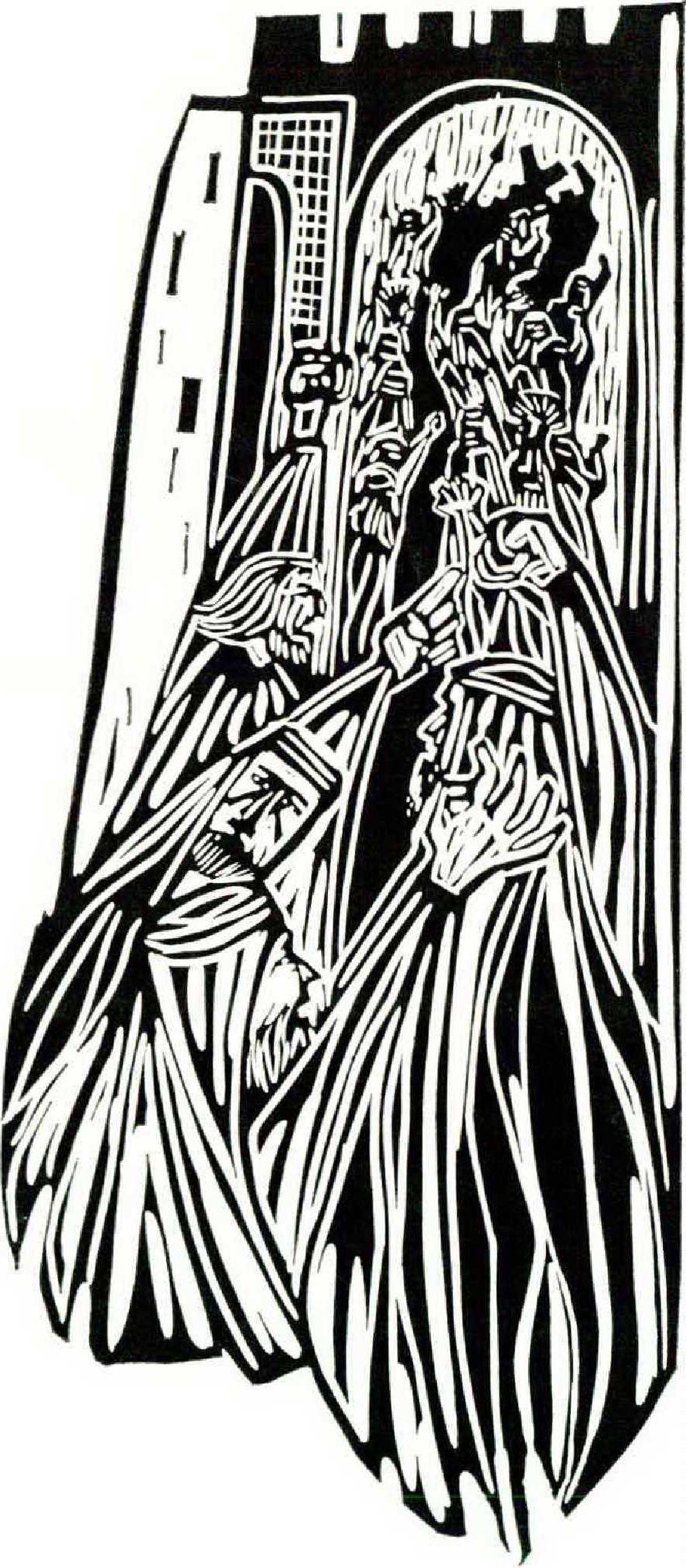
Now, however, a breakthrough has been achieved by a thirty-fouryear-old avant-garde composer from Poland named Krzysztof Penderecki. His Passion and Death of Our Lord Jesus Christ According to St. Luke is a work that employs a great many avant-garde techniques — in fact, it is almost an anthology of them — and yet it manages to communicate emotion and meaning with great individuality. Penderecki’s eightyminute Passion, which was commissioned by the West German Radio to mark the seven-hundredth anniversary of Münster Cathedral, created a sensation at its world premiere on March 30, 1966, and has since repeated its success throughout Europe and at its American premiere last fall in Minneapolis. It has also appeared simultaneously on two American recordings, from Philips (PHS-2-901, stereo: two records) and from RCA Victrola (VICS-6015, stereo: two records). Other music by Penderecki is being programmed by American orchestras this year, including his searing Threnody to the Victims of Hiroshima, his most-talked-about work prior to the St. Luke Passion.
Penderecki will spend the 1968— 1969 season in the United States as composer in residence with the Buffalo Philharmonic Orchestra at the invitation of its conductor, Lukas Foss. He came here for the first time late last year to attend performances of the St. Luke Passion in Minneapolis and, as he thought, New York. Unfortunately, a few days before the eagerly awaited Carnegie Hall premiere Stanislaw Skrowaczewski, the Polish-born conductor of the Minneapolis Symphony, was suddenly hospitalized with a detached retina, and the concert had to be postponed, until, hopefully, this spring.
Penderecki seemed perfectly tranquil about the cancellation as we sat and talked, with the help of an interpreter, in his Manhattan hotel room on the night the concert was to have been held. He is a mediumsized, trim young man, with a small beard and intense dark eyes behind black-rimmed eyeglasses. Whatever other avant-garde composers may be wearing these days, Penderecki was neatly clad in a white shirt, striped tie, blue blazer, and gray trousers.
The next morning he was flying to Essen, Germany, where he teaches composition, and as he spoke about his works in progress he seemed almost impatient to apply his novel techniques to all sorts of traditional musical forms. His new Dies Irae, dedicated to the victims of Auschwitz, is being prepared by Philips for release on records soon; he is currently working on an Orthodox Church Mass to be written in Old Church Slavonic, the ancient Russian liturgical language; and he is planning an opera on John Whiting’s hallucinatory play The Devils, based on Aldous Huxley’s The Devils of Loudon, which ought to make a fine subject for his highly original and exploratory techniques.
Penderecki takes his role as a prophet of the avant-garde seriously; he said he had deliberately set out “to enlarge the scale of sounds and to create new sounds” by developing such devices as new types of vibrato for stringed instruments, and even getting percussive effects from violins. Some require new kinds of musical notations, which Penderecki has not been slow to invent.
But he pointed out that in many of his works traditional techniques exist side by side with the innovations, and he almost raised his right hand as he solemnly subscribed to the ancient aphorism that there really are two basic kinds of music — good and bad. He did wish, however, that American audiences were more receptive to avant-garde compositions. He had heard some fine music here, he said, citing specifically works by Elliott Carter, Lukas Foss, and several products of the Columbia University electronic music laboratory, but he had been disappointed to find so little avantgarde music programmed by American conductors. “The public in Europe is much more prepared,” he said. “Contemporary music is played on the radio and on television, and there are festivals devoted to it, such as the Warsaw Festival.”
Penderecki, who was born in the small town of Debica near Cracow and has vivid boyhood memories of the Nazi conquest, said he had no easy explanation of Poland’s postwar cultural renaissance. “The question of the political regime has nothing to do with it,” he insisted. “Over the centuries every nation seems to have its turn in art: Holland, Italy, France. Perhaps now it is our chance.”
A practicing Roman Catholic, Penderecki is well aware of the outpouring of religious music which has become one of the most striking phenomena of the current musical scene, as represented, for example, in the recent but widely different War Requiems of Benjamin Britten and Dimitri Kabalevsky. “It is a reaction to the world we see, the world of science and rockets,” he said. “It is an escape; people are seeking some deeper human feeling. My own St, Luke Passion is not altogether a religious work, you know. It is also symbolic and humanitarian.”
“Why did you choose St. Luke instead of one of the other gospels?” I asked. “Why not St. Matthew or St.John?”
Penderecki smiled. “In my view, St. Luke is the most beautiful of all the texts,” he said. “Besides, those others had already been set to music by a not-bad composer.”
In its broad structure, Penderecki’s Passion is strikingly similar to those of Johann Sebastian Bach, with its use of an Evangelist narrator (though he speaks rather than sings his lines), its mighty choruses, and its expressive setting for baritone of the words of Jesus. It also pays the homage of using, as many composers through the ages have, the notes B-A-C-H (equivalent to B flat, A, C, and B natural) as a basic melodic and harmonic element.
But Penderecki’s individuality is apparent from the very first note, an anguished, twisted cry of “Crux!” (“cross”) which is wrung from the massed choruses. As the work progresses one becomes aware of some of the avant-garde techniques that help give the music its impact and immediacy: twelve-tone rows, jagged melodies, quarter-tones, and great tone clusters, which are the kind of sounds you can produce on a piano by smiting the keyboard with the forearm or elbow. Yet dozens of other composers have employed similar devices without producing a like effect. Part of the reason for Penderecki’s success is that he has shrewdly combined his advanced approach with some thoroughly traditional modes and methods. Dissonances often resolve in traditional cadences; a Stabat Mater section for unaccompanied voices is strikingly reminiscent of medieval plainsong; suggestions of Slavic folk melodies are present; one of the most moving and deeply human moments of all occurs when Jesus intones the words “Deus meus, Deus meus” in a rocking musical pattern whose very simplicity carries a poignancy of its own.
Above all, it is the choruses in the Passion According to St. Luke which establish the power and individuality of the work. Penderecki dispenses with Bach-style chorales; instead his contemplative passages are drawn from the psalms, the Roman breviary, and the missal. His chorus plays a vital part in the drama, spitting out words and syllables with such precision and intensity that one receives almost a three-dimensional sound picture of a surging, seething crowd mocking Christ on the road to Calvary. Seldom has the eternal mob been depicted in music so vividly and frighteningly.
Both the Philips and RCA Victrola recordings are of first quality; indeed, it is difficult to distinguish between them because they were made with almost identical performers — Stefania Woytowicz, soprano; Andrzej Hiolski, baritone; Bernard Ladysz, bass; and Henry Czyz, conductor. But there is one difference: the Philips set emanates from Poland, with the Cracow Philharmonia Orchestra and Chorus, while the RCA is from Germany, with the Cologne Radio Symphony and Chorus. Furthermore, the Evangelist in the Polish set, Leszek Herdegen, speaks a Latin which seems more authentic, or at least less localized, than the Teutonicflavored accents of the German speaker, Rudolf Jürgen Bartsch. This last is a small point, but a decisive one, and if I had any doubts, they were dispelled when Penderecki said he preferred the Cracow recording for the same reason.
The Philips album has one other advantage: it also includes Penderecki’s To the Victims of Hiroshima, a threnody for fifty-two string instruments. This nine-minute work, which is several years older than the St. Luke Passion, is even more startling in its avant-gardism. Scored for twenty-four violins, ten violas, ten cellos, and eight basses, it almost gives the impression of every string player for himself with its vast range of seemingly disjointed sounds and its extraordinary percussive and sliding effects. Penderecki stretches sound to its uttermost limits, particularly in the upper registers; he has his violinists play behind the bridge, saw and rub their bows across the strings, and even strike them against their chairs. The piece, which observes its own structural rules, has the effect of a lacerating lament.
Some European critics have contended that the St. Luke Passion, with its admixture of conservative elements, actually marks a regression from the uncompromisingly modern Hiroshima threnody. Others complain that To the Victims of Hiroshima depends for its impact upon its title. Take away the name of the city, they argue, and the piece would seem a meaningless exercise in sound, although it always will remain possible to thrill to the drama of Beethoven’s Egmont Overture without knowing who Egmont was.
To all such criticisms Penderecki remains outwardly serene and untroubled. If he knows how to select apt titles for his compositions, or, putting it another way, how to find inspiration in topicality, surely he is no less a modernist for that. As for regressing or progressing, he intends to go his own way, however others may characterize it. “I am not copying anything or anybody,” he said. “And I am not the same composer today I was three years ago. I feel I am more individual, that I am developing my own musical language. I am more in the avant-garde than ever.”
Record Reviews
Bach: Chromatic Fantasy and Fugue in D Minor; Partita No. 5 in G Major; Partita No. 6 in E Minor
Alexis Weissenberg, pianist; Angel S36437 (stereo)
The Bulgarian-born, Americaneducated Weissenberg likes to play Bach on the piano rather than the harpsichord, and on this record, at least, the results are intriguing. The opening phrase of the Chromatic Fantasy, which seems an entity in itself and yet creates a sense of suspense for what is to follow, sets a standard of interest that seldom lessens. Purists very likely will continue to insist on the harpsichord in this music, but Weissenberg makes out a good case for the piano as an at least occasional variant.
Mozart: Don Giovanni
Karl Böhm conducting Prague National Theater Orchestra, with Dietrich FischerDieskau and Alfred Mariotti, baritones; Ezio Flagello and Martti Talvela, basses; Peter Schreier, tenor; Birgit Nilsson, Martina Arroyo, and Reri Grist, sopranos; Deutsche Grammophon 139260/63 (stereo): four records Despite several strong individual performances, this set is a major disappointment. Most of all it lacks a Don Giovanni; Dietrich FischerDieskau, in his second try at recording the complete role, still seems uncomfortable. His “Champagne” Aria, to cite one instance, is little more than a succession of barks. Birgit Nilsson’s Mozart has always been less impressive than her Wagner. Best of all are Ezio Flagello’s Leporello, richly sung if not exactly bubbling with comedy, and Martti Talvela’s strong Commendatore. Against so uneven a cast, Karl Böhm’s clean and judicious conducting and the always excellent DGG sound fail to achieve their fullest effect.
Shostakovich: Symphony No. 13: Babi Yar; Humor; At the Store; Fears; A
career Kiril Kondrashin conducting Moscow Philharmonic Orchestra and Male Chorus, with Vitaly Gromadsky, bass; Everest 3181 (stereo)
This is a “pirated” recording — that is, one made from a private tape without authorization and released over the protests of Soviet recording authorities. But its contents are of extraordinary interest, for Shostakovich’s Symphony No. 13 has been banned from further performances in Soviet Russia, presumably because it includes a setting of the poem “Babi Yar” along with other works by Yevgeny Yevtushenko. “Babi Yar” set to music is a moving, deeply felt piece expressing an ineffable sadness over the death of thousands of Jews at the infamous ravine; it helps make the Symphony No. 13 a major work by Shostakovich. The sound of the recording, while adequate enough to establish the beauty of the music, is really less than the work deserves. It’s to be hoped that one day an authorized and richer-sounding version will be permitted to appear.
Gottschalk: Piano Music
Amiram Rigai, pianist; Decca DL710143 (stereo)
Louis Moreau Gottschalk, who lived from 1829 to 1869, was one of the first American pianists and also one of the first American composers. His music was both virtuosic and patriotic, much of it being flavored with Negro, Creole, and SpanishAmerican folk tunes, reflected in titles like “The Banjo,” “Souvenir de Porto Rico,” and “Minuit à Séville.” It’s great fun to hear, with the pleasure of recognizing familiar tunes adding a further zest. Amiram Rigai, an Israeli-American pianist, breezes through this music a bit percussively at times, but with plentiful spirit and sparkle.
The Anthology of Indian Music, Vol. I
Ravi Shankar, Ali Akbar Khan, S. Balachander, and others; World Pacific WDS-26200 (stereo): three records To its purely auditory virtues, this album adds a sense of organization and cohesiveness unusual in recordings of Indian music. Ravi Shankar not only leads his associates in a demonstration of its various manifestations, but he gives an extended spoken discussion of its legends, styles, and techniques. The combination of his softly accented voice and the musical illustrations makes for a rare sense of immediacy. An elaborate, handsomely printed text contributes to the general enlightenment. All that is missing are English translations of the songs. Surely those exotic, haunting chants mean something.
Benny Goodman & Paris
Benny Goodman conducting Joe Newman, trumpet; Urbie Green, trombone; Bernie Leighton, piano; Attila Zoller, guitar; George Duvivier, bass; and Joe Marshall, drums; Command RS-921-SD (stereo) It’s a pleasure to hear jazz so well recorded; come to think of it, it’s a pleasure to hear jazz, period. This may not be the greatest band B.G. ever assembled, but it’s a mighty good one, clean, balanced, and taut. The pervasive French flavor adds another attractive element, and Goodman’s clarinet shines forth with elegance in such numbers as “C’est si bon” and “C’est magnifique,” both of which happen to be expressions that apply neatly to the quality of sound attained by Command’s engineers.
Hair — An American Tribal Love-Rock Musical
Original-cast album directed by Gerald Freedman, with John Morris, musical director; RCA Victor LSO-1143 (stereo) Hair is real hair — the hippie kind, long and uncut. It’s worn that way by most of the participants in this strictly contemporary show, staged in Joseph Papp’s new Public Theater on Astor Place, at the edge of New York’s East Village. The play itself has confused more than one onlooker, but the musical score pulsates with exuberance, freshness, and originality. The words by Gerome Ragni and James Rado and the music by Galt MacDermot demonstrate that a rock score can have both variety and vitality, and that racial conflicts, anti-war sentiment, and even the generation gap can be mirrored in music. Hair comes as close as anything we have had yet to catching a generation in song, and even those who sing a different tune should find this one worth hearing.
The Poems of James Dickey
Read by the poet; directed by Arthur Luce Klein; Spoken Arts SA-984 (monaural) On this record James Dickey not only reads thirteen of his poems in a clear, direct voice, but prefaces each of them with a brief explanation of its intent. For a poet thus to indicate his thought in advance is highly unusual, but Dickey’s purpose has always been to communicate meaning, not conceal it. And to hear the explanation followed by the actual verse is to gain a fascinating insight into the poetic process, the refinement of thought into words. In this way one is made all the more keenly aware of the emotions and the universality of a suburban householder reliving his years as a bomber pilot (“The Firebombing”), a swimmer who has watched a child drown (“The Lifeguard”), and a son saluting his dying father (“The Hospital Window”). This is a poetry record of rare interest.