The Peripatetic Reviewer
by Edward Weeks
In a recent televised interview Walter Lippmann said that this country “is in a mess.” He was not speaking of Vietnam but of our domestic condition, and he is absolutely right. The conscientious minority know this to be true; the affluent majority are indifferent so long as their incomes and the market go up; and the politicians, baffled by the enormity of the problems and the power of the vested interests, have thus far compromised with half or quarter measures. Of the problems, what I am essentially concerned with here is the pollution of our air, our streams, and our land, which proliferates with each passing year.
On windless days in Boston, New York, or Los Angeles the smog created by industrial chimneys and engine exhausts is so thick and insidious that one’s breath comes short. A freshly painted windowsill in Boston will be coated with cinders in a week. What about one’s lungs? The stench from the industrial waste dumped into the Nashua River can be smelled at least a mile before one secs the stream, and the odor of the Charles is little better. There are two elemental facts about such pollution: first, that it is the spoliation of public property for private profit, and second, that it can be most accurately measured at the source. It should of course be subject to a graduated tax, beginning modestly and moving up, but local authorities quail at the thought of driving out industry into a less scrupulous state.
In the control of the air the nation should go to school to Pittsburgh, for what was once the dirtiest city in the country has now become the cleanest, thanks to the Allegheny Conference, that combination of private capital, led by the Mellons and supported by the entire network of industry, capable engineers, and an enlightened mayor. The air was cleansed, slums cleared, the desert on the wrong side of the tracks converted into the Golden Triangle, and a small beginning made in the depollution of the Allegheny and Monongahela rivers.
Now what we need is equally bold planning in those states which are renowned for their forward-looking legislation. The cities and towns can set an admirable standard, as they do in Concord, Lincoln, and Dennis in Massachusetts, but the control must be wider than that, for what good does it do to clean your portion of a poisoned stream only to have the boys at the headwaters keep fouling it up without compunction? Intrastate surveys should be authorized to examine biologically an entire watershed, as is being done today by the New England River Basins Commission, and when their recommendations have been agreed to and given teeth we may have a practical new system worthy of being copied the country over. It will cost money: Roger Revelle, director of the Center for Population Studies at Harvard and an authority on water control, estimates that ten billion dollars should be spent over the next twenty years on stream depollution alone.
California, with its ever increasing population, presents the most critical battleground of all the states. GEORGE R. STEWART is a California naturalist who in his earlier books, Storm, Fire, Earth Abides, and Ordeal by Hunger, has dramatized the great changes which man has to contend with in his environment. Now in
NOT SO RICH AS YOU THINK (Houghton Mifflin, $5.00) he confronts us with as difficult and disagreeable a subject as any American can face up to —the devastation which we have lazily, greedily, destructively inflicted on our own country. No more realistic horror story will be published this year.
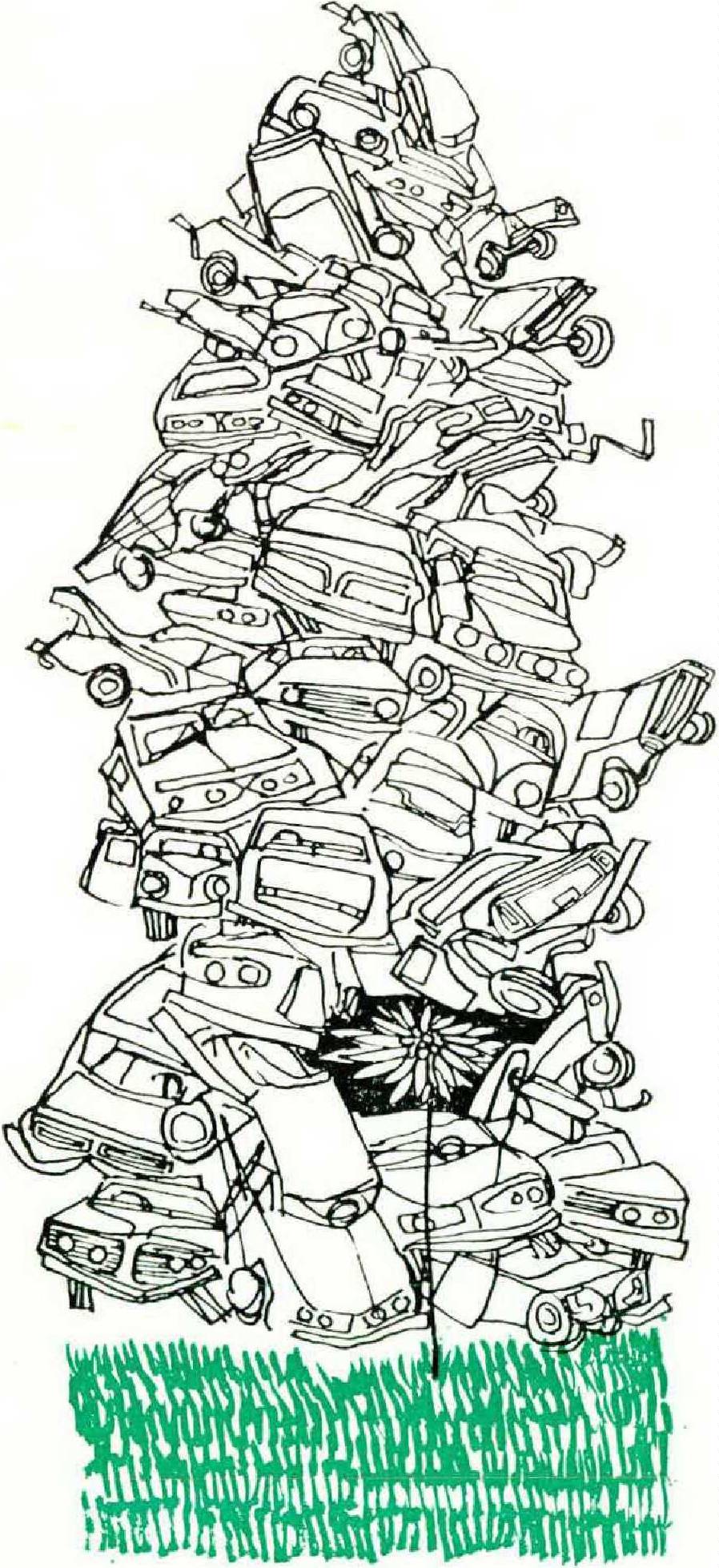
His reasoning is irrefutable; we worship the twin gods Production and Invention, and our sacrifices for them are hysterical. Everyone needs an automobile, and hopefully a new one every second year. If beer bottles are a nuisance, devise a can — it is so easy to throw out the window. If the land must give a higher yield, drench it with pesticides; if we need more power, look to the atomic energy plants with their fallout. This has been our success story for too many years. Now it is time to pay the bill, because the sewage, the factory effluents which have been poisoning our rivers, the garbage which we have been stuffing into holes, the tin cans and the rusty cars which won’t dissolve, the smog, the pesticidal runoffs, and the atomic poisons add up to an enormity of neglect which must be taken seriously. Matter cannot be annihilated; and if we do not begin to control it, it will overwhelm us.
Without wit and a good patient sense of humor. Mr. Stewart’s story would have been too dreary to bear. But he makes it readable and concise; he places us against our vivid, reckless, historical background; he plays on our native pride; and in the three final chapters of this short book he suggests a more responsible alternative than apathy.
In the ten chapters of his main argument he considers what happens to matter which is primarily “committed” to water, or to land, or to air, and what happens in each area after the processes of nature take over. He tells us that “riversfull” of water pour into factories, are contaminated, and then released again into the stream with results which have caused Mark Twain’s River, the Mississippi, to be termed “the colon of the Middle West.” He says that the list of the country’s dirty industries, according to Secretary Udall, is headed by a large paper company in Detroit involved in the manufacture of toilet tissue. He has some hopeful things to say about our automobile graveyards and the recycling of metal scrap, but no hope whatever for the exhaust control of the internal-combustion engine. He tells us fifty millions are spent annually to remove litter from our main highways and believes that the beer can should be outlawed. In a brief but fascinating chapter entitled “The Ultimates,” he studies the tyranny of power: waterpower is by all odds the neatest, he says, but there can never be enough of it to run civilization. He then goes on to assess the atomic power plants and tells how to dispose of atomic wastes. Man’s part in all this devastation has been sardonically delineated in the black and white drawings by Robert Osborn.
Nice is not always safe
I have many reasons for liking THE NICE AND THE GOOD (Viking,
$5.75), which I find IRIS MURDOCH’S most versatile novel, and chief among them the pleasure which the author takes in her characters.
To Trescombe House, their capacious seaside home in Dorset, Kate and Octavian Gray have attracted an assortment of friends, relatives, and refugees who have every appearance of staying indefinitely and in amity. Octavian, who is head of a department at Whitehall, is well-todo and fat — his wife calls him a perfect sphere; he and Kate have a trusting love for each other, and in a casual fashion they radiate a happiness which spills over onto those less fortunate. Willy Kost, who had spent the war in Dachau, is a white-haired bundle of nerves who with his books has taken over the guesthouse. Uncle Theo, who did something unseemly in India&emdash no one quite knows what—is the grumbler who has meals by himself. Mary Clothier and her son, Pierce, have lived for nearly four years at Trescombe House; she is an old school friend of Kate’s who came for solace after her husband’s death and stayed on to be the housekeeper. Paula, the classicist, who teaches in the nearby school, is the mother of the nine-year-old twins, and she too has turned to Kate for protection after she has been divorced for her one and only infidelity. The maid of all work, Casie, talks to herself, commenting and complaining about the vagaries of the others, as she sets the table and makes up the rooms. The interdependence of these people for an indeterminate stay is very English and constantly amusing.
In this book Miss Murdoch is equally successful in her delineation of the young. The children are refreshing and a constant surprise. Edward and Henrietta at nine speak their own language, invent their own games, and have a passion for bringing into the house collections of stones which for them hold a special significance. The Grays’ only child, Barbara, has returned from a finishing school in Switzerland flirtatious and vain of her French, and Pierce, Mary Clothier’s son, in the throes of calf love, finds himself outgrown by Barbara and at odds with her and the world.
Miss Murdoch has a sweet tooth for the macabre, and from the very first page the reader is alerted that there are dark forces working beneath the surface of this seaside serenity. The story begins with a suicide in Octavian’s department at Whitehall. The victim, Radeechy, is a dim figure given to strange practices which one might have thought would have disqualified him for civil service long before he shot himself. Ducane, Octavian’s friend and assistant, whom the Prime Minister puts in charge of the investigation, has every reason to increase his visits to Trescombe House, and an additional one which he does not quite clear with himself: at fortythree, a good-looking bachelor and a Puritan, he has fallen into a semiPlatonic love for Kate, and it amuses them both to go on with it. Radeechy’s suicide, Ducane’s dalliance, Mary’s surprising discovery that she loves the German refugee, young Pierce’s desperation to do anything that will reinstate his sovereignty over Barbara these are some but not all of the dangerous involvements which propinquity has forced upon this happy commune. The dialogue is high-spirited and alive with individuality, the pastels of the seaside quite lovely, and the entrapment of Ducane, father confessor and arranger for the group, keeps the suspense rising.
God’s spies
Essays are for reflection and for recharging the mind; they flow from one who is observant, ripe in his humors, poetic, or sardonic, as Hazlitt was in his feeling. Essayists are rare in any season; of my English contemporaries I esteem Robert Graves and Cyril Connolly; of American, E. B. White and ARCHIBALD MACLEISH. All of these were watchers — “God’s spies,” as Keats put it — capable of translating their experience, their loyalties and deepest concern into moments of crystal, intent meaning for us all. In A CONTINUING JOURNEY (Houghton Mifflin, $5.95) Mr. MacLeish speaks as a passionate believer in the integrity of this country and of those who add to its greatness. His papers range from the mid-forties to the mid-sixties: he is outraged by McCarthyism as he is exalted by Judge Learned Hand; he derides the fear of Communism which hypnotized us for too long, and whether he is dedicating a library or addressing a commencement he urges us not to bother about discovering “our national purpose” but to exercise it. His polite, patient remonstrance with Messrs. Walter Lippmann and Reinhold Niebuhr over their questioning of the American dream leaves me cold, but I am drawn closer to him in his essays on poetry and on what he learned while teaching at Harvard — his rediscovery of old loves in these is appealing. And how well he blows on the coals of friendship: his memorials of Jane Addams, Felix Frankfurter, Ernest Hemingway, Robert Frost, and Eleanor Roosevelt are full of warmth and insight. The concluding essay, “Thirteen Candles,” is most evocative, bringing me as near to the American Revolution as I am ever likely to be.
VANNEVAR BUSH is God’s spy in a cosmos accessible to only a few. An engineer with a panoramic knowledge of science, this quizzical Yankee out of Provincetown directed during World War II the greatest task force of American scientists ever assembled. Swift in his anticipation of our needs, he encouraged the immediate application of abstract research for practical use, and being articulate, he could correct Mr. Churchill or direct field commanders on how and when to use the proximity fuse. In SCIENCE IS NOT ENOUGH (Morrow, $4.50) he is writing of his more peaceful explorations after V-J Day.
When Dr. Bush asks, “Can a man be truly cultured who knows nothing whatever about solid-state physics,”
I plead guilty, for what little I acquired at Ithaca in my youth has not been remembered or enlarged. He says that “more has been discovered about the universe in the past decade or two than in all previous time,” and when some of these discoveries prove to be a maze to me, I do not stop reading, for Van’s allusions to the work of his fellow scientists are so often lanterns which guide me back to the path of his argument. His breathtaking descriptions of modern astronomy and of how we can avoid catastrophe, if given time, are as clear as sunlight. I have checked the passages expressing his skepticism about our present concentration on space flight and the fact that he has no confidence in the labors of those who do psychic research.
When Dr. Bush writes that “man has not yet succeeded in creating life, as here defined, but there is little doubt that he soon will,” or “science rendered absurd the concept of great war as an implement of national policy,” or, in speaking of our contest with Communism, the outcome “will depend, in the last analysis, upon the attitude of our people, and especially of our young men —whether they can make even better use of prosperity than their Russian contemporaries are making of adversity” — I come to a full stop, cogitate, and then begin rereading.