The Biggest Sponge Exchange on Earth
Dodecanese Street announced the character of the Tarpon Springs waterfront at once, with a stucco structure plainly derived from memories of the Erechtheum. Caryatids were mercifully not attempted, but the building had numerous attenuated Ionic columns and a raised porch overlooking the harbor, with a view of placid water, small shrimp fishermen, and boatyards. The place should have been a prosperous restaurant, but it was closed, empty except for an old coot sorting trash on the back staircase and a tangle of abandoned music stands on the porch. Beyond this doomed relic lay a sandy, potholed parking lot and beyond that the actual working waterfront.
Since sponge fishing is the notable enterprise at Tarpon Springs and sponge boats sometimes stay at sea for a couple of months, the waterfront is not constantly active. Something other than sponging must therefore be done to accommodate the tourists that turn up, for nobody likes to see tourists roaming about with no place to spend their money.
The problem has been solved by a row of shops selling, naturally, sponges, coral and shells, and also a variety of objects sharked up around the Caribbean or imported from Japan, India, and even Greece. Most of this stuff is, to be candid, quite ghastly— dust-catching native handicrafts and Laocoöns in pressed marble dust. But the sea remains honest. The shells are lovely; one shop displayed a bouquet of snow crystals two and a half feet high, composed of various delicate sprays and branches of coral; the sponges, set out in wire baskets and kept damp so that their texture can be appreciated, come in all kinds and sizes and prices. They stand in piles along the sidewalk, pale yellow or dead-grass color and dappled with brown shadows.
In addition to the shops, there is a place that deals in good sheep and cattle hide rugs and any other leather that turns up. (The skin of a large boa was drying in the back room, draped over four sawhorses.) There are two boats that take people deep-sea fishing, Pappas’ elegant restaurant, three inelegant but more amusing restaurants, and the spongediving exhibition.
The east end of the street began with a shop that carried little but sponges, shells, and coral of the highest quality. The proprietor was a rather stout old gentleman with a melancholy expression which I attributed to the necessity of answering, in English, questions which he would have found foolish in Greek. He was, it turned out, concerned about the row over Cyprus, partly on principle (his view of Turks was moderately bloodthirsty) and partly because his wife and daughter were visiting relatives in Greece. He had wired the ladies, ordering them to “go straight to the American Embassy; they will get you home.” But he did not know whether he had been obeyed, and hovered about the radio, which sputtered crisis under the counter.
He was a kindly man and forgot his worries long enough to recommend the sponge-diving show. It was, on the word of an old sponge fisher, substantially correct except for no smelly sponges on the boat.
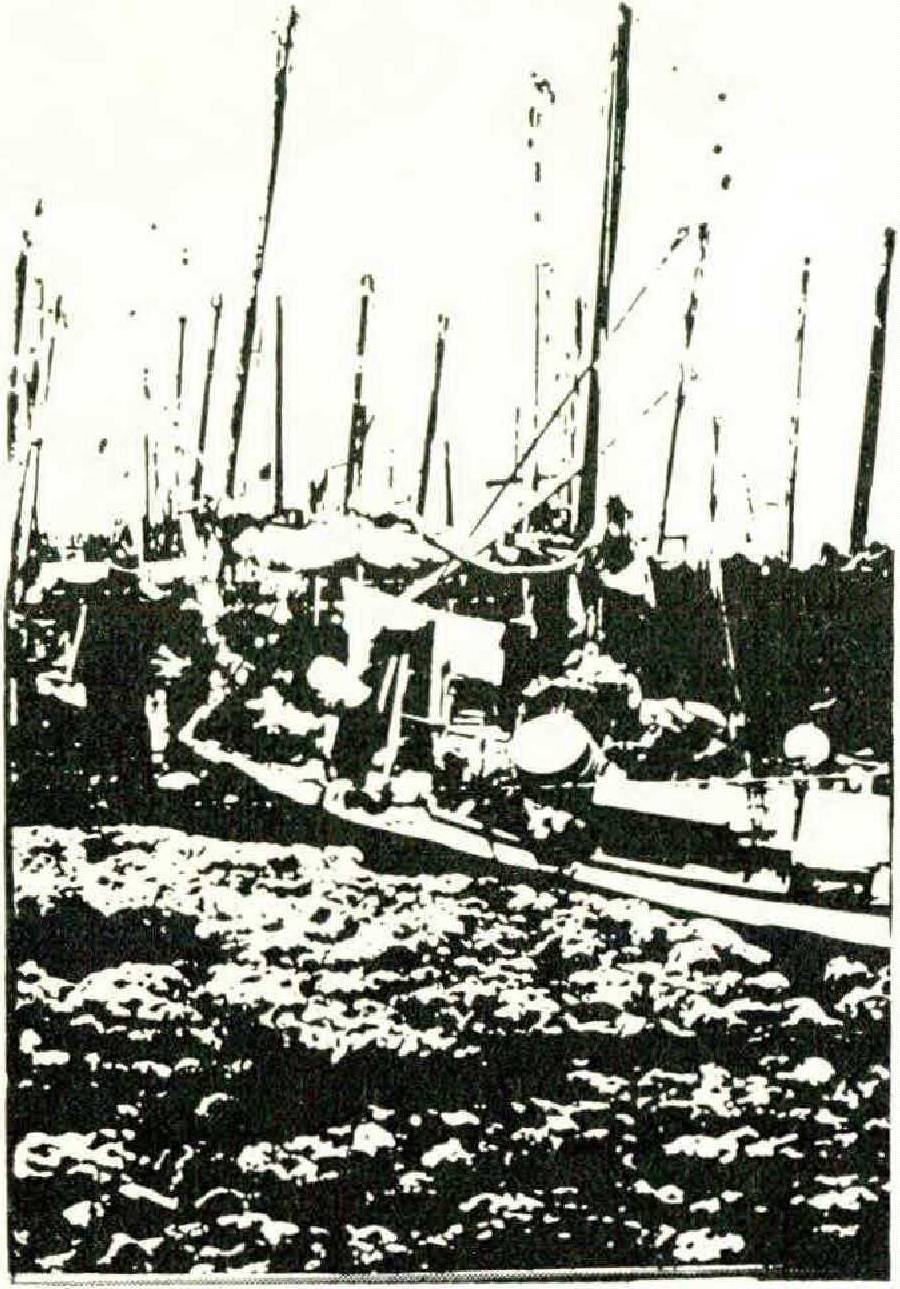
The boat was at the main quay, which was simply another sandy parking lot alongside the street. There were scattered palm trees and benches, and tied up beyond them, three real sponge fishers, two large shrimpers with red and blue nets drying in the rigging, and a pleasure yacht. The shrimpers looked permanently deserted, but on the sponge boats, sunburned men bellowed fiercely in Greek and moved about as softly as cats. None of them were young. Neither were the sponges which lay on the decks, covered with green dies.
Two men, one broad and hearty, the other thin and precise, walked up and down barking for the diving exhibition. The hearty one roared, “Leaving in five minutes,” while the thin one bowed to passersby and gently mentioned the catching of sponges, waving a fine-cut hand toward the boat.
This boat was a round-ended, tough-looking tub, the shape of a working sponge boat but minus masts and deckhouse, if deckhouse is the word for the minuscule protuberance on a sponge boat. In their place was a sort of glass house with a light roof. Inside, benches had been installed along the gunwales, and on these the passengers sat. The center of the deck was occupied by hoses, pumps, lines, nameless machinery, and the crew. One man ran the engine and did the talking. A taciturn youth collected tickets, and a silent walnutbrown ancient minded lines. They were all dark and Greek, but the diver was blue and gold and hopelessly Anglo-Saxon. He was immersed in an enormous dun-colored rubber suit from which only his hands and head protruded, and the lifeline tied around his waist gathered the rig into incongruous monkish folds.
In spite of the huge weighted shoes on his feet, the diver clumped about displaying the suit and assuring everybody that it was just as hot as it looked. He was asked, predictably, “Are you Greek?” and replied, predictably, “No, I’m not.” He was then asked, “Why are you diving?” and explained cheerfully that he was “an inadvertent college dropout. Ran out of money.”
Everybody patted the suit, which felt like wet rubber, and the boat chugged off down the narrow harbor. While the diver was locked into his helmet by the speechless ancient, the captain-engineer explained that sponges are never found on sandy bottom, that a normal boat carries a crew of six plus two divers, that divers work at depths of 30 to 100 feet, that only one diver works at a time and the boat follows him because divers always move against the current. While working, the diver has two men in attendance, one on the pump and one on the lifeline. The collected sponges are periodically hauled up in a bag.
Then came a detailed account of the weight of the diving rig: shoes, 24 pounds; suit, 18 pounds; copper and brass collar, 22 pounds; copper, brass, and glass helmet, 38 pounds. Shoulder weights totaling 70 pounds are hung over all this, and the diver, incredibly still able to move, sits on the gunwale, swings his feet overside, and simply drops off. “Navy and salvage divers,” said the captain contemptuously, “go down a ladder.”
At this point the diver, armed with a wire basket and a piece of metal resembling a jimmy, went overboard with a neat plop. The boat hung in the channel, and the passengers crowded to the windows. Presently ripples appeared halfway to shore and the top of the helmet rose above the water. There were outcries and pointings, “It’s shallow here,” said the captain soothingly. He added that it was fortunate to have sponges so close to town. We were in fact still in town, hardly half a mile from the dock, with pleasant old houses visible behind a screen of brush. Nobody asked whether the sponges had been planted.
The diver came back aboard via a ladder, with a small sponge in his basket. It was carried around and displayed. The diver, hastily relieved of helmet and shoulder weights, urged everybody to touch the sponge (it felt like wet rubber) but only about half the passengers did so. The structure of the sponge was quite visible through a dark, transparent, gelatinous substance which filled all the interstices and formed a thin layer over the outer surface of the creature. Properly speaking, I suppose it was the creature; the marketable sponge is only the skeleton.
On the way back to the dock, we were told that wool sponges are the best kind, but that the several lesser grades also have their uses. The exception is the finger sponge, a branchy, plant-shaped affair good for nothing whatsoever. Presumably for this reason, finger sponges in the local shops are egregiously expensive.
Sponges are cleaned at sea, the captain went on; they are laid on the deck and allowed to rot in the sun, and the crew takes pains to walk over them as much as possible. They are occasionally turned over and whacked about, and if the boat is out any length of time, they are pretty well cleaned when they reach port. The process is simple, but hard on the atmosphere.
Since sea voyages make me hungry, I went from the diving exhibition to a coffee shop down the street. It was a pleasant place, offering sandwiches, pastries labeled in transliterated Greek, and information if anybody cared to ask for it. I asked, and learned that sponges are sold at auction twice a week, and that there would be an auction next morning at the sponge exchange. “Of course you can go to it,” said the proprietress, grinning. “I hope you’ll come back and tell me what you think of it.”
The sponge exchange confronted the street with a plain iron fence, bearing a memorial plaque to John Cheyney. Behind the fence stood several trees and a small cubical building, and gates at either end gave on a courtyard surrounded on three sides by an arcade. The courtyard contained five small live oaks (a small live oak is not a negligible tree) in pots and a utility pole where the sixth pot should have been. The entire complex, including the pots, was made of concrete in the simplest possible design and achieved the elegance of pure, logical functionalism.
Under the arcade, the wall was broken by a row of padlocked doors in metal basket weave of a curious color compounded of rust and silver radiator paint. Each door gave on a small room with a slatted wooden floor and a slatted second story, propped, or suspended, about six feet up. About a dozen of these cribs contained sponges, a few more contained nautical gear, and most of the fifty-eight were empty.
At the back of the court a gap in the arcade led to an inner court, which was closed off by a casual barricade and must have contained as many cribs again. A sign on the left wall, by the entrance gate, exhorted captains — KA⊖APIZETE TA ΣϕOY&39484;&39484; APIA ΣAΣ — clean your sponges thoroughly. This was being done by an old man who was sousing sponges in a galvanized washtub and rinsing them with a hose. Sunlight glittered and sizzled on the sandy courtyard, on a couple of abandoned bottles, and on the back windows of the cubical building, one of which was broken.
Next morning at nine, the exchange did not sizzle. The weather had changed, and a cold wind snarled through the arcades and raised twirls of dust in the court. The auction got slowly under way, with considerable tugging at sweater sleeves and shrugging up of collars.
Three piles of sponges, strung on loops of cord, lay well apart under the arcade, and some twenty men gradually assembled around one of them. Except for three business-suit types bustling about with notebooks, they looked like sponge fishermen. They were all sun-darkened, elderly, and dressed in casually assorted garments of black and dark blue. The unique exception was a juvenile exquisite — he looked a hard-bitten forty—in beige corduroys and a white turtleneck sweater.
Unlike most Greek enterprises, this auction was conducted in silence. There were no loud greetings and no public conversations. New arrivals got a muttered kalyméra, and any further remarks were exchanged in whispers. Only one man, very tall and wearing a very wide brimmed felt hat, spoke aloud. He proved willing to talk with inquisitive strangers.
Between pauses to watch the action, he explained that the notebook carriers were sponge buyers. “Those other fellows are from the crews, and that man with the necktie represents the captains and takes the bids. If they’re too low, there’s no sale.”
“Do they write the bids?”
“Yes. The highest is read out. And you listen. You’ll be surprised.”
I was surprised. The pile of firstquality sponges, about enough to cover the bed of a small pickup truck, went for $1800. The larger pile of second-class sponges brought $2300.
It seemed a great deal of money, but the authority pointed out that this was two months’ income for two boats, and had to support the boats and at least sixteen men. Sponge crews are paid on a system that is probably older than Odysseus: a percentage of the take of the voyage, determined by each man’s function. Divers get more than deckhands, for example.
Men used to be paid a preliminary bounty, on occasion, for signing on a particular boat, but this system was never satisfactory since certain wily rascals instantly vanished with the cash and the captain had to recruit all over again. The best crews gravitated to boats where the food was good and the captain was lucky, meaning able to drop the lead and find sponge bottom. The sponge-yielding bottom in the Gulf of Mexico is estimated at over 9000 square miles, hardly a minor target, yet elusive enough so that boats sometimes stayed out until supplies were exhausted, and returned with no sponges worth mentioning.
“I used to be a diver,” said the man with the hat as the crowd silently moved to the third pile of sponges. “Yes, it’s hard work. I got married in—let me think — end of October. Two days later I went to sea and didn’t get back until January.” He stared into space, ruefully amused. “We had to start all over again — getting acquainted.
“That was quite a while back. Sponge fishing isn’t what it used to be, and neither is this town. It was 1905 when Cocoris came to Tampa.
I don’t know why—all Greeks wandered around the country in those days. He found the Americans sponge fishing with hooker boats, a poor way. Cocoris was from the islands, the Dodecanese — we all are — and diving suits had been used a long time there.”
Hooker boats are those on which men use a long pole with a hook at the end to drag up sponges. The depth limit is thirty feet, and any surface action of the water interferes with the operation by disturbing the view. The best sponges grow in water deeper than thirty feet. To call this method “a poor way” was polite understatement, for to men from the Dodecanese, accustomed to working in strong currents at dangerous depths, hooking must have seemed a feckless habit.
“He, Cocoris, got hold of Mr. Cheyney on the plaque, who owned some hooker boats, and arranged backing for sponge boats with divers. He went up to New York and went through the Greek coffeehouses, yelling for men from the islands. He found some, and they wrote letters to others or to home. I was out West on a construction job when I heard about it. I’m from Rhodos.
“Cocoris got diving equipment from the old country, and plans for the boats, and we all came to Tarpon Springs. That was in 1905.”
“What was it like? There was nothing here, nothing at all. We lived on the boats. But after a while we had a fleet, and we sold sponges, and people kept coming. See that man there? He’s just over from Greece. A few still come. But it’s not like the old days. Very few come, and the young people all leave. Only a dozen boats now — there used to be a hundred and twenty-seven — and the young people all gone.”
This oral history does not entirely agree with the information handed out by the Tarpon Springs Chamber of Commerce, which reports that the town was founded in 1882 and incorporated in 1887 with a population of 52, and adds that the sponge fleet at its highest point numbered better than 200 vessels, of which over 20 are still operating.
The sponge exchange, the biggest one in the world, was built in 1937, and trouble started shortly afterward when disease struck the sponge beds, a disaster complicated by the appearance of plastic sponges and the departure of young men from the town. The old diver who mourned the decline of sponge fishing said that his own son is a junior professor, or something similar, “up in Kentucky.” His tone indicated that he considered the fact unremarkable. It is, of course, entirely unremarkable that people with the ability to enter a profession should refuse to settle for uncertain pay at the hard ancestral trade.
Just how hard sponge diving is was illustrated by the only new enterprise on the waterfront. It was so new that it was not yet finished, and consisted only of masonry walls rising mysteriously around a couple of sunken bathtubs and a wire mesh fence. The walls grew at impressive speed, for there is no Southern languor in Florida building projects, and on the third day, the smaller tub contained a little alligator.
The whole affair was under the supervision, and seemingly the ownership, of a dark, wiry young man who was eager to explain its purposes. “Going to rassle gators. It’s easier than diving.”
Specifically, he complained of walking against the current at an angle of 45 degrees. A wearing business, he said, but necessary because a diver moving with the current cannot see the sponges through the grass and weed flattened over them. Sharks he dismissed as a trifle. “The navy has never found a good shark deterrent.” Tarpon Springs is very conscious of the deficiencies of the navy. “You know what the Greeks use? Ordinary household vinegar. I was never bothered by sharks. But diving’s hard work. I made a stake at it, and now I’m going to try the gators. I’ve got a big one coming in a couple more days. This place needs a little variety.”
He looked down Dodecanese Street, which contained, at the moment, a number of elderly Greeks and a busload of soft-voiced, slowmoving, distinctly-middle-aged tourists. He himself and the yellowhaired exhibition diver were the only people in sight under the age of fifty. His resolute expression became a trifle wistful. “I hope it goes. In some ways, this is kind of a strange town.”