Thomas Nast and the First Reconstruction
The political cartoonist who drew the elephant and donkey as symbols of the two political parties, Thomas Nast chronicled the hopes and later the disillusions of the mid-nineteenth-century’s civil rights leaders. Morton Keller, professor of history at Brandeis University and an authority on the post-Civil War era, restores to the public light this timeless and timely cartoonist in the following article adapted from his book THE ART AND POLITICS OF THOMAS NAST,to be published this month by Oxford University Press.
IN THE wake of a bloody and protracted war, Americans turned their attention to the most intractable of their social problems. Influential media of news and opinion and a major political party vigorously championed Negro civil rights. But soon this movement lost its force, and foundered on the Negrophobia that darkly streaked the society. Intellectuals came to doubt that Negro political activity offered much hope of beneficial social change. Public hostility and indifference grew, and soon the politicians dropped a cause that seemed both futile and dangerous. Such was the course — of the Radical Republican movement for Negro rights after the Civil War.
Since World War II there has been a revolution in Negro civil rights that C. Vann Woodward aptly calls “the Second American Reconstruction.” But now the historical parallel has a new and ironic dimension. There is reason to fear that once again this nation will be witness to a great tragedy — a tragedy of ennobling social aspirations thwarted by indifference and hate. We face what has come to be a recurring feature of our public life: a surge of belief that we can quickly reform our society, and then an angry, wasting disillusionment when unrealistic hopes run afoul of stubborn social realities. The experience of the First Reconstruction reminds us that once before Americans ventured boldly against the labyrinthine stronghold of racial discrimination; and that once before idealism was compromised, hope deferred.
Thomas Nast’s political cartoons are the best record we have of that era of American public life a century ago. He published more than 3000 drawings over the course of his career, the great majority of them in Harper’s Weekly between 1862 and 1885. No record of that time better conveys the mood of optimism, the belief in the perfectibility of the Great Republic, that came on the heels of the Civil War. And no one more poignantly expressed the painful disillusionment with the political process that spread over important areas of public opinion in the 1870s.
It is easy to forget that post-Civil War American life was something more than Vernon Parrington’s Great Barbecue, Mark Twain’s Gilded Age. Nast spoke to, and for, a vast number of Americans who were ready to believe that the good society lay close at hand, and that the Republican Party was God’s chosen instrument to achieve this goal. The end of the Civil War found most publicists and intellectuals in a state of euphoric optimism. Horace Greeley intoned in his New York Tribune: “A new world is born. . . . Never before had nation so much cause for devout Thanksgiving; never before had a people so much reason for unrestrained congratulations and the very extravagance of joy.” The historian John Lothrop Motley told a friend: “. . . sometimes I wish to live twenty years longer that I may witness the magnificent gains to freedom and civilization and human progress which are sure to result from our great triumphs.” James Russell Lowell found the Northern victory evidence of “the amazing strength and no less amazing steadiness of democratic institutions.”
The political process, especially the Republican Party, was the instrument by which the gains of the war — national union and human freedom — would be consolidated in peacetime. George W. Curtis, the editor of Harper’s Weekly, summed up the Radical Republican political attitude: “A hearty faith in the great principles of popular government, a generous hospitality toward new views and constant progress, a practical perception of the close relation between morals and politics, a deep conviction of the vital necessity of intelligence to a true republic will generally lead a man to act with the Republican party. . . .”
Thomas Nast was admirably suited to be the artistic spokesman for this Radical Republican spirit. He came of age with the ideological and technological conditions that made it possible for him to become the first, and perhaps the greatest, of America’s political cartoonists. Born in Germany in 1840 and brought to New York in 1846, he grew up imbued with the mid-nineteenth-century belief in nationalism, liberalism, democracy, and progress. The development of the Civil War as a struggle for American nationalism and human freedom had great emotional meaning for him. During the last years of the conflict he frequently drew allegorical representations of the war’s inner significance. These drawings had an enormous impact on his Harpers Weekly audience. His cousin-in-law, the biographer James Parton, thought that Nast’s “powerful emblematic pictures” were “as much the expression of heartfelt conviction as Mr. Curtis’ most impassioned editorials, or Mr. Lincoln’s Gettysburg speech.” Lincoln himself more pragmatically called Nast “our best recruiting sergeant. His . . . cartoons have never failed to arouse enthusiasm and patriotism, and have always seemed to come just when those articles were getting scarce.”
The issues that most strongly engaged the American people before 1861 — the Revolution and Independence and, almost a century later, the debate over slavery and states’ rights — evoked great words, not great pictures. Pamphlets, books, and broadsides sped over the vast country far more rapidly and less expensively than etchings, lithographs, or engravings. But in the 1850s there appeared the first devices by which an art of political commentary might flourish. Frank Leslie’s Illustrated Newspaper, the first successful pictorial magazine in the United States, began publication in 1855. Harper’s Weekly, which was to serve as Nast’s great medium, followed in 1857. By the eve of the Civil War Leslie’s had a circulation of over 160,000; Harper’s had almost 100,000; and each copy had many readers. During the same years Currier & Ives lithographs, sometimes treating political topics, habituated large numbers of Americans to the pictorial representation of ideas and events. The Civil War provided the new outlets for American graphic art with their first great theme. And Thomas Nast had gifts of technique, imagination, and feeling powerful enough to reach and move the vast audience now at hand.
Inevitably Emancipation was one of Nast’s wartime themes. And Negro civil rights emerged as the touchstone issue of post-war Radical Republicanism. It might seem that political expediency — the lure of Negro votes in the South and the lower North — sufficiently explains the party’s commitment. But to call for Negro suffrage and other civil rights entailed political dangers as well. Negroes suffered under a heavy, and popular, burden of civil disability in most Northern states. Time and again white voters in the North made it clear that while they opposed secession and slavery, they had no desire to see Negroes enjoy the blessings of equal citizenship.
One must go beyond political considerations to understand the adherence of so many Republican politicians, journalists, and intellectuals to the cause of Negro civic equality. Men whose public lives had been taken up with the struggle against slavery and the defense of the Union were reluctant to accept a political environment where nothing divided the parties but a lust for office. To champion the cause of the Freedmen was to perpetuate the moral idealism of the war years. So at a time when racist assumptions had an important place in intellectual circles throughout the Western world and an overt Negrophobia was the prevailing sentiment among white Americans, Republican spokesmen in growing numbers supported the cause of Negro civil equality.
The Republican effort was not limited to the Radical Reconstruction governments of the Southern states. Party organizations in the North set out to eliminate the restrictions on Negro voting and other civil rights that encrusted their states’ constitutions and statute books. Typical was the Minnesota Republican platform of 1865: “The measure of a man’s political rights should be neither his religion, his birthplace, his race, his color, nor any merely physical characteristics.” (Typically, too, the people of the state in 1867 rejected Negro suffrage.) Michigan Republicans in 1866 declared: “We scout and scorn . . . that political blasphemy which says, ‘This is the white man’s Government.’ It is not the white man’s Government, nor the black man’s Government. It is God’s Government made for man!”
Legislation approached, if it did not match, this rhetoric. Massachusetts passed the first state civil rights act a month after Appomattox; Pennsylvania followed in 1867, New York and Kansas in 1874. Other states repealed laws that restricted the movement and legal rights of Negroes. A national civil rights act in 1866 gave the Freedmen national citizenship and federal protection against state discrimination. The Fifteenth Amendment to the Constitution in 1870 authorized Congress to guarantee Negro voting everywhere. The Civil Rights Act of 1875 was the last major statement of Radical Republican racial policy. Holding that the object of legislation was “to enact great principles into law,” the bill guaranteed to all the right to “full and equal enjoyment of the accommodations, advantages, facilities, and privileges of inns, public conveyances on land or water, theaters, and other places of public amusement.”
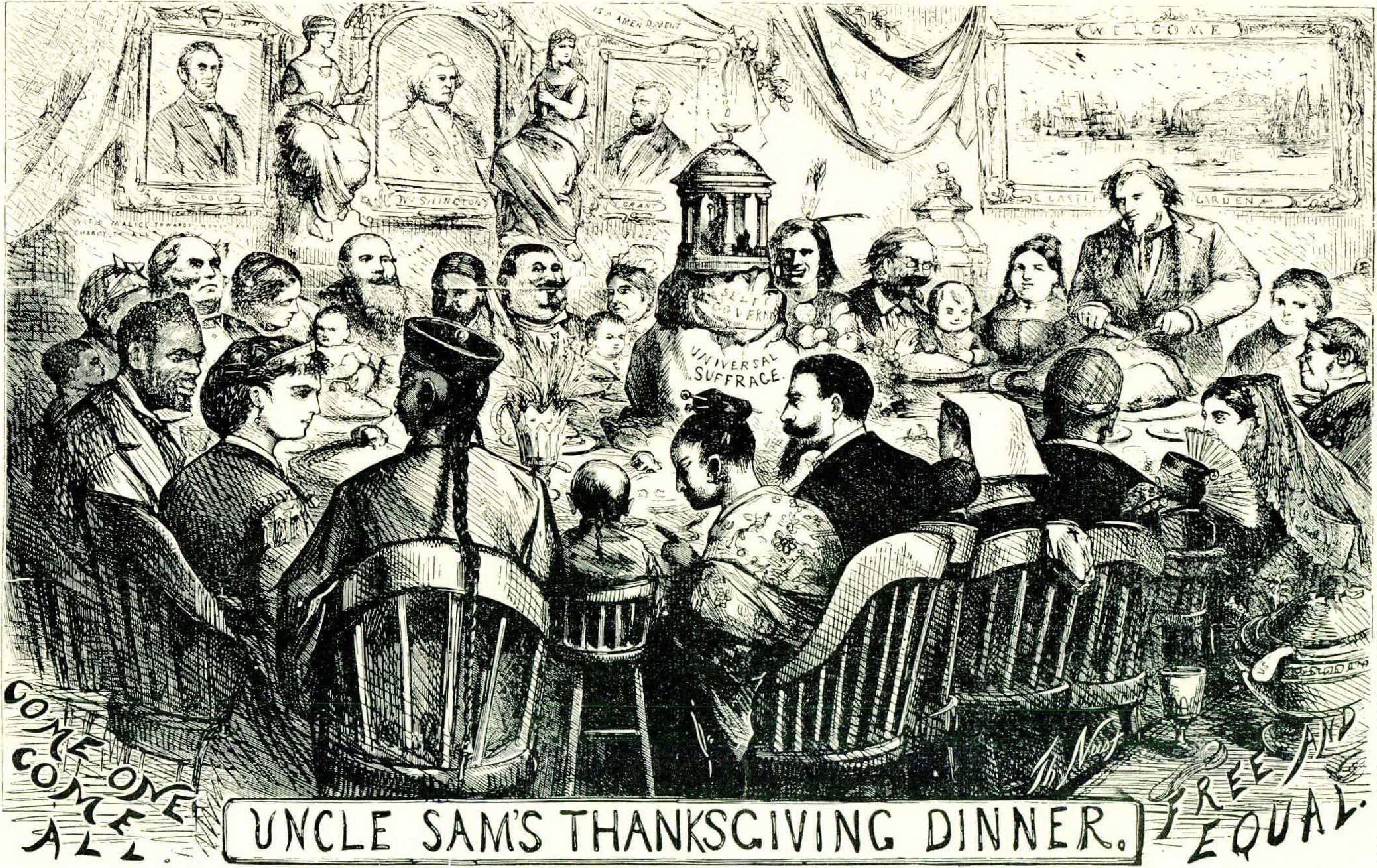
As a good Republican, Nast of course had a political interest in Negro suffrage. But he viewed the mistreatment of Negroes with an indignation that rested on more than party considerations. He had a strong sense of the United States as a nation of diverse peoples, welded together by self-government and universal suffrage. (Plate 2.) The brutal repression of Negroes by an intransigent — and Democratic — South outraged his moral sensibilities. So did Northerners who reacted to Negro equality with hypocrisy or fear.
But the post-war movement for Negro civil equality had a short and stunted life. Custom and the courts quickly stripped civil rights legislation of its effective force. Southern Radical Republican governments based on Negro suffrage could not sustain themselves, and most American intellectuals and publicists took this as evidence of Negro racial inferiority.
More than the cause of Negro equality was abandoned in the 1870s. Politicians, entrepreneurs, and publicists once were bound together by a common belief in the evil of slavery and the inviolability of the Union. Now, as new issues arose and the old ones receded, they went their separate ways. Political leaders devoted themselves increasingly to the demanding, technical business of strengthening their party organizations. Businessmen, farmers, and workingmen, struggling with the harsh depression that began in 1873, had little time for issues not germane to their immediate economic needs.
Intellectuals and journalists had growing doubts about a party system that was less and less interested in great national issues, that gave itself over so openly, and corruptly, to the niggling demands of practical business and practical politics. E. L. Godkin’s Nation, created in 1865 to preserve in post-war America the abolitionist spirit of Radical reform, soon became the voice of the Mugwump: querulous, frustrated, disillusioned. Political novels of the seventies — Mark Twain’s and Charles Dudley Warner’s The Gilded Age, Henry Adams’ Democracy — looked cynically at a party life that seemed to have no purpose but its own perpetuation and enrichment. John W. DeForest’s Honest John Vane (1874), an ironic examination of the corruption of a young congressman, suggests the new mood. Vane tells an older colleague: “I thought general legislation was the big thing . . . reform, foreign relations, sectional questions, constitutional rights, and so on.” “All exploded, my dear sir!” is the response. “All dead issues, as dead as the war. Special legislation ... is the sum and substance of Congressional business in our day.”
Nast brilliantly portrayed the new political order as he had the old one. He made the elephant and the donkey the symbols of the major parties. With great prescience he had caught the transformation of a politics of sharp ideological confrontation into a politics of competing placemen: for no discernible ideological difference distinguished these valueless, neuter beasts from one another. But while he described the new politics, he could not accept it. In 1884 the artist of post-war Republicanism bolted his party to support the Democrat Grover Cleveland for the presidency.
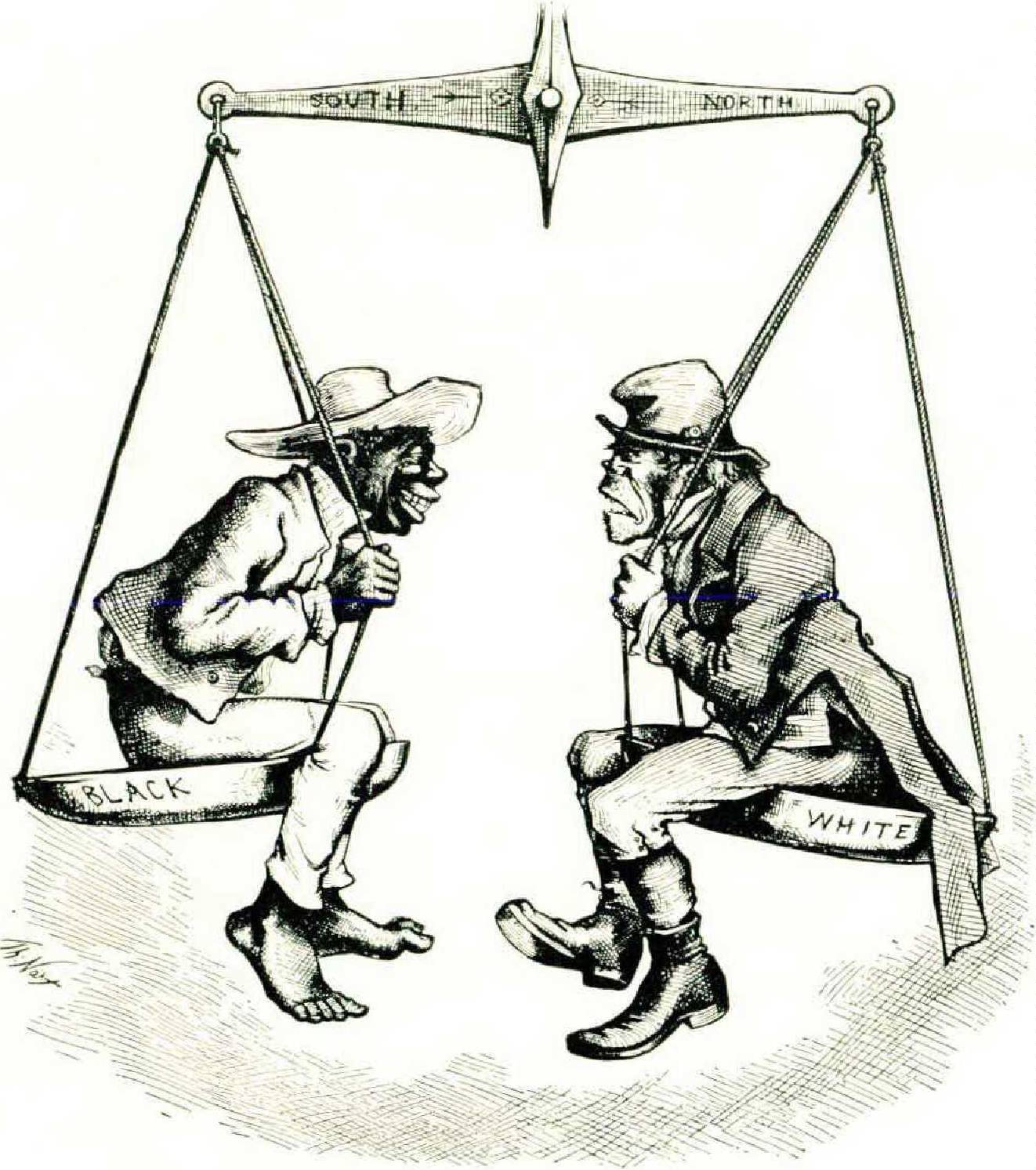
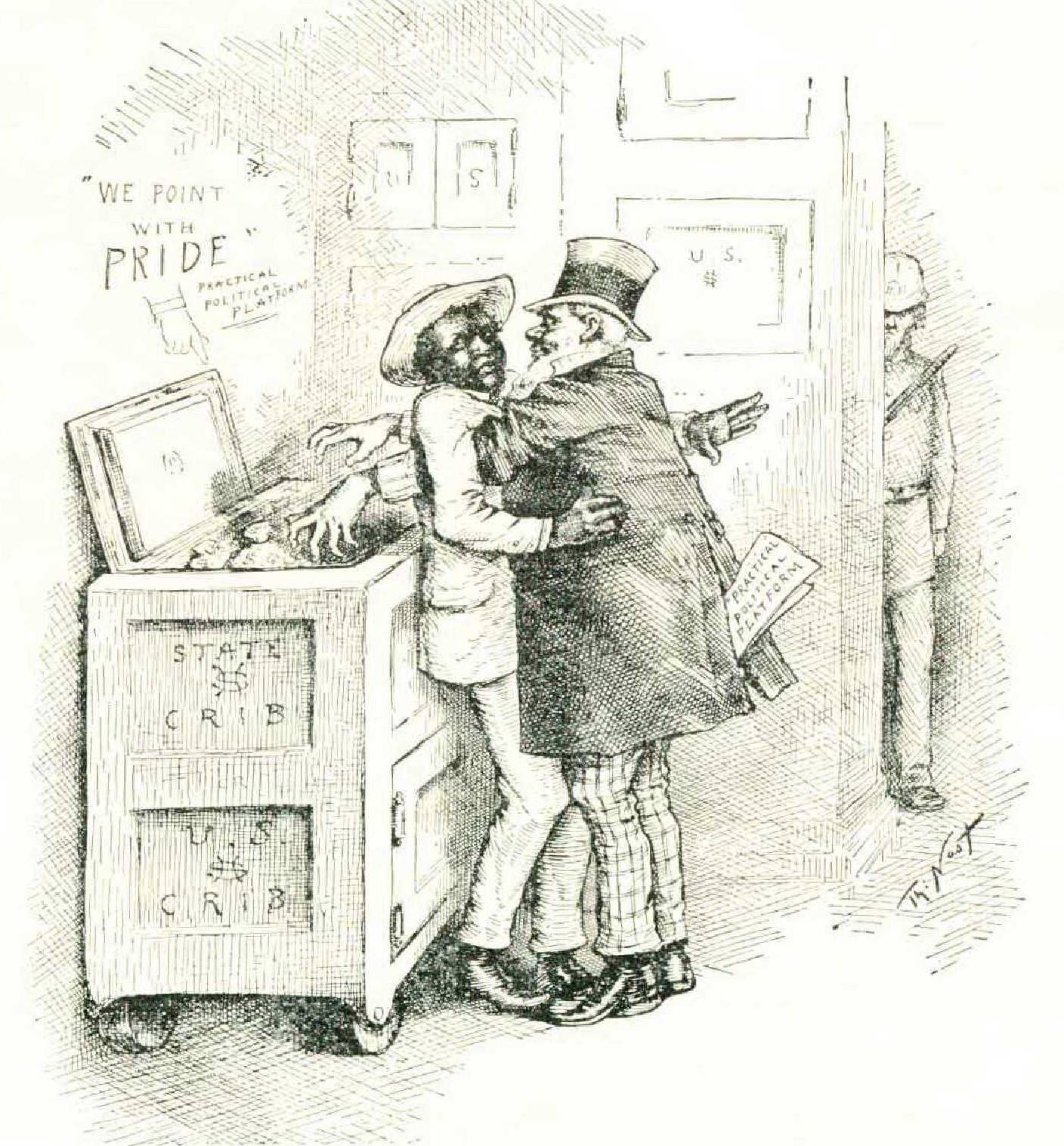
Nor could Nast escape the prevailing change in racial attitudes. The cause of Negro civil rights fell victim to his increasing disenchantment with the Republican Party. He came to equate the Irish of the North and the Negroes of the South as “the ignorant vote.” (Plate 1.) By the early 1880s he shared the general Northern view that Negro rights had become little more than the device of cynical politicos. (Plate 3.)
Nast lived on to 1902, bedeviled by artistic and financial insufficiency. Harper’s Weekly observed at the time of his death: “He belongs so much to the past that the impression has naturally spread that he is an old man”; in fact, he was sixty-two. His art belonged to a brief but distinctive era, by the turn of the century only a faint (and distasteful) memory. Not until our own time could Nast’s aspirations and his disappointments regain their original evocative power.
This is not to say that the generation of the Second American Reconstruction is condemned by some immutable law of history to repeat the experience of the first. But the fate of the Radical Republican commitment to Negro civil rights does suggest how evanescent are political moods in American life, and how complex and difficult is social change even in a society supposedly dedicated to the pursuit of happiness.
A tougher-minded realism — alien alike to Nast’s Radical Republicans and to much of the contemporary civil rights movement—may, it is true, discourage bold aspirations. But it may also prevent the wasting disillusionment — the disillusionment that swept over Nast and is so endemic today — that comes when undue hopes are duly disappointed.