The Peripatetic Reviewer
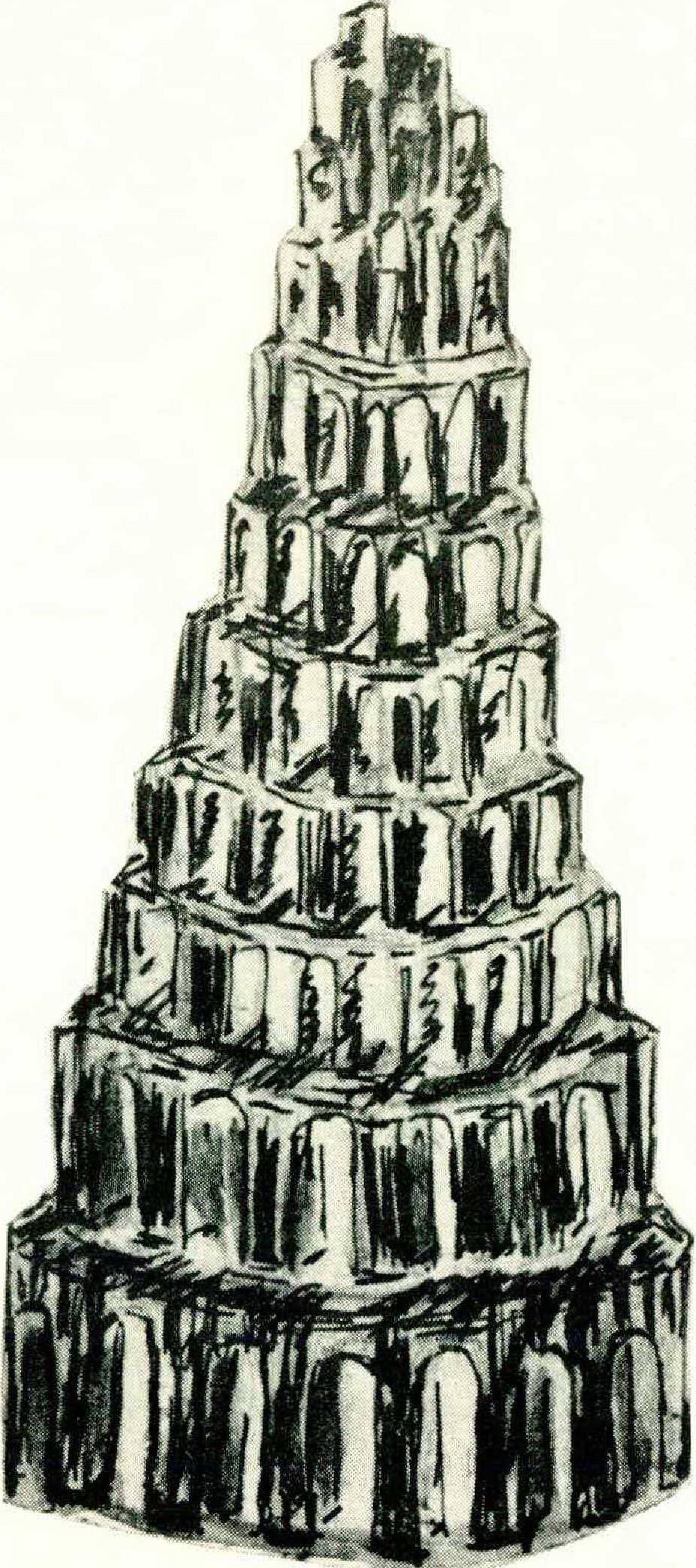
The Levant is a part of the ancient world that has been on collision course since about the year One. It is a man’s world, which has seen the rise of conquerors, the blaze of empire, and the inevitable disintegration; has seen religions wax to a frenzy, then wane but not expire. Today it is an oil-enriched territory where wealth and skulduggery thrive, the killer and the fanatic do the dirty work, and women are a protected necessity or a piece of the spoils. No better setting exists for a novel of intrigue, and in THE TOWER OF BABEL (Morrow, $5.95) MORRIS L. WEST has made the best of it.
Mr. West knows his way about in the Levant: he knows the fanaticism and greed which ferment in Arab states like Lebanon and Syria, and the desperation and discipline which keep Israel on the alert, and while he plainly favors the Israeli, he can credit aspiration as well as revenge to the sons of the Prophet. He has chosen for his skillfully plotted story the period of sabotage and raiding which led up to the Six-Day War of 1967. It was a time of imbalance throughout the Middle East. The left-wing socialists in Syria were causing the Kuwaitis and the Saudis to wonder about the future of their wealth; Egypt was embroiled in the Yemen and deep in debt to Russia; King Hussein’s life was in danger, and Jordan’s willingness to pressure Israel was in doubt. Opposed to this Arab “unity” was an Israel in which the day of the trumpets had passed: unemployment was rising, young men were leaving, the shipping was in trouble, and bank failures were impending. Such insecurity breeds apprehension, especially among the Israelis, who must depend on secret agents for the ultimate warning of where and when the Russians will erect missile sites for the Arab League. The spies in this story are what give it excitement and plausibility, and their operations are fascinating to follow.
On the one side is Selim Fathalla, whose Arabic name signifies Gift of God. An inventive man with a quick sense of humor and a quicker temper, Selim runs an import-export business in Damascus, where he is regarded as a bold trader and faithful Muslim; he lives with his mistress in discreet luxury, is trusted by the government, and occasionally entertains friends from the Party and diplomats from Moscow, Prague, or Sofia who value his backstairs knowledge of Arab politics. But appearances are deceptive, for in fact his real name is Adom Ronen, and he is a Jewish agent. He daily risks his life filing coded radio reports to Tel Aviv, and has been unapprehended for so long that the wife and daughter he left behind in Jerusalem have less claim on him than Emilie, his half-French, half-Syrian secretary, who gives him his interludes of happiness. Selim, his accomplice, the inscrutable Dr. Bitar, and their sources, known only by number, form one team, under the remote control of Brigadier General Jakov Baratz, director of military intelligence at Tel Aviv. The ingenuity and dispatch with which they intercept the Arab plans make for eager reading.
Opposed to them are Idris Jarrah, a killer and gunrunner who is a little too unscrupulous for his own safety, and Omar Safreddin, director of public security in Damascus, a suave, ruthless schemer, fanatically determined that Syria rather than Egypt shall regain the glory of the past. And caught between the pincers are some fat cats like Nuri Chakry, who lives for money and who has built himself a half-solvent empire stretching from Beirut to Paris to Fifth Avenue in his trading with sheikhs, Greek shipowners, and millionaires from Texas. Chakry’s golden web will be destroyed if the Arabs lose, but with a gambler’s instinct he has cash in hiding, a forged passport, and an escape hatch to South America. His front man, incidentally, is Mark Matheson, an American who is just as venal but not as clever as his boss.
These arc the principals, and what they do to each other is for the novelist to relate, which he does surely and with suspense. The contrast between the fleshpots of Beirut and the austerity of Tel Aviv is well drawn, and that there is fierce dedication on both sides we see in the activity of Omar Safreddin in Damascus and Brigadier General Baratz in Israel. The idealism in the midst of all this bellicosity is brought out in two quite pathetic scenes, the first when Dr. Bitar, the Jewish agent, in a fury at Arab incompetence, saves the life of Safreddin’s son, and the second at the story’s close when the brigadier, grown hard in his vigilance, lonely and self-accusing for the insanity of his wife, and now wanting consolation, turns for advice to an old friend. “Can you give me one hope, Franz?” “A very little one,” the wise elder replies. “But yet ... a hope. Which of us can ask more?” The hope for peace hangs by the same slender thread.
Wit’s End
It would have been an adventure to have lived close to Harold Ross, the founding editor of the New Yorker, for any length of time, and I am grateful to JANE GRANT, ROSS’S first wife, for lifting the window shade on her partnership with that droll, gifted, and irascible man, as she does in ROSS, THE NEW YORKER AND ME (Reynal & Morrow, $5.95).
Both were Westerners, Ross born in Aspen, Colorado, in 1892, Jane ! in Kansas. Jane’s precocious ability as a singer had earned her a year to study “vocal” in New York City, but before the year was up, she had gravitated to journalism and been hired by Carl Van Anda to write social notes for the New York Times at $10 a week. The staff called her “Fluff,” and she had a desk not far from Aleck Woollcott’s — “Louisa M. Woollcott,” as he was nicknamed by Howard Dietz. She prodded Aleck into taking her to Hamilton College dances, and when he was promoted to dramatic critic, to an occasional first night; Elmer Davis escorted her to the fancy dress at Webster Hall; house seats for the Met came down to her from the great Caruso himself. And she had learned poker and how to defend herself as a lone female long before she was introduced to Harold Ross, managing editor of the soldiers’ newspaper, The Stars and Stripes, in Paris in 1918.
There are three periods in this chronicle: Jane’s career as reporter and entertainer in a YMCA unit; their homelife at “Wit’s End”; and the establishment of the New Yorker. Jane’s personal warmth fades noticeably after the first. When she and Ross were married in 1920, it was agreed that they would try to live on her earnings — she was being syndicated and selling articles to the Saturday Evening Post — saving every penny of Ross’s salary for a magazine of his own invention. He had three in mind: a high-class tabloid, a shipping magazine, and last, a weekly about life in Manhattan. This was what Jane favored.
It took them five years to raise the capital to launch the New Yorker, and during most of that time they lived in a madhouse. With friends they renovated twin houses in a West Side slum known as Hell’s Kitchen, one of their partners being Aleck Woollcott, who hated to be alone and whose vanity and intrusion gave the newlyweds no peace. They had a Chinese cook, a Chinese garden, and a huge living room, and to it came many who were to be Ross’s early contributors: Benchley, Dorothy
Parker, FPA, Marc Connelly, Heywood Broun — the works. When they were alone, there would be five for supper, Sundays there might be thirty extra. The Thanatopsis Poker and Inside Straight Club played through every Saturday night, and Ross when liquored up was likely to lose. In one expensive game at the Swopes’ when very tight, he lost a stake equivalent to their initial investment in the New Yorker. Wit’s End, as their house was named, was to fracture their marriage.
They held together for nine years sharing the uphill triumph of Ross’s magazine. At first it seemed doomed —no readers, no ads — but Ross, born with taste and an unerring sense of humor, persisted. Jane, who has a good deal of the masculine in her, tells of this struggle in flat, realistic detail; she does not have James Thurber’s ear for comedy, but what Thurber brought to the New Yorker, and what brilliance came with Peter Arno, Rea Irwin, Helen Hokinson, and E. B. White, she does appreciate. The price of success was high. Ross in his impatient dedication became impossible to live with: he developed ulcers and she a cancer. Their separation, in which Woollcott played a mischievous, vindictive part, is sad to read. For, as it proved, Ross could be happy with no one else.
The Three Suilors
A new English novelist, RICHARD JONES, makes his bow with THE THREE SUITORS (Atlantic-Little, Brown, $6.00), a novel in which family secrets and the selfish friction between old and young are delightfully disclosed. The heroine, known familiarly as Mignon, is the widow of Sir Arthur Benson-Williams, a defunct British statesman who according to his daughter was a dreadful bore. But his relic, Mignon, now in her late seventies, is a woman whose charm and intuition have improved with age. She lives with her elderly brother, Freddy, in their grandfather’s old house in Caeriforshire, stuffed with books, memorabilia, and fine furniture, and the reason she sounds so snappish at the beginning is that she knows the house has been running to wrack and ruin and she hasn’t the money to repair it. She won’t accept charity and spurns a check of $1000 offered by the real estate man, who, of course, has designs on selling the place; and her difficulties are compounded by the condescending visit of her nephew Edward, a somewhat pompous don from Oxford, and the imminent arrival of her prickly daughter and grandson from Rhodesia. It is remarkable how swiftly the novelist entraps the reader in the lady’s affairs.
Mignon’s freedom of action is censored by Freddy, a mild clergyman who writes poems in Welsh suitable for any occasion. Freddy lacks her spirit and intuition, but he serves as a useful sounding board; she can work off her rages on him and end by seeing things in a fairer light. The other censor is Rohama, her husband’s illegitimate daughter, a sturdy farming type who has been installed in the cottage, is jealous of her stepmother, and very determined to get her share of the estate.
The estate is almost penniless, until Sir Arthur’s papers and his private diary are resurrected and thought to be publishable. The younger members of the family — the resentful daughter from Rhodesia, the Oxford don, and the disagreeable niece in the village — all scoff at the idea: Sir Arthur lived on clichés, they protest, he would search for hours for the predictable thing to say. Nevertheless, down from London in rapid succession come three suitors, each hoping to cash in on Sir Arthur’s literary remains: the first a willowy aesthete in his mid-twenties; the second a preposterously vulgar bore representing a newspaper syndicate; and the third an American who proves to be as much of a surprise to Mignon as he is to the reader.
This literary quest reminds me of The Aspern Papers by Henry James. The house in its unmarred, out-ofthe-way corner of Wales is picturesque, and the household so full of hilarious conversation and surprising encounters that I envy anyone reading this engaging book for the first time.
Animal society
Any man who writes about wild animals cannot avoid telling us what kind of animal he is. JEAN-PIERRE HALLET, the author of ANIMAL KITABU (Random House, $6.95), was born in Louvain, Belgium, in 1927. His father was an artist renowned for his paintings made in the Belgian Congo, and there JeanPierre spent six years of his childhood. He fought in the Belgian Resistance, and then in 1948, standing 6'5" and weighing 250 pounds, he went back to live with the African tribesmen. Despite his size he was for eighteen months an adopted brother of the Bambuti Pygmies, and in one skirmish he took a poisoned arrow in the leg but survived the crude Pygmy surgery. He qualified as a member of the Masai tribe by killing a lion with a spear. In Burundi a dynamite explosion blew off his right hand at the wrist, taking much of his hearing with it. Today his body is a patchwork quilt of “old African scars.” During his integration he learned seventeen native dialects, and what is more remarkable, did not carry a gun or even a knife while living at close quarters with killers like the buffalo and the rhino.
Animal Kitabu is a series of overlapping animal portraits which blend together to show us the complex animal society of Equatorial Africa —before these great beasts are extinct. I need hardly tell you that Mr. Hallet has a hearty contempt for the average sportsman with his high-powered rifle, as becomes evident in his rating of the Big Five, those animals which are most dangerous to pursue: the Cape buffalo, elephant, rhino, lion, and leopard. According to Mr. Hallet, the leopard is far and away the most intelligent, elusive, and dangerous of these beasts. He cannot “be a goodnatured idler like the lion, letting his ladies kill for him and living on the profits like a pimp. He cannot, like the elephant, spend sixteen hours a day in the simple act of eating and lead a family life that is blatantly bourgeois. . . . And least of all, he cannot be a snorting, dimwitted windbag like the rhino, who rarely knows exactly what he is charging.”
Hallet came to know the leopard well during the months he lived with the Pygmies, and he tells us that if a single Pygmy moving through dense brush suddenly comes upon a leopard, he will brandish his little three-foot hunting bow and shout loudly, “Get out of my way, grandfather!”, and the leopard will disappear. When Hallet, unarmed, was surprised by a full-grown leopard at a distance of twenty-five feet, he tried the same trick: “Grandfather,” he shouted, “get lost!” The leopard vanished into the bush.
But there was one occasion when the shouting did not work. Hallet was on the trail with a party of Bantu tribesmen, and the Bantu, unlike the Pygmy, is in deadly fear of leopards and will run screaming at the animal’s approach. On this particular march, the sight of a leopard crouched on a tree branch over the trail panicked the whole procession, and in their flight the next to last of the Bantu was pinned to the ground and raked by the great cat. Weaponless and one-handed, the white man leapt, and by sheer strength spread-eagled the forearms and legs so that the leopard could not claw him. The Bantu were all in the trees, but one of them flung a knife toward him, and as man and cat rolled over and over, Hallet was able to reach for the knife and plunge it in before he was mortally injured. Trader Horn would hardly have dared do a thing like this, much less write about it. But when JeanPierre Hallet records it for us, it has every vestige of truth. Incidentally, he tells us that both the leopard and the lion find the smell of man repugnant and that they would much prefer to eat dog meat or a baboon than a sport in Abercrombie & Fitch regalia.
His chapters on the baboons and the chimpanzees are among the most amusing in the book, so closely has he observed their social relations and so respectful is he of their intellect. According to his friends in the Bambuti tribe, “chimpanzees talk as much as people do and make just as much sense . . . chimpanzees are smarter than people, excepting only Pygmies.”