No Thrills, Lotta Laughs
by
People dependent on movie-going for learning about the facts of life thought for a long time that sexual intercourse was performed by shooting off fireworks, inciting stallions to rear up and whinny, watching blazing sunsets to the accompaniment of swelling violins, or simply turning the lights off and moaning. But the current moviegoer knows that’s not the way it’s done anymore. From watching the films of our new, uninhibited, anything-goes era, the viewer learns that the sex act is performed by a man and a woman taking off their clothing, pressing their bodies together, and rolling their hips around a lot. There is apparently nothing connecting the two bodies, but the camera shows closeups of the hips swaying and twitching, and that seems to be how it’s done.
That at least is the way everyone does it in four recent movies that involve people doing it a lot. The movies, though different in style and content, all base their box-office appeal on sex appeal of one kind or other, including a French mènage à trois with a little lesbianism (Les Biches), a gang of homosexual cowboys who meet up with a prostitute, her male nurse, and a transvestite sheriff (Lonesome Cowboys) , an American teeny-bopper who innocently lays her way across the country (Candy) , and a futuristic space chick who makes it with an angel on a sinister planet ruled by a tyrant dyke with a constituency of sadomasochists (Barbarella) .
Les Biches
directed by Claude Chabrol (vip)
Candy
directed by Christian Marquand (Cinerama)
Barbarella
directed by Roger Vadim (Paramount)
Lonesome Cowboys
directed by Andy Warhol (Sherpix)
With all that freedom of expression, one would assume that moviegoers could learn all about the human anatomy, since it is well known that people can now be “shown in the nude” on a neighborhood movie screen. The “nude" shots reveal that men and women are exactly alike except that women have larger breasts. Neither gender has any sexual organs of any kind, nor do they have hair anywhere on their body except the head. (The exception to this rule is contained in one glimpse of a naked man facing the camera in the Warhol “Cowboy” movie. This man has an appendage not seen on anyone else, but even in the Warhol movie it seems to have no relation to any sort of sexual behavior.)
One gathers from these frank movies that sex in America may not be much fun in terms of sensual pleasure or excitement, but at least it is very funny. In France, however, sex is a very grim business, laden with guilt, sin, and leading to madness and murder, at least if one is to judge from Les Biches. (The title means “The Does” but is translated in U.S. movie ads as “The Girlfriends,”obviously to emphasize the lesbian angle, which turns out not to amount to much.) A dominant middle-aged woman (Stephane Audran) picks up a pretty, meek young girl (Jacqueline Sassard) , whom she takes to her house in St. Tropez, where a couple of silly fellows who are evidently supposed to be homosexuals are already installed, presumably for the mistress’ amusement. When the young girl has her first heterosexual love affair, the jealous mistress seduces the handsome architect-lover, and brings him into the house. The architect is not there long when he observes, in the one great line of the movie, “There’s something unwholesome about the atmosphere here.” In the course of the movie Candy moves her hips with Ringo Starr playing a Mexican garden boy, Charles Aznavour as an eccentric hunchback, James Coburn as a hilarious archetype of the arrogant ace surgeon, Walter Matthau as a superpatriot paratroop general, Marlon Brando as an amateur guru, and John Astin (a very funny actor whose face is familiar from his role as a leering uncle in the TV Addams Family series) as both her lascivious uncle and her frightened father. Richard Burton is marvelous as a lecherous middle-aged rebel poet who gets too drunk to make it with Candy, a circumstance which, as Burton’s unflappable chauffeur (played by Sugar Ray Robinson) wryly observes, “kinda makes you stop and think.”
But he needn’t have worried. Even when the architect gets drunk with the two women, the ménage never jells. The poor young girl stands mooning outside the bedroom door of the two heterosexual lovers, who are inside making those hiptwisting motions with one another. When the girl pleads for affection and tells the mistress that she loves both her and the architect, the mistress tells her such love is “disgusting.” The poor frustrated girl gets loony and ends up murdering the mistress, thereby showing that even thinking about such a liaison is sinful, dangerous, and deadly stuff.
In America, sex is apparently taken much more lightly, and leads to numerous hilarious situations, as one learns from watching Candy. The seventeen-year-old Swedish international teen queen Ewa Aulin plays an American high school girl who has lovely physical endowments, the ordinary limited mental facilities, and a kind of moral neutrality that allows her to accommodate sexually the many men who are drooling over her. She does it with a sort of resigned benevolence, in the spirit of a Girl Scout doing her good deed for the day: there is no hint of any pleasure involved for her, making the act as selfless as it is . . . sexless.
The male actors obviously had a good time wrestling around with the Swedish nymphet, and play their parts with realistic relish as well as great humor. Miss Aulin is gamely battered around a good deal, and performs her charitable deeds in such impromptu locations as a pool table, a flooded men’s room, a hospital bed, the top of a grand piano, and the inside of a moving van. These odd situations often lead to laughs but never to eroticism, since Candy herself maintains her position as an unwitting, untraumatized, wholesome young citizen doing favors to those in need without regard for her own personal comfort—or pleasure.
The monotonous and physically wearing burden of this sort of selfless act by American women is solved in the futuristic fantasy Barbarella. Though based on a French comic strip, the movie is written and played by Americans, and its sexual attitude is mainly American, spiced by some old-fashioned French De Sade touches. Jane Fonda plays the heroine, an American girl of the galaxy age, who, when she finds herself on a backward planet, runs into the same sort of request for favors as Candy does. She explains to a barbarian male who wants her to lie down for him that enlightened people don’t do it that way anymore; they take a pill that produces rapport, and press one palm against a palm of their mate. The barbarian doesn’t buy that plan, and after doing it the “old-fashioned way,” Barbarella admits that the old custom had its points—but she can see why it was criticized for being “distracting.” She even uses the “old way” to raise the morale as well as (symbolism!) the wings of a formerly broken-down angel. Miss Fonda is pretty and funny and gets to wear a lot of kinky space costumes, which, along with elaborate props of devices for pleasure, torture, and/or both, have a certain appeal for any healthy, red-blooded fetishist, but it’s all so obviously in such wholesome good fun that the kinks are lost in the laughs.
In America, sex is a humorous but not very erotic pastime for homosexuals as well as their straight countrymen, as the moviegoer can see from Andy Warhol’s Lonesome Cowboys. Uneven and rough in the Warhol style, this camp Western is nonetheless an interesting film with some high-comic scenes. Most of the explicit sex turns out to involve a handsome young cowboy seduced away from his fellows by a brazen hussy, and is just the same old hip movement thing we have seen in the other movies cited. But the interplay—the jealousies, rivalries, and jokes, sexual and social, among the gang of cowboys—shifts from the put-on to the weird sort of sudden reality that can come in this sort of improvisational filming when people are reacting to and off one another. Sometimes the camera frames a face for what seems like a sort of TV man-in-the-street monologue about Great Issues, and one cowboy tells how the gang should really settle down and try to build a home—then build a town, and build a city, “and then we’ll be ready for World War I.”
In this, as in the other American films mentioned, viewers hoping for a dirty movie will probably be disappointed by finding a lot of laughs and hardly any thrills, cheap or otherwise. (The French movie offers neither laughs nor thrills, but a boring kind of faded gloom.) The opportunity to deal relatively freely with sex on the screen is perhaps a more complicated and frightening opportunity than anyone bargained for. One solution is to play it primarily for laughs.
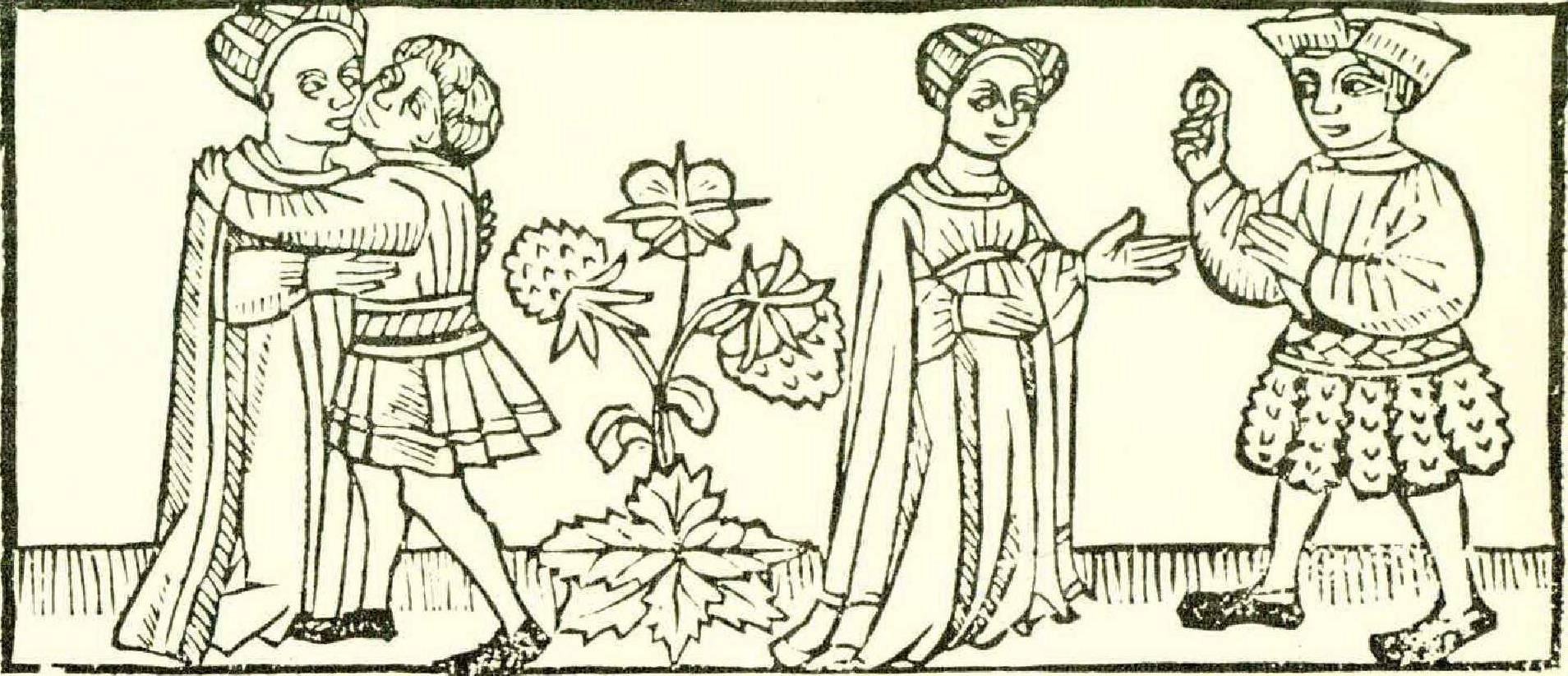
Woodcut illustrations are from Nicolaus Pergamenus, Moralized Dialogue of Creatures, Geneva, 1500. They are reproduced by permission of the Museum of Fine Arts, Boston.