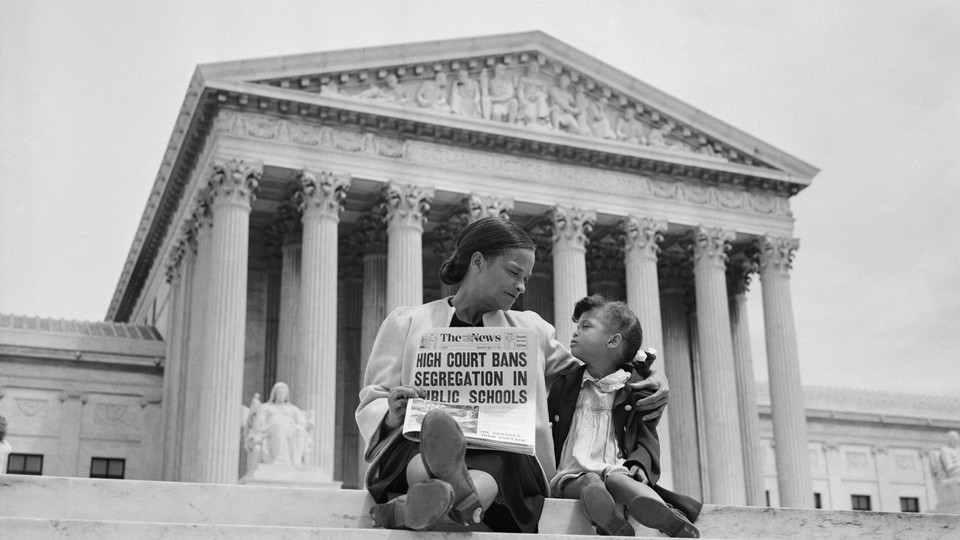
In a matter of hours after first coming to the Supreme Court, I learned more about the important cases that were lumped as the school desegregation cases.
There were five of them, from Kansas, Virginia. South Carolina, Delaware, and the District of Columbia. While the latter was in a somewhat different setting because it did not involve a state law, they all involved the “separate but equal” doctrine as established by the Supreme Court in the case of Plessy v, Ferguson (1896). That decision declined to prohibit separate railroad accommodations for blacks and whites. It sought to justify racial segregation for almost every movement or gathering so long as “separate but equal” facilities were provided, and it became known as the “Jim Crow” doctrine. The central issue in each of these school cases was,
Does segregation of children in public schools solely on the basis of race, even though the physical facilities and other “tangible” factors may be equal, deprive the children of the minority group of equal educational opportunities?
The five cases had been argued during the 1952 term before I came to the Court but had not been decided and had been put over for re-argument, with a set of specific questions for discussion.
The United States government, through Assistant Attorney General J. Lee Rankin, supported by a brief signed also by Attorney General Herbert Brownell and other Justice Department attorneys, argued as a friend of the Court in favor of the positions maintained by the black students’ lawyers. The first case was argued December 7, 1953, and it was easy to understand why the Court felt it necessary to have a full complement of Justices. Resubmission of the case for argument would normally indicate a difference of opinion within the Court. In these circumstances, particularly if any Justice is absent or disqualifies himself, the danger exists of an evenly divided, four-to-four Court, which means that the decision of the lower court is affirmed without opinion from the Supreme Court and without any precedential value.
Some of the cases under review had been decided against the black petitioners in the lower courts on the authority of the much eroded “separate but equal” doctrine of Plessy v. Ferguson.
To have affirmed these cases without decision and with the mere statement that it was being done by an equally divided Court, if such had been the case, would have aborted the judicial process and resulted in public frustration and disrespect for the Court. The Court was thoroughly conscious of the importance of the decision to be arrived at and of the impact it would have on the nation. With this went realization of the necessity for secrecy in our deliberations and for achieving unity, if possible.
We realized that once a person announces he has reached a conclusion, it is more difficult for him to change his thinking, so we decided that we would dispense with our usual custom of formally expressing our individual views at the first conference and would confine ourselves for a time to informal discussion of the briefs, the arguments made at the hearing, and our own independent research on each conference day, reserving our final opinions until the discussions were concluded.
We followed this plan until February, when we felt that we were ready to vote. On the first vote, we unanimously agreed that the “separate but equal” doctrine had no place in public education. The question then arose as to how this view should be written—as a per curiam (by the Court), or as a signed, individualized opinion. We decided that it would carry more force if done through a signed opinion, and some Justices thought it should bear the signature of the Chief Justice. I consented to this, and we discussed the importance of secrecy. We agreed that only my law clerks should be involved, and that any writing between my office and those of the other Justices would be delivered to the Justices personally. This practice was followed throughout and it was the only time it was required in my years on the Court. It was not done because of suspicion of anyone, but because of the sensitiveness of the school segregation matter and the prying for inside information that surrounded the cases. We thought we should confine our communications to the fewest possible people as a matter of security. Progress made in conference was discussed informally from time to time, and on occasion I would so inform Mr. Justice Jackson, who was confined to the hospital, recuperating from a heart attack which had incapacitated him for some time. Finally, at our conference on May 15, we agreed to announce our opinion the following Monday, subject to the approval of Mr. Justice Jackson. I went to the hospital early Monday morning, May 17, and showed the Justice a copy of the proposed opinion as it was to be released. He agreed to it, and to my alarm insisted on attending the Court that day in order to demonstrate our solidarity. I said that was unnecessary, but he insisted, and was there at the appointed time.
It was a momentous courtroom event and, unlike many other such events, it has not lost that character to this day.1
These five segregation cases all raised the same central issue and four of them are compendiously referred to as Brown v. Board of Education of Topeka (1954).
In the Brown decision, we decided only that the practice of segregating children in public schools solely because of their race was unconstitutional. This left other questions to be answered. For instance, could plaintiffs bring court actions as class actions for all who were similarly situated, or should persons actually joining in the action be entitled to relief only for themselves? What court should determine the decree in each case? For what reason could there or could there not be any delay in obeying the Court’s mandate, and to what extent? All such questions we continued until the next term, inviting the United States and all states affected by our decision to file briefs and argue if they desired to do so.
These cases, postponed because of the death of Mr. Justice Jackson, which left an eight-man Court, came on for argument from April 11 to 14, 1955, with the newly appointed Mr. Justice Harlan in attendance. At the time of Mr. Justice Jackson’s death in October 1954, John Harlan was a recent appointee to the Court of Appeals of the Second Federal Judicial Circuit. President Eisenhower nominated him to the Supreme Court on January 10, 1955, but those were the investigative days of Joe McCarthy, and Harlan was not approved by the Senate until March 17 because of the silly bulldozing he was given as a result of having been a Rhodes scholar, which some right-wingers vaguely associated with Red-tinged “internationalism.”
Solicitor General Simon Sobeloff, in response to the Court’s invitation, argued for the United States on behalf of the petitioners as a friend of the Court. The attorneys general or their assistants of the states involved in the litigation argued for their states, which included Arkansas, Florida, Maryland, North Carolina, Oklahoma, and Texas. All opposed school desegregation.
The principal arguments on this phase of the case, as well as in the original proceeding, were made by John W. Davis for the states and Thurgood Marshall, now an Associate Justice of the Supreme Court, for the plaintiffs’ side. The arguments, for me at least, took a strange course. One might expect, as I did, that the lawyers representing black schoolchildren would appeal to the emotions of the Court based upon their many years of oppression, and that the states would hold to strictly legal matters. More nearly the opposite developed. Thurgood Marshall made no emotional appeal, and argued the legal issues in a rational manner as cold as steel. On the other hand, states’ attorney Davis, a great advocate and orator, former Democratic candidate for the presidency of the United States, displayed a great deal of emotion, and on more than one occasion broke down and took a few moments to compose himself.
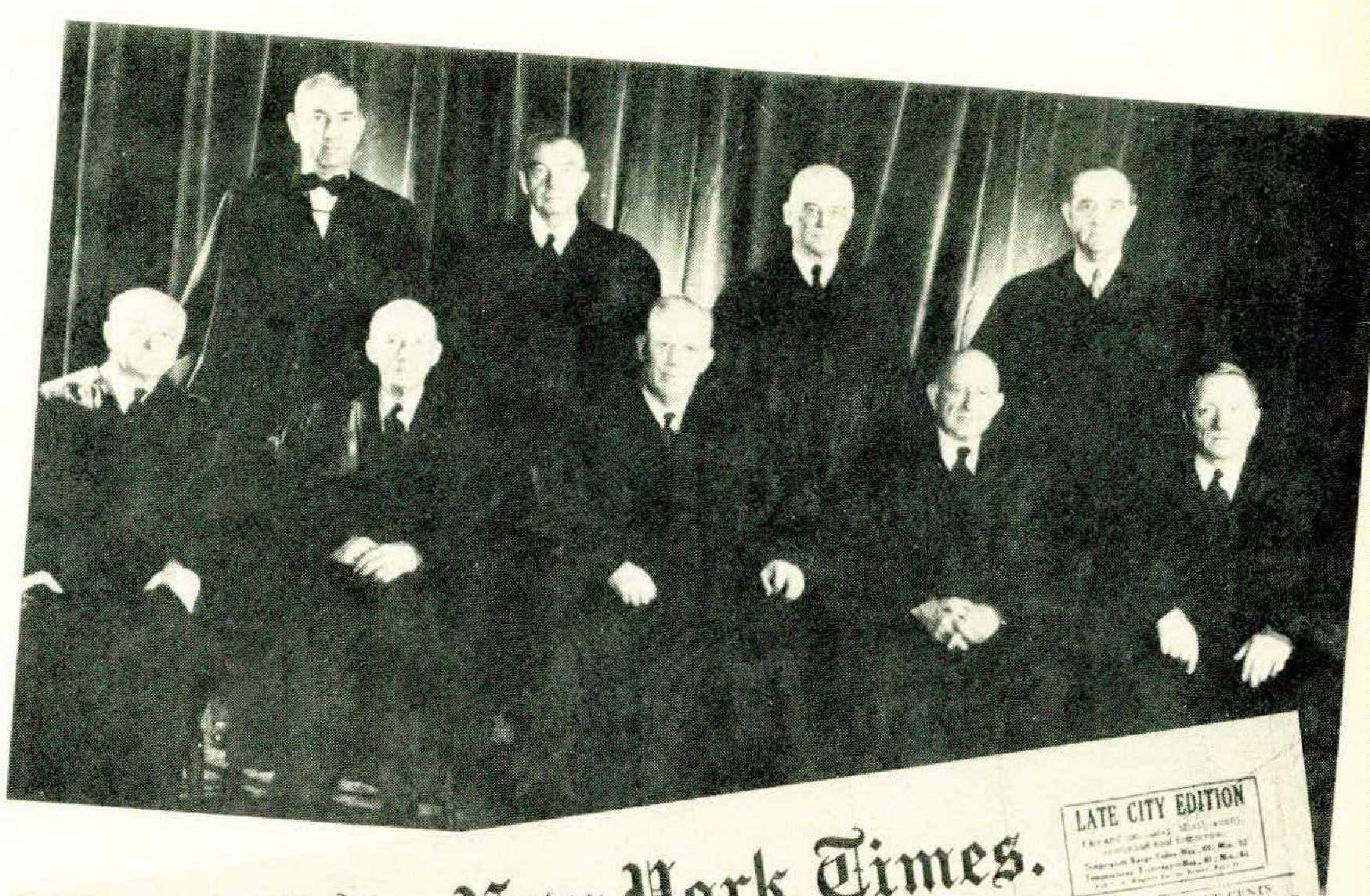
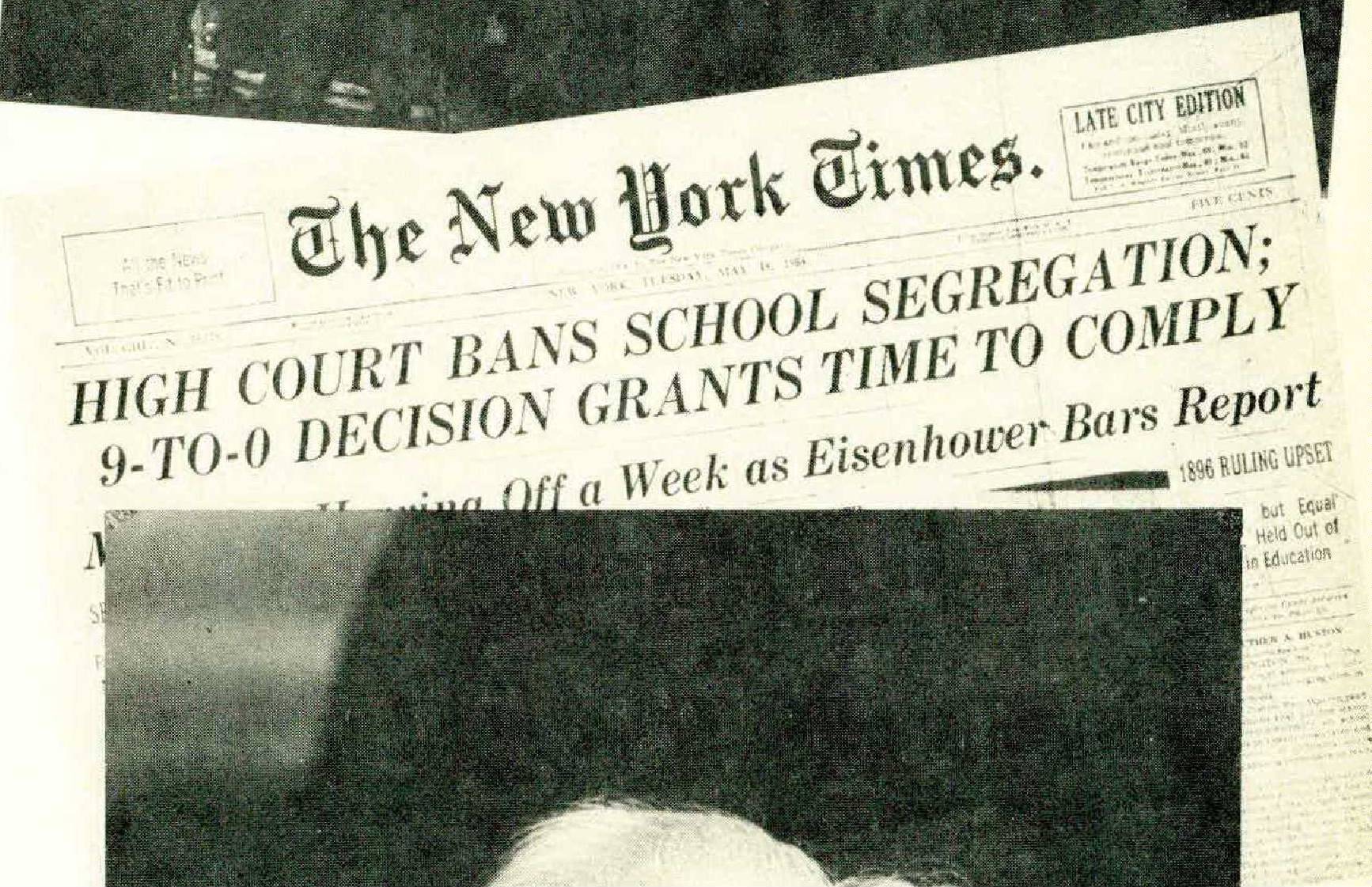
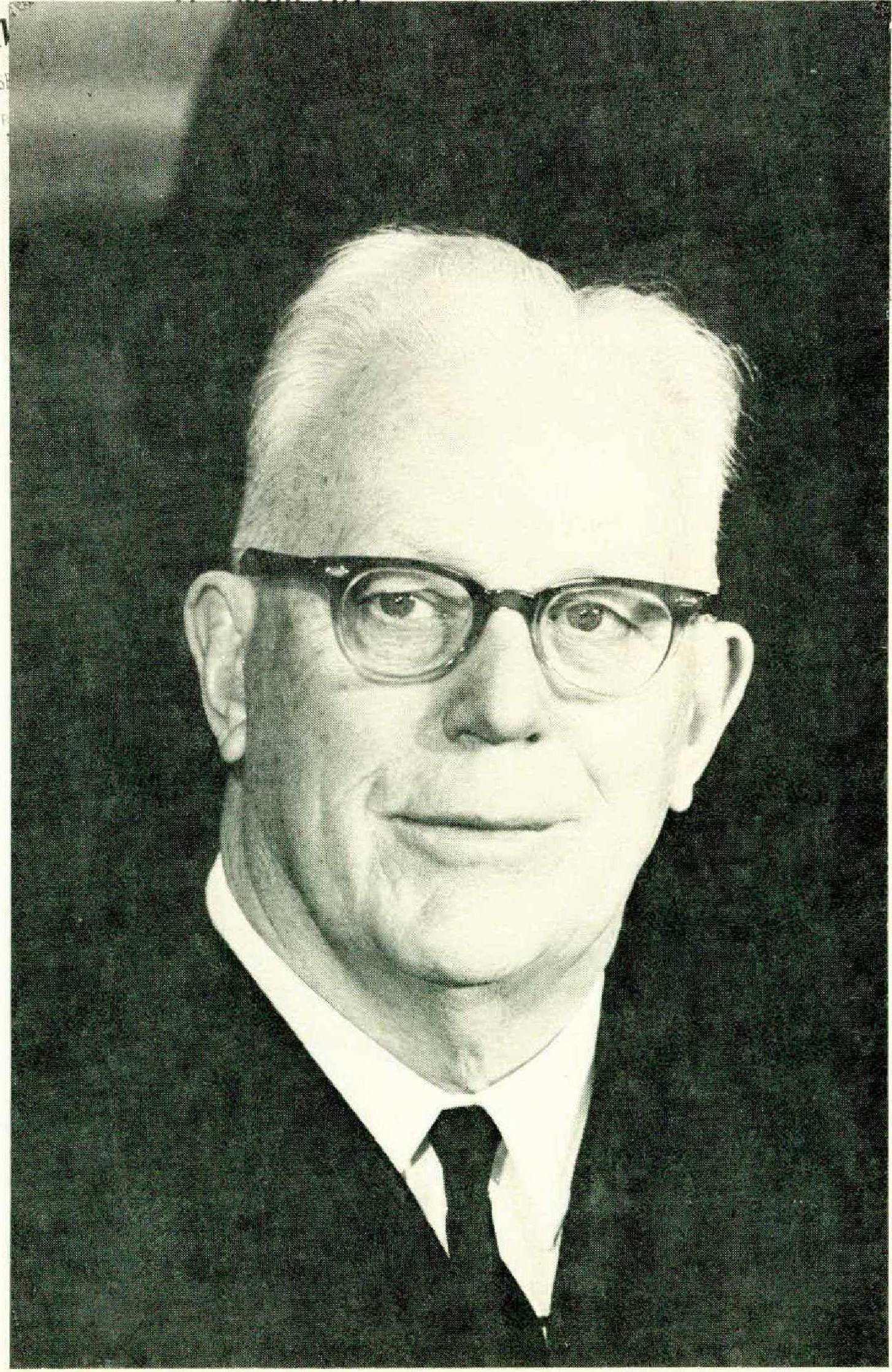
Again the Court was unanimous in its decision of May 31, 1955, reaffirming its opinion of May 17, 1954, by asserting the fundamental principle that any kind of racial discrimination in public education is unconstitutional, and that all provisions of federal, state, or local law requiring or permitting such discrimination must yield to this principle. Recognizing that because full application of these constitutional principles might require solution of a wide variety of local school desegregation problems, school authorities were given the primary responsibility for elucidating, assessing, and solving such problems. However, we stipulated that courts would ultimately have to consider whether the action of school authorities constituted implementation in good faith of the governing constitutional principles.
We discussed at great length in conference whether the Supreme Court should make the factual determinations in such cases or whether they should be left to the courts below. We decided finally to leave them to the latter, subject, of course, to our review, because they were getting closer to the problems involved, and were in a better position to engage in the fact-finding process. As guidelines for them, we directed that neither local law nor custom should be permitted to interfere with the establishment of an integrated school system, and that the process of achieving it should be carried out “with all deliberate speed”—a phrase which has been much discussed by those who are of the opinion that desegregation has not proceeded with as much celerity as might have been expected.
These people argued that the Supreme Court should merely have directed the school districts to admit Brown and the other plaintiffs to the schools to which they sought admission, in the belief that this would have quickly ended the litigation. This theory, however, overlooks the complexity of our federal system; the time it takes controversial litigation to proceed through the hierarchy of courts to the Supreme Court; the fact that the administration of the public school system is a state and local function so long as it does not contravene constitutional principles; that each state has its own system with different relationships between state and local government; and that the relationship can be changed at will by the state government if there should be a determination to bypass or defeat the decision of the Supreme Court. Evidence that such evasion would occur came immediately in some of the resolutions and laws initiated by certain states. In this, they were encouraged by the so-called Southern Manifesto, signed by over a hundred southern representatives and senators in the Congress of the United States. It urged all such states to defy the Supreme Court decision as being against their way of life and their “good” race relations, and to use “all lawful means” to make the decision ineffective. So reinforcing to southern defiance was this manifesto that the doctrine of “nullification”—first advanced by John C. Calhoun of South Carolina, discredited more than a century before and made forever inapplicable by the Civil War Amendments—was revived by southern governors, legislators, and candidates for public office. The doctrine, in simple terms, argued that states have the right to declare null and void and to set aside in practice any law of the federal government which violates their voluntary compact embodied in the United States Constitution. The doctrine, of course, did not prevail, but the delay and bitterness occasioned by it caused inestimable damage to the extension of equal rights to citizens of every race, color, or creed as mandated by the Fourteenth Amendment.
With courage drawn from this profession of faith in white supremacy by practically every southern member of Congress, together with oft-repeated congressional speeches and statements to the effect that no nine honest men could possibly have come to the conclusion reached by the Court in Brown v. Board of Education, excited and racist-minded public officials and candidates for office proposed and enacted every obstacle they could devise to thwart the Court’s decision. This was aggravated by the fact that no word of support for the decision emanated from the White House. The most that came from high officials in the Administration was to the effect that they could not be blamed for anything done to enforce desegregation in education because it was the Supreme Court, not the Administration, that determined desegregation to be the law, and the executive branch of the government is required to enforce the law as interpreted by the Supreme Court. Bernard Shanley, the personal counsel of the President, in an effort to allay southern animosity against the Administration, was reported in the press to have said in a speech that the Brown case had set race relations in the South back by a quarter of a century. The aphorism (dear to the hearts of those who are insensitive to the rights of minority groups) that discrimination cannot be eliminated by laws, but only by the hearts of people, also emanated from the White House.:2
A few years later, Governor George Wallace was emboldened to stand at the entrance to the University of Alabama and, in the face of the deputy attorney general of the United States, who had read to him the order of a United States district judge directing the university to admit Vivian Malone and James Hood, two black students, shout in defiance, “Segregation in the past, segregation today, segregation forever.”
The Court expected some resistance from the South. But I doubt if any of us expected as much as we got. Nor did I believe that the Republican party, which freed the slaves through the Civil War and the Thirteenth Amendment and granted them all the attributes of citizenship through the Fourteenth and Fifteenth Amendments, would develop a southern strategy intended to restrict such rights in order to capture the electors of those states and achieve the presidency. I, for one, thought it would be wonderful if, by the time of the centennial of the Fourteenth Amendment (1968), the principle of desegregation in Brown v. Board of Education could be a reality throughout the land. And I still believe that much of our racial strife could have been avoided if President Eisenhower had at least observed that our country is dedicated to the principle that “We hold these Truths to be self-evident, that all Men are created equal, that they are endowed by their Creator with certain unalienable Rights, that among these are Life, Liberty and the Pursuit of Happiness . . .”
With his popularity, if Eisenhower had said that black children were still being discriminated against long after the adoption of the Thirteenth, Fourteenth, and Fifteenth Amendments, that the Supreme Court of the land had now declared it unconstitutional to continue such cruel practices, and that it should be the duty of every good citizen to help rectify more than eightv years of wrongdoing by honoring that decision-if he had said something to this effect, I think we would have been relieved of many of the racial problems which have continued to plague us. But he never stated that he thought the decision was right until after he had left the White House.
I have always believed that President Eisenhower resented our decision in Brown v. Board of Education and its progeny. Influencing this belief, among other things, is an incident that occurred shortly before the opinion was announced. The President had a program for discussing problems with groups of people at occasional White House dinners. When the Brown case was under submission, he invited me to one of them. I wondered why I should be invited, because the dinners were political in nature, and I could not participate in such discussions. But one does not often decline an invitation from the President to the White House, and I accepted. I was the ranking guest, and as such sat at the right of the President and within speaking distance of John W. Davis, the counsel for the segregation states. During the dinner, the President went to considerable lengths to tell me what a great man Mr. Davis was. At the conclusion of the meal, in accordance with custom, we filed out of the dining room to another room where coffee and an after-dinner drink were served. The President, of course, precedes, and on this occasion he took me by the arm, and, as we walked along, speaking of the southern states in the segregation cases, he said, “These are not bad people. All they are concerned about is to see that their sweet little girls are not required to sit in school alongside some big overgrown Negroes.”
Fortunately, by that time, others had filed into the room, so I was not obliged to reply. Shortly thereafter, the Brown case was decided, and with it went our cordial relations. While Nina and I were occasionally invited to the White House after the decision for protocol reasons, when some foreign dignitary was being entertained, or were invited to some foreign embassy for a reciprocal honoring of the President, I can recall few conversations that went beyond a polite “Good evening, Mr. President” and “Good evening, Mr. Chief Justice.”
Some southern states, and northern areas as well, have used every conceivable device to thwart the principle of the Brown case, and they have been successful in preventing full compliance or even that degree of compliance sufficient to create good will between the races. Because of these drawbacks, some people are of the belief that the Court’s decree was a failure, but the fact is that real progress has been made. However, the tragedy of the situation is that because of die-hard segregationist resistance, advances have come about only after torrid litigation or after federal legislation which has emphasized the unfairness of the white supremacy theory to the point that deep bitterness against whites is felt by all minority groups—blacks, Chicanos, Puerto Ricans, Asians, and American Indians. That, too, can be remedied whenever we all realize the importance of the Thirteenth, Fourteenth, and Fifteenth Amendments to the Constitution in granting absolute equality of citizenship to “Everyone born or naturalized in the United States . . .”
Some more recent cases decided by the Supreme Court emphasize that these patterns die very hard. Despite the Court’s condemnation of the principle of racial segregation and outlawing of it in public schools in 1954, not until 1962 was the separation of blacks and whites in state courtrooms likewise outlawed. Not until 1964 was a black witness given the right to be examined by counsel in the same spirit of deference accorded to white witnesses. Not until 1968, over one hundred years after the passage of the civil rights statute on which the Court belatedly relied, were blacks determined to have the same rights as whites to live where they choose. Despite an old holding by the Court that systematic exclusion of Negroes from juries is unconstitutional, that problem still persists. And as late as 1969, after I had retired from the Court, Mr. Justice Black was moved to say in the case of Alexander v. Holmes County Board of Education that “... there are many places still in this country where the schools are either ‘white’ or ‘Negro’ and not just schools for all children as the Constitution requires.” In Justice Black’s view, there was “no reason why such a wholesale deprivation of constitutional rights should be tolerated another minute.”
An extremely touchy matter that has arisen out of the need to integrate schools is that of busing. Governor George Wallace of Alabama injected it into a presidential campaign, and others from Berkeley to Boston have brought the “busing issue” before the American public. Opponents hold it to be an undesirable principle whereby the courts are determined to wrench children from their neighborhoods and put them on buses for hours every day all over America in order to bring about a proportionate balance of black and white children in the schools. They have even argued that this must be prevented by depriving the courts of their constitutional jurisdiction.
This, however, is a complete distortion of the situation.
The Supreme Court has never held that there must be exact racial balance in the schools or that longdistance busing is desirable. Until recently, it has not recognized busing as a principle, only as a tool for the courts to use where the authorities have been reluctant to carry out the desegregation called for by Brown v. Board of Education. That decision was aimed at affording all children an equal opportunity for a good education, nothing more.
I believe that most parents would prefer having their children attend a school within walking distance of their home. They recognize, however, that it often becomes necessary or at least desirable to have pupils transported to a more distant school in order to educate them better. Busing is only one means to accomplish proper results when others have failed or been denied. There is much merit in a suggestion of Notre Dame’s Father Hesburgh to the effect that busing can properly be used to transport underprivileged children to better schools but not the opposite; he would leave poorer schools to the bulldozer.
Harmony in race relations is not simply or easily achieved. No matter how comprehensive and clear the law is on this subject, there will always be bigots to promote tensions and patterns of resistance. But the vast majority of people must realize by now that racial equality under law is basic to our institutions and that we will not and cannot have peace in our nation until the race issue is properly settled. We have, we should be aware, 34 million members of minority groups whose civil rights have not been but must be fully respected. That calls for a combination of effective law and good will. In the absence of both or either of these elements, we can only expect chaos. If there is one lesson to be learned from our tragic experience in the Civil War and its wake, it is that the question of racial discrimination is never settled until it is settled right. □
- When Earl Warren took over as Chief Justice, the Court was quite divided. Justices Black and Douglas usually took a strongly liberal view in their opinions; Justices Jackson and Frankfurter were more conservative: the other Justices fluctuated in between. In addition, there were personality conflicts which provided a certain amount of bristling discord and admittedly had been beyond Chief Justice Vinson’s powers to settle. ↩
- Some historians have given Warren credit for bringing greater amity and unity to the Court, at least for all-important racial decisions. Other observers, including the Chief Justice himself, have been more modest in their estimate of his harmonizing influence, holding that nothing could unify such differing spirits unless they individually wanted to be unified for a particular purpose. Memoranda in the Warren files for his Court years indicate that the Justices themselves gave Warren much credit for his leadership. A note to Warren from Mr. Justice Frankfurter on the day of the Brown decision says: “ ↩
This material is adapted from The Memoirs of Earl Warren, to be published early next month. The Chief Justice died in 1974.