Washington
1. A continent rediscovered
“Africa matters very much to the United States. This is a fact more and more Americans are coming to understand’” said Secretary of State Cyrus Vance in his speech to the NAACP in St. Louis in July. Vance’s declaration sounded straightforward enough, and it pleased the crowd. But it was probably less a confident pronouncement of the state of affairs than an expression of a cautious hope: that the American people, weary from Vietnam and already presented by the Carter Administration with policy shifts in China, Cuba, and Korea (not to mention the Panama Canal), will now gladly turn their attention and their hearts toward the momentous events in southern Africa.
The Administration is asking not only that attention be paid to Africa, but also that popular support be given to an activist American position in favor of black majority rule in Rhodesia and Namibia (Southwest Africa) as well as pressure on the white rulers of South Africa to improve the social and political status of blacks. The prospects for such support are uncertain at best.
To the rest of the world, it may seem strange that the United States government should find it necessary in 1977 to persuade its own people that Africa— home of one third of the member countries of the United Nations, supplier of 38 percent of this country’s crude petroleum imports, and the scene of a political crisis with profound implications— “matters.” Yet for most of America’s years as a world power, Africa has been treated by policy managers and politicians in much the way it was by the writers of old-fashioned grammar school geography texts: as “the Dark Continent,” a mysterious place where doings were as remote from American concerns as they were inexplicable.
More recently, diplomats and journalists alike routinely stereotyped the newly independent states of Africa and their leaders; coups d’etat and internal growing pains were portrayed with more ridicule than understanding. Even today, when the average American thinks of Africa, he undoubtedly thinks of Idi Amin, the renegade president of Uganda who has cleverly obtained for himself a guaranteed spot in newspaper headlines. Asked now to identify with the aspirations of black Africans, rather than with the white minority regimes of southern Africa— who have traditionally been portrayed as the protectors of Western civilization and a bulwark against communism—that average American may resist.
On one level, it is appropriate that the job of awakening and converting the American public on the subject of Africa should fall to Jimmy Carter, who has gone out of his way to stress the links between foreign policy and domestic politics. He was the beneficiary of overwhelming support, from black voters last year, and he recognizes that American blacks across the political spectrum are now paying more attention to Africa. What is more, the effort to achieve dramatic change in southern Africa seems to fit neatly into Carter’s international crusade for human rights.
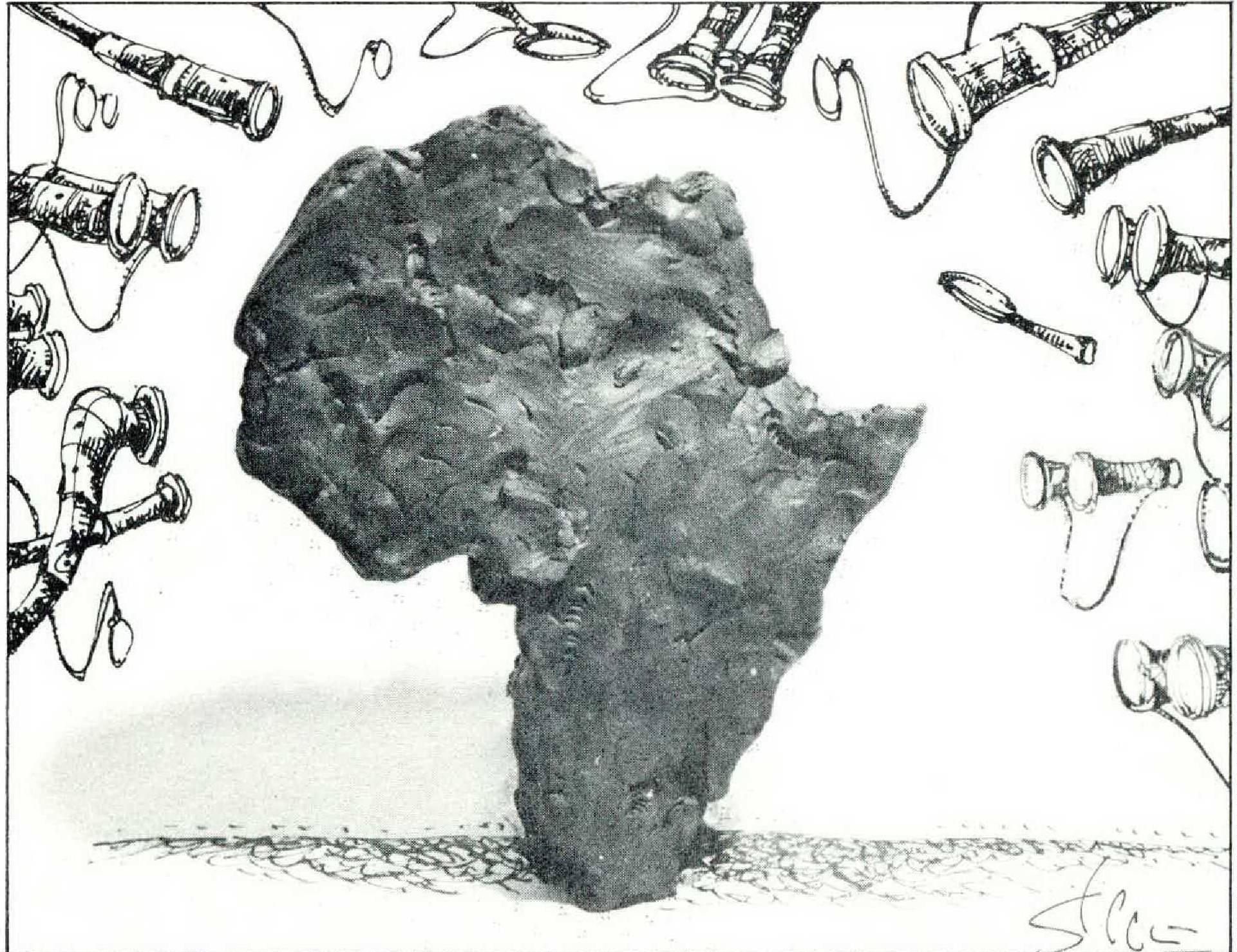
But there is also irony in the fact that Carter and his team must develop, explain, and enforce a new African policy, because the process was really begun in the spring of 1976 by that defender of the old order, Henry Kissinger. Then serving as Gerald Ford’s secretary of state, Kissinger extended his much-vaunted shuttle diplomacy to Africa, promising to settle the deadlock over Rhodesia’s future. Although his Rhodesian scheme fell apart in the midst of counterclaims and accusations among rival black and white leaders about what they had agreed to, the most important event of Kissinger’s trip was a speech he gave in Lusaka, the capital of Zambia. “We support self-determination, majority rule, equal rights, and human dignity for all the people of southern Africa,” he said, “in the name of moral principle, international law, and world peace.”
Those noble words can, of course, be interpreted in different ways. The basic strategy behind Kissinger’s effort, it later became clear, was to strike a deal with the white South Africans: If they would put economic and political pressure on the white regime in Rhodesia to accede to the creation of a black-ruled state of Zimbabwe (the black nationalists’ name for the country), and if they would cooperate in faster progress toward independence for Namibia, they could buy more time for change in their own country. The United States would not unduly pester the Pretoria government about its rigid system of apartheid; on the contrary, the white South Africans would be allowed, if not encouraged, to believe that if race war ever came, the Americans would bail them out.
It is on the latter point that the Carter Administration claims to have made a major shift. As Vice President Walter Mondale stressed at his urgent meeting with South African Prime Minister John Vorster in Vienna in May, and as Vance repeated in his NAACP speech, “We will welcome and recognize positive action by South Africa on each of these issues”—Rhodesia, Namibia, and South Africa itself. “But the need is real for progress on all of them.” Mondale was particularly blunt in explaining the import of the American position: “We hope that South Africa will carefully review the implications of our policy and the changed circumstances which it creates. We hope that South Africans will not rely on any illusions that the U.S. will in the end intervene to save South Africa from the policies it is pursuing, for we will not do so.”
Was the United States implying that it might intervene militarily on the other side, to force a settlement in Rhodesia and Namibia, or to assure the blacks a better shake within South Africa? Not at all, insist the policymakers. The Administration was thinking more in terms of moral persuasion, trying to exploit the potential psychological impact on South Africa of pressures from the leader of the free world. And it was avoiding use of the term “majority rule” to refer to the complex situation in South Africa. “Without evident progress that provides full political participation, and an end to discrimination,” Mondale declared, “the press of international events would require us to take actions based on our policy and to the detriment of the constructive relations we would prefer with South Africa.”
Questions of motive and meaning abound. For Kissinger, the impetus for sudden American involvement in Africa came from collapse of the Portuguese empire and the ascendance of the Soviet Union and Cuba on the continent after their support of the victorious faction in the Angolan civil war. Zbigniew Brzezinski, Carter’s national security adviser (who meets with the President daily), apparently shares with Kissinger an almost fanatical concern over the Soviet and Cuban presence in Africa, and feels that the United States must counteract it. But UN Ambassador Andrew Young, a close political friend of Carter’s and, by some accounts, chief architect of the new directions in Administration policy toward Africa, has repeatedly debunked the communist influence.
A casual observer could be forgiven for feeling confused about the line of authority on U.S. African policy and the method by which it is being developed. A juggling of command in the State Department’s Bureau of African Affairs has not helped, and the problem is worsened by a lack of personnel with experience or expertise in that part of the world; many of the people called upon to make decisions about Africa in this and other administrations have never been there and are unlikely to go in the near future. So shallow is the reservoir of interest on Capitol Hill that the most respected congressional voice on Africa now is a man who came to the subject only two years ago, Senator Dick Clark, Democrat of Iowa. Even Clark’s interest grew out of an accident: early in 1975, just as he was starting his third year in the Senate, he won a much-coveted seat on the Foreign Relations Committee. But when the subcommittee chairmanships were distributed, Clark was the lowest in seniority and had to settle for everyone else’s last choice—Africa. Since then, he has traveled throughout Africa to educate himself, and he has joined black Congressman Charles Diggs, Democrat of Michigan, in urging the Carter Administration to take things one step further and give aid to the “front-line” states that are supporting the guerrilla war against Rhodesia.
Clark, as a white senator from a state where blacks make up only one half of one percent of the population and few other people express an interest in Africa, believes that Americans can be awakened to the importance of the continent and persuaded to side with the black majority in the south. He urges an appeal to economic interests (“We need Africa’s natural resources”) alongside an emphasis on the parallels between the American civil rights experience and the troubles faced by South Africa. As a last resort, Clark says, it is legitimate to point with alarm to “short-term Soviet gains in southern Africa.”
But others in Washington are less optimistic, and complain that the Administration may have moved too quickly, without sufficient domestic political preparation. Since so few Americans have much knowledge of Africa, it may take a long time to persuade them of the wisdom of a bold activist attitude. On the other hand, there is also a chance that American blacks will be impatient with the notion that although black majority rule is an immediate priority in Rhodesia and Namibia, the Afrikaners in South Africa (Africa’s only real “white tribe,” which has been on the Cape of Good Hope since 1652) deserve more time. Another potential problem is unrealistically heightened expectations, especially on the part of black-ruled African countries, which may find that the United States, because of congressional or other restraints, cannot deliver what it seems to be promising.
What does the policy promise, and when? State Department insiders speak of a period of “a few months,” perhaps until the end of the year, during which the South Africans are expected to “digest the message and decide if they want to act on it.” Unless the Pretoria government takes some internal steps, such as an easing of petty apartheid regulations or of restrictions on the movement of blacks within the country, the Carter Administration will supposedly make its own symbolic moves—perhaps a refusal to veto anti-South African resolutions in the United Nations Security Council, or active support for new economic pressures against the embattled South African government. Whether Vorster is likely to respond to such gestures, or merely to dig in further in reaction to his own domestic pressures, the State Department has not yet managed to calculate. Nor is it clear whether such American actions will strengthen the hand of the moderate blacks in South Africa or of the militants who have been staging riots.
Beyond the short-term issues in Rhodesia, Namibia, and South Africa lies the question of whether the United States has any policy toward the African continent as a whole. Is a southern African policy a durable African policy? Or will individual countries to the north now demand sensitivity and attention to their particular needs? And how exacting will the Carter Administration be in applying its strong feelings about human rights and political freedom there? Those dilemmas, State Department strategists admit, will simply have to be taken up later.
2. The instant conservative
In retrospect, it all has a certain dreamlike or theatrical quality. A hardworking liberal Republican senator, little-known by the public outside his own state, gets his moment of glory when a nationally prominent and charismatic conservative, desperately striving for the GOP presidential nomination, breaks with tradition by choosing the senator as a running mate weeks before the party’s national convention. They travel together frantically from one end of the country to the other, proclaiming that only their unusual coalition can unite the splintered party and lead it to victory. The dizzying events bring adulation, exhaustion, and instant celebrity to the senator. The requests for television interviews are so numerous as to be impossible to fill; the presence of Secret Service guards for his family is exciting. In a count that goes down almost to the wire, they lose; but the senator has had an unforgettable experience.
A visitor to the office of Senator Richard Schweiker, Republican of Pennsylvania, has little trouble sensing the significance to Schweiker of his brief and extraordinary fling last year with Ronald Reagan. His suite is decorated with mementos of the events of the summer of 1976, including pictures of him holding a press conference and appearing on Sunday television interview shows to explain his decision to bolt from Gerald Ford and run with Reagan.
Senator Bob Dole of Kansas, who made the losing race with Ford against Jimmy Carter and Walter Mondale, may have long since stopped discussing what might have been and moved on to other business, but Schweiker is still reliving his experiences. “What we did last year,” he says, “is something that the Republican party has to do if it’s to survive as a national entity.” More to the point, he believes devoutly that if Reagan and he had been nominated at the GOP convention in Kansas City, they would have whipped Carter and Mondale. Schweiker’s arithmetic is simple: “Governor Reagan would have brought in Texas, Mississippi, and Louisiana, and I would have helped us in Pennsylvania and Ohio. We might have lost Michigan, but none of the others [that Ford and Dole won] . . .”
Armed with that self-confident, view, and convinced that many Republicans are grateful to him for what he did last year, Schweiker, at fifty-one, is determined not to become a mere historical footnote, a name remembered mostly for its usefulness in college trivia quizzes. He believes, rather, that his involvement in “the national arena” has only just begun, and that he has a certain obligation to look at “the national picture” in 1980 (which happens to be the year when he will be up for reelection to a third term in the Senate). Schweiker is quick to point out that he was invited to join the steering committee of “Citizens for the Republic,” the new right-wing Republican organization that is expected to become the vehicle for another run at the presidential nomination by Reagan or his personally selected stand-in. And the senator notes with obvious pride that he has met with Reagan “at least six times” since last summer’s drama, not to mention their frequent phone calls and correspondence. The unspoken fantasy is that Reagan might choose him as a running mate again, or that he himself could get the nod from the Reagan camp.
All of which means that Richard Schweiker—once near the top of Richard Nixon’s enemies list and banned from attending White House functions; the only senator of either party whose voting record scored 100 percent with the AFL-CIO in 1975; a man who in that same year voted against his own party 81 percent of the time and against the positions of the informal conservative coalition 93 percent of the time—has decided to go conservative.
The switch (one of his Republican colleagues in the Senate says it can be more aptly called a “pirouette”) actually began, of course, on July 26, 1976, the day he joined the Reagan team. Even though Schweiker was recruited precisely because he was a liberal, which was what Reagan’s strategists felt they needed at that point to buy time and win new delegate support, the supposedly independent running mate was immediately put under great pressure to demonstrate his ideological compatibility with Reagan. During an ill-fated trip to Mississippi to meet with Reagan delegates who were unhappy with his selection, Schweiker stressed that he had always taken conservative positions on gun control, abortion, and busing; before long, he was promising that whenever his established position on an issue disagreed with a conservative plank in the Republican platform, he would change his mind instantly. The folks back home in Pennsylvania, who had voted for one Schweiker, would simply have to learn to live with another one, who now proclaimed himself to have “a national constituency.”
That new Schweiker has been in full bloom during the first session of the Ninety-fifth Congress. Whereas his voting record was once liberal enough to shame any northern Democrat (he voted against the antiballistic missile program, for divestiture of the major oil companies, and for most federal spending measures), Schweiker is now unequivocally ranged on the other side. This year he voted to oppose Carter’s pardon of Vietnam War draft resisters; to reject the nomination of Paul Warnke as both director of the Arms Control and Disarmament Agency and chief of the American delegation to the Strategic Arms Limitation Talks (announcing that he had wind of a secret plan to make Warnke the dictator of all U.S. disarmament policy); and to defeat a proposal by his junior (and now more liberal) Republican colleague from Pennsylvania, H. John Heinz III, to increase the federal funds available for family planning programs.
In a dramatic turnabout from his past record, Schweiker led an unsuccessful Senate floor fight last May against Carter’s proposed expansion of public service jobs authorized under the Comprehensive Employment and Training Act. Last year Schweiker customarily would have been found cosponsoring legislation with such Republicans as Clifford Case of New Jersey, Charles Percy of Illinois, and Edward Brooke of Massachusetts; but his cohorts in the effort to cut the public service job authorization included such arch conservatives as Strom Thurmond of South Carolina, Jake Garn of Utah, and Paul Laxalt of Nevada.
Schweiker is at once boastful and defensive about his new image. Having been accused of making an earlier, more gradual switch—from a relatively conservative suburban Philadelphia congressman to an ultraliberal Pennsylvania senator—for reasons of expediency, he is straining to find common threads that run through his entire political career. He digs out earlier votes against increasing the congressional budget ceiling, for example, which seem consistent with his newfound concern over the size of the federal deficit. Looking back, Schweiker finds that he was already questioning the effectiveness of federal programs before that fateful phone call from Ronald Reagan. “But there is no question about it,” he admits, “the events of the summer of 1976 sharpened the focus of my concern.”
Mostly, Schweiker wishes that people would stop combing over his record in search of inconsistencies and instead listen to what he is saying about the need to bring the opposing wings of the Republican party together behind a program that is distinct from that of the Democrats. He is still a member of the “Wednesday Group,” a caucus of liberal and moderate Republicans which he founded along with Senator Charles Mathias of Maryland and others, but he has struggled to have it meet once a month with the “Senate Steering Committee,” a hard-core group of conservative Republicans such as Thurmond, Jesse Helms of North Carolina, and Carl Curtis of Nebraska. (Some liberal Republicans argue, however, that the sudden togetherness is a façade and that the conservatives, increasingly in control of the party machinery in the Senate, are being tough and exclusionary. The liberals point with alarm, for example, to the ruthless tactics employed by the conservatives to deny Mathias the ranking Republican seat on the Senate Judiciary Committee and later on one of its most important subcommittees. In the first instance, seniority was invoked to give Thurmond the job, and in the second it was ignored to hand the subcommittee plum to conservative William Scott of Virginia.)
Schweiker believes that a united Republican party has an opportunity to co-opt the growing conservative sentiment in the country, because the liberal Democratic congressional majority will ultimately prevent Carter from doing so. “The thing I found out last year,” he says, “is that the two [Republican] wings have more that pull them together than push them apart”—including a belief in what he calls basic conservative principles: the rights of the individual against big government, the need to use the private rather than the public sector to solve national problems, a strong defense, and the need to control federal spending and inflation.
As he tours the country giving his own speeches (in one recent week he appeared in Miami, Houston, and Cincinnati), and as he makes more frequent appearances on the Washington cocktail party circuit (which he once avoided), Schweiker stresses these themes and his own availability to promote them more widely. He perceives himself as a man with a mission, and he is trying to accumulate the status to carry it out. One recent boost was his inclusion in a congressional mission to China (the direct result, apparently, of his support of Howard Baker of Tennessee as the new Senate Republican leader).
How has Schweiker’s “pirouette” gone over at home in Pennsylvania? He has never been all that well-known a senator, so the initial criticism and derision in the press may not have taken hold among the voters. But Schweiker is nonetheless trying to mend his fences. Aloof from the state Republican organization in recent years (the support of organized labor did much more than the GOP to help him win a second term in 1974 against Peter Flaherty, then mayor of Pittsburgh and now deputy attorney general in the Carter Administration), Schweiker has urgently involved himself in its affairs. That is logical enough, since it is safe to assume that he will need the party more than ever if he comes down from his national ambitions and settles for another Senate race in 1980. As one Pennsylvania politician who has observed Schweiker closely puts it, “Dick desperately needs to build up his credentials with the right wing in the state, if only for fundraising purposes, because he has lost all his credibility on the other side.”
With his fellow senators, Schweiker’s reputation has probably suffered more clearly. Very much a loner and a family man, he has never had many close personal friends among his colleagues; but now, moderate and liberal Republicans omit him from the list of people they say they respect and trust, and when Schweiker’s name comes up, they politely change the subject. He is a topic of laughter for many Republican senators, and the jokes behind his back make references to Dr. Jekyll and Mr. Hyde. “At least he hasn’t gone as far as Charlie Goodell,” said one Senate Republican, referring to the conservative upstate New York congressman who, upon appointment to the Senate in 1968 on the death of Robert Kennedy, changed into a liberal; “Schweiker hasn’t changed his suits and his haircut yet.” (Indeed he hasn’t. He still dresses rather unfashionably and vainly combs a slick of curly hair down over a bald spot in front. Schweiker’s speaking style as a conservative is no less shrill and monotonous than when he was a liberal.)
“You know,” continued the same senator, converting his observations on Schweiker into a sort of Confucian epigram, “you have to be careful around here. You have to beware of radical changes. Otherwise, your old friends don’t trust you anymore, and your new ones really don’t know what to make of you.”
—SANFORD J. UNGAR