Tumoresque: The Films of David Lynch
“Lynch must be one of the most unalloyed surrealists ever to work in the movies; his material seems to come to the screen straight from his unconscious, uncensored.”
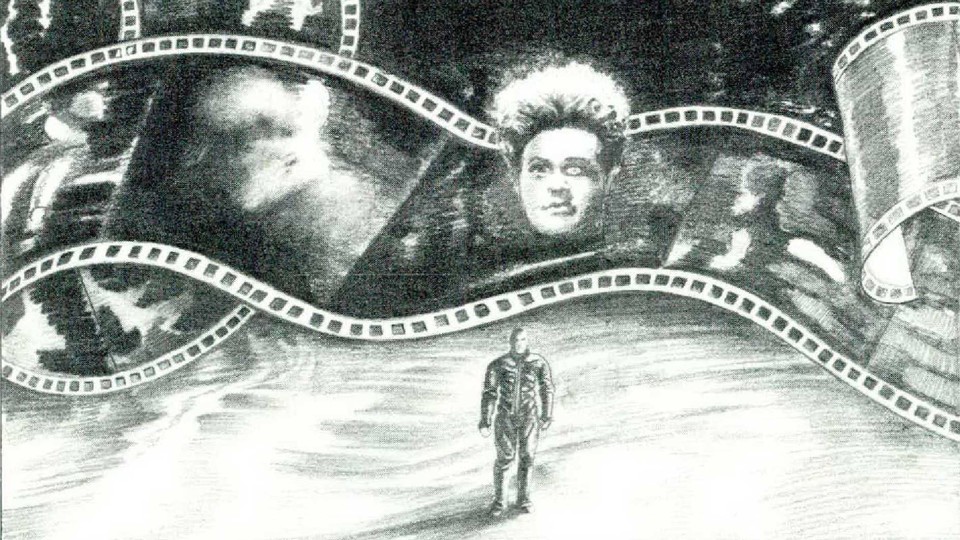
DAVID LYNCH, THE thirty-eight-year-old director of Eraserhead and The Elephant Man, stands on the edge of what most observers believe will be a brilliant career—unless the blockbuster that is going to seal his reputation rolls over and crushes him. That blockbuster, which is to be released in December, is Dune, the $40 million-plus movie of Frank Herbert’s science-fiction classic about a messianic figure who leads a revolt on a desert planet. Lynch has said that he isn’t nervous about the size and budget of Dune, that his nerves got their workout with his first (and only other) feature film, The Elephant Man. Lynch’s previous movie work consisted of a couple of shorts and the midnight-movie cult film Eraserhead. The Elephant Man was his watershed; Dune is more of the same, only bigger. Yet Dune isn’t just his second film for a Hollywood studio; it’s his bid for the big time—not only for critical respect (which he got with The Elephant Man) but for the kind of popular hit that is made by Steven Spielberg and George Lucas. If Lynch joins this company, he will surely be its strangest denizen: a director with a genuinely avant-garde sensibility who can apply his talents to that most conservative of film forms, the Hollywood narrative movie.
Not that Lynch’s short films, The Alphabet (a partly animated four-minute film, which I have not seen), The Grandmother (a thirty-four-minute film made in 1970 with a grant from the American Film Institute), and Eraserhead (which took him from 1972 to 1976 to make), lack narrative. In The Grandmother a lonely, emotionally abused boy grows a grandmother from a seed; they are happy together for a little while; then she dies (whistling like a steam kettle), and shortly afterward he follows her. Eraserhead chronicles the experiences of Henry, whose girlfriend (later his wife) gives birth to a number of odd creatures, and who finally finds happiness with a woman (she has enormous growths on each of her cheeks) whom he has seen in visions. But describing the plots of the two films, even though it gives some idea of their strangeness, fails absolutely to convey what they are like when seen. They’re not exactly not about their stories, but the story elements bob on them like driftwood on the surface of a dark sea.
In The Grandmother (which, along with The Alphabet, is one of Lynch’s two films in color before Dune) the blacks are so rich that you feel you could sink your arms into them up to the elbows. Against this black, which is the backdrop to most of the scenes, Lynch’s other colors stand out with hallucinatory sharpness: they almost hurt your eyes. The boy’s dreadful mother wears a dress with a greenand-pink floral pattern, bright as a tropical bird’s plumage. The boy wets his bed frequently, and the urine stain is a rich yellow-orange, like egg yolk. Lynch is one of the great movie sensualists, but his is an odd sort of sensuality, because there’s no overt sexual charge to it. Even when he’s dealing with directly sexual symbols, there’s something cool and dry, clinical, in his attitude. And his technique has no lush pleasures. There is no languorous camera movement, and none of the high excitement of vivid editing. We aren’t swept along by Lynch’s camera; we’re caught by his images. Our memory of his work is likely to be a series of mysterious, monographic compositions—as if we had been looking at an exhibition of paintings rather than at a film.
Lynch is, in fact, a painter. He studied at the Corcoran School of Art, in Washington, D.C., the Boston Museum School, and the Pennsylvania Academy of Fine Arts. His films don’t much resemble the sketches of his I’ve seen (though his animation in The Grandmother does), but clearly they’re made by someone with a painter’s eye. Orson Welles and Akira Kurosawa have backgrounds in painting too, but the influence shows up mostly in their sense of composition, and each of them is fascinated by the fluid shifting of that composition, within the frame or through editing. Lynch is more interested in the cinematic equivalent of brushwork, the thickness of paint on canvas, its ridges and bumps. You find yourself thinking that you could touch the screen and feel the objects he’s showing you. And his light (particularly in the short films) is very much the light of a painter’s studio. The sources aren’t necessarily natural or, often, explicable. The figures aren’t really lit for movement; Lynch means for them to stay put so that we can have a good look at them. And, as when looking at a painting, we may feel that we need to examine every single object in the frame in order to make sense of what we’re being shown.
What we’re being shown—invited to stare at; invited, almost, to put our hands on—is an array of grotesque and mysterious objects. (There are people in Lynch’s films, but until he gets to ordinary character drama in The Elephant Man, they’re objects too, depersonalized surfaces to respond to.) A leafless tangle of branches, like wires, spills from a mound of earth on a bedside table. A roasted Cornish game hen twitches and spurts out dark, viscous fluid. A pair of passionate lovers sink into a liquefying mattress. Lynch’s images are obscenely organic—obscene not because they’re disgusting but because they seem somehow wrong. Something tumorous lurks beneath the surface of his movies; the physical world is unstable, mutating, breaking apart. In the opening sequence of The Grandmother three of the main characters enter the film by thrusting up through a surface of earth and dead leaves. Lynch sees the living world as a compost heap. The camera isn’t so much an eye to him as a microscope; objects are their structures, and structures continually decay.
Lynch seems as fully an aural as a visual artist. Since The Grandmother he has worked with Alan Splet (who won an Oscar for the sound for The Black Stallion), and the two of them have created soundtracks clanking and hissing with noise, as if the world were a factory. The mechanical-biological wheezes, groans, hums, sighs, and wails are perhaps the clearest indication of Lynch’s perception of organic reality as machinery breaking down.
THERE’S WIT IN Lynch’s work, and humor. The grandmother in The Grandmother is born (of a tree) fully clothed, in a very proper crushed-velvet dress and sensible black little-old-lady shoes. The drowning-pool bed in Eraserhead is a sardonic comment on lust. But these touches seem incidental. If there is any underlying theme in Lynch’s work, it is that you can’t trust the flesh. John Merrick, the Elephant Man, is the living realization of pregnancy gone wrong. The “good” grandmother is born of a plant (and is thus free of the taint of animal matter) in a deluge of rain-clean water. The boy is continually punished for involuntary bed-wetting, body juices in rebellion.
The ultimate betrayal is inflicted on Henry, the unfortunate hero of Eraserhead, when his wife gives birth first to a deformed creature with no apparent epidermis and then to a series of semiformed, glistening creatures, which Henry disposes of by hurling against the wall. Although jokes are made about advising pregnant women not to see Eraserhead, it seems clear that the dreadful offspring are not the wife’s fault but Henry’s. The monsters he smashes are spermlike in form, masculine. And at one point he hallucinates that his head falls off, and in its place appears the horrid, raw skull of his child. His very essence as a man is something corrupt. When he murders his baby, its body disgorges like vomit waves of some oatmeal-textured substance, and its neck elongates furiously, the steadily enlarging head swinging through the room like a snake’s.
Lynch must be one of the most unalloyed surrealists ever to work in the movies; his material seems to come to the screen straight from his unconscious, uncensored. Ultimately, though we may glean some of what’s going on, his short films remain mysteries. His images have no “meaning.” They’re intensely personal, and on this level his work is inaccessible, sealed off from us. Yet this hermetic quality is the source of his movies’ power. Even the greatest surrealist films, such as Buñuel and Dali’s Un Chien andalou, and Buñuel’s L’Age d’or, have a distancing self-consciousness and wit. And Buñuel and Dalí want to reach the audience—they want to skewer us, as an unselfconscious, homegrown surrealist like Buster Keaton wants to entertain us. But Lynch isn’t reaching out to us from his films; we’re sinking into them. They have a quality no other dream-films have ever held for me; they give the viewer a sense of being trapped inside the dreamer’s skull, unable, as the dreamer is unable, to wake up.
IT’S ASTONISHING TO come from the closed-in, subconscious world of The Grandmother and Eraserhead to The Elephant Man and discover the grace and assurance with which Lynch tells a conventional story. In the opening credits a beautiful woman is trampled, perhaps assaulted, by an elephant. This scene should be the highest camp, but it has a ghostly beauty—everything is blurred, half-glimpsed, transcendent. In the sequence immediately following, Dr. Frederick Treves (Anthony Hopkins) moves through the narrow, crowded alleys of a sordid London sideshow, looking for the exhibition that houses the Elephant Man. Time and again we think we are on the edge of seeing the monster; time and again Lynch draws back from revealing him. This isn’t a tease, it’s a gentle, firm statement. When we finally do see the Elephant Man, it’s in a long shot; he’s in a bed in the corner of a hospital room, cowering from the camera and the maid who is screaming at the sight of him. We understand the maid’s reaction, but we’re not inclined to scream. When Lynch moves in closer, showing Merrick in profile, he already seems familiar to us, a matter-offact presence.
Shot in black-and-white by the great Freddie Francis (who is also the cinematographer on Dune), The Elephant Man looks like an etching done on silver. Some of it, such as a night-time procession of freaks beside a river, has the visual power of a silent film. There are some hallmark Lynch oddities—shots of pounding machinery; a man with a terribly mutilated chest lying on an operating table—but they’re part of the film’s nineteenth-century, Industrial Revolution milieu. Merrick’s enlarged, fetallooking skull is Lynch’s main object of contemplation. The movie’s simple, unsentimental compassion clearly is based on the fact that Lynch finds Merrick beautiful.
Most of the actors give understated performances. Hopkins, as Treves, is especially dry and moving in what could have been a very wet role. The Elephant Man isn’t humanistic; it’s not about the glory of the human spirit overcoming obstacles. It’s a Dickensian fable: the lost, abused child is rescued and taken care of, stolen away by his evil master, rescued again; then he dies. Perhaps it’s because Lynch isn’t primarily interested in emotions that he treats this potentially lachrymose story with an economy that lets us accept and be touched by it.
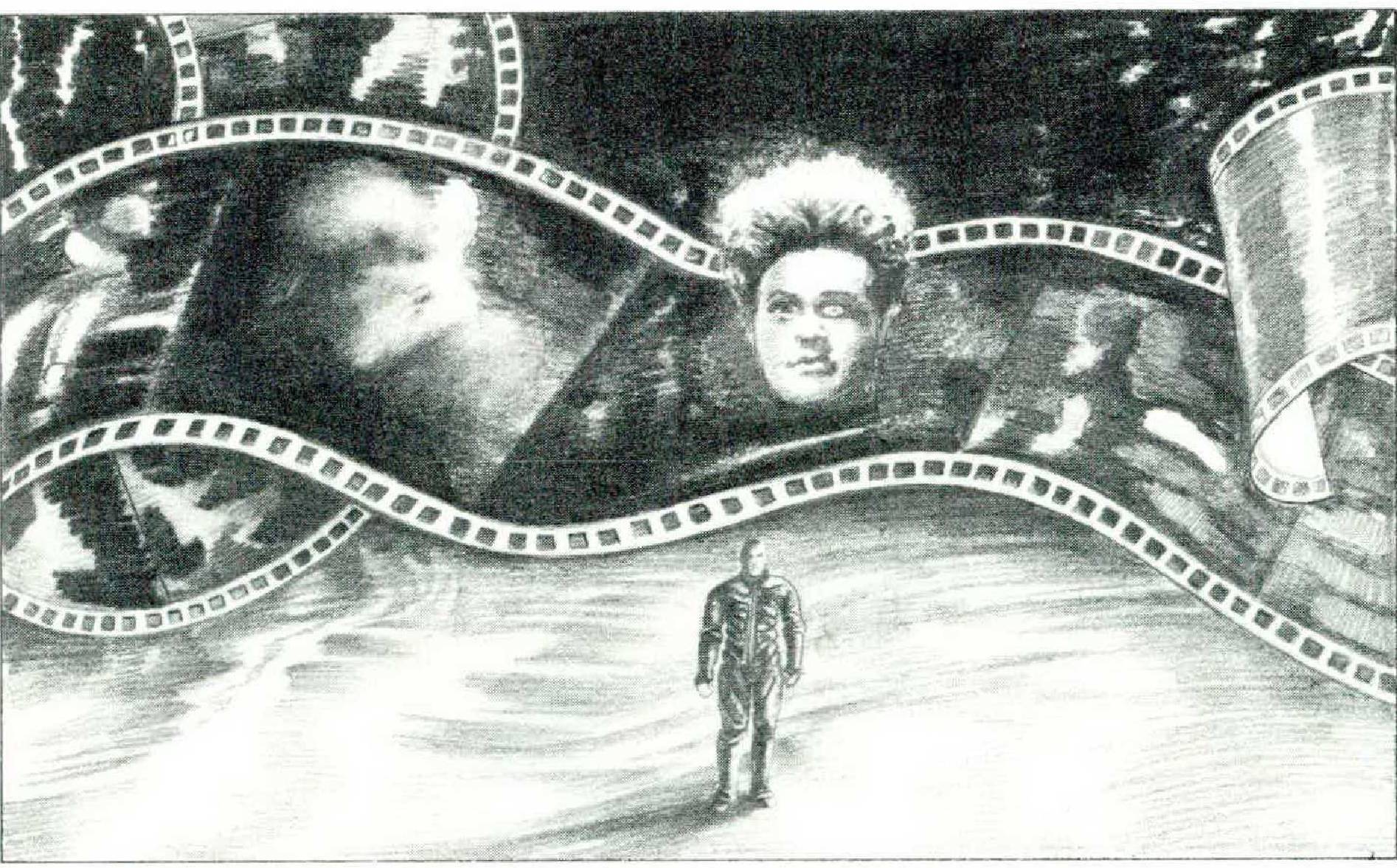
Maybe he will similarly cauterize Dune’s grandiose, junk-mythic excesses. He has said that he was drawn to the book because of its “textures.” This is a word he uses a lot in interviews, generally in its tactile sense. With Dune he’s talking about the book’s variety of physical and mental environments: water and wood, rock, sand, scarred and mutating flesh, dreams, visions. Directing what may turn out to be the most expensive science-fiction movie ever made. Lynch isn’t worried. Nor, I think, should we be. It will be no surprise if, on Dune, the desert planet, he shows us wonder in a handful of dust.