The Last Word
ALEXANDER POPE.: A LIFE by Maynard Mack. Yale University Press in association with Norton. $22.50.
ALEXANDER POPE dominated English poetry virtually from the publication of his first long poem, An Essay on Criticism, in 1711, until his death, in 1744, shortly after the publication of the final version of The Dunciad, a rollicking, mock-epic attack on pedantry and dullness. Pope was a Roman Catholic who refused to sign an oath supporting the Church of England and was therefore required by law to live no closer to the Court than ten miles. With his close friends Jonathan Swift and John Gay he formed the Scriblerus Club. Gulliver’s Travels, The Beggar’s Opera, and The Dunciad all began as “papers” for the Scriblerus Club, and all were aimed at political abuses of the time.
Less than five feet tall, hunchbacked, and gradually crippled by tuberculosis of the spine, Pope never married nor begot children, though otherwise he led a life of immense sociability and unbelievable productivity. His Works, mostly in verse, run to ten volumes. A master of the heroic couplet, he used it to translate all of The Iliad and most of The Odyssey, he published an edition of Shakespeare; he wrote imitations in verse of Horace and other Roman poets.
Pope might be described, if not as the last Renaissance man, as the last man of the Renaissance. His values were those of Western Christian culture as modified by the rediscovery of classical learning. If his translations of Homer affected for more than a century the way the English and their colonists looked at the epic quarrels of old Ilium, the scholars of Pope’s time, like the brilliant and monstrous Richard Bentley, were sophisticated enough to challenge his capacity: “[Though] it is a pretty poem, Mr. Pope,” Bentley chided, “you must not call it Homer.” Today, with ancient Troy rendered more fittingly to our temper by Robert Fitzgerald, we might hardly recognize our Homer in Pope’s version, but we can certainly recognize our own species and our own shortcomings in his rich, wise, and penetrating satires, the sort of poetry that no one in our century has been able to give us.
Endorsed by the received culture of his time, Pope could confidently take his seat as a taste-maker. Voltaire himself welcomed Pope’s Essay on Man (1733) as “the most beautiful, the most useful, and the most sublime didactic poem ever written in any language.” This majestic (and slightly meretricious) work set Pope on the intellectual throne of Europe. It seemed to approve the new science but hesitated at the door, for it could not help colliding with science’s challenges to ancient authority. As long as the old values could be construed as tasteful. Pope might prevail, but it would become increasingly difficult to prove them true.
In Shakespeare the values of the Renaissance had manifested themselves as an expansiveness of invention, which could not have taken place at any other moment in the history of our language nor have been imagined without a theater where the verse could be spoken by living actors. Milton, half a century after Shakespeare, attempted to dominate English with such encrustations of allusion and metrics as to leave it an altered language, caparisoned with Christian humanism and nearly unrecognizable. Pope’s ambition lay within easier reach. He had the talent neither to dramatize the language, setting it in a thousand mouths, nor to transform the language, dominating it by a single voice. His talent was more collective: inheriting the “correct” and scrupulous diction of Dryden, and coming to the laurels fifty years after Paradise Lost, he wanted to utter the last word on the classical age, and he wanted it badly enough to get his wish. Seldom has a poet so governed the taste of his time; seldom has a time been so willing to be governed.
Pope was born in 1688, the year when the Glorious Revolution supplanted England’s last Catholic monarch with a Protestant line. Those who, for a variety of reasons, opposed the new Whig notion of constitutional monarchy were first banished or jailed, and then neutralized by Sir Robert Walpole’s parliamentary oligarchy. Yet the dominant literary figures up to the French Revolution—Swift, Pope, Dr. Johnson—favored the Tory persuasion, basing their preference in part on ancient Roman authority, in part on divine descent. Pope dominated the literary culture of England throughout Walpole’s hegemony—1721 to 1742. He spoke for order, decency, and taste.
What Pope said about these Tory virtues has often been remembered, even if we do not remember Pope as the author. “An honest Man’s the noblest work of God,” “Hope springs eternal in the human breast,” “The proper study of Mankind is Man,” “A little learning is a dang’rous thing,” “For fools rush in where Angels fear to tread”—the list of famous lapidary lines could be extended. Over and over again we find ourselves quoting Pope without knowing: his words fill seventeen columns of the latest edition of Bartlett’s Familiar Quotations, more space than is granted any other English poet save Shakespeare and Milton. If, as Stanley Kunitz has said, our contemporary poetry is easier to write but harder to remember than that of former generations, by the mnemonic standard Pope cannot avoid being counted as one of the great poets of the past. But, then, he was dedicated to unforgettability. In writing of aging ladies of quality, indeed, he saw oblivion as the final blow:
See how the World its Veterans rewards!
A Youth of Frolics, an old Age of Cards,
Fair to no purpose, artful to no end,
Young without Lovers, old without a Friend,
A Fop their Passion, but their Prize a Sot,
Alive, ridiculous, and dead, forgot!
A Youth of Frolics, an old Age of Cards,
Fair to no purpose, artful to no end,
Young without Lovers, old without a Friend,
A Fop their Passion, but their Prize a Sot,
Alive, ridiculous, and dead, forgot!
This raises the unforgiving to the unforgettable.
Maynard Mack’s definitive biography is the first complete life of Pope since 1900, for Pope has hardly been the rage. It’s the sort of book we rarely see now (975 pages, including 98 illustrations, 109 pages of notes, 44 pages of index). Among recent biographies it will, I imagine, stand with Irvin Ehrenpreis’s three-volume Swift and Walter Jackson Bate’s Samuel Johnson. Mack, a distinguished Yale professor, has clearly adopted Pope as his lifework and has stuffed his book with every scrap of scholarship and wisdom that a long and thoughtful career could collect. His eye for history seems nearly perfect, even if his ear for poetry strikes me as a trifle pedestrian, and the book exasperates me by its sheer wordiness: no one would wish it longer.
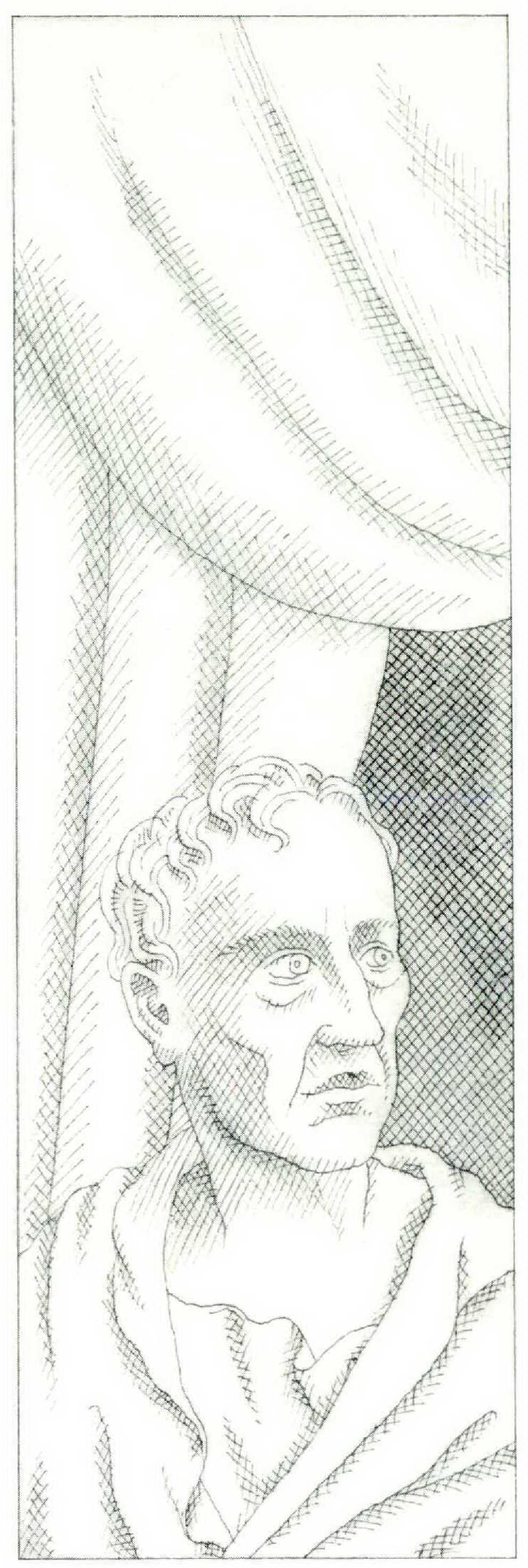
POPE WAS THE first millionaire—and perhaps the last—to earn his fortune as a serious poet. He manipulated the publishing machinery of his time, seeing to it that his letters were published during his lifetime but seemingly without his instigation, and that his poems of attack burst without warning upon his enemies, while his poems of friendship (of which there were a great many) were appreciated, well in advance, by those who loved him. He made a thousand enemies, but foiled them by his skill. He engineered the publication of An Essay on Man to seem anonymous, so that his harshest critics would be tricked into praising it for its virtues instead of attacking it for its authorship. Mack describes him as “crippled, quick-tempered, highly sensitive to slights, at times vengeful, carrying out a career by sheer genius and relentless application in the face of envy, religious bigotry, and almost continuous slander.” Perhaps in response, Pope’s villa at Twickenham was constantly being renovated with grottoes and obelisks and busts, until it became as famous as he. During his lifetime at least sixty portraits of him were painted or sculpted.
Even Pope’s peers and allies, if they displeased him, came under fire, as in these famous lines about Joseph Addison in his masterpiece “Epistle to Dr. Arbuthnot”:
Should such a man, too fond to rule alone,
Bear, like the Turk, no brother near the throne,
View him with scornful, yet with jealous eyes,
And hate for arts that caus’d himself to rise;
Damn with faint praise, assent with civil leer,
And without sneering, teach the rest to sneer;
Willing to wound, and yet afraid to strike,
lust hint a fault, and hesitate dislike . . .
Bear, like the Turk, no brother near the throne,
View him with scornful, yet with jealous eyes,
And hate for arts that caus’d himself to rise;
Damn with faint praise, assent with civil leer,
And without sneering, teach the rest to sneer;
Willing to wound, and yet afraid to strike,
lust hint a fault, and hesitate dislike . . .
On and on it goes, the anatomization of pettiness: an acidulously inked portrait of the literary lion.
Pope was not a poet, like most of ours, of introversion, of inner passions, of selfinflation. His language, less elevated than that of the classical models he emulated, used images of manufacture, of the human scale, of everyday understanding, above all of control:
The spider’s touch, how exquisitely fine!
Feels at each thread, and lives along the line. . . .
Feels at each thread, and lives along the line. . . .
A Romantic poet might have attempted to become the spider; Pope made the spider seem almost human, a master spinner. Likewise with the famous lines, immortalized a second time by their musical setting in Handel’s oratorio Semele:
Where’er you walk, cool gales shall fan the glade;
Trees, where you sit. shall crowd into a shade;
Where’er you tread, the blushing flowers shall rise,
And all things flourish where you turn your eyes.
Trees, where you sit. shall crowd into a shade;
Where’er you tread, the blushing flowers shall rise,
And all things flourish where you turn your eyes.
How regulated poetry becomes when everv gesture performed by nature takes on the style and scale of social understanding, when flowers flourish, gales fan, and trees crowd, all at the poet’s summons—and when the original idea comes from a writer like Persius. This is the wild world as a landscape gardener conceives of it: this is civilization under control.
Any poet, whatever his era, would like to have been remembered as well as Pope. Since his era, relations between poet and audience have altered profoundly. Today’s audience finds its poets unclear, irrelevant, unaccountable; our poets find their public dense, unresponsive, untrained to hear what they say. Poet and audience alike have a true grievance: poetry has taken a journey to the interior, no longer concerning itself with public matters, no longer able to invent, as Pope could, a diction that presumes public and private questions to be indistinguishable. Today what may the poet presume? That his reader shares the belief that poetry offers a way of living, away of thinking and feeling, that is common to “all civilized mankind”? Certainly not.
To defend such a belief against the assaults of a new mercantile society was Pope’s ultimate commitment, for he (and Swift and Gay and others) saw it threatened by mediocrity, pedantry, and above all dullness. Putting on the armor of certainty. Pope wrote (and rewrote over many editions) The Dunciad, the ultimate eschatological Book of Revelations of the Age of Taste. It is at once his most magnificent sustained achievement and the poem most limited to the terms of his time. In the accents of Virgil he told the adventures of a hero of darkness, Tibbald (the misspelled name of one of his leading literary enemies), in his quest to found a great empire of dullness.
Even now, in the Age of Efficiency, wireless, raped, and duped, we can respond to Pope’s peroration, in which the whole world is set snoring and returned to the beginning of things, when the earth was without form and void, and darkness was upon the face of the deep:
More she had spoke, but yawn’d— All Nature nods;
What Mortal can resist the Yawn of Gods? . . .
Lost was the Nation’s Sense, nor could be found,
While the long solemn Unison went round:
Wide, and more wide, it spread o’er all the realm;
Ev’n Palinurus [Walpole] nodded at the Helm. . . .
In vain, in vain—the all-composing Hour
Resistless falls: the Muse obeys the Pow’r. . . .
Thus at her felt approach, and secret might,
Art after Art goes out, and all is Night.
See skulking Truth to her old cavern fled,
Mountains of Casuistry heap’d o’er her head! . . .
Lo! thy great Empire, CHAOS! is restor’d;
Light dies before thy uncreating word;
Thy hand, great Anarch! lets the curtain fall,
And universal Darkness buries All.
What Mortal can resist the Yawn of Gods? . . .
Lost was the Nation’s Sense, nor could be found,
While the long solemn Unison went round:
Wide, and more wide, it spread o’er all the realm;
Ev’n Palinurus [Walpole] nodded at the Helm. . . .
In vain, in vain—the all-composing Hour
Resistless falls: the Muse obeys the Pow’r. . . .
Thus at her felt approach, and secret might,
Art after Art goes out, and all is Night.
See skulking Truth to her old cavern fled,
Mountains of Casuistry heap’d o’er her head! . . .
Lo! thy great Empire, CHAOS! is restor’d;
Light dies before thy uncreating word;
Thy hand, great Anarch! lets the curtain fall,
And universal Darkness buries All.
“A very pretty poem Mr. Pope,” says Maynard Mack, “but you must not call it prophecy.” Perhaps not. Yet it is, and has remained, about the last word on mediocrity. And as Pope said when rebuking the hapless poet laureate Colley Cibber:
Poor Colly, thy Reas’ning is none of the strongest.
For know, the last Word is the Word that lasts longest.
For know, the last Word is the Word that lasts longest.