Business: Seeing Red
The mysterious moves of a nationally prominent randy manufacturer
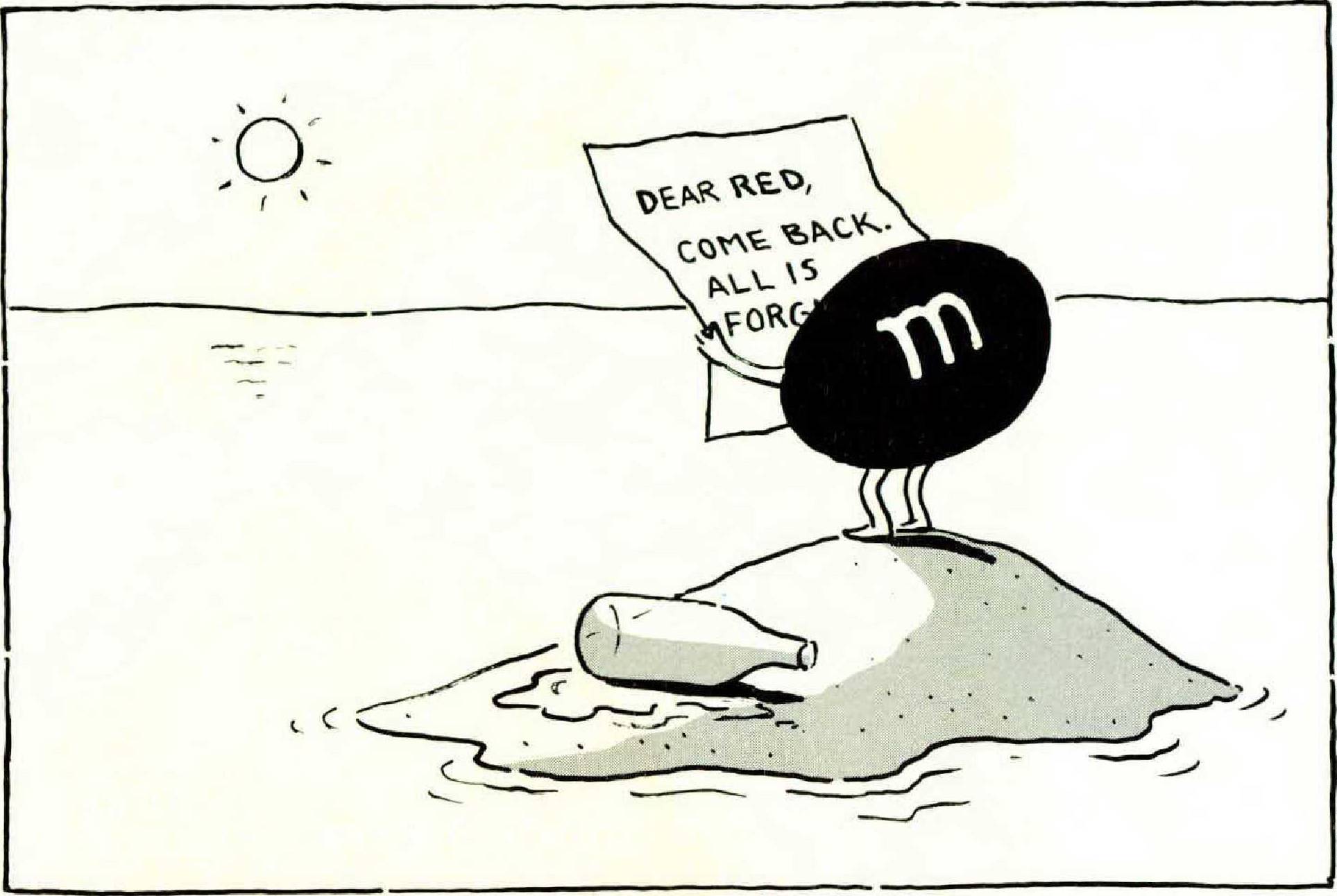
ENIGMATIC AND seemingly chickenhearted actions by major confectioners really burn me up. This accounts for my sudden mood shift twelve years ago, when M&M/Mars, a division of Mars, Incorporated, stopped making red M&M’s. It also explains why I am somewhat less than ebullient now that red M&M’s are back.
M&M’s are the favorite candy of most Americans, according to M&M/Mars. This may or may not be true. They are not my favorite candy. But red M&M’s are my favorite M&M’s. As far as I know, they are everyone’s favorite M&M’s. And red, in whatever form, is the favorite color of 64 percent of all Americans, I would guess.
Why would a large, privately held candy manufacturer embark on a policy guaranteed to anger, vex, and disappoint the vast and economically powerful redpreferring majority? To find out, let’s go back in time (just a simulation—don’t try this yourself) to 1976.
Okay, we’re in 1976. It is a year like any other. But suddenly from the Toxicology Advisory Committee of the United States Food and Drug Administration comes alarming news: a statistically significant number of malignant neoplasms have been observed in a group of female Osborne-Mendel rats that have ingested large quantities of amaranth for 131 weeks. These results lend weight to an earlier, Russian study in which non-inbred male rats had also developed neoplasms, after being fed amaranth for 143 weeks. Neoplasms are tumors. Amaranth is a water-soluble rust-colored powder (derived from the stems and leaves of certain plants related to bachelor’s buttons and cockscombs) better known as Red Dye No. 2. The FDA announces its intention to remove the dye from the list of colors provisionally approved for use.
Almost immediately, representatives of the cosmetics, toiletry, food, fragrance, and coloring industries descend on Washington, D.C. “Boo, hoo, hoo, hoo, hoo—we want Red Dye No. 2,”they seem to cry. But their imagined sobs are unavailing. On February 12—the 167th anniversary of the birth of Abraham Lincoln—the FDA bans the dye.
One can only imagine the maelstrom of grumbling this ruling engenders in many sectors of the country. Still, there is one sector where one expects to hear no grumbling at all but, rather, exultant merrymaking. This sector is Hackettstown, New Jersey, the home of M&M/Mars. For while M&M/Mars does indeed manufacture a red-dyed food product—red M&M’s—the redness of red M&M’s is produced not by Red Dye No. 2 but by Red Dye Nos. 3 and 40, colorants enjoying the official blessing and protection of the United States government.
Nonetheless, shortly after the FDA ruling M&M/Mars decides to cease production of red M&M’s. According to the company, this decision is made “to avoid any consumer confusion and concern.” Disinterested observers can only shake their heads and wonder whether it is not someone other than consumers who is confused.
GETTING TO THE bottom of the missing-M&M mystery is a task that, although it has not consumed the past dozen years of my life, has kept me pretty busy for a couple of weeks. My investigation has not been easy. For a company that doesn’t make rockets or cater to movie stars, M&M/Mars is remarkably secretive. If you try to arrange an interview with one of the company’s coloring researchers, your request will be denied. If you ask if someone might take you on a tour of the M&M manufacturing facility, where well over 20 million red and 80 million other M&M’s are produced daily, the answer will be no. Regardless of what sort of inquiry you make, your call will be routed to Hans Fiuczynski, the company’s director of external relations. Fiuczynski’s voice is lightly accented. He refers to a single M&M as “an M&M’s.” If you ask him how the small white M is applied to the surface of each candy, he will direct you to A Little Illustrated Encyclopedia of M&M/Mars, which the company sends to people who ask questions. It says that the process is “similar to that of offset printing,” revealing nothing.
Perhaps there is no one at the company except Fiuczynski and a handful of assistants. Perhaps Fiuczynski makes all the M&M’s himself, or buys them in bulk from Asia. Perhaps it was he who made the decision to stop manufacturing “the red piece,” as he calls it. There is no way to know. One cannot pursue these matters without falling once again into his hands.
Denied access to the company’s interior, I went to the grocery store and bought a half-pound bag of plain M&M’s and a half-pound bag of peanut M&M’s. I took these back to my office and sorted each bag by color, something I used to do as a child. (In those days I would often pick two M&M’s at random and press them together until one of them cracked. This M&M I would eat, advancing the uncracked M&M to the next round, and so on, through the bag. The idea was to find the “strongest” M&M—invariably a red one—which I ate last.)
But the sorting I did in my office was not mere child’s play. I wanted to check some figures that Fiuczynski had given me concerning the average distribution of colors in bags of M&M’s. M&M/Mars uses focus groups of consumers as part of an elaborate and secret process to arrive at what it believes to be the most pleasing of all possible color assortments. (Don’t bother asking to sit in on one of these sessions.) For plain M&M’s, according to Fiuczynski, the optimum assortment is 30 percent browns, 20 percent each reds and yellows, and 10 percent each oranges, greens, and tans; for peanut M&M’s, the breakdown is 30 percent browns, 20 percent each reds, yellows, and greens, and 10 percent oranges. There are no tan peanut M&M’s, for some reason.
All right, the numbers checked out. This left me with the task of consuming a pound of what Fiuczynski calls “that delicious snack product.” As it turns out, there is something curiously unpleasant about eating handful after handful of M&M’s that are all the same color, even though color supposedly makes no difference in the taste of an M&M. About halfway through the pound I mixed my remaining M&M’s into a rough approximation of the intended palette. This made them easier to eat.
Then, while I sat ill and immobilized in my chair, I thought of something. I dug up a copy of a magazine advertisement M&M/Mars had run at Christmastime (the dreadful slogan: “Grab on to that M&M’s feeling”) and tallied up the numerous M&M’s in the picture. Roughly 20 percent were red, as expected. But only about 15 percent were brown. Why?
FRANKLIN C. “FRANK” Mars began selling candy in 1902. He was nineteen years old. Twenty years later he formed the Mar-O-Bar Company, which immediately lost $6,000. In 1923 MarO-Bar introduced Snickers and Milky Way, candy bars that made the company’s fortune and that retain their popularity to this day. (Snickers would not receive its familiar chocolate coating until 1930.)
In 1932 Frank’s son, Forrest E. Mars, moved to England and established a candy company called Mars Limited. If you buy a Milky Way in Great Britain today, you will bite into what you are accustomed to thinking of as a 3 Musketeers. This is Forrest’s doing. He also dabbled in canned pet food. In 1940 he returned to the United States and established M&M Limited, in Newark, New Jersey. The second M in the company’s name belonged to Bruce Murrie, Mars’s associate. Because there is room for only one M on an M&M, Murrie’s name has been cruelly neglected.
Among the first people to eat M&M’s (or, as the Encyclopedia says, “what we now know as M&M’s Plain Chocolate Candies”) were American soldiers. This was during the Second World War. The colorful treats, packaged in small tubes, lifted the spirits of our fighting men and contributed in some small way, perhaps, to their ultimate triumph. There were purple M&M’s in those days, but they were soon eliminated, eerily foreshadowing the red purge to come. Peanut M&M’s were introduced in 1954.
You may remember the famous M&M’s television commercials that began airing in the mid-1950s. In them characters named Plain and Peanut jumped into a swimming pool filled with liquid chocolate. I used to dream that I, too, would one day jump into such a swimming pool. Then Plain and Peanut took showers in a stream of liquid candy. By doing this they became M&M’s.
These commercials were extremely effective as marketing tools, but we now know that chocolate swimming pools and candy-coating showers play no part in the manufacture of real M&M’s. Instead, the ellipsoid chocolate centers of plain M&M’s are formed by machines. Any seams or rough edges resulting from this mechanical process are eliminated by “tumbling” the centers in other machines. The centers of peanut M&M’s are formed by coating peanuts with chocolate. All the centers are then subjected to a process known as “panning.” In panning, the centers are “color-coated by rotating them in a revolving pan, while corn and sugar syrup are added,” according to the Encyclopedia.
IF YOU OPENED a bag of plain M&M’s between 1976 and 1987, you know what you found there: excessive brownness. Fiuczynski speaks of “the tan piece,” but of course “tan” is merely an external-relations euphemism for light brown. What was one to make of a bag of candy containing no red pieces but two shades of brown ones? Members of the rock group Van Halen knew what to make of it. Upon discovering that the brown M&M’s had not been removed, as Van Halen had instructed, from two pounds of M&M’s provided for their refreshment at a concert in 1980, the musicians wrecked the stage and dressing room.
Most grieving M&M consumers took the less drastic step of writing to the company. “I am writing in regards to inquiring as to why your M&M’s candies doesn’t contain the color red?” said (asked?) one of these letters, edited excerpts from which were made available to me by Fiuczynski. Another correspondent wrote:
My kids and my husband love the little critters but I just can’t help feeling the emptiness inside when I open a bag of that candy and pour it into my hand and there lie those blah! dull! naked looking little candies melting and sweating in the palm of my hand.
In 1982 a University of Tennessee student named Paul S. Hethmon founded The Society for the Restoration and Preservation of Red M&M’s. Hethmon conducted a letter-writing campaign and gave interviews to the media. “There wasn’t that much to do at college,” he later explained to a reporter.
Without warning, M&M/Mars apparently shifted its stance on the red question. The year was 1985. As Christmas approached, the company introduced a new product, called Holidays Chocolates. M&M/Mars officially treated Holidays as a distinct kind of candy, but anyone else could see them for what they were: off-the-shelf M&M’s with little bells, candles, sleighs, and Christmas trees printed on them instead of little Ms. Also, unlike normal M&M’s, Holidays came in just two colors: green and . . . red.
But wait. If it was possible to sell red Holidays without “confusing” consumers, why was it impossible to sell red M&M’s? I wasn’t the only person who wanted to know this. “I cannot comment on speculations,” Fiuczynski said at the time.
The appearance of Holidays rekindled a number of questions that had been smoldering for a decade. Hadn’t eliminating red M&M’s created exactly the impression the company had wanted to avoid (namely, that red M&M’s were indeed crimson pellets of death)? Hadn’t other candy manufacturers managed to survive—nay, prosper—without banishing red-dyed items from their product lines? Even if M&M/Mars’s initial anxiety about consumers had been justified, hadn’t the nation’s concern about red dyes long since passed? And, finally, why so many browns?
While these and no doubt a few other questions swirled in their minds, some consumers bought vast quantities of Holidays, ate or discarded the greens, and mixed the reds into bags of ordinary M&M’s. Then they waited. Perhaps Holidays were a trial balloon, these people hoped. Christmas came and went. Easter came—bringing pastel-colored Holidays—and went. Christmas came and went again.
THEN, LAST YEAR, it finally happened. Eleven years after their disappearance red M&M’s came back. Fiuczynski marked their return in a lengthy press release. “We have talked about reintroducing red ‘M&M’s’ Chocolate Candies for years,”he said without irony, “and now we feel the timing is right to bring them back and satisfy consumer wants.”
Press release in hand, I called Fiuczynski recently to ask him what he had meant. Why, I asked him, had so many red-free years been allowed to pass? What exactly had it been about 1987 that had made it seem like the “right" time to undo something that should never have been done?
“I can only venture to say that after reading all the fan mail that kept pouring in—particularly after ‘85, when we introduced the Christmas edition of the Holidays Chocolates—we decided that there was such a large popular demand for it that we ought to bring it back,” Fiuczynski said.
But hadn’t that popular demand been around for a very long time? “I believe the company had looked at the matter every now and then. It wasn’t exactly the number-one priority, quite frankly.”
While he was talking, I had a flash of insight into the questions that had been bothering me. Why so many browns? Because brown is the favorite color of someone important at M&M/Mars. I won’t go so far as to say that this important person is Fiuczynski. Why the ban on reds? Because for complicated psychological reasons red is repellent to this extremely important person, who may be resentful of the color’s popularity. Why have reds returned? Because for more than a decade there has been some sort of sinister and dangerous power struggle going on at M&M/Mars, and now, finally, the good guys seem to be winning.
—David Owen