The Life Force
BY ANTHONY BURGESS
BERNARD SHAW 1856-1898: The Search for Love by . Random House, $24.95.
ON THE STRENGTH of this first VOlume it seems possible to predict that after the second and third, Michael Holroyd will have completed one of the three great literary biographies of the century, the other two being the late Richard Ellmann’s lives of James Joyce and Oscar Wilde. It is perhaps not curious that all three should have Irishmen as subjects. Bernard Shaw predicted, in Back to Methuselah, that with the extinction of the Irish race, and also the Jewish, the life of the world would become unendurable dull. We await biographies of Marx, Freud, and one other great Jew to match the Hibernian achievement.
Let us forget the Jews for the moment and the Shavian aphorism that, rightly, implies that two races have taught the others everything worth knowing (Shakespeare, as O’ Flaherty, V.C. reminds us, was born in Cork). It might be dangerous to suggest that the genius of Bernard Shaw was a specifically Irish endowment. He himself felt closer to Voltaire than to any of his literary countrymen and, in John Bull’s Other Island, lambasted the Irish furiously for watery romanticism, shiftlessness, impotent vindictiveness, and a life-denying poetic imagination fed by poteen. No Irishman could do anything if he stayed in Ireland except blow people to pieces and then laugh like a horse about it. Joyce, Wilde, and Shaw all got out. Shaw’s loathing of alcohol was a reaction against a drunken father and drunken uncles, most of them shiftless, and his other abstinences—from tobacco, beefsteaks, unclean textiles, and the easy declaration of love—may be regarded as a life-long declaration of revulsion at Irish squalor. Holroyd’s subtitle reminds us that love was what Shaw was after during his first forty-two years, but it was not the kind of love that either his father or his mother would have understood.
Of course, it is possible to interpret Shaw’s puritanism as an Irish Protestant quality (one to be found in Beckett, though not in Wilde), just as Shaw arrived at his interpretation of the nature of love as a result of living in a loveless Dublin household. His mother did not seem to know what love was: it was certainly not a property to be wasted on her husband. She, like her son, opted for the emotions of art rather than the slobber of a Dublin bedroom. She became a singer and followed her vocal instructor, the great George Lee, to London. Shaw learned music from Lee, but from his schooling nothing at all. The love of music was something he got from the Dublin adoration of the voice, as Joyce was to get it later. It is important, as Holroyd makes clear, to take Shaw seriously when he speaks of the importance of the operatic in his plays. His prose owes more to the ear than the eye.
Socrates may have learned dialectic from his shrewish wife, just as he learned from his midwife mother how to bring thoughts into the world. Still, from Holroyd’s account of the early life of Sonny, as Shaw was called (he detested the name George), his peculiar genius was neither genetically transmitted nor nurtured in the home. He was a lonely, reading boy. When he followed his mother to London, he disclosed a talent that nobody wanted. It was made up of a passion for sound and a reformist anger, which only in his late thirties fused into highly entertaining works of theatrical didacticism. Before he was a playwright, he was a failed novelist and then a highly successful music and drama critic. Success had nothing to do with money—of which, up to middle age, he never had much; he was, ironically, becoming moderately prosperous by his own efforts when he married the millionairess Charlotte Payne-Townshend. His passion was to reform British society and, along with it, British artistic taste. The youth who had never been properly taught became a great teacher.
The reformist anger belonged to Shaw. The amusing eccentricities, the capacity to entertain, the relentless optimism springing from a belief in a Life force that, if human stupidity permitted, would in time produce supermen and superwomen, were the properties of an invention called GBS—which, Holroyd might have pointed out, is the opening chord of Das Rheingold (in German notation). He acknowledged certain masters: Ibsen (as Joyce did), Samuel Butler, Wagner. Indeed, he originated few ideas. His task was to disseminate and make acceptable, chiefly through paradox and laughter, the revolutionary notions that were coming out of Europe. As the great self-taught orator of the Fabian Society, he relied on the sedulous researches of Sidney and Beatrice Webb. If he invented nothing except himself, he had at least the capacity to combine passions that looked disparate into a kind of holistic philosophy. Thus, if creative evolution was at work in the biosphere, it ought also to apply to politics—hence his Fabianism. Sidney Webb coined the phrase “the inevitability of gradualness,” and Shaw was the greatest of the gradualists. Still, though the Life Force knew what it was doing, it had to be helped—strenuously. This volume is, as the others will be, a record of almost unbelievable hard work. It was work on behalf of humanity. The monster egoist was a farcical mask. Shaw was one of the great altruists of all time.
He was not well understood by his contemporaries, and he is not much better understood today. He was overweening only to shock. When he said that he despised Shakespeare, this was meant as a whip for the thoughtless bardolators. It is the great virtue of Holroyd’s biography that it uncovers the serious man, the doubter, the sufferer, unafraid to look absurd since absurdity was a door to selfunderstanding and even intellectual progress. And if GBS was heartless, Bernard Shaw wept for the wrongs and fatuities of the world.
WILLIAM BUTLER YEATS, having seen Arms and the Man, had a nightmare in which GBS appeared as a sewing machine, shining and rattling and smiling perpetually. ‘Loo many have seen this cold and mechanical side of Shaw, believing the man to be bloodless (not enough beefsteaks) and even sexually impotent. Holroyd gives us what facts he can about the erotic life, which was tolerably intense. Shaw was something of a sex object, despite the thinness, the pallor, the red beard (grown to hide a smallpox scar), and the anaphrodisiacal Jaeger woolens. Jenny Patterson fell heavily, and when she espied the flirtatious and philandering side of him (this may have been an Irish endowment: its best expression was in Thomas Moore) grew boringly jealous. Shaw had wet dreams, like other frustrated males. Given the chance to copulate, he did not much care for condoms (“French letters . . . . extraordinarily revolted me”). He recognized the Life Force at work in the female, where its end was not the pleasures of sex but the duty of breeding the superman. His own fertility was never in doubt: he seems to have been responsible for one pregnancy that miscarried. The handsome women of the Fabian Society are presented to us in some detail. Shaw eventually preferred to fall for actresses—Florence Farr, Ellen Terry, and in the next volume Mrs. Patrick Campbell—but romance in powerful love letters, not French, was better than the rank sweat of an enseamed bed. Sex was irrelevant to the human personality. His marriage to Charlotte was not intended to have much sex in it. He knew the power of sex and what it was all about: now let us get on with some work.
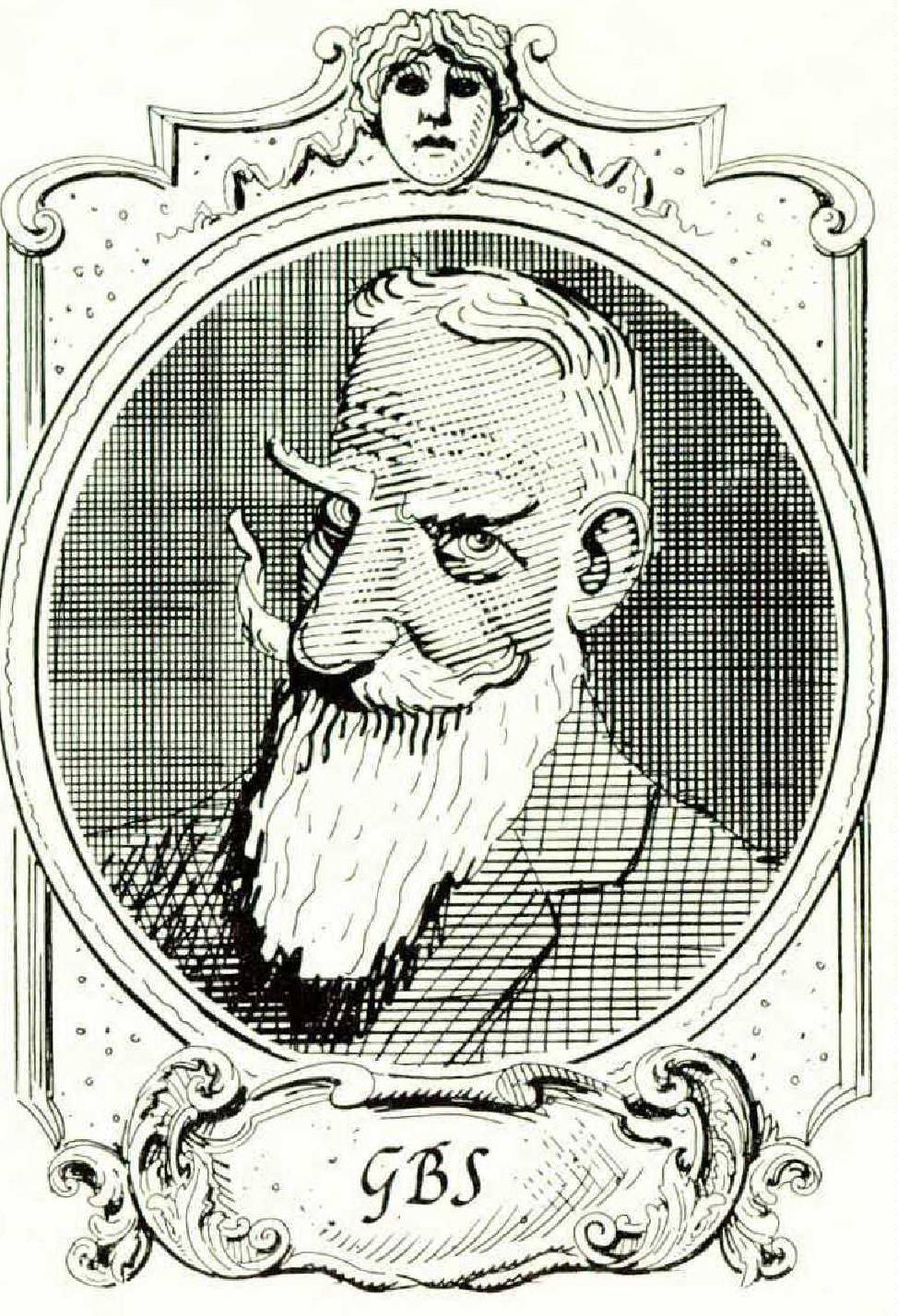
It is, of course, only comparatively late in this volume that Shaw the dramaturge emerges. His early plays failed not because they were unintelligible but because they were all too intelligible in their nagging at aspects of the human condition—slum landlordism, prostitution, the folly of war, and above all the hypocrisy of the middle class. He swore to abandon the theater but, to the glory of the stage, did not. The Devil’s Disciple did well in the United States and permits this volume to close with a more than philosophical optimism. At the close, too, Shaw gets married seemingly in a fit of absentmindedness—that, of course, is GBS talking.
This is an admirable biography— terse, witty, very informative. I am puzzled by only one thing. The Shelley Society put on The Cenci in Islington in 1892, and Holroyd depicts Robert Browning as having been present. But Browning died in 1889. Perhaps this evidence of posthumous life is fitting in a book on a man who refuses to die. Shaw was in a Disney film and on the sleeve of the first record of My Fair Lady. Instantly recognizable in dress, features, and brogue, he is always with us. How much we owe to him this first volume already makes clear.