Footprints of the Hapsburgs: Tracing Love and Empire in Vienna, Prague, and Budapest
WHAT WITH ALL the recent astonishments in Eastern Europe, Prague and Budapest have leaped to the top of the curiosity list for travel. My wife and I visited them and Vienna—the three old capitals of the Hapsburg empire—last summer, just as the Iron Curtain was beginning to clank aloft. We had one purpose that went beyond recreation: to locate and visit a branch of my family, once rooted in the Austro-Hungarian Empire, a few flowers of which were rumored still to survive despite war and change. We did indeed find them and rejoice. But we also found, among the first stirrings of renewed political liberty, stronger traces of the old order than we might have expected. Perhaps it was the nature of the old order itself to be essentially disorderly. In his recent Vanished Empire, Stephen Brook noted that Robert Musil wrote, in his classic The Man Without Qualities, “This is what happened to the Austrian and Hungarian Austro-Hungarian Dual Monarchy: it perished of its own unutterability.” Musil also wrote, “Finally there was nothing left of [it] but oppressed minorities and a supreme circle of persons who were the actual oppressors and who regarded themselves as being outrageously hoaxed and pestered by the oppressed.” Who says history has no sense of humor?
The series of republican entities, whether Western or Eastern style, that replaced the old Gemütlichkeit and Schlamperei (rough translation: “charm” and “laziness”) have still, after seventy years, failed to extirpate the attitudes of the past, and as the Red order crumbles, we can expect to see those habits sprouting again. After the past forty years of monolithism, they may even look desirable.
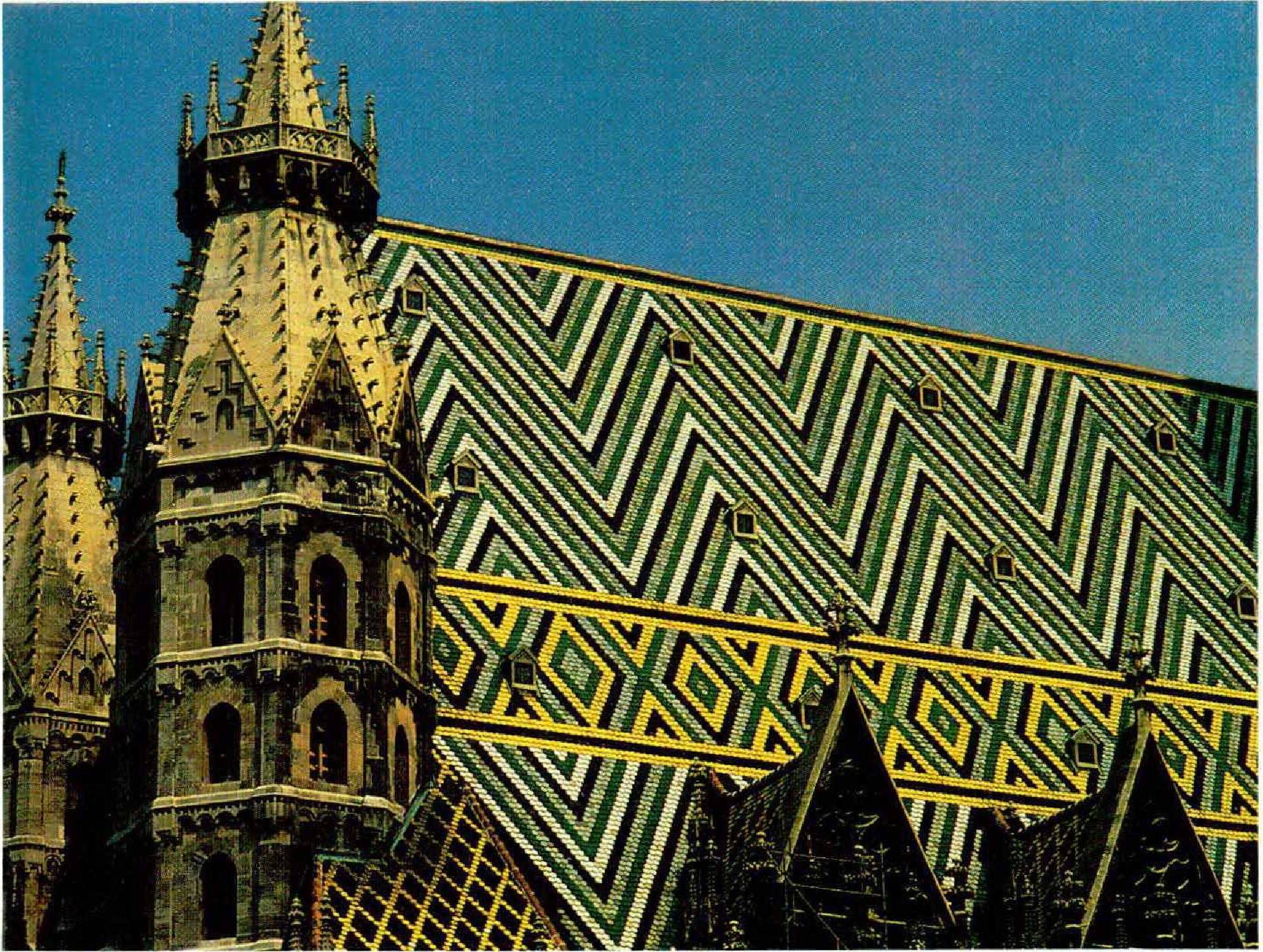
We began our three-nation journey on the Kärtner Strasse and Graben in Vienna, those great pedestrian shopping streets near St. Stephen’s Cathedral which on any sunny Sunday come alive with strollers of all ages, genders, dispositions, and, apparently, nationalities. Middle Eastern women swathed in black mingle with slender Austrian Mädeln in microskirts; portly burghers with jackets over their shoulders walk leashed sheepdogs wearing bamboo muzzles. The streets are dotted with cafés and small outdoor restaurants. Every twenty yards a student plays a violin, or an apparently impoverished Balkan a harp or accordion. Underfoot—almost literally—pigeons scrounge, for Vienna has many crumbs to spare. Sunday wanderings take one into the Stadtpark, where an orchestra plays Strauss waltzes in a weekly ritual under the shelter of a café’s vine-covered arbor, the leader, like Johann Strauss himself, conducting with his fiddle bow—in his shirtsleeves, on a hot day like this one. Around him a sizable crowd of Viennese ladies of all ages, ranging from the dowdy to the dangerous, sit at tables in the open air devouring whipped-cream pastries and applauding every repetition of “Wiener Blut” or “An der schönen, blauen Donau.” At night we repaired to the Hotel Kaiserin Elisabeth, near St. Stephen’s, a place that once accommodated Richard Wagner, who had excellent taste in hotels.
Among the public benefactions— though they were strictly involuntary—made by the Austro-Hungarian Empire on its demise were the vast residences of the Hapsburg royal family and its aristocratic hangers-on: the Hofburg, the Schonbrunn Palace, and the Schwarzenberg Palace, among others. Part of the Schwarzenberg Palace, hidden on a rise just behind an enormous red-marble monument to the bravery of the Soviet army that liberated (and brutalized) Vienna in 1945, has been made over as an extremely grand hotel, in the Relais & Chateau family. We reserved a table to dine there, at the edge of the gardens, enjambed with floodlit baroque statues of Sabine women being ravished in frozen semiprotest. The long avenues of the garden wafted the scent of roses toward our table, where, sheltered from our neighbors by greenery and summoning up every schilling we could spare (about half a week’s pay), my wife and I treated ourselves to a magnificent seven-course dégustation with first-class Austrian wines.
Another day we were able to get off-season tickets to the Staatsoper for The Magic Flute, performed by the Vienna Volksoper. It proved altogether charming: excellent orchestral playing, good singing in the principal roles, masses of splendiferous scenery and costumes, and a menagerie of ostentatiously unthreatening lions, dragons, and zebras, all prepared to turn to Jell-O at the soothing tones of Tamino’s flute. Although Mozart is international, and Die Zauberflöte immortal, I couldn’t help reflecting, as the sweetly absurd plot unfolded, that the conflict between love and authority ranks as an enduring obsession of Central European opera. Later, as we strolled through Vienna’s eminently walkable streets, looming with the vast ornate palaces and offices of deserted empire, the squares chockablock with overblown equestrian statues in the manner of Saul Steinberg, we could feel a little like the lovers in The Magic Flute, unable to tell from scene to scene whether the Authority that ruled their fates was benign or evil.
After a few days in Vienna, having anticipated that our appetites for opera, shopping, and architecture (Baroque, Biedermeier, Jugendstil, or Sezession) might be sated, we took refuge in a country hotel on the Danube amid the Wachau vineyards. Our choice of the Hotel Schloss Dürnstein, which ties an hour’s drive northwest of Vienna, was appropriate. The tiny village of Dürnstein hangs out over a great curve in the Danube, the view of which must have soothed Richard the Lionhearted, who was held captive there in 1192-1193. Below our windows the main artery of Central Europe, highway for the ancient Romans, the Hapsburgs, and the Socialist Soviet Republics, throbbed with Bulgarian and Soviet tugs churning barges of oil, coal, and timber up the river toward Regensburg and Passau, and with tourist steamers of all sizes and nationalities. Alongside much of the Austrian Danube runs a paved bicycle path down which singleton speedsters, stately family parties, and groups of corpulent puffers pedal on bicycles that may be rented at one railway station and left at another. The need for refreshment is easy to satisfy in the Heurigen, or vineyard oases, that crop up every few hundred yards. To sit outdoors on a summer afternoon under a roof of vines, with bunches of unharvested grapes hanging overhead, and sip the delicate wine from the barrels of the most recent harvest—das ist sicker Gemütlichkeit. Who cares if the next leg of the journey seems a little dazed and wobbly?
If the vineyards had changed little since the days of Franz Josef, our quarters in the Hotel Schloss Dürnstein might have been designed for him. The Furstenzimmcr (“Princes’ Room”) had gold faucets and a heated tile floor in the bathroom, and the room itself, lavishly arrayed with period furniture, could have served as a junior-high basketball court, even allowing for the Baroque sculpture mounted on the wails, if only the eight-by-ten-foot bed had been removed. Meals—very large and elaborate, with game as varied as Franz Ferdinand might have shot—were served on outdoor terraces overlooking the Danube. Of course, we faced daunting moral choices: sit still and gain weight, or swim in the pool and walk and bicycle and gain less weight. We ignored such choices and drove, taking the Hapsburg way out, to visit the churches and castles along the river, most remarkable among them the vast Baroque Benedictine abbey at Melk, celebrating its nine-hundredth year of existence with a dazzling renovation in gold, copper, and silver, replete with angelic trumpeters and the acrobatic stunts of innumerable putti.
MY YOUNG SLOVAKIAN cousin, Rudolf, drove us from Vienna in his German company car past the barbed-wire frontier between Austria and Czechoslovakia into the titanic industrial and sports complexes of Bratislava, the brutish capital city of Slovakia—an imperial province that belonged successively to the Hungarian nation, the Austro-Hungarian Empire, and Czechoslovakia. When the Germans overran Czechoslovakia, Slovakia became in effect a puppet state, and the Germans mounted part of their Polish invasion from Slovakian soil. After Hitler, it returned to Czechoslovakia, though the inhabitants spoke Slovakian as their first language and in due course found it convenient to adopt Russian, rather than German or Hungarian, as their third—after Czech, of course. This is rather confusing. Slovaks generally understand Czech, Czechs generally understand Slovak. I neither spoke nor understood either—only the apparently outmoded German of the Hapsburgs.
My grandfather’s place of origin (my grandfather spoke German and Hungarian before he emigrated to America) was Trenčín, a small city lying near the Slovak-Moravian border. To reach it we drove for a couple of hours through collective farmland, planted in large acreages of corn and sunflowers, mostly for oil. There were no villages or villagers, only occasional towns, surrounded by borders of garden plots. Nearly every substantial hilltop, it seemed, held an old castle, from which Hungarian nobles had oppressed the lowland Slovakian peasants. Now weekend cottages were creeping up the hillsides toward the ruined castles, a few of which were being transformed into tourist hotels.
Three of my grandfather’s five brothers left Austria-Hungary in the 1860s and 1870s to avoid conscription, and of all the brothers’ eight children only one, whom I had heard spoken of as Erszi, lived out her days in Slovakia. There during her lifetime (1898-1987) she experienced an alarming diversity of regime, plus a change of faith from Judaism to Catholicism, which saved her life and the lives of her two children. All her other local relatives perished in the Holocaust. One of her children, now sixty and a surgeon like his father, remains in Trenčín; the other, also a doctor, went west, to Switzerland, and until recently was not allowed to return. The Trenčín doctor’s family lives comfortably and well, and it was a delight to try to reconstruct the past in our different Germans; but to look at the town that had loomed so large in the legends of my early childhood made me tearful. Founded by the Romans, towered over by a medieval castle, surrounded today, like Bratislava and Prague, by a high, sterile hedge of tombstone-like housing developments, the old town looked dreadfully shabby.
I was especially touched by the emptiness of the synagogue, which has not been able to muster a minyan since 1945 and is now used as a civic display space. The Jews are gone from nearly everywhere: in all Czechoslovakia there are only perhaps 5,000; in Vienna, which held 200,000 Jews before the war, there are fewer than 15,000. Hungary, except for Budapest, is virtually empty of Jews. Treňcín no longer resembles the charming market town I had seen in old family photo albums, which I had brought with me. My relatives were fascinated by what I could tell them of those parts of the past which history had stolen from them; I could tell them more about their kin than they had heard for some twenty years. I was fascinated by their present, and even more by what we could already see of the changes that lay in their future.
Young Rudolf drove us on to Prague, through the hills of Slovakia, the rolling country of Moravia, across the battlefield of Austerlitz, through the shabby suburbs of Brno—where we stopped for a quick view of Mies Van der Rohe’s classic Tugendhat house (1950), now refurbished as a place of official entertainment for the mayor— and on through beautiful country, and crowded highways, into the metropolis of Prague. Our hotel, the Alcron, lay just off the vast spaces of Wenceslas Square and seemed to be full of apparatchiks in ill-fitting pinstripe suits, except late at night, when a cluster of sinister ladies sat at tables by the elevators, waiting to be offered a nightcap. Wenceslas Square was empty—no vast demonstrations yet. The most recent small one had resulted in the arrests of a group of Hungarian students, with whom we would later share a plane to Budapest.
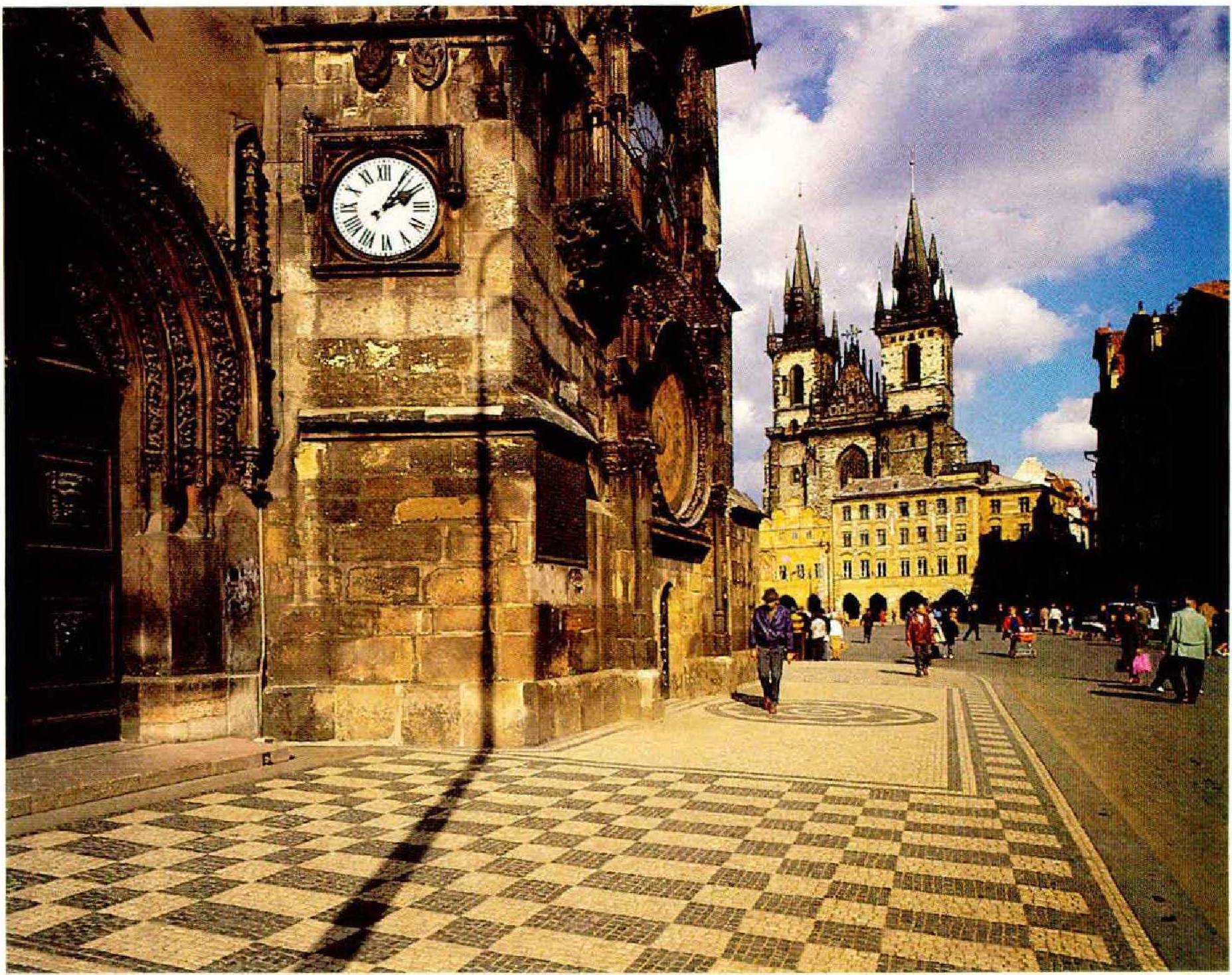
It was, rather, Old Town Square, where the Jan Hus monument stands, that caught my eye: it ranks with Piazza San Marco, in Venice, among the most beautiful public spaces in Europe. Neither received any war damage, and both have something of the air of a movie set. The square’s medieval surfaces look spanking clean, suspiciously bright. The movie atmosphere pervades the city: Rudolf, who works in the Slovakian film business, showed us a French costume drama being shot on location and, as we walked around the city, pointed out one place after another that had lent itself to period movies: Turgenev’s Torrents of Spring here, Shaffer’s Amadeus there . . .

Another side to the city was revealed to us by Eda Kriseova, a charming writer who is the author of half a dozen samizdat books. Over lunch she told me her history: as a journalist in 1968, she was suddenly and without explanation deprived of her work and turned into a nonperson, like so many writers and artists who have been tending boilers and sweeping corridors for the past twenty years. She led me and my wife through the streets of the nearly abandoned ghetto, where several synagogues, one dating back to the ninth century, have been agglomerated into a Jewish museum neighborhood, including the old Jewish cemetery where the creator of the Golem, Rabbi Löw, is buried. During her girlhood Eda Kriseova used to live in a home overlooking it, and when lovers stole into the forbidden cemetery, she learned much about life from her drawing-room window. The ghetto is beautiful but lifeless: it might in its remoteness be a monument to the Phoenicians. Only in one building, where the heartbreaking drawings and writings of Jewish children from the concentration camp at Terezín are displayed, does life linger on. Prague is a haunted city, as its denizens have always understood, from the Hapsburg Emperor Rudolf II, patron of the astronomer Tycho Brahe, to the martyred Jan Masaryk and the Jew Franz Kafka. At the première, in Prague, of Don Giovanni in 1787 the citizens cheered the statue of the Commendatore when it swept the wicked Don off to dine with it in hell.
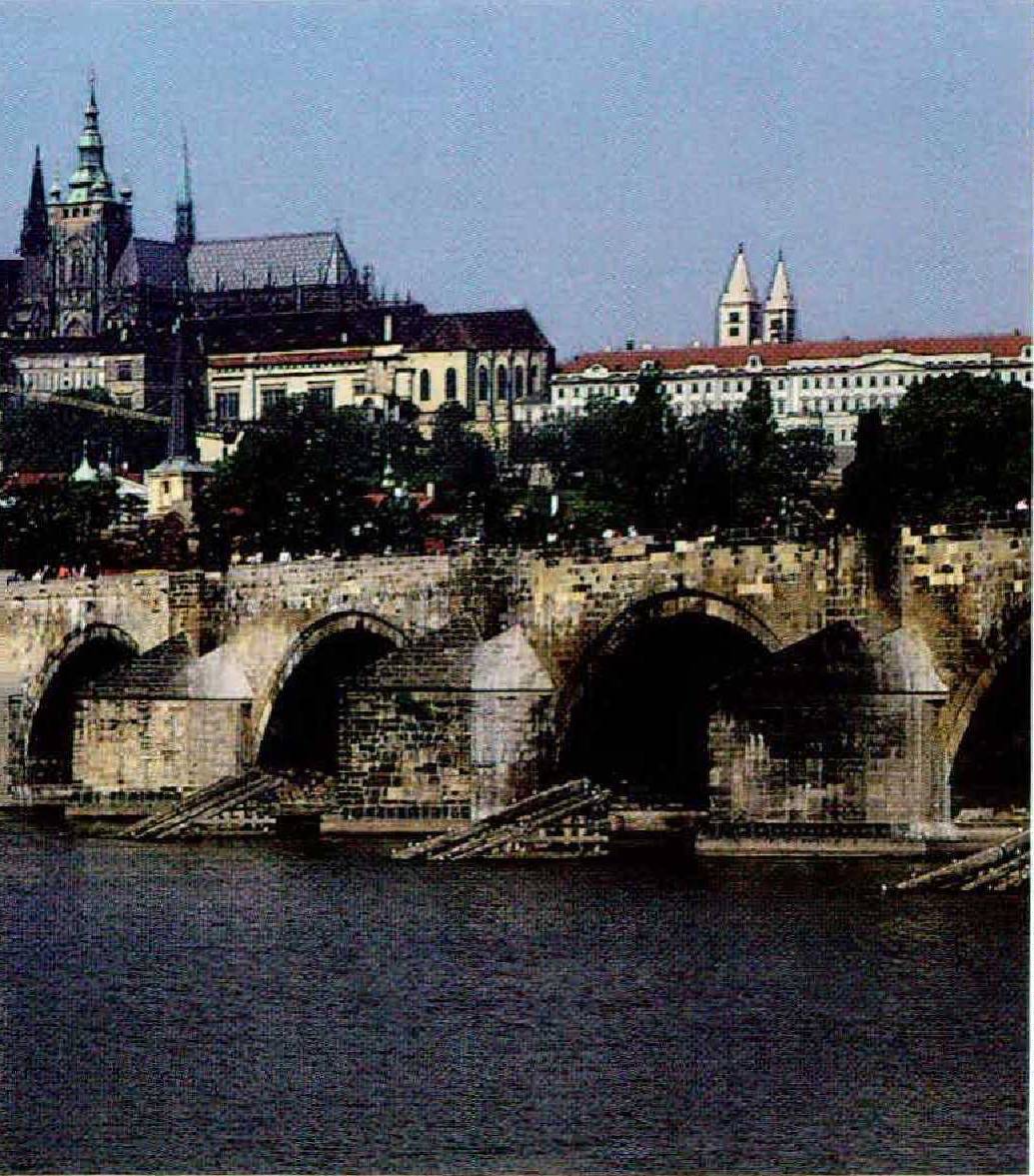
Floating atop one of Prague’s hills, like Noah’s Ark, the Hradčany Castle has harbored every ruler of the city for a thousand years—Hapsburg, Republican, Communist, coalitionist. Its earliest underpinnings are Roman and Romanesque; its more recent buildings, erected during the republic, were designed with slanted windows, gilded balls, and parodic pedestals by a zany Slovenian architect named Plečnik. At the castle’s center stands the soaring Cathedral of Sr. Vitus. It could never in its heyday of worship have entertained so many of the devout as it now compacts: worshippers of tourism, elbow to elbow—Japanese, East Germans, West Germans, Americans, Italians. Choose your tour and listen: nobody can keep track. By its side, in a charming street, Vlata Ulicka, Franz Kafka lived for a while in a claustrophobic single room that lent him a narrow view into the tiny street and a vista down over the castle walls hundreds of feet to the bare ground. By Kafka’s time the Hapsburg opera had given way to surrealism. One need not be puzzled, looking at this residence, that his Castle radiates such vertiginous intimations of power. (Power has also exalted Eda Kriseova, to the castle. Since my Prague visit she has become a close adviser to President Vaclav Havel.)
We descended the lonely hill, in the rain, by winding cobblestone streets through one perfect square after another, threading our way past the embassies, while the exquisite spaces between them awaited their turns to be movie sets. Finally we reached the River Vltava and crossed the Charles Bridge, which that summer entertained nightly groups of speakers and singers mouthing furtive anti-government sentiments, and which linked the unsteady pinnacles of power above with the deserted squares of the Old Town on the other side. Today the Charles Bridge can be crossed with pride.
OUR PLANE WAS met in Budapest by a longtime Hungarian friend who took us on a thorough tour of the city, from the crowded metropolitan sprawl of Pest to the hilly medieval tourisms of Buda; from the intricate spires of the nineteenth-century neoGothic Parliament Building (bigger than those of Westminster), Hungary’s monument to its quasi-independence from the Viennese Hapsburgs, to the walls of the numerous hydrotherapeutic baths of the city; from Heroes’ Square, near where the Stalin statue was toppled in 1956 (and the Lenin statue was recently removed “for repairs”), to the monument, “revised” only two weeks prior to our arrival, honoring Raoul Wallenberg, the Swedish diplomat who rescued Hungarian Jews during the Second World War. “Revised” because in Budapest itself, almost alone in former Nazi territory a substantial Jewish population (estimates of it range from 35,000 to 100,000), synagogues, and a Jewish quarter still thrive, thanks to the actions of the Hungarian government and to military circumstances in 1944, when Soviet pincers severed the Nazi defenses before the Final Solution could be carried out in the capital, though the country-side had already been swept.
Last summer’s Budapest was vivid, alive, crowded, apparently prosperous, and vigorous indeed by comparison with Prague, though by Vienna’s standards still spartan, gray, and dreary. Western newspapers were accessible. In the restaurants the food was good; in the shops all sorts of folkloric artifacts were inexpensively for sale; in the streets samples of lace and embroidery were held up hopefully by rows of peasant men and women— including some Vietnamese!—while twenty feet away the restless teenagers of Budapest lined up, hundreds strong, to await their turn in the Adidas outlet.
Footwork in Budapest is tiring, for the distances are great. My wife and I, weary indeed, managed to gain entry to the public baths adjacent to the Hotel Gellért, on the Buda side, where we lolled for half an hour in the thermal-radioactive waters, one temperature in one room, another in another, among huge crowds of families, and found the experience startlingly refreshing—just as the Romans had two millennia before. In our hotel, the Astoria, a Zigeuner orchestra obliged the diners with gypsy violin, zither, and clarinet, while we in the café nibbled the obligatory dobostorta and sipped Tokaj.
Unlike Prague, Budapest hummed with optimism; unlike Vienna, it seemed ripe for change. Our friend and his wife, entertaining us at dinner, seemed to possess every comfort that New Yorkers, even on vast salaries, cannot afford: a new car, a parking place, inexpensive and excellent public transportation, good jobs for both parents and flexible work time for the mother, a regular and dependable babysitter, a safe, affordable, and charming apartment in a building with an inner courtyard where children may be watched, and a place in the country only fifteen miles away. It was enough to make a yuppie gargle with envy. But they are still heirs of the Hapsburgs. When we told them of our visit to my relatives in Slovakia, they said, “But Treňcín is Hungarian!” As Claudio Magris writes in his Danube, “The Habsburg art of government does not stifle dissidence or overcome contradictions, but covers and composes them in an ever-provisional equilibrium, allowing them substantially to go on as they are and, if anything, playing them off against one another.”
We traveled back to Vienna on the Danube hydrofoil, a restful and visually stimulating five-and-a-half-hour trip through Hungary and along the Hungarian borders of Czechoslovakia, passing river towns like Szentendre, Vác, Esztergom. Not until then did we begin to understand how the power of the river rendered fragile all Austro-Hungarian borders. At Györ we passed one of the Roman borders where Marcus Aurelius wrote his Meditations. And as we wound our way through the river traffic that plies the yellow waters, passing deep forest on both banks, we felt the weight of ancient national rivalries more and more heavily, until we finally reached the Austrian border, beyond Bratislava, and could see along the riverbank at hundred-yard intervals the familiarity of cozy shacks and lodges where Austrian countrymen come to fish in the river or shoot its migrating ducks. Somehow we had left behind us the conflicts of race and policy, of doctrine and nationalism, of democracy and dictatorship, of East and West. We had departed from the absolutist realm of empire and reentered the more comfortable confines of love. The Hapsburgs, after all, achieved their conquests not in war but by marriage.