Tan
WHEN I WAS a little kid. of course, I was brown all summer. That’s because I was free as a bird—nothing to do but catch bugs all day—and didn’t care what color I was. Whatever didn’t wash off handily at night was the tone I took.
Puberty ended all that. As we know, puberty alienates the skin from the mind and both skin and mind from the young person involved. If I had it to do over, I would go through puberty again, but I would do it where no one could see me.
Spring vacation when I was fourteen I traveled sourly with my parents—the last people anyone would choose to go through puberty with—to Daytona, Florida. On the beach I met a strange girl named Lu, from Racine, Wisconsin. She spelled it out for me in a provocative tone of voice: L-U. I had never met anyone named Lu or from Wisconsin, and I had certainly never met a girl who was cute by popular standards (by any standards—her hair was bouncy and the color of lightly buttered toast) and yet would be the one who approached me on the beach because she saw me reading an anthology of stories of horror and the macabre. There must have been something wrong with a girl who had perky but full lips and also admired the stories of H. P. Lovecraft (“The Call of Cthulhu,” “The Rats in the Walls”), but to my way of thinking at the time, borderline schizophrenia was the only thing that seemed to pull everything together. When I met her there on the beach she was more or less my color. I turned my back for a moment, and when I looked again she was already butterscotch.
I didn’t want Lu to sink deeper and deeper into sepia without me. And, hey, I was only a couple of years removed from brown boyhood. So I abandoned myself to the sun. Chuckled when Lu wondered, in a provocative tone of voice, whether I wasn’t rushing it. Did take certain precautions, like keeping my arms akimbo so as not to run the risk of white stripes down the sides.
The next morning I woke up (to use a word that often appeared in stories of horror and the macabre) eldritch: a pulsing salmon-pink, with tiny white blisters all over. Since my first instinct at that time was to be ashamed of being seen in any condition, I was not about to return to the beach, even for Lu, especially for Lu, looking like I’d been covered in garish chintz.
Lu surely found other fish to fry— her father was a big dairy magnate, she refused to eat ice cream for that reason, and she had been to seven high schools. When I got back to my school, my new color had nearly all scaled away. What traces remained did not move anyone to ask me, “Mmm, where’d you get all that tan?” However, a naturally platinum-haired senior majorette, whom I had never had any pretensions to being on the same level of reality with, stopped me in the hall. “Who do you go to?” she said.
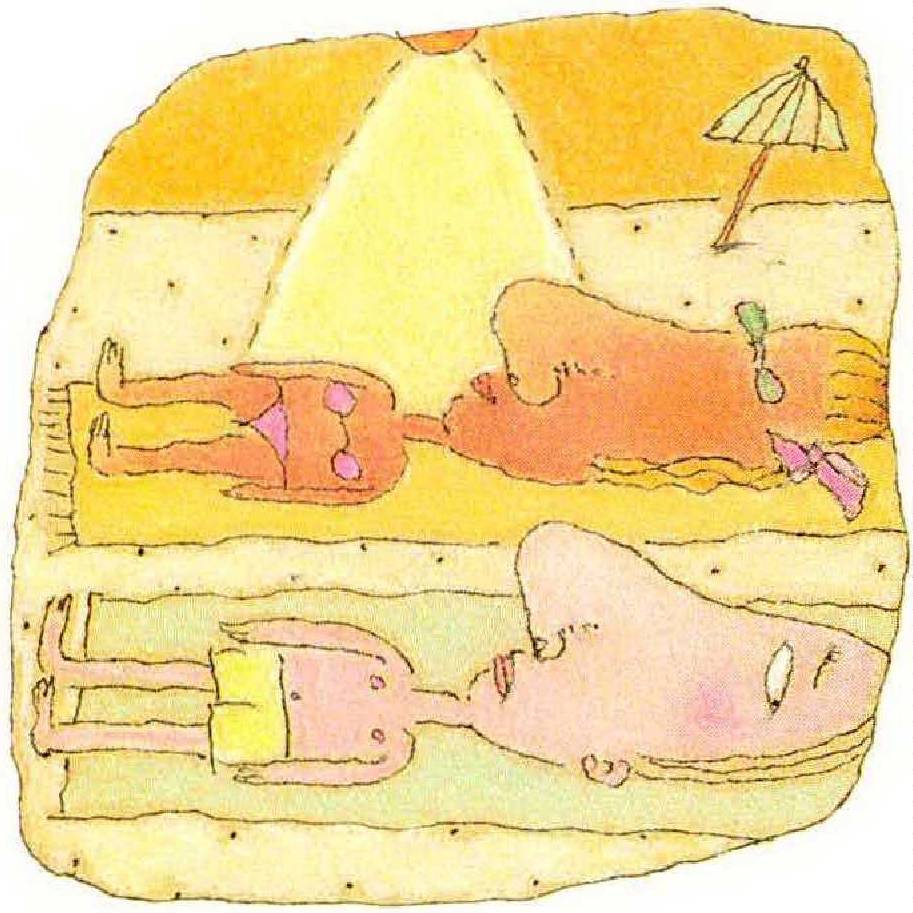
For a wild moment I thought she had said, “Who do you go with?”I was astounded to find that physically I was larger than she. I said, “Whuph?”
“Your dermatologist,” she said. She thought I had been undergoing dry-ice treatments.
Officially my complexion is “ruddy.” It says so on my draft card, which was issued in October of 1959. In the fall and winter months, when other Caucasians tend toward the peaked, I look healthy, at least by 11 A.M. But often in the summer, by comparison with more seasonal people, I pale. And showing my draft card does no good. In summer, sometimes, my draft card looks tan next to me.
IT WOULD BE one thing if I were a roofer, but the kind of work I do— this, for instance—doesn’t get me out into the sun regularly. I travel, type, talk. On a given Fourth of July I may have Juned where it isn’t sunny, as in departure lounges. I may have spent June losing a tan of some interest.
The last real tan I had was one March. I got it in Africa, riding camels. A camel-riding tan is an honest tan, especially if it has been achieved despite eighteen-power sunblock.
Sunblock is a great invention for people who want to make it clear that their purpose in life is nothing so superficial as getting tan. If you happen to get tan while putting all your effort into (a) learning to imitate the cry of a camel (an amalgam of moose gargling diesel fuel, club member being goosed by steward, and outboard motor in tooshallow water) and (b) not getting burned so badly that you end up looking stranger than the camel, then fine. If someone, say a senior majorette, should ask you where you got such a tan, you can say, “Hm? Oh, let’s see. Zanzibar?” Getting tan has not been your pursuit.
However. A cool, incidental tan may well be a head, arms, and knee-to-ankle tan—which should be enough for decent people, but then you turn up in a bathing suit somewhere and you look like one of those 1940s shoes. In fact, your tan may begin halfway down your forehead, because you have been wearing a practical hat, a hat appropriate to camel-riding, say.
There are only so many things you can do as an adult in a bathing suit. In fact, there is only one thing you can do in a bathing suit without being largely covered, like the earth itself, by water. That one thing is sunning.
I hate to be just . . . sunning. Sunned against is more like it. Lying smeared with lotion on sand in the hot sun is like being rolled in cornmeal and dropped into a hot pan of Crisco, only less dramatic. “Soaking up the rays,” sunners call it. I would rather soak up gravy, thereby replenishing, not depleting, the body’s essential oils. (I say that, but of course I’ve had to lose my innocence about gravy, had to learn the malignity of it, as we all have, in these health-conscious times. We have to live more naturally and wholesomely. We have to stop eating the things we love.)
One spring in my late twenties I was in Florida, covering the baseball training camps. I was new to sportswriting and hadn’t made many sporting friends or started to drink much yet. I was in Florida for a month, and I had to do something. For some reason I decided to take another shot at tanning. I applied myself systematically. Anointed my limbs. Held to a schedule. Within a week I possessed, for the first time since the age of twelve, a good, deep, hamburger-bun glow over every mentionable part.
A consummation, but also a responsibility. It isn’t easy to cover spring training and maintain your tan, too, what with the games being played in prime sunning time. Driving to ballparks, I would roll my left sleeve up awkwardly high and hold my arm and shoulder out the car window at various angles, to catch the sun all around. The police pulled me over and accused me of giving intentionally farcical hand signals. I didn’t care. I got so transcolored after a while that in the light of my motel bathroom I was orange. After that nothing was enough.
I developed new fears. One day I went to Flamingo, Florida, in the Everglades, and sat on a dock watching pelicans and eating a po’ boy sandwich. Observing. Getting outside myself. Pelicans are like snowflakes, in that no two of them are alike. But no given pelican is like any snowflake either.
Suddenly a blackbird, which I hadn’t been watching, swooped down and literally grabbed my sandwich from my hand, with his feet.
The po’ boy was too heavy for him to fly very high with, so I ran after him a few steps and grabbed it back, scarcely damaged. I had paid eighty-five cents for it, which would be a couple of dollars today. I liked it. I was still hungry. Ignoring the blackbird’s cries, I started eating the po’ boy again.
But then I began to worry. I might catch some kind of rare tropical disease from a south Florida blackbird’s feet. Who knew what the symptoms might be? What if my tan fell off?
My last day in Florida, I overbaked. I turned a peculiar, sizzling shade of rust. I sat in my hotel room fascinated by the color of my own stomach. What had I become? Fiery chills ran through my thighs. At length I slept, and tossed, and dreamed that I had fallen off a speeding bicycle and was skidding over concrete.
But as I flew north, burnt sienna, I was under the impression that it had all been worth it. I went straight from airport to office.
No one said anything. I dropped hints. No one took them.
Finally I worked my tan into an editorial conference. When someone said, “That’s a good line,” I sprang up, tore open my shirt, tugged at the top of my pants, and said, “Speaking of lines . . .”
There it was, visual proof. The line where my bathing suit had left off and the rich dark gold began.
Only no one seemed impressed, favorably. I looked down. The line was gone.
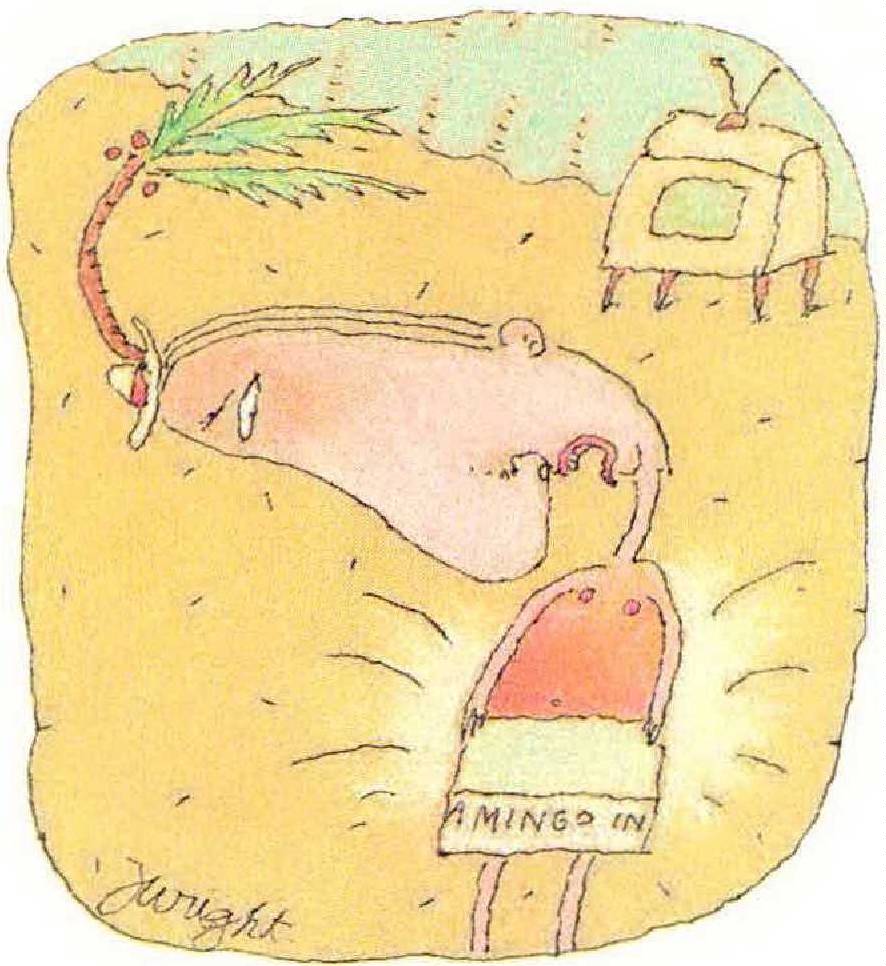
Airport x-ray machines, I now believe, neutralize tan in some cases.
“Oh,” someone said, grudgingly, at last. “You got a little color.”
You can “get a little color” drinking! Which is what I worked on that year as the spring gave way to summer. I found I had a knack for it. Years went by. Drinking is more active than sunning, and it makes you feel no worse in the morning than sunning does. And it recalls your innocence.
THE GIRLS THAT I caught bugs with back in the old days were so easy to talk to. No, not easy, fun. because that was when summer was summer, you were out of school, you didn’t have to do anything most of the time (back when time was time), tire pavement was hot but your feet were tough, and the air was sultry but you were out moving, creating a breeze, and you could treat yourself to an unhealthy soft drink of some kind and it would be sweet, refreshing, exactly what you wanted.
And the bugs were for the taking. Bumblebees to trap between jar lid and jar, roly-polies to roll up into hard gray BB-sized balls lined with little curled legs, lightning bugs to snatch in midflash and get that funny smell on your fingers, grasshoppers in your fist like vaguely pulsing stem-wads and then you’d open it and feel them ping off. You wouldn’t torment bugs, but you wouldn’t care how they felt, either; if they died, they died, the sun shone on them and you alike.
Drinking was like that to some extent. The way I did it. But it’s changed. Lately I have so many forms to fill out. And I don’t feel as fluid as I used to in my joints. My very children are borderline adults. And I need to take niggling conscious measures to shore up my everyday health. And I tend to wake up before I want to. And money is so much more of a consideration than it used to be. And I find drinking gets irksome. Who has time for it anymore? Not even reporters. A campaign-trail press veteran was quoted as saving of his new, young colleagues, “They don’t even drink at night.”
O temperance! O mores! You start thinking about why you are drinking, and how much of it you ought to be doing, and it gets to be too much like sunning. So I am drinking less and less, and the days get longer and the nights earlier, and I suppose as a matter of course I will be spending more time wholesomely in the sun.
The last remark surprises me. But it could well be true. On television I saw an international fashion model being interviewed. She looked a little hard, you know, but ravishing. She said tan was passé. What she was at pains to maintain now, she said, was just “a blush.” Which is what I have long maintained by way of natural embarrassment. Now, if tan has become unseemly, my life can be expected to adapt. I’ve noticed of a noon that I was outdoors mowing the lawn in nothing but athletic shorts. By the time I am elderly I may be back to running after bugs (Nabokov did it), brown as a berry. □