The Cava Jive: Spanish Sparkling Wines Aren't Beneath Consideration Just Because They're Not Champagne
THIS MONTH you will probably find yourself buying sparkling wine, either for your own party or for someone else’s. You may wonder whether to make a gesture with a French champagne or to spend less. You might very well buy a bottle of Spanish sparkling wine, which is usually less than $10. But you’ll feel sheepish, and probably try to hide your bottle behind anything French.
In fact Spanish sparkling wines are nothing to be ashamed of. They’re often delicious—simple, fresh wines that open an evening on a festive note. What you may have heard about their being well-made and worthy wines for the money is true. Complexity, profundity, and many of the other attributes that serious wine people demand must be reserved for a few French champagnes. But what do you really want from a champagne or a sparkling wine? Something that grows in depth with each sip, something to ponder? Or something that tastes good and refreshing, and not cloying? In most settings I prefer something brisk. Chances are that a Spanish sparkling wine will suit your purposes, too, and admirably.
ALTHOUGH THE when and where of the first manufacture of sparkling wine is disputed, the French refined the art. Most of the terminology used to describe it, including the word “champagne" itself, is French, and French champagnes set the standards by which sparkling wines are judged.
All Spanish sparkling wines exported to the United States are made by the classic, finicky champagne method, even though they’re not allowed to call themselves champagnes and soon enough won’t be able to boast of following the méthode champenoise. The Champagne region of France has successfully blocked any European Community maker of sparkling wines outside the rigidly defined French region from using the name, and by 1994 no outsider will be able to say more than that it follows the “traditional method.”Today Spanish sparkling wines made by the traditional method are called cava (“cellar”), a term in wide use only since 1960, when the French had their way with Spanish makers of sparkling wine. According to Colman Andrews, who wrote the authoritative Catalan Cuisine, some of those makers find cava an “undistinguished, nondescriptive, unromantic moniker,” but “nobody has yet come up with a better idea.”Italian wines made by the traditional method are identified as metodo classico or classimo, a newly coined term that similarly displeases many Italians and is perhaps justly close to classismo, which means “class consciousness.”
It takes not one but two fermentations to get bubbles into a wine (unless you simply add carbon dioxide, a method beneath contempt in the view of most wine makers). Every maker uses roughly the same method for the first fermentation, which usually lasts three or four months and takes place in big chilled stainlesssteel vats; yeasts are added to feed on the sugar in the juice and create most of the wine’s alcohol content, which is usually about 11 percent (the finished wine’s is about 12 percent).
Unlike most wine, sparkling wine is a blend of several grapes. In the case of champagne, the blend usually consists of chardonnay, pinot noir, and pinot meunier. Pinot noir and pinot meunier are red grapes; their skins, which give pigment and flavor to some wines, are removed before fermentation unless the wine is to be rose. Some sparkling wine is blanc de blancs, or made from white grapes only—for example, the delicate Salon le Mesnil, a very expensive and memorably refined champagne made from chardonnay alone.
The grapes of the Champagne region are what defenders of champagne say make it great. The region is so far north—Reims, its main city, is eighty miles northeast of Paris — that its grapes have an unpredictable and cool season in which to ripen; in some bad years they don’t ripen at all. The region’s still wine is of little interest alongside wines made from the same varieties in Burgundy, south of Champagne. But the uncertain sun means that the grapes are high in acidity and low in sugar, which ensures that their flavor will cut through the bubbles. The discovery and widespread adoption of the champagne method, in the sixteenth century (the method is frequently and wrongly attributed to the Benedictine monk Dom Perignon, who was nonetheless an innovative wine maker), was a lucky stroke for the region. Its wines became famous throughout Europe and especially in England, which to this day remains the largest buyer of champagne.
Because cava is made in sunny Spain, with grapes that are sufficiently high in acid but not as celebrated as pinot noir and chardonnay, detractors say that greatness Is beyond it. They don’t give one of the grapes, the parellada, the credit it deserves, or recognize that the Penedes region, just to the west of Barcelona, has several climates—one Mediterranean and balmy, yes, but a higher interior one, too, and even a mountainous one, below the dramatic white peaks of the Montserrat Massif.
There are three grape pressings; the first yields the premium juice and is used in high-priced sparkling wines. After the juice of the different grapes has gone through the first fermentation, each wine maker determines the composition of the blend he will continue with. This base mixture is called the cuvée or assemblage. After the addition of yeast, and sugar for the yeast to feed on (none remains from the first fermentation), the wine ferments in closed bottles. The bubbles form because the yeasts work anaerobically to produce carbon dioxide and alcohol. Most of their work is done after just a few weeks, but by law makers keep cava “on the yeast" for at least nine more months, and champagne at least twelve months, and they often choose to age the wine three to five years.
Autolysis, or the decomposition of dead yeast, deepens the flavor of the wine during this aging. The English like the flavors of autolysis, frequently described as “toasty.” For most people, though, including the French, who like fresh champagne, age isn’t necessarily a sign of quality. Vintage sparkling wine doesn’t necessarily mean quality either: in most sparkling wine the initial cuvée is made up of many wines, often from different years, and the wine is usually better if one year doesn’t predominate.
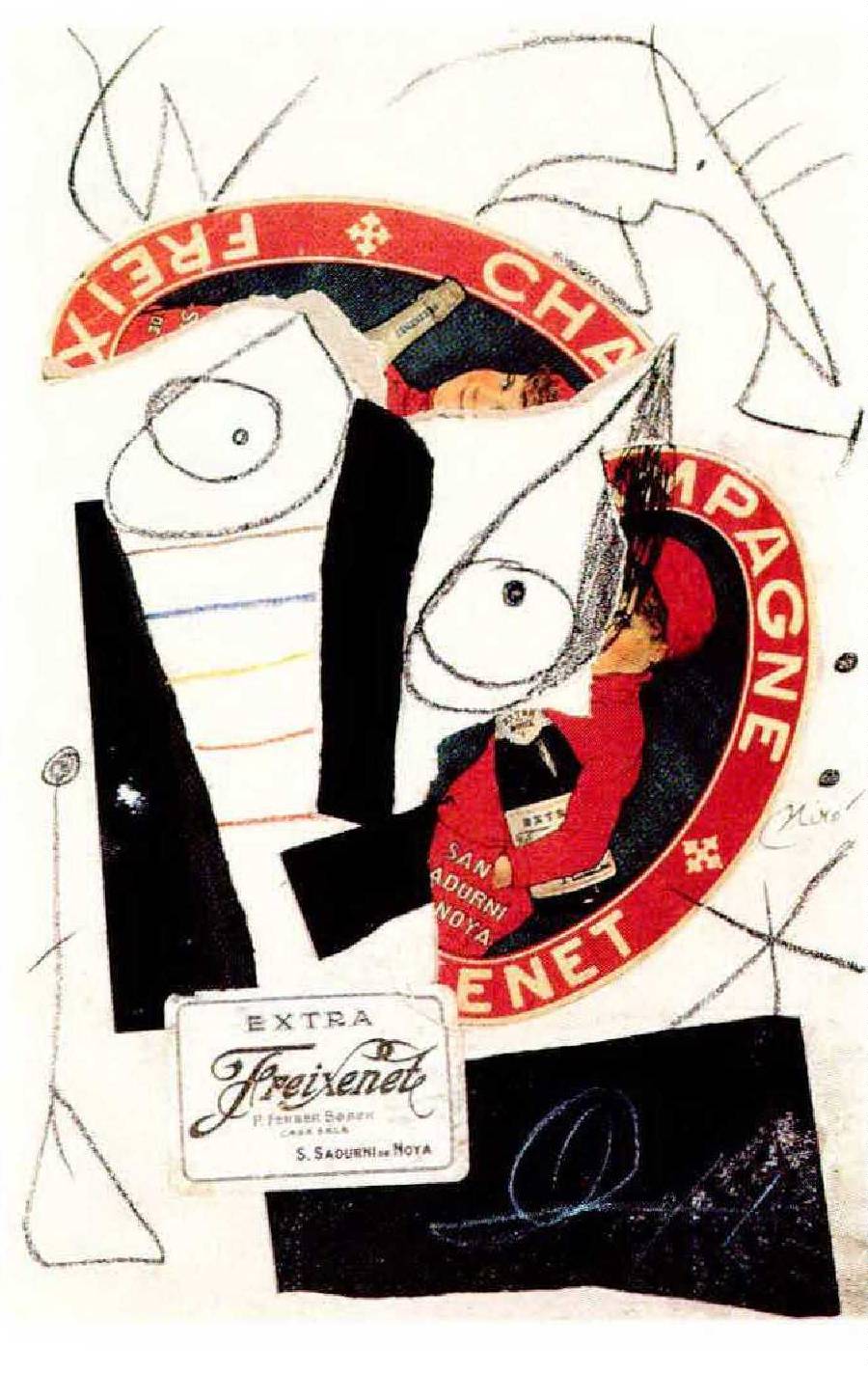
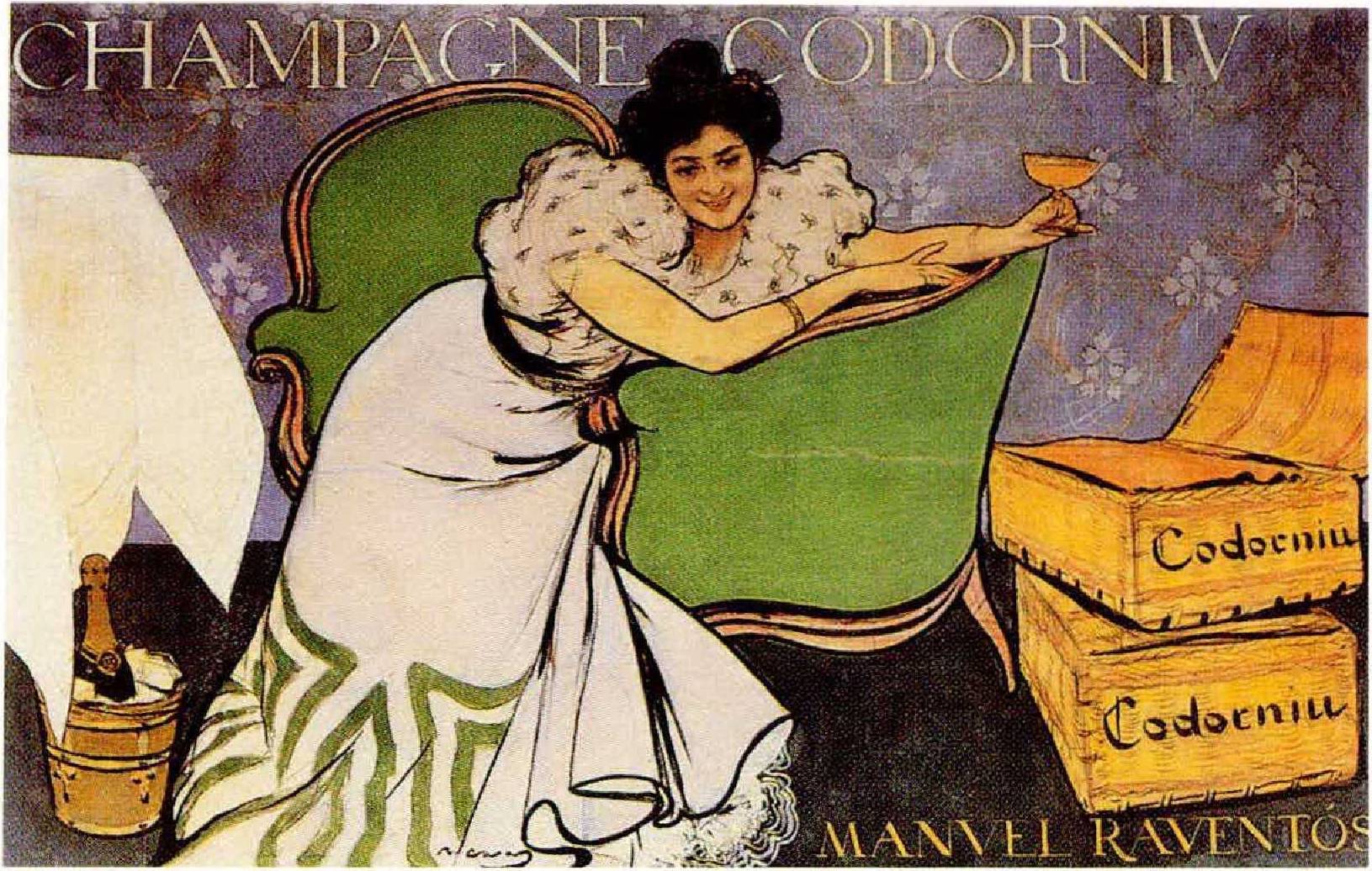
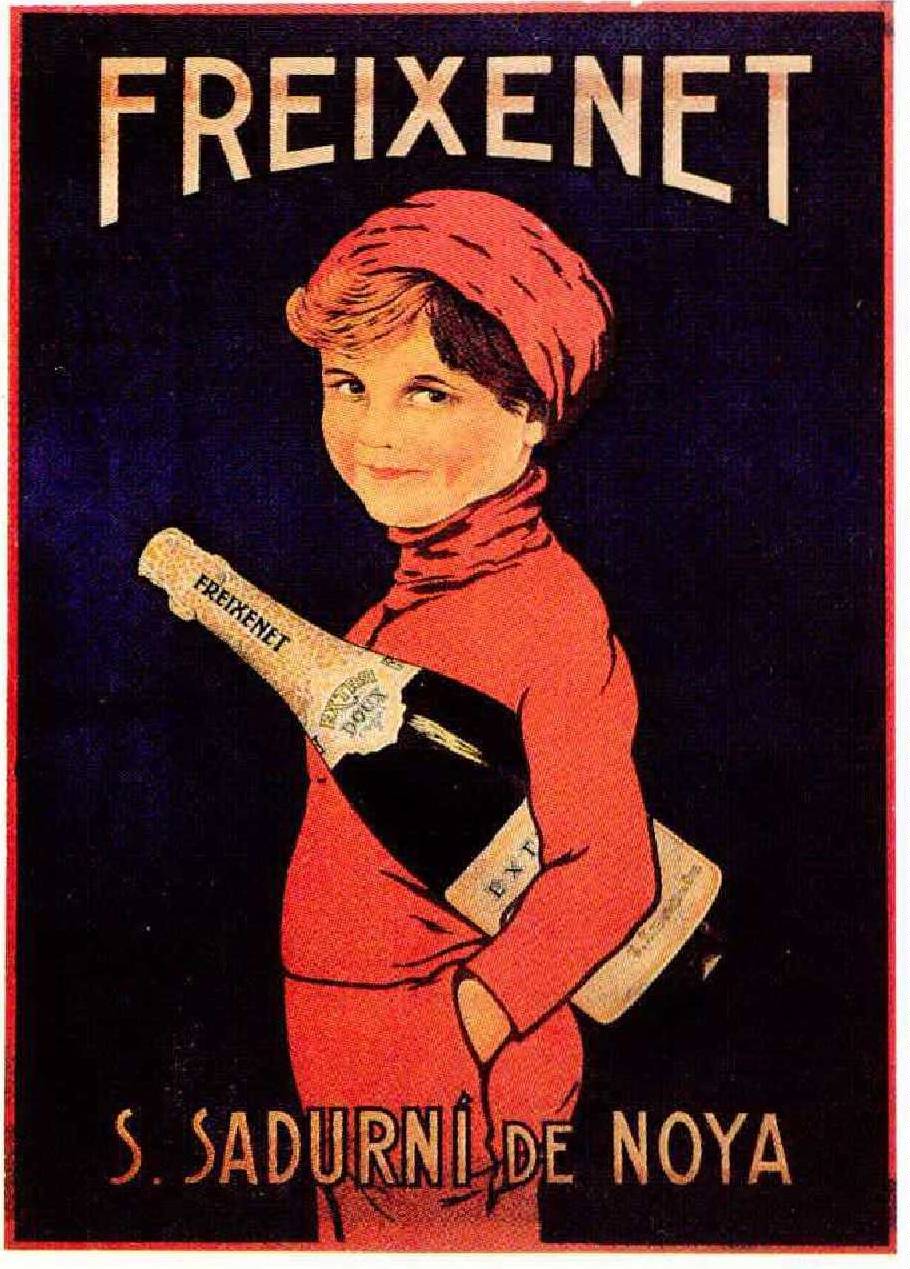
I HAVE TOURED two makers of sparkling wine, Ca’ del Bosco, a winery north of Milan that uses chardonnay and pinot noir grapes in its meticulously crafted, very good sparkling wines, and Freixenet (from a Catalan word meaning “ash grove” and pronounced “freshenette”), whose mattefinish black bottle for its Cordon Negro is by now very familiar. Freixenet and its rival Codorniu are the mighty cava makers in Sant Sadurni d’Anoia, a small town in the middle of the Penedes that lives, and lives very well, on cava. Each has at various times claimed to be the world’s largest maker of sparkling wine, and together the two account for at least 80 percent of the cava made in the Penedes. The sight of hundreds of thousands of bottles densely stacked in dark, unusually deep cellars (a stable cool temperature promotes good flavor and small bubbles) is impressive and a little scary.
But it’s fun to watch the next part of the process, called riddling. The dead yeast and other sediment must somehow be removed from the bottles. Riddling was invented, it is said, at the beginning of the nineteenth century, by the Veuve (Widow) Clicquot, when she took charge of her late husband’s champagne company. Instead of sticking bottles upside-down in sand, as was then traditional, she cut some holes in her kitchen table and stuck the bottles in them head down. (Like other quaint stories, this one is disputed.) She, or her associates, or somebody else, later angled the holes such that after rhree months of being daily administered a quick jerk—riddled—a bottle that started at a 45-degree angle would end up on its head, with all the sediment neatly collected in the neck. Today this step is much more often accomplished in ten days with a girasol (“sunflower”), a Catalonian invention that looks like a jungle gym with a pallet of bottles in the middle.
Ejecting the sediment is even more fun to watch. Workers used to uncork each bottle upside-down, let the sediment rush out for a second or two, and immediately right the bottle. This possibly dangerous procedure, which requires protective clothing (bottles break), is still followed for a very few wines, including Salon, more for reasons of cachet than of taste. But since the 1890s the standard procedure has been to immerse racks of upended bottles briefly in a shallow bath of freezing brine and then to flip them over. The metal “crown” caps—the kind on beer bottles—are removed, with a cacophonous explosion, and the frozen blocks of sediment are sucked out.
The biggest alteration in what is already the most manufactured of wines comes just before the cork goes in and the label is pasted on. A dosage, or final addition of sugar, wine, and liqueur, is added, and this determines not only which of the several gradations from “brut” to “sweet” the wine will be classified by but also much of its flavor. Wine makers who use the traditional method are determined to advertise the fact, however strained their terminology, because they don’t want anyone to suspect that they use the tank method (called cuve close or Charmat, after its inventor) for the second fermentation. This process is less dramatic, since it takes place in enormous closed vats rather than bottles. The wine is often considered inferior and without character. But Matt Kramer, the author of Making Sense of Wine, a lean and lucid book that delivers on the promise of its title, defends the process as appropriate to a highly flavored grape like the muscat. Muscat is used in the luscious Asti spumante, the Italian sparkling wine of the region around Asti, in the Piedmont. Asti and moscato d’Asti, an intensely fruity and much less bubbly version of Asti spumante, undergo just one fermentation, in order to preserve the sweetness of muscat grapes. The tank process is stuck with its low-rent reputation, Kramer explains, because it is associated with cheap mass production that starts with terrible grapes. Kramer has a “real passion" for moscato d’Asti and Asti, and he recommends Fontanafredda, Hera, and Felice Bonardi.
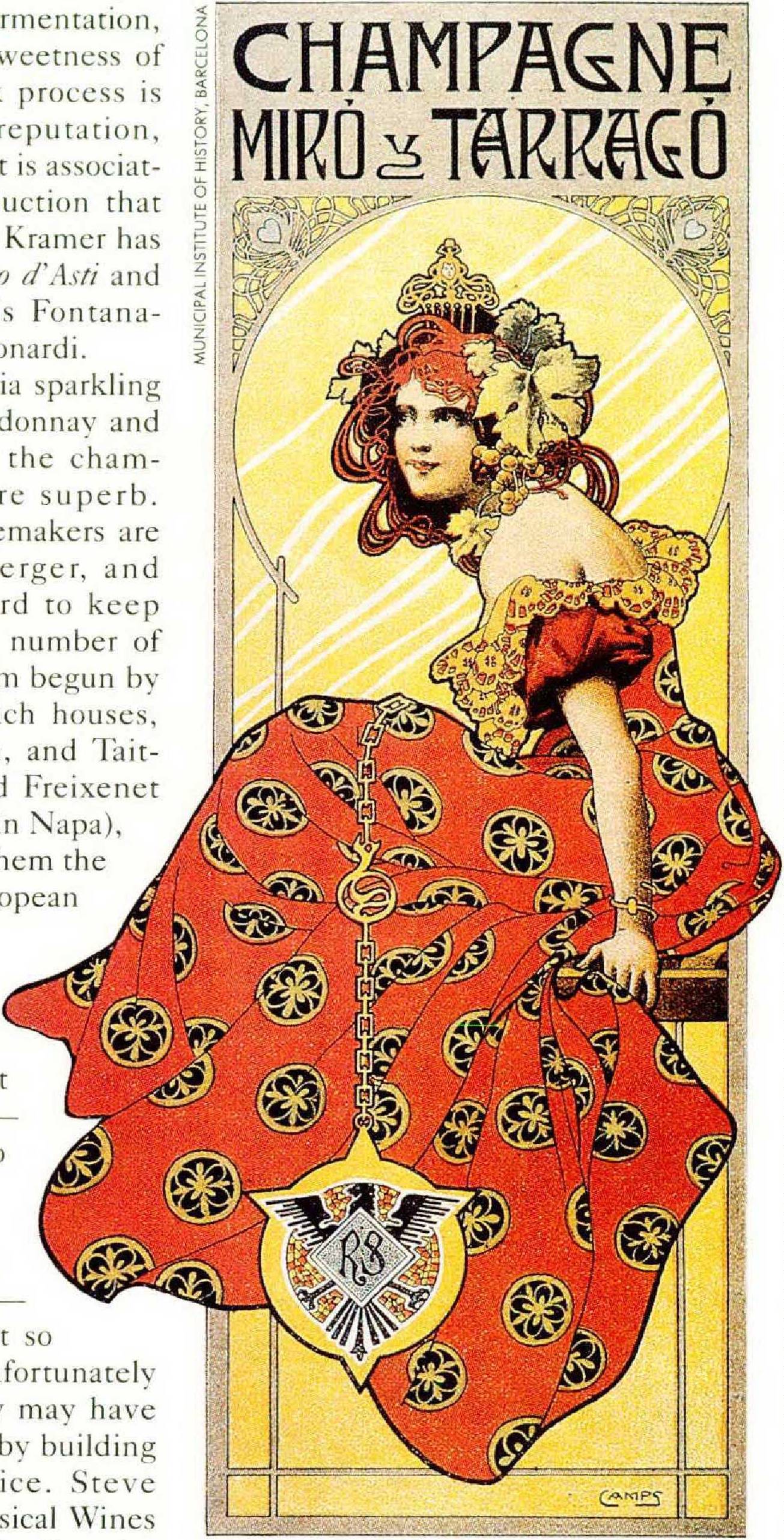
Many premium California sparkling wines are made from chardonnay and pinot noir grapes, using the champagne method. Some are superb. Three much-admired winemakers are Iron Horse, Scharffenberger, and Schramsberg. But it’s hard to keep track of the ever growing number of new wineries (many of them begun by the most prestigious French houses, such as Chandon, Mumm, and Taittinger; both Codorntu and Freixenet have also opened wineries in Napa), let alone to associate with them the same consistency that European makers have achieved.
CONSIDERING THE vast numbers of bottles of cava that Spain exports annually—1,400,000 cases last year to the United States alone, compared with just over a million cases of champagne shipped here from France— the surprising thing is that so much of it is so good. Unfortunately the Spanish wine industry may have painted itself into a corner by building its reputation on low price. Steve Metzler, the owner of Classical Wines from Spain, an importer in Seattle, says that small wine makers using parellada grapes grown in the highest vineyards make fine cavas that deserve attention, but they are unable to compete in a market that has defined itself as selling wines for under $10. He accuses the Spanish wine industry of promoting itself backward. The French industry, he points out, emphasizes its highest-quality wines over its much more plentiful inexpensive ones. “We have to sell a good wine at something less than its actual value,” he says, “A family estate has to make a higher profit margin than the big producers, but once you go beyond $5.99 a bottle, the market drops.”
As a result, most of the limited-pro-duction, expensive cavas from grapes grown at higher altitudes are not even exported. Reserva Heredad is, because it comes from the handsome estate of Segura Viudas, a winery owned by Freixenet. Reserva Heredad, the best cava I tasted in Spain, costs $20 a bottle in Barcelona, where much is made of its quality and its bottle, a revival of an eighteenth-century design with antiqued plastic medallions. When the wine is sold here, it often goes for as little as $10 a bottle, because its distributors know the public’s reluctance to pay more for a Spanish sparkling wine (you can call 212-888-3474 to find out where the wine is sold near you).
I was able in this country to find a number of the cavas that critics and wine merchants mention as improvements on what they consider the undistinguished lines of the large producers. With the exception of Lembey Brut, I didn’t like any of them. Wine makers beef up the final dosage with chardonnay, brandy, or any flavor they like; dosage can be the finishing touch that makes a good wine excellent, but it can also be a crude way to flavor a sparkling wine and impose on it a house style. (In any grade sweeter than a brut, which can range from dry to fairly sweet, the sweetness also serves to hide defects in the wine.) Tom Stevenson, in his informative and elegant book Champagne, darkly hints that in years with bad harvests some famous French champagne makers buy champagne made and aged from secondpressing juice that they sold other producers, add the house dosage, and label it as the finest cuvée. The Spanish wine makers who try to add complexity to cava with dosage too often make clumsy and unpleasant wines.
Best to stick with something as straightforward as Freixenet Cordon Negro, which usually costs about $6 a bottle. Recently I served it to a group of friends next to a $40 bottle of a French champagne that is widely admired by food and wine professionals—which none of these people were, even though a few people had lived in France and cultivated their palates for wine. Everyone preferred the Cordon Negro. True, it has “no finish,”the cry of champagne-lovers. Its flavor is gone as soon as you swallow it. But it has a pleasantly acid, clean flavor in its brief life, and makes a refreshing wine that can provide a way, as one English advertisement puts it. to “lose a daughter without gaining an overdraft.” Better still is Freixenet Brut Nature, a firstpressing cava with no dosage at all, which sells for a dollar or two more. It has the same virtues as Cordon Negro, with a richer, more complicated flavor (it’s not really much drier) and even, dare I say it, finesse. You certainly can’t find a comparable traditionalmethod French champagne for the price, or one nearly so widely distributed, although there are good buys among sparkling wines from outside Champagne, particularly sparkling Vouvrays from the Loire, and limoux from southwest France.
Perhaps my friends and I are part of the American generation that simply goes for tingling “mouthfeel,”as an article I read on sparkling-wine sales argued, and is used to drinking soda. And perhaps we demand too little of the sparkling wine we buy. Matt Kramer says, “People buy sparkling wines for completely different reasons than they buy another wine. It’s the wine of celebration. Nobody breaks a bottle of Bordeaux over the bow of a ship.”
THERE’S NO REASON to fear opening a bottle of sparkling wine. It should be chilled, of course. Try chilling it for at least a half hour in a bucket of ice water, or you can resort to putting it in the freezer tor twenty minutes; wine makers counsel against leaving a bottle in the refrigerator at all, and never more than a few hours. Don’t imitate waiters who open bottle after bottle bare-handed: if the glass in the bottle has a flaw, you’ll regret your machismo. Grasp the cork with one hand, holding it under a heavy dish towel, and as you twist it up, slowly twist the bottle downward with the other hand.
It’s easier to hold the bottle if you stick your thumb in the deep indentation in the bottom, called the punt, and it’s more elegant. Pour a bit into each glass, wait for the foam to subside, and then fill the glasses. Some people think that the mark of a fine sparkling wine is a stream of tiny bubbles coming from the very bottom of a glass, but as Kramer, in Making Sense of Wine, says he learned from long and frustrating experience, such an even stream depends on how rough the inner surface of the glass is (the rougher the better, for its friction) and even more on how clean it is. For washing glasses he recommends a solution of powdered dishwasher detergent, which is easier to rinse off completely than liquid detergent.
As for the shape of the glass, the bathtub “coupe" glass has long been derided as a monstrosity popularized by etiquette books intent on showing an aspiring middle class how to condescend to people who didn’t know which glass to drink out of, and kept alive by restaurants and caterers whose waiters can tell at a glance where to pour the sparkler. Kramer makes a persuasive case for a long narrow glass that curves slightly inward—a tulip; any glass that flares outward lets bubbles and bouquet escape too fast. The standards are the beautiful and delicate glasses made by Baccarat and Riedel, an Austrian company, which unfortunately cost upwards of $50 apiece and are so light that you feel you’ll shatter one if you grasp it with too much enthusiasm.
WHAT DOES sparkling wine go with? Not caviar, according to the irreverent David kosengarten and Josh Wesson, the authors of the book Red Witte With Fish and the publishers of the sassy newsletter Wine & Food Companion. They say caviar makes sparkling wine taste sweet and coarse. But they think sparkling wines are great with fried food, and that cava and “coarser California sparklers” are “the perfect mates for Mexican food, as long as the jalapeño count’s not too high.” They recommend 1985 Codorníu Anna de Codorníu, another cava with a percentage of chardonnay, and a wine worth seeking out, with guacamole. Richard Nalley, a critic and the editor of the pair’s new Companion Wine Review, says that nothing beats sparkling wine (he’ll take one from France or California, thank you) with hot buttered popcorn.
When I asked Gerald Asher, the distinguished wine critic, what was a good food to match with cava, he replied with common-sense advice. “I find that most things go with most things,” he said. “We’re getting so damned precious. It’s better to pay attention to the atmosphere a wine creates than whether it will kill a cilantro leaf.” Asher, who before devoting all his time to writing was a consultant who helped develop a cava that became very popular, finds cava an ideal aperitif—an attitude that most enthusiasts would endorse. And it does go with spicy foods. But few things arc better with cava than roasted almonds, particularly if they’re the wide, hat ones from Catalonia, which taste nuttier than any other country’s. You can’t do better to launch an occasion. □