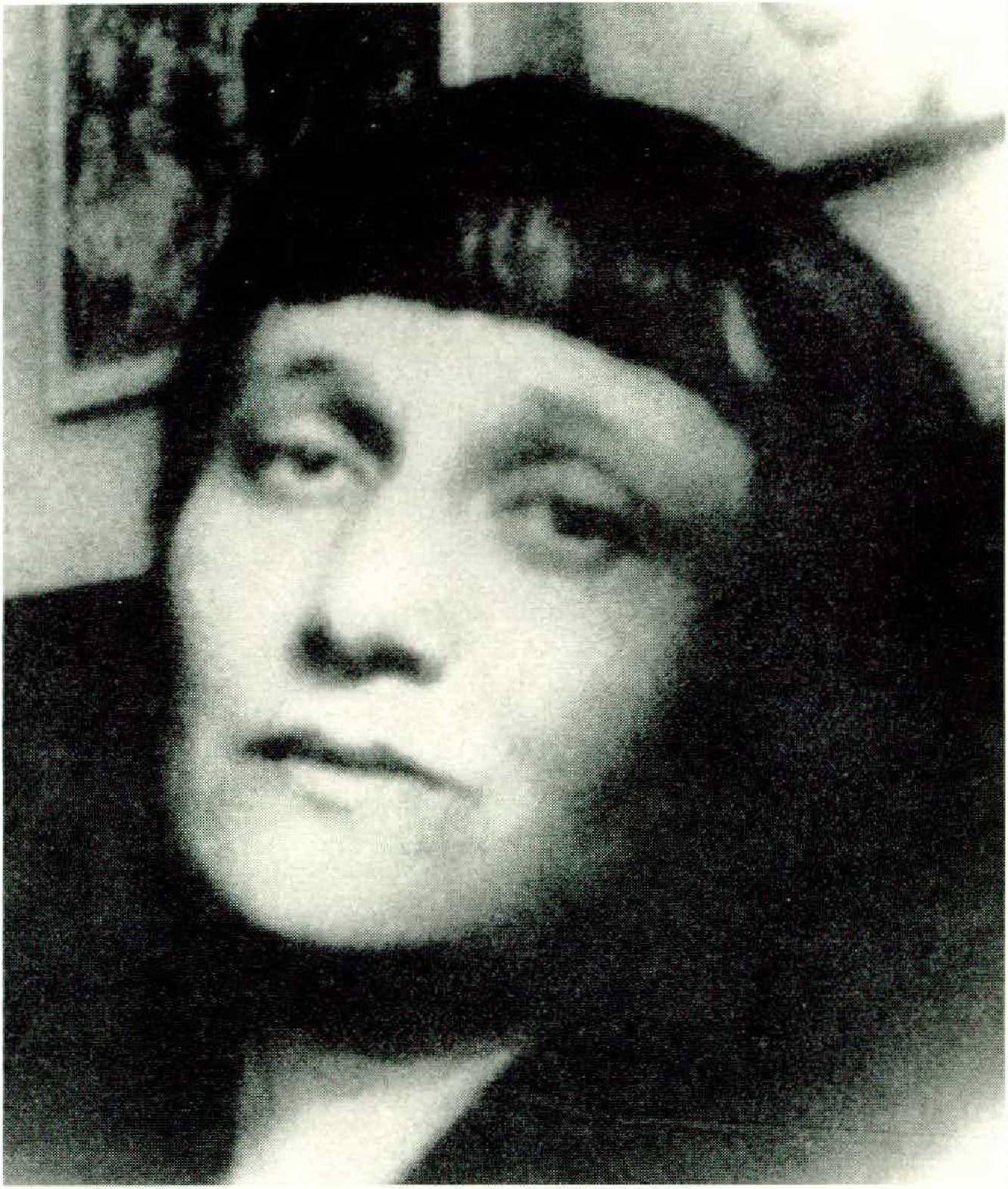
THE COMPLETE POEMS OF ANNA AKHMATOVA translated by Judith Hemschemeyer,: edited and with an introduction by Roberta Reeder. Zephyr Press, $85.00.
Today I see you a black angel in the snow, and I cannot keep this secret to myself, God’s mark is upon you. . . .
THIS is HOW the poet Osip Mandelstam described his peer Anna Akhmatova in 1910, at the very beginning of her long career as a poet. She was a great beauty with a great literary gift, which grew and flowered despite the calamities that the twentieth century bestowed on Russia. For many Russians her poems, because of their classical clarity, are second only to Alexander Pushkin’s. (To Western readers this might seem of little significance, for Pushkin has prosed untranslatable into English. Even Nabokov’s renderings of his verse are not successful.)
Born Anna Gorenko, in 1889, at Bolshoi Fontan, on the Black Sea near Odessa, the daughter of a marine engineer, Anna Akhmatova published her first collection of poems, Evening, at the age of twenty-two, under the name of a maternal ancestor, because her father had asked her not to use the family name as a writer. As Anna Akhmatova, she quickly became the woman most admired in Petersburg literary circles just before the Revolution. She was married first to Nikolai Gumilyov, a talented, charismatic poet with a taste for foreign travel, who was shot in 1921 for allegedly plotting against the Bolshevik regime. After the Revolution she was relentlessly vilified by Soviet authorities, and by writers as well. Her contemporary Vladimir Mayakovsky had this to say about her (and about their elder, the Symbolist Vyacheslav Ivanov): “Of course, as literary milestones, as the last born child of a collapsing structure, they find their place on the pages of literary history, but for us, for our epoch—these are insignificant, pathetic, and laughable anachronisms.”
But Alexander Blok and Boris Pasternak praised Akhmatova, and so did Mandelstam, who considered her voice the purest in Russian poetry, and Marina Tsvetaeva, who called her “Golden-mouthed Anna of all the Russias.”Mandelstam dedicated many poems to her, including his ominous “Preserve My Words”:
Preserve my words forever for their aftertaste of misfortune and smoke, for their tar of collective patience and conscientious work— water in the wells of Novgorod must be black and sweetened to reflect a star with seven fins at Christmas.
(Adapted by Robert Lowell in my Poets on Street Corners, Random House, 1968)
Pasternak, remembering in 1928 her “Lot’s Wife” in his poem “For Anna Akhmatova,” recognized her rare ability to fuse personal fate with history:
In all our affairs, your lines throb with the high charge of the world. Each wire is a conductor.
(Ibid.)
In the late thirties Akhmatova’s son, Lev Gumilyov, and her husband, the art critic Punin, were arrested. So was Mandelstam, who died in a gulag in 1938. Except for an interlude during the Second World War, when Stalin exploited every patriotic impulse to help win the war, persecutions continued, notably with the infamous Zhdanov edict of 1946. It singled out Akhmatova and the prose writer Zoshchenko as pernicious and led to their exclusion from the Writers Union, leaving them without means of support. To earn a little money over the years, Akhmatova did many translations of foreign poetry, which she asked editors not to include in collections of her own poems. After Stalin’s death she was slowly rehabilitated and allowed to travel to Italy, Paris, and Oxford, where she was given an honorary degree. But her works continued to be censored. No complete edition has yet been issued in the USSR, though there are plans for one, and plans are being considered for a monument to her on the bank of the Neva River in Leningrad.
THE ARRIVAL BY mail of the two enormous volumes of The Complete Poems of Anna Akhmatova was a joy for me. Here at last was all of Akhmatova’s poetry in Russian, collected, dated, uncensored, with faithful translations into English and, also in English, ample and reliable commentary, as well as a huge array of beautiful illustrations.
Here was the possibility of sharing with English-speaking friends an essential part of a Russian’s heritage—Akhmatova’s poems, hundreds of them, from the thoroughly feminine lyrics of her early youth to the patriotic verse of the Second World War to the “Poem Without a Hero,” with its sweeping assessment of Petersburg’s Silver Age at the turn of the century, to the poignant poems of her late years about encounters and reunions that should have happened but did not.
The project coordinator and designer of this monumental book, Ed Hogan; its translator, Judith Hemschemeyer; and the editors Roberta Reeder and Leora Zeitlin are to be congratulated on their achievement, but particularly Hemschemeyer, who, while creating her graceful English imitations of Akhmatova’s poems, must have known that the Russian language—the pride and joy of educated Russians, especially as it is used by a master like Akhmatova—will forever remain just beyond reach. Complete Poems is a credit to Zephyr Press, a small New England house that publishes elegantly designed books of literary importance produced to last. It is one of the merits of this edition that it brings together a rich variety of voices commenting on Akhmatova. In addition to Reeder’s introduction there is a recollection by Isaiah Berlin and two engrossing essays by Anatoly Naiman, a poet from Leningrad now in his fifties, one of a small group of Akhmatova proteges that included Joseph Brodsky. And in Reeder’s introduction Raisa Orlova and Lev Kopelev, two well-known dissident writers, provide Akhmatova’s own account of Robert Frost’s visit with her in Komarovo, near Leningrad, where she had a summer cottage:
And then the old man arrived. An American grandfather . . . redfaced, gray-haired, cheerful . . . We sat next to each other in wicker chairs. All kinds of food [was] served and wine was poured. We talked without rushing. And I kept thinking: “Here are you, my dear, a national poet. Every year your books are published . . . they praise you in all the newspapers and journals, they teach you in the schools, the President receives you as an honored guest. And all they’ve done is slander me! Into what dirt they’ve trampled me! I’ve had everything— poverty, prison lines, fear, poems remembered only by heart, and burnt poems. And humiliation and grief. And you don’t know anything about this and wouldn’t be able to understand it if I told you . . . But now let’s sit together, two old people, in wicker chairs. A single end awaits us. And perhaps the real difference is not actually so great?”
It may be that Akhmatova’s poetry will inspire a few readers to learn Russian, as it did this book’s translator. For lovers of poetry this extreme effort would have its rewards. As the scale of the war waged by Lenin and Stalin against the Soviet people is being revealed, so is the answering grandeur of Russian poetry of the early twentieth century. Boris Pasternak, Marina Tsvetaeva. Osip Mandelstam, Vladimir st Mayakovsky, Anna Akhmatova, the literary giants of Russia, were among the tyrant’s victims. Two of these poets, Pasternak and Akhmatova, lived into their seventies, bearing testimony about their times, growing steadily as artists, while Osip Mandelstam perished in a camp and Mayakovsky and Tsvetaeva committed suicide. Akhmatova’s “Requiem,”describing how she stood in line day after day at the gates of the Kresty Prison, waiting for news of her son and her husband, has become Russia’s most famous poem on the subject of Stalinist repression. It was composed between 1935 and 1940, but Akhmatova did not write it down until several years after Stalin’s death. Until then it was preserved only in the memories of a few friends who knew it by heart. This long work begins
No, not under the vault of alien skies. And not under the shelter of alien wings— I was with my people then. There, where my people, unfortunately, were. . . .
In the terrible years of the Yezhov terror, I spent seventeen months in the prison lines of Leningrad. Once, someone “recognized” me. Then a woman with bluish lips standing behind me, who, of course, had never heard me called by name before, woke up from the stupor to which everyone had succumbed and whispered in my ear (everyone spoke in whispers there):
“Can you describe this?”
And I answered: “Yes, I can.”
Then something that looked like a smile passed over what had once been her face.
As centennials of Akhmatova’s and Pasternak’s births are being celebrated and their entire works are beginning to be published, the Russian reading public is being astonished by the scope of their literary achievements. In the case of Akhmatova, the Russian reader is overcome by the sheer beauty and abundance of her work. There is so much here that is new. suppressed for political or sometimes personal reasons. Taken as a whole, as it is now: presented by Zephyr Press, Akhmatova’s oeuvre is huge, majestic, and magnificent.
English-language readers whose interest is stimulated by these volumes can look forward to Lydia Chukovskaya’s Conversations With Anna Akhmatova, soon to be published in the United States. Chukovskaya, the dean of Russian literary dissenters and the daughter of the celebrated children’s author and critic Kornei Chukovsky, wrote an exact account of her frequent meetings with Akhmatova from 1938 until the poet’s death, in 1966.
During the Revolutionary period in Petersburg, in a time of famine, Akhmatova gave her friend Chukovsky milk for Lydia. This was the gesture of a fairy godmother, and Lydia Chukovskaya was to live up to it. She is the author of powerful novellas about a woman’s fate under the Soviet terror, and her Conversations With Anna Akhmatova lies at the center of her life’s work. Reviewing the first volume of the French edition, John Russell wrote.
If [Chukovskaya’s] role had been simply that of an amanuensis, the book would hold us uninterruptedly, such is the presence of Akhmatova and the implacable candor with which she conducts herself on all occasions. But, so far from being mere interviews, Conversations impresses us as a dialogue between equals— and equals who have survived the worst that our century has had to offer.
Not surprisingly in the case of a writer who made refusal to compromise the essence of her life, stern literary7 judgments abound in Conversations, which is an encyclopedia of Akhmatova’s insights into her own and others’ work. Of confessional writing, which she detested, she said, “In Pushkin’s day poets never talked about themselves. But they said everything all the same—everything, to the end.” She worshipped Dostoyevsky for his ability to chart the intricacies of the human spirit: “I was rereading The Adolescent. What a work! And not at all terrifying. It does not reflect real life, only the facets of Dostoyevsky’s soul....” On the other hand, her judgments of Tolstoy could be severe. A passionate believer in women’s right to self-fulfillment, she was offended by what she saw as his misogyny: “How disgusting his feelings for Anna [Karenina]! First he is in love with her, he relishes her, relishes the black curls on her neck.
. . . And then he begins to hate her— he even mocks her corpse. Do you remember—‘shamelessly stretched out’?”
WHEN I MET Akhmatova, in Moscow in 1963, my overwhelming impression was of her regalness. During my first visits with her she was kind to me, because she knew my parents and because I was a friend of her close friend Nadezhda Mandelstam, the widow of another, still closer friend of her youth, Osip Mandelstam. Nonetheless, at the beginning of our acquaintance our conversations, though cordial, had an undercurrent of strain. Akhmatova wanted to know as much as possible about the Russian emigration in Paris and London, and I, who was born in Paris, answered her questions as well as I could. I knew Akhmatova’s poems excoriating those who had left their country, but I did not realize then that a personal wound had inspired these poems—betrayal during the Revolution by a man whom Akhmatova loved, and who had fled Russia, leaving her behind forever. Little by little I came to understand this, while Akhmatova’s harshness toward those who had been forced to emigrate softened, turning at times almost to sympathy.
Akhmatova loved Russia passionately. Her patriotic poems of the Second World War period are among the most beautiful ever written in that genre. It must be noted, however, that in the USSR her patriotism is sometimes misrepresented by critics who are uneasy with the current convergence of the two halves of modern Russian literature, the Soviet and the émigré. The latter is still regarded as subversive by the kind of Soviet officials who once attacked Akhmatova as “half nun, half harlot.” But in fact Akhmatova’s love of Russia transcended both politics and personal involvements. Here is her celebrated “Courage,” part of the cycle “The Wind of War” (1941-1945):
We know what lies in balance at this moment, And what is happening right now. The hour for courage strikes upon our clocks, And courage will not desert us. We’re not frightened by a hail of lead,
We’re not bitter without a roof overhead— And we will preserve you, Russian speech, Mighty Russian word! We will transmit you to our grandchildren Free and pure and rescued from captivity Forever!
Again from “The Wind of War”:
And you, my friends from the latest call-up! My life has been spared to mourn for you. Not to freeze over your memory as a weeping willow, But to shout all your names to the whole wide world! But never mind names! None of that matters—You are with us! Everyone down on your knees! A crimson light pours! And the Leningraders come through the smoke in even rows— The living and the dead: for glory never dies.
From “Victory” (1942-1945):
The first lighthouse flashed over the jetty, The precursor of many— And the sailor who had sailed seas packed with death, Alongside death and on the way to death, Took off his cap and wept.
Whenever I called on Akhmatova, no meeting was complete without her reading aloud two or three poems at the end of the conversation. It was a wondrous ritual. We would adjourn from the parlor to the small back room where she slept. Sitting very straight, facing her guest across her diminutive writing table, Akhmatova folded her arms, draped in her ivory silk shawl. Closing her eyes, she recited poems from memory in the muted yet sonorous monotone that has been Russian poets’ style of recitation since the days of Pushkin. And always she read at least one poem about her Muse. It was an homage to what the poet Anatoly Naiman calls, in one of his essays in Complete Poems, “the genuineness of her fate.” Akhmatova was deeply religious; she was honoring the supernatural, benevolent power that had sustained her and inspired her throughout the years—what Mandelstam had seen as “God’s mark” upon her. □