For the Cruise-Suspicious: Sail and Windjammer Cruises Fill the Gap Between Forced Jollity and Sailing the Boat Yourself
by Barbara Wall raff
THERE ARE plenty of cruises for people who want to have a rousing good time on vacation. And there are plenty of cruises for people who want to tour remote parts of the world—Antarctica, Borneo, or the Galápagos, say—in comfort and ease, in an ecologically sensitive way, or both. There are cruises for people who love elaborate food (probably the most spectacular example has been charterings of Norwegian Cruise Line’s Norway, née France, by French gourmets, which present signature dishes of numerous highly regarded chefs, and also lectures, cooking demonstrations, and tastings). There are jazz cruises, steamboat cruises, bridge cruises, barge cruises, an antismoking benefit cruise (on Dolphin Cruise Line’s Dol-phin), and even cruises for people who love basketball, skiing, or tennis (NBA players and pro skiers and tennis players are invited on board during particular sailings of Norwegian Cruise Line ships). But are there cruises for people who mistrust the very idea of cruises? Yes. The luxurious ones are called sail cruises, the bargain-priced ones are called windjammer cruises, and both types can be wonderful.
I am not mistrustful of cruises. I must admit. It is because Ii am a cruise enthusiast—“booster“ might not be too strong a word—that I’ve learned how many serious-minded people scorn cruising, and how many other people are incredulous that someone they perceive as serious-minded would enjoy it. I suppose they’re thinking of the Love Boat stereotype. By taking the stereotype for the reality, though, they’re missing out. The stereotype has become less and less true, as the cruise industry has grown, segmented, and created within itself as many niches as there are in a coral reef.
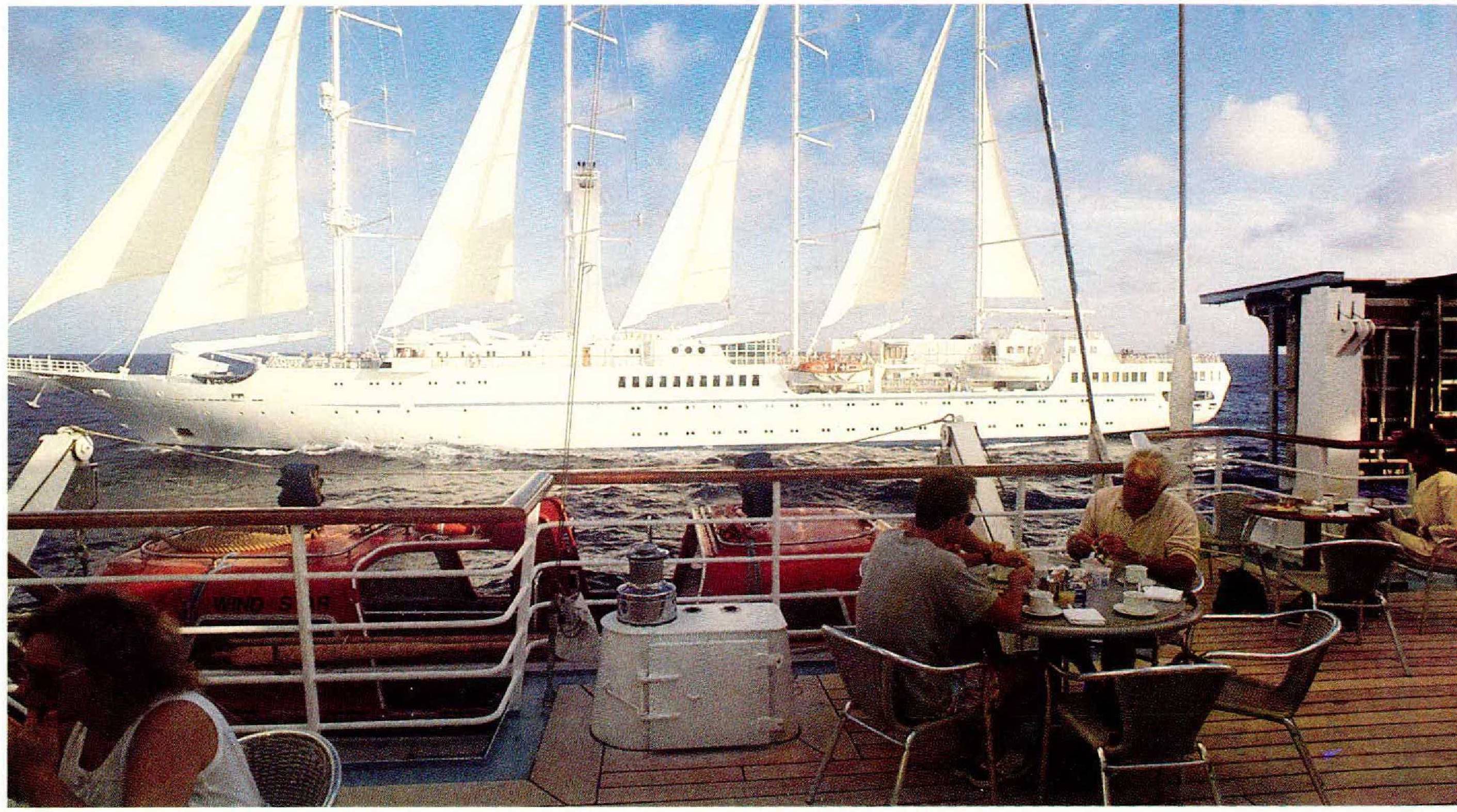
WHEN THE Wind Star, the first ship in what is now windstar Cruises’ fleet of three, came along, six years ago, it was a revelation. With its four tall masts and computercontrolled sails, its handsome and comfortable cabins, its sports platform (which drops down to serve as a watersports center when the Wind Star is at anchor), and its shallow draft (which enables it to call at sleepy villages and pristine beaches as well as busy ports), the 148-passenger Wind Star is not only an exceptionally beautiful ship but also one poised at the intersection of windjammer, charter yacht, and cruise ship. Thus was born the sail cruise, and the cruise industry didn’t take long to recognize this as an idea whose time had come. Club Med, which was seeking to enter the cruise market, chose to do so with similar 386-passenger sailcruise ships, the second of which is scheduled to enter service in the South Pacific late this year; and a new company called Star Clippers introduced two 180-passenger sail-cruise vessels, the second of which is scheduled to enter service in the Mediterranean this May. Is imitation or acquisition the sincerest form of flattery these days? Windstar itself was snapped up by the well-established Holland America Line, which in turn was bought by big, aggressive Carnival Cruise Lines. Windstar remains the sail-cruise line to beat: its ships are the most elegant and spacious, its food the best.
Elegant, spacious, best . . . the specter of pretension often lurks in the neighborhood of words like those. But Windstar is not stuffy at all. There’s something about having sails overhead that’s wholesome and restful, and sets a tone. Windstar complements that tone perfectly, with historical sailingrelated engravings and prints lining the corridors; with cabin boys who race down the corridors getting their work done until you step in front of them, whereupon they amble respectfully behind you until you’re out of the way and they can begin racing again; with a captain, on the Wind Star, who once completed the Whitbread Round the World Race and who, at welcomeaboard cocktail parties, addresses the passengers: “Ladies and gentlemen, this is a sailing vessel, and I hope to have the chance to prove it to you this week” (indeed, Windstar ships have been known to travel under sail power alone for some 70 percent of a voyage); with food that is diverse, light, creative, healthful, contemporary, and good. Ultra-deluxe cruise lines typically give their passengers all the caviar they want—but how many people can spoon up bowlsful without feeling queasy afterward? Smoked salmon, though, is a treat most people can eat a lot of, and it is one of the foods available round the clock on Windstar.
The Windstar cruise I took last summer was my second. Having shippedout on the Wind Song in French Polyne-sia in Windstar’s second year, I worriedthat I would be disappointed by theitinerary, which took us to various outislands of the Bahamas—an itinerarythat Windstar had hurriedly substitut-ed, during the Gulf War, fora Mediter-ranean one (and is unlikely to repeat).I didn’t like this as much as I’d likedFrench Polynesia, but I also came tothe conclusion that the ships them-selves make for sucha great vacation thatthe itinerary doesn’tnecessarily mattervery much.
Also, I worriedthat I would makeunhappy discoveriesat every turn aboutchanges that had oc-curred since Wind-star had become partof a huge, mass-mar-ket corporation.Such differences as Inoticed, though,were relatively minor and detractedfrom the overall experience not at all.The biggest single change is one froma European to an Indonesian and Phil-ippine staff (the officers continue to bemostly Scandinavian). And there werelittle changes that seemed intended toplease and reassure passengers who areaccustomed to normal cruise-ship rou-tines. For example, one morning whenwe were under sail—a time when theold Windstar would have left us to ourown devices—interested passengerswere invited to the lounge to learn fan-cy ways of folding table napkins;strange and wonderful lessons are acruise-ship staple. I was reading in thelounge (and was, by the way, untrou-bled by motion sickness, since the boathas remarkably effective high-tech sta-bilizing equipment) when older wom-en arrived for the lessons, by ones andtwos, and settled in. They broughtwith them an air of comfortable, famil-iar anticipation—and suddenly I real-ized that people who aren’t mistrustfulof cruises are likely to love Windstartoo.
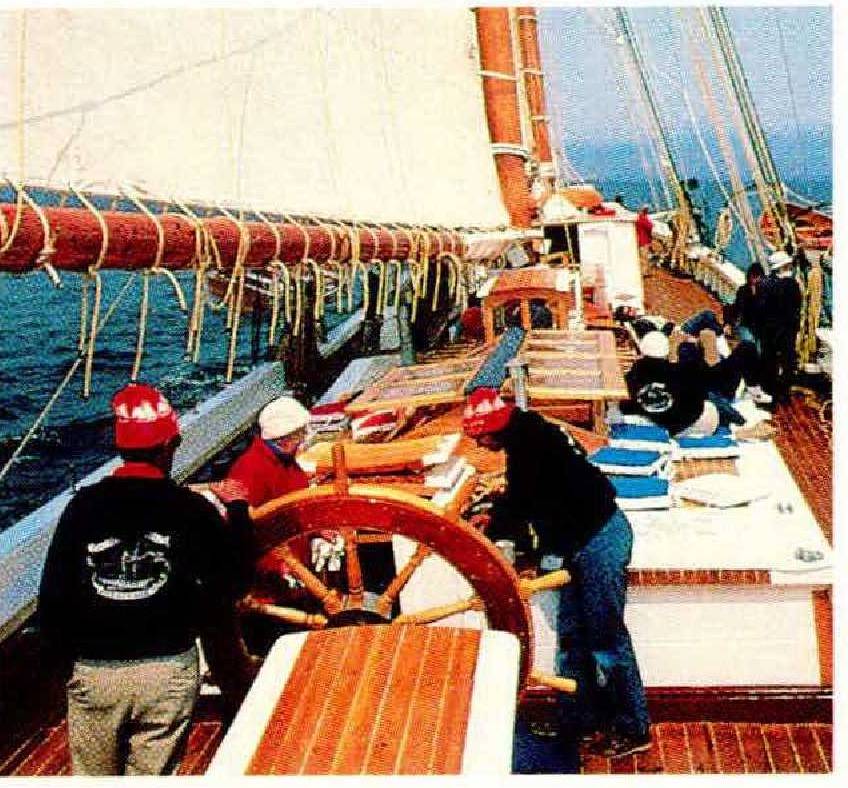
THIS ISN’T a cruise. This is aweek on a sailing-historymuseum,” Bill Alexander,the owner of the Timberwind, a wind-jammer, said to me one sunny summer morning as we gusted along off thecoast of Maine. The Timberwind is infact not a self-consciously old-timeyboat. Rather, it is a handsome two-masted schooner (any configuration ofsailing ship can be a “windjammer”;the term doesn’t mean anything veryprecise) that was built in 1931 andserved as Portland Harbor’s pilot boatfor thirty-eight years, until Bill, a highschool math teacher, and his wife, Ju-lie, a nurse, bought it. They have offered cruises out of Rockport, Maine,lasting three days to a week, aboard itevery summer since. This comingsummer they will be leasing the Tim-berwind to Captain Rick Miles.
A luxury cruise this isn’t: You andthe fifteen or twenty other passengersare all invited to help hoist the sails ev-ery morning after breakfast, furl thesails late every afternoon, and prepareor clean up after a meal or two duringthe week. The bunks are narrow, thecabin doors are curtains, and suchbathing as was done aboard ship was,at the time I was aboard, accomplishedwith water heated on the galley woodstove and available from a keg on deckevery morning. (Showers have sincebeen installed.) In the evenings, whenthe ship was at anchor, we were free tobathe in the sea (Joy detergent workspretty well in salt water as a shampoo),and then someone would pour a buck-et of fresh water over us when weclimbed back on board, bluish andshivering but invigorated.
After four or five days of this I madesure I was first in line to be tenderedashore at Stonington, where Julie hadtold us a bed-and-breakfast offeredshowers to windjammer passengers.Later, poking around in town, I wasmade to feel foolish by a charmingdown-Maine eccentric, Evelyn Kok. A slight woman with long white hair andbright eyes, Kok runs a little shop,much of whose merchandise (book-marks, note cards, and the like) shewill inscribe to order with calligraphyor Egyptian hieroglyphics. She said, “Ihate to tell you, but we make fun ofpeople who come here and headstraight for a shower. Why are you onthe boat? Not for that. You have ashower back home.”
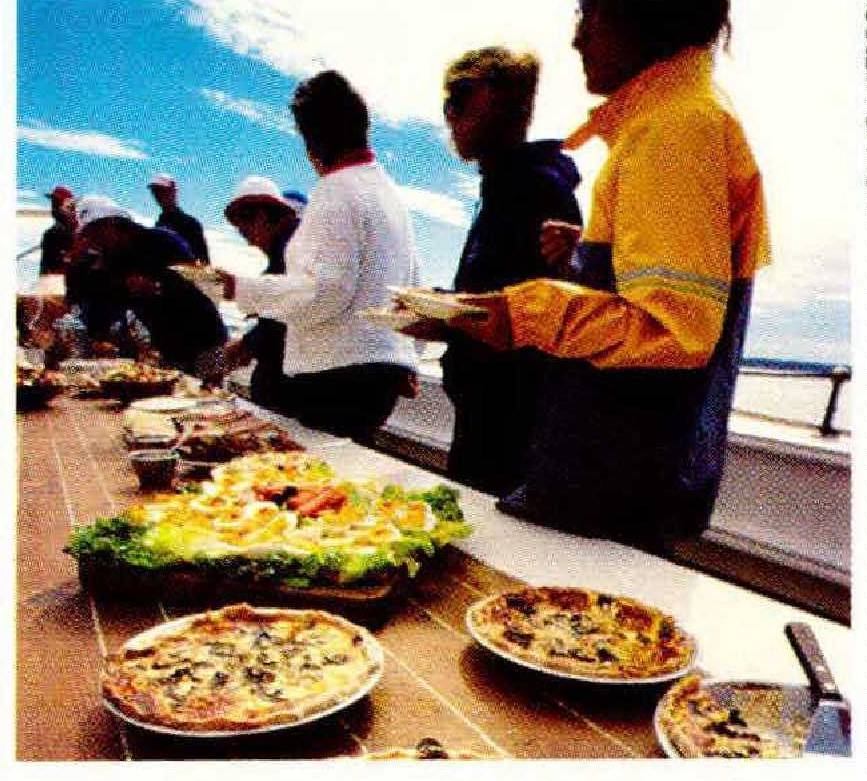
What I don’t have back home, butwish I did, is some-thing to rock me tosleep like the Tim-berwind, with itsgentle motion. (Peo-ple who suffer fromseasickness but whowould like to cruiseshould ask their phy-sicians to prescribescopolamine patch-es, which are wornbehind the ear andwhich have provedvery effective.)Night after night weslept like innocents. Day after day weate like lumberjacks—wholesome,hearty, unpretentious food like blue-berry pancakes, chili, brownies, androast turkey with stuffing.
All day you sit on the deck in the sun(or in your cabin or in the dining area ifit happens to be raining), reading or re-marking on the coastal scenery, or oth-er boats, or the birdlife, or your fellowpassengers. In late afternoon you an-chor, generally near a picturesque townor village, and members of the crew-take you by fours and sixes ashore inthe yawl boat to have a stroll, have abeer, look around. There’s no printeditinerary: the captain sails according tothe wind and his inclination.
One night we fetched up at Isleboro,deep in Penobscot Bay. A group of uswere ferried ashore after dinner, andwe sauntered up the lawn to the ter-race of the lovely, peaceful IsleboroInn to have a drink. The sun was set-ting; the bay view was like a Tiffanywindow. The air was still and a bitheavy, enhancing the effect. I wentinto the inn’s bathroom to wash myface and hands before the drinks ar-rived and discovered a gleaming claw-footed tub. I was tempted for only amoment, and then I hurried back out-side to watch the sunset. That was,after all, why I was here.
TRYING TO get the best possible deal on a sail cruise is almost as much of a challenge as trying to get the best possible deal on a flight. Unfortunately, it’s not always enough simply to call up the cruise line or your local travel agency and ask for their best price.
When I recently called asking about high-season week-long sailings this April out of Barbados, Windstar was quoting a fare of $2,595 per person, double occupancy, plus airfare (this rate applies to all except one of the ship’s cabins, which are roughly the same); discount cruise agencies were quoting fares of $2,039 to $2,205, sometimes with proportional discounts on airfare. Some of these agencies got certain details wrong about what Windstar has to offer (for example, one said that it offered only a fourteen-day cruise in mid-April, whereas it really offers two seven-day itineraries that may be combined). Thus a smart shopper would call Windstar (206-2813535) at least to ask for its brochure, and then, brochure in hand, call around to discounters. The big, nationally known ones include Baton Rouge Vacations at Sea (800-9992493), Cruise Directors (800-3480009), Cruises of Distinction (800-6343445), The Cruise Line (800-3273021), Landry & Kling (800-4314007), and South Florida Cruises (800327-7447). Other good deals may be advertised in local newspapers. Windstar was offering two-for-one specials last summer, to compensate for having changed their itinerary, and bargains may also be available in the future, because the cruise industry is generally suffering from overcapacity.
Agencies also book most windjammer cruises, but no one offers substantial discounts on them. A week on the Timberwind (800-759-9250) costs $525 to $600 per person; the ship sails May through October. You might also call the Maine Windjammer Association (800-624-6380) for information about various windjammer cruises in Maine, and Windjammer Barefoot Cruises (800-327-2601) for information about ones in the Caribbean. By now all of these windjammers offer opportunities to take showers on board. And all of them have sails. Which of these features more greatly enhances the quality of an oceangoing vacation I leave to you.