Creature Comforts: Kachemak Bay Neatly Condenses the Attractions of the Largest State
by Barbara Wallraff
ALASKANS PUT up with a lot to live where they do—winter days only a few hours long, Olympic-poolsized snowdrifts in the parking lot, the threat of bear attacks (no joke). The payoff is the unearthly scenery, profuse and mostly appealing wildlife, freedom from crowds, and expansive frontier atmosphere. The visitor has the happy prerogative of collecting the payoff without enduring the trials. And, as I discovered on a trip last summer, the joys of Alaska are all the sweeter for knowing that the trials exist and one is escaping them. In the glimmering ten o’clock twilight of late summer the three o’clock nightfall of winter is almost palpable, and it gives an exhilarating edge to the view.
Midwinter may seem an odd time to bring up Alaska, but most people who travel there—whether they go on their own or join a cruise or package tour— begin planning their trip at least half a year in advance. The hard part of the planning might be fitting into one trip everything you’re tempted to see and do: Denali (Mount McKinley), in whose glacier-streaked environs I went flightseeing with a grizzled pilot straight out of Sky King, who kept looping around to give his passengers a closer view of the moose and bear browsing below; the Inside Passage, where on my trip the weather was bad and I could barely see, let alone enjoy, the majestic fjords; the capital, Juneau, where I cheered up, discovering the first-rate Native-arts store Objects of Bright Pride and gawking at suburban streams packed with spawning salmon; Glacier Bay, where I took a ride on a little boat that was quickly surrounded by whales and dolphins, with seabirds wheeling overhead; the reconstructed frontier towns of Gold Rush country; one of the state’s bald-eagle sanctuaries; the midnight sun.
More likely the hard part is coming to terms with being unable to fit everything in. Alaska presents logistical problems. For example, incredibly, Juneau cannot be reached by road—water and glaciers hem it in on all sides. And then there is Alaska’s sheer size. Indeed, the state contains a glacier (one of at least 5,000) that is bigger than Rhode Island. Alaska itself is more than twice as large as Texas, and a fifth as large as all the Lower Forty-eight together—statistics whose meaning begins to be clear when you discover that it will take you the better part of a day to fly from southerly Juneau to Barrow, in the far north.
You can’t, therefore, easily or cheaply work your way down a checklist of the state’s major attractions. And even if you could, you’d miss much of the feel of the state. I rushed around, by ship and boat and plane and bus and car and floatplane, to visit as many of Alaska’s attractions, see as much of its wildlife, and experience as many of its out-ofthe-way inns and eating places as possible. I don’t recommend this. A much better idea is to see a few of the sights for which Alaska is justly famous and then spend three days to a week off the beaten path, enjoying Alaska where many Alaskans do—at Kachemak Bay.
KACHEMAK BAY belongs on more visitors’ itineraries because it’s easy to reach, magnificent to look at, and agreeably diverse, with ocean and mountains and culture and all sorts of places to stay and to eat. Its hub is the town of Homer, from Anchorage either an hour by air or a scenic five-to-sixhour drive past the impressive Portage Glacier and on down the west coast of the Kcnai Peninsula, a recreation area especially popular with Alaskans.
Lonely Planet’s excellent guidebook Alaska calls Homer a “charming, colourful fishing village” set in an “incredible panorama of mountains, white peaks, glaciers, and the beautiful Kachemak Bay”; Alaska’s Official State Guide and Vacation Planner (call 907-465-2010 for free copies of this and other relevant publications) refers to it, unsentimentally, as an “art community and fish processing center.” Both descriptions are apt. In addition to being the home port of a number of commercial fishing boats (and innumerable pleasure boats), Homer hosts an annual Spring Arts Festival. It is where Tom Bodett, Alaska’s answer to Garrison Keillor, broadcasts from, and it has a half dozen galleries showing crafts and art—unusual for a town whose year-round population is less than 4,000. Homer has accommodations ranging from campsites to hotels, a spectrum of restaurants, and numerous businesses that will take visitors hiking, fishing, birding, kayaking, and flightseeing. (These tourism-related concerns, and also ones in nearby communities, are listed in the Homer Tourist and Recreation Guide, available free from the Homer Chamber of Commerce; call 907-235-7740.)
Probably the town’s most unusual feature is Homer Spit, a naturally formed strip of land that extends some five miles into the bay. Along its shores is an entertainment district that will remind you of every boardwalk and pier you’ve ever been on. The marina is here too. Late in the day, after the charter boats have come in, tourists stand on the dock with the big halibuts they’ve caught, having snapshots taken as their fish are weighed. Hundred-pounders are not uncommon. The charter-boat captains carry guns to subdue large fish (by shooting them between the eyes), for these can be dangerous if they thrash around on board.
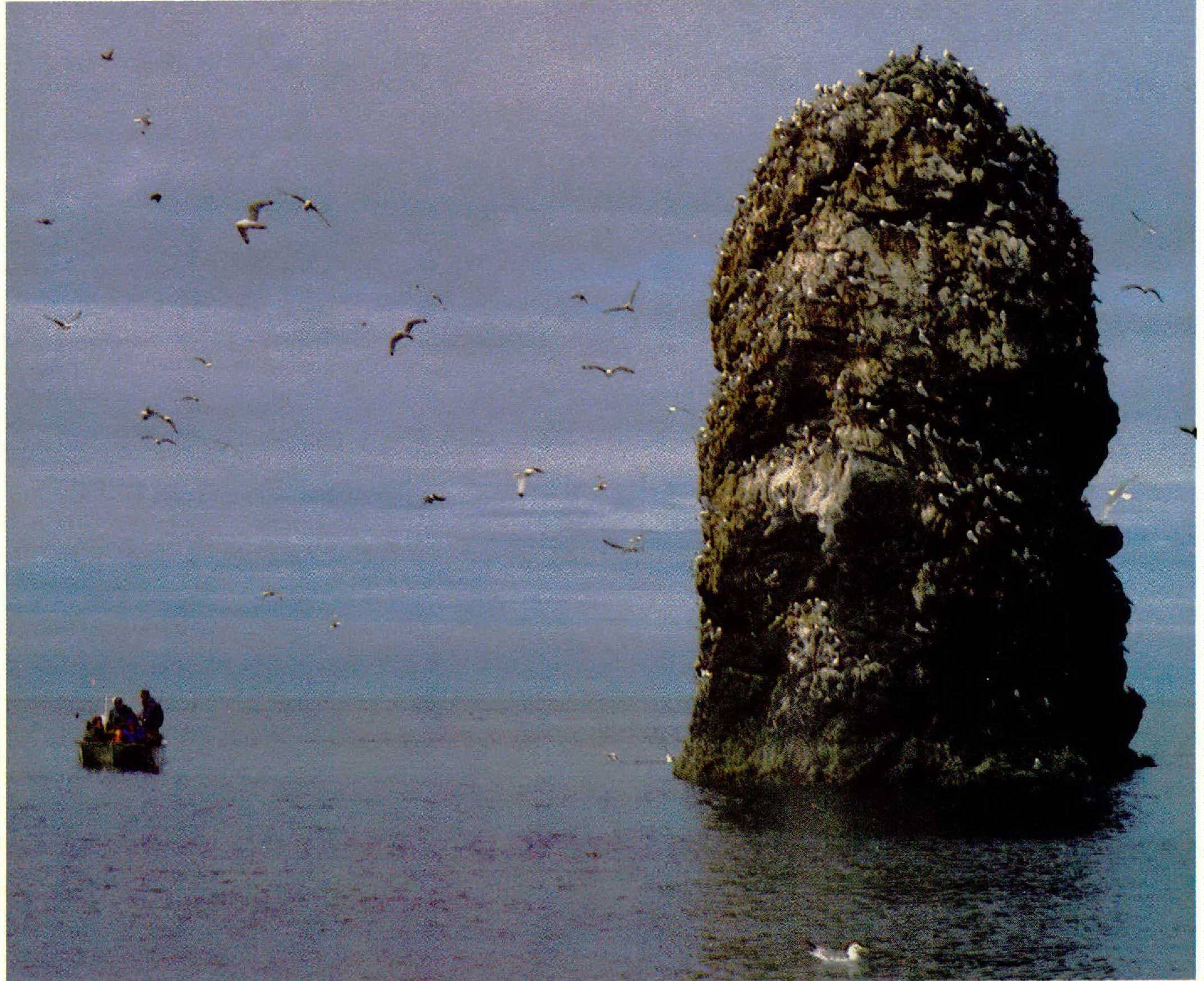
The passenger ferry Danny J leaves from the spit too, bound for the tiny community of Halibut Cove—a lovelyplace to spend an afternoon and evening. The noon ferry makes a brief detour past Gull Island, a mound of rock every inch of which is covered, like an insanely popular avian resort, with nesting birds—some 18,000 glaucous-winged gulls and kittiwakes, murres and guillemots, cormorants and puffins. The noon ferry conveniently arrives after “quiet time,” from noon to one each day, when a person who is, say, sitting out on the water in a rowboat talking with a friend will be politely asked to hush up or go inside for the duration.
The idea seems only natural in the peaceful setting. Although Halibut Cove is situated on little Ismailof Island, the idea of “cove” is truer to the experience of the place than that of “island,” for virtually all vistas lie across the water. Everyone gets around in skiffs or on the boardwalks that line the cove partway around; there are no cars. There are, however, three art galleries to poke around in (one devoted to the work of resident Diana Tillion, known for her work in the medium of octopus ink), a few hiking trails, an enclosure of llamas, and The Saltry, a fine restaurant. In what passes for frontier America today—including rural Alaska—the first fashionable thing to arrive tends to be good food.
Today, when the height of fashion involves fresh, locally grown or caught ingredients, frontier communities even have the edge on cities. This fact impressed itself on me throughout my trip, at country inns and remote fishing lodges. At The Saltry, as a member of a cooperative party of seven, I tasted most of what was on the menu that night. Nearly everything except the desserts was based on fresh seafood: salmon pâté, halibut ceviche, blacksablefish chowder, Thai-spiced scallops, and rockfish Veracruz-style, to name some of the memorable dishes.
Halibut Cove has a few places to stay overnight (they’re listed in the Homer guide); reservations are almost certainly needed, and you’ll want ferry and restaurant reservations as well. Or you can have an early dinner and catch the last ferry back to Homer at nine.
THOUGH REMOTE, Halibut Cove is hardly wild. Sojourning in Kachemak Bay’s wilderness can be fun too. You can camp, or you can stay in comfort and even style, provided you’re willing to pay the price. I stayed at Tutka Bay Lodge, an ambitious work in progress situated on an arm off Kachemak Bay and accessible by boat, floatplane, or helicopter. The main lodge and dining room, four guest cabins, a sauna, and the helipad have been completed; more cabins are on the drawing board. For the minimum stay of two nights, rates including all meals are $400 to $600 per person.
The highlight was an afternoon’s seakayaking expedition. The destination that my group’s guide had in mind, it turned out, was a bald eagles’ nest full of half-fledged eaglets. When we were nearly there, a seal joined us, popping up repeatedly among the three kayaks and swimming alongside us for a half hour or so. No sooner had we left the seal behind than we began spotting sea otters, floating on their backs and cracking open shellfish with their teeth.
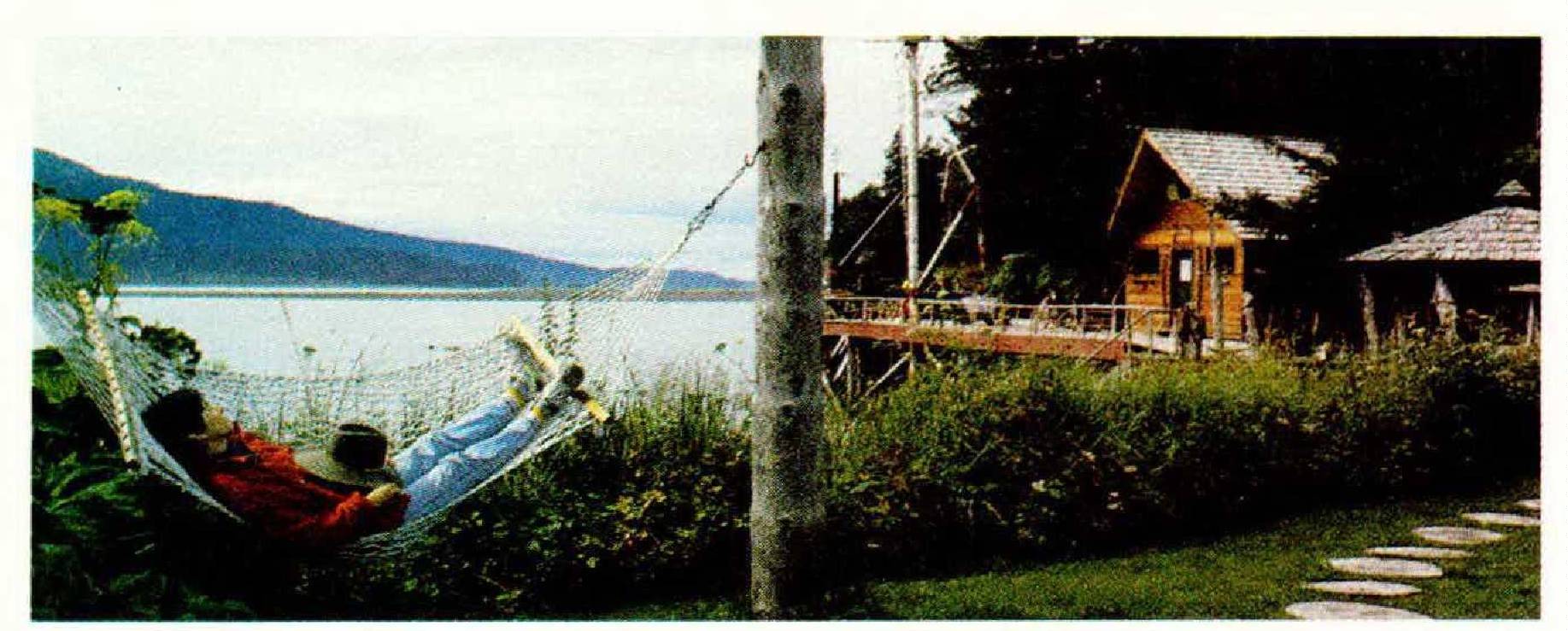
More finished—and all but perfect in its tasteful rusticity, it seemed to me on a brief lunchtime visit and tour—is Kachemak Bay Wilderness Lodge, on China Poot Bay, another, especially choice arm off Kachemak. The complex here, which includes a main lodge, five guest cabins, a solarium, and a sauna and outdoor hot tub, is a twenty-year labor of love by Michael and Diane McBride, whose attention to detail struck me as flawless. Having completed one of the cabins a few years ago, they realized that it would command a better view of the bay if it were sixteen feet farther back— so they had it moved.
In urban America inns sometimes boast that their rooms are “individually decorated,” the point being that more care was taken than if someone had ordered up identical bedroom sets out of a catalogue. In other parts of rural Alaska I visited, the idea of “individually decorated” sometimes seemed like a joke: one cabin I stayed in was decorated with empty clear-glass bottles—Canada Dry and Jim Beam labels and all—on the windowsills and on the exposed crossbeams. I could find no fault with the Kachemak Bay’s cabins, though. They managed to be handsome and luxurious and at the same time perfectly in tune with the frontier.
The McBrides serve as wilderness guides as well as hosts, showing guests —whether they fancy themselves fishermen, photographers, or amateur archaeologists—the spots they seem most likely to enjoy. The rate here, alas, is $1,950 per person for a minimum stay of five days. Five days is in effect the maximum, too, for the lodge is open only Monday through Friday.
IF ALL OF the above sounds hopelessly tame, call Biological Journeys (800-548-7555 or from outside the United States 707-839-0178), and get the brochure on their natural-history cruises aboard the large-yacht-sized Delphinus. I joined one of their groups, briefly, for a landing at the Pack Creek Bear Sanctuary, where we watched grizzly bears, and was impressed by their programs, which seemed challenging but not physically arduous. Also call Alaska Discovery (907-5861911) for information about their still more active, sometimes rigorous trips into the wild. If even that doesn’t seem adventurous enough—well, the annual Iditarod sled-dog race will be starting in just a few weeks.