The Legendary Lowry Greither
He was under arrest in a foreign land, confident that the truth would set him free. But what was the truth?
A Short Story
by E. S. Goldman
THE ANNOUNCEMENT WAS FIRST MADE IN THEIR language, and then translated. They were to keep seated. They should not stand in the aisle. Their disembarkation from the plane would be briefly delayed.
If he was the reason for the delay, they were moving a day or two faster than they were supposed to in these somnolent latitudes. Greither composed himself to appear uninterested. Three men in uniforms shouldered in. One had the mean face of management material, a junior officer who could become dictator.
“Señor Greither,” he demanded. “Who?”
“Greither. Here.”
Get up, come with me, the officer motioned him.
“What is the problem? Problema?” He opened his document wallet and showed his visa. “I am an American citizen.” The officer took the paper and the wallet, too, and urged him to be in more of a hurry. They took his briefcase and travel bag, his hat and raincoat from the overhead. He was led out while the other passengers stared. The cabin attendant looked at him with concern. Did she think he was a drug baron? A famous swindler? The fear was tighter in his lungs than he had expected it to be, but authenticity had a price, and the notion that he was regarded as a personage exhilarated him.
“Not to worry,” he assured her.
He was hurried into the back seat of a military jeep, between two soldiers. The officer took the seat beside the driver. Greither asked again, without effect, “What is the problema? I am an ordinary American citizen.”
He was driven to a hard-used colonial stone building and hustled through a dim lobby furnished with a high court bench on which no one sat to receive a petition, down halls and up stairs depressingly lighted by spattered light bulbs, into a cell. He had not fully realized how radically the scenario could be revised. He should be in an office. A curious official should be discussing with him clarification of his identity.
He called out, “American consul! Porfavor. You must tell the American consul!” as the door was locked in his face.
Gray light seeped from a small barred window on the opposite wall. From American television Greither recognized the poster portrait of the country’s youthful colonel, wearing his father’s hat. Separated by an aisle the width of a small table were two cots. One was occupied by a human bulk, naked to the waist.
“Buenos días,” Greither said, to begin a good relationship.
The senior resident, waking, replied with a guttural, and then another that by intonation was a question.
Greither pointed to himself. “Greither. Norteamericano. U.S.A.”
The man hefted his body to a sitting position while he scratched his shoulders awake and cleared heavy phlegm into a tin can that had begun to filigree with rust. He tapped his chest.
“La tos.”
“Let Tos, yes. St. Buenos dtas, Señor Let Tos.”
The senior prisoner attempted twice to speak before settling on the sound of revelation: “Ahhhhh.” He hawked more phlegm into the can. “LA tos.” He again tapped his chest. “Juan Deriba.”
In the manner of somebody influenced by the speech of a foreigner, a southerner, or a child, Greither replied, “Ahhhhh. Excuse. Buenos días, Señor Juan Deriba.”
Deriba hunched himself awake a little more and stretched his jaws, revealing a wreckage of teeth. He mumbled, “Norteamericano,” and reflected on the implications. On his left hand only stubs remained of two fingers that had not got clear of something fast enough. He wore canvas pants and shoes made of inflexible planks of leather. A splayed sombrero and a sunstruck, washed-out plaid shirt hung on nails in the wall behind him. Greither took off his tie and sweated shirt and hung them on his own nail.
Deriba expressed the pleasure he would get from a cigarette, and was disappointed that the new prisoner did not smoke. Greither hoped Deriba had no friends outside to bring him CARE packages. He did not think he could survive cigarette smoke in this room, dense with sweaty, stinking air, better suited to a gilled transitional species.
They were without conversation tor a few moments until Deriba, through gestures, asked why Greither was there. Greither indicated that he didn’t know, an answer Deriba derided. The senior prisoner described himself as a farmer of some kind. Greither understood that it had to do with trees. In turn, Greither explained his work. Deriba grasped that the American did something about rectangular objects—buildings. Did something on top of buildings, over buildings. Did not build, but what? Defended houses from attack by birds? A profession with which Deriba was not familiar. He looked at the American appraisingly as if to discover what muscles or mental qualities were needed to defend houses against birds. Not birds?
“No? Ahhh—la bomba!”
Good enough. It made no difference if Deriba mistook the sale of roofing materials for fending off bombs or if Greither thought that Deriba picked fruit. This was merely social information; they might as well tell each other fairy tales to pass the time.
The room darkened. Through the barred square in the door they heard traffic and voices in the corridor. Deriba became somber and withdrew to the corner of his bed, pulling himself into a bundle and lying back against the wall. “Olmo,” he muttered, more to himself than to Greither. They heard scuffling sounds, and a shout: “Yo soy Sebastián Olmo de Ayotla!”
Greither recognized the words as nouns, as a person’s name. A person either was being called up or was announcing himself to anyone within hearing. The man was then almost certainly struck; a groan escaped, and Greither heard the sound of a group receding.
“La interrogation . . . ,” Deriba said, defining it as hair screwed tight, a finger hammered, an eyelid pinched, a kick in the pit of the back, a punch in los testfeulos.
“You?” Greither asked.
The reply apparently meant either “not yet” or “we will not discuss it.”
In the drowse of night Greither had a reverie of Nina’s baffled look on receiving word that her husband was in a Central American jail. Her mouth opened without words. Her tongue moistened her lips. Her eyes searched for enlightenment. “W hat?” She had never before heard anything so incredible. “That’s crazy,” she eventually said, when strange things came to her attention. He listened to her say “That’s crazy,” and felt a little comforted.
IN THE MORNING, AFTER GREITHER VISITED THE toilet at the end of the hall and was given a breakfast of larded bread and bitter soup which he handed to Deriba, two guards came for him. For a moment he thought to announce himself as Olmo had, but it seemed an embarrassing thing to do. It was not his style; he was not one of them.
He was taken to a large office on the ground floor, in which an officer sat at a desk reviewing papers contained in a red pressboard folder. His youth was obscured by a rampant black beard, which did not end until it arrived at his chest and divided in the Hapsburg manner. A clearing had been cut in the brush to admit a cigar. He wore the shoulder insignia of a major. He looked up at the prisoner thoughtfully and pointed to the chair in which he was to sit.
“Mr. Lowry F. Greither, of Pittsburgh, Pennsylvania, U.S.A. Whom do you come to see in my country?” the major said, by way of announcing that his side of the interview would be competent and in excellent, if slightly accented, English. Pittsboorgh. Whum as in Tecumseh.
“Major, I didn’t come to see anybody. I don’t know anybody here. I came to look around, like any ordinary tourist. I read in The New York Times that your country welcomed visitors,”
“Mr. Greither, do you like our detention facilities?”
“No, sir, not especially, and I would certainly be glad to clear up any misunderstanding that got me here.”
“Whom did you come to see?”
“I don’t know anybody here, major. A mistake has been made. I have a few days of holiday and came to see your volcano and the ruins of the pueblo and the cathedral and so on.”
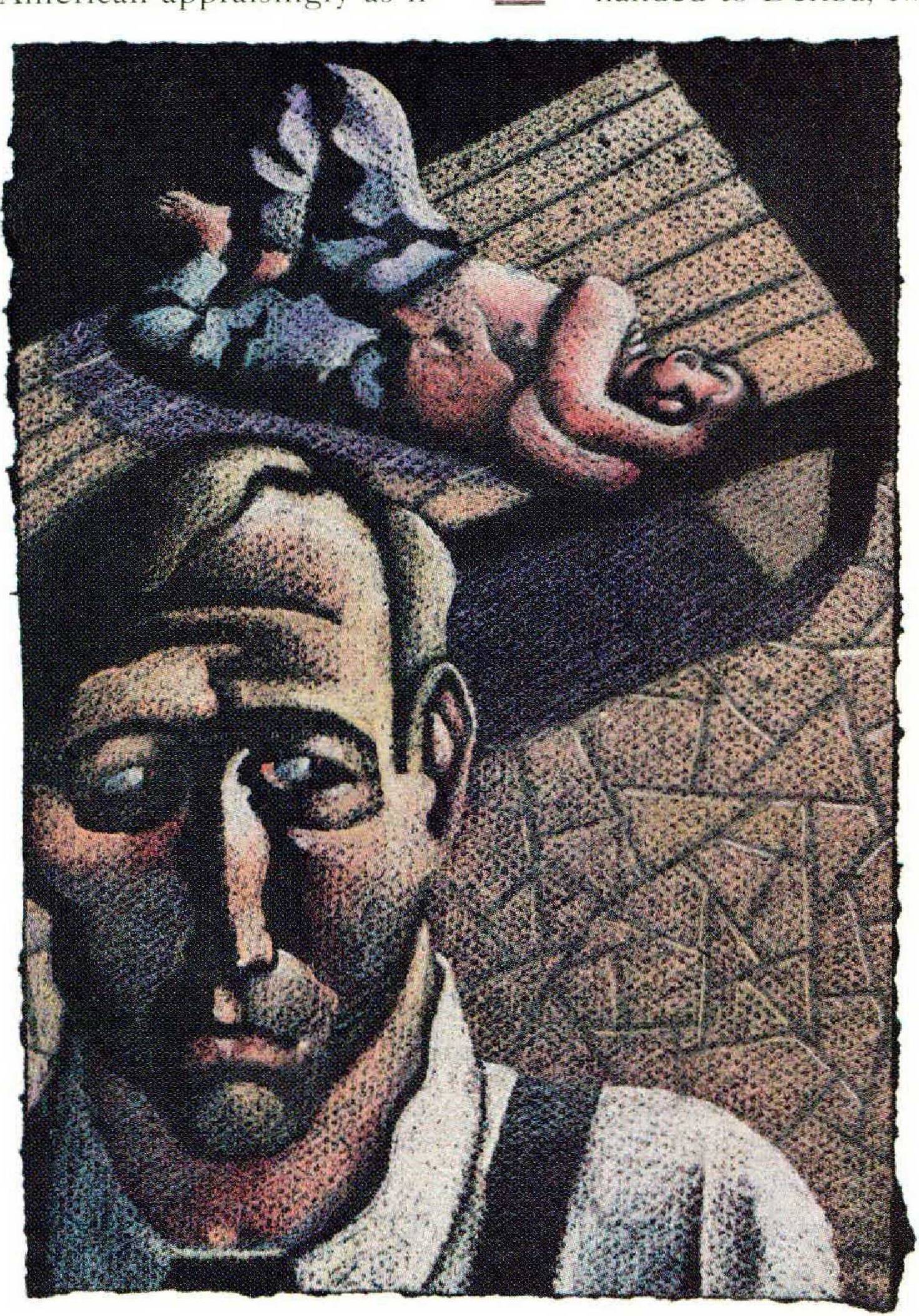
“You are a person of consequence. You are our guest only overnight, and already reporters are inquiring for you.”
“I wouldn’t know anything about that. I am vice-president for customer services of a roofing company. When I was taken into custody, all my identification, including my passport, was taken. Somebody here has those papers.”
On the major’s desk was a plastic tub, like the vegetable bin of a refrigerator, in which Greither now saw an edge of his green passport case showing among papers. “I’m not telling you anything you don’t know. I see my documents on your desk.”
The major was more interested in his file. “Already in your Pittsboorgh Post-Gazette newspaper you are missing. The headline read to me by Miss Bonfils, of your Associated Press, is, I quote to you, ‘Pittsboorgh Man Missing.’”
“I have a family. I guess I could be missed.”
“Is it customary? A man takes a holiday and his family reports him missing?”
“I was traveling on business in the U.S.A. I had a fewopen days. I decided on the spur of the moment to come here. I had no reason to tell anybody I was in any particular place.”
“I see. Let me read more to you. ‘Believed to Be CIA.’”
“That’s absolutely preposterous. Why would anybody say anything like that?”
“Yes, why?”
The major returned the page to the file and took out another. “You have friends. Yesterday morning our direetor of airport security received a letter. I read: ‘Aboard LineaSur Flight 247, arriving from Mexico City 11:35, November 2’—that is to say, yesterday—‘Lowry F. Greither, of the Central Intelligence Agency, U.S.A.’ Signed ‘A Friend of Your Cause.’ So, he is your friend and our friend. Mutual, as Mr. Dickens would say.”
“Major, this couldn’t be more preposterous.”
“Agreed. As the preposterous is not normal, do you wish to stay in detention while it is investigated—as you would do in your own country—or will you tell me now whom did you come to see?”
“I’ve given you the honest answer. Nobody. I don’t know anybody. I’m a tourist.”
“Not, perhaps, Sebastián Olmo?”
Greither showed that that was even more preposterous than what had gone before. “If you are speaking of the man who called out his name in the hall last night, that’s exactly all I know about him. That’s it. No more.”
“You know a different Sebastián Olmo?”
“No Sebastián Olmos. I don’t know anybody. The other man in my cell, Señor Deriba, told me it was Olmo, and the man called out his name. It may have been a guard who called it out. Major, this is all completely preposterous.”
“The man in detention with you knows Olmo?”
“I don’t know who people know here. I was taken from the airplane and put in jail. Deriba was there. I know about Deriba what two men who are together for a few hours and don’t speak the same language know. Nothing.”
“We are not stupid, Senor Greither. We know the CIA has hidden arms in our country. You have come to tell some criminal scum the places. You discuss bombs with Señor Juan Deriba, whom you don’t know.”
Bombs! Greither had weakened the usefulness of “preposterous” and could think of no replacement sufficient to show how utterly he rejected the major’s hallucinations. He tried “lunacy.” What the major was proposing was lunacy. Greither was a man who had taken an impulsive holiday. His arrival may have innocently intersected some piece of intelligence they had. He knew nothing about it. “Bomb” had been just a word said, a misunderstanding about his work, which was roofing, as the file would confirm—
“I see,” the comandante said. “You may look at it differently after another night to think it over.”
He directed the guards to lead the prisoner away. Greither resisted and shouted, “I demand to see the American consul! I demand to make a telephone call to the American consul!”
“Your country does not favor us with consuls,” the major said, as the norteamericano was jerked out of the room.
Behind him in the corridor echoed his demand that the ambassador of whatever country was taking care of U.S. affairs be notified that Lowry Greither, an American citizen, was being held incommunicado in a stinking cell on false charges. The British. The Swiss. The French. The Red Cross. The length of the corridor, up the stairs, down the next corridor.
“Lowry Greither, U.S.A.”he shouted while he waited for the door to his cell to be unlocked. A kick in the pit of his back sent him through the door.
Two guards came, this time for Deriba. He assured them that he would make no disturbance. He wished only to announce his name so that the others would know he was alive and well. ”Yo soy Juan Deriba. Vivo en Quetalorba.” They were on him with blows. An hour later they brought him back, looking like a barefisted fighter who had lost. They dumped him on his bed and went out. He lay on his stomach, face toward Greither, an arm hanging to the floor, his exhalations moans.
“Jesus, Jesus, Deriba,” Greither muttered, “what the hell kind of world is this?” He got up from the bed, straightening against the soreness in his back where he had been kicked. He wet his shirt in the water pitcher and attempted to cleanse Deriba’s bloody face wounds. He let water dribble into the side of Deriba’s mouth and sponged down his back. Deriba struggled to consciousness and turned toward the water cup Greither offered. His nose was unhinged and dripping blood. An ear was swollen fat and torn. Both eyes were bruised over, but he could see, and he kept them on Greither until he finished sucking at the cup. He raised a hand slowly, pointing—
You.
“Me. I.”Greither understood. “I go? I take? No?”
Deriba began again laboriously. Greither leaned to wipe away blood glittering under Deriba’s nose and at a corner of his mouth.
You.
“Me. I taker I give? I give—them ... I give them— you?”
“Mi nombre”
“Your name? I give them your name?” I gave them your name? which he pantomimed as passing a secret.
Deriba replied with a short hiss: “Sí.”
“No, no! I did no such thing. I did not give them your name. No! Do you understand? Savvy? I did not give them your name! What about? What do I have to give? I know nothing.”
Deriba hissed again: “CIA.”
“Not CIA. If they said I gave you to them, they fooled you. Do you understand? I gave them nothing. They fooled you. Not CIA. Do you understand? Nothing!”
Greither continued to reject the accusation every way he knew, until Deriba held up his hand—I.
You? Me?
Now the subject was known and the exchange went swiftly.
I gave them you, Deriba mimed. I gave you to the major. “Le entregué al comandante. Lo siento.” He was sorry. They had confused him, they had beat him, it was done. He turned to the wall.
LYING ON HIS BED IN THE YELLOW LIGHT THAT filtered into his cell, Greither kept a listless eye on Deriba. Greither was hungry and itched from sweat and dirt. Flies taunted him. Where he had been kicked he ached from a bone-deep bruise. He had been taken by barbarians. They could deal with him as they wished. What had Nina thought when the paper called to ask if she knew where her husband was, before the reporter told her what he knew?
Well, yes. down south on business. He called from Tampa last Friday. What’s all this about?
They had a story that her husband was believed to be a CIA agent in a Central American country. What did she know about it?
She would say that was crazy, but she would be nagged bv the possibility. Would she have called David? Dave, I don’t know what to do. Your father disappeared. It’s going to be in the paper that he may be a CIA agent in Central America. Isn’t that crazy? As far as I know, he was in F lorida on a business trip. He called me from Tampa last Friday.
Greither’s defining memory of his son was a Sunday afternoon on the high school baseball field, where he and his son threw liners, flies, Texas Leaguers, grounders, to each other. Dave had fired a liner just as his father took off in a new direction, putting his legs and reach at crosspurposes. The ball was going to pass behind him, no way to get his glove on it. Greither had stuck back his bare hand for the hell of it—and there was the ball, caught! He hadn’t even looked. He tossed it to the boy, who had seen a miracle. No one had ever made a catch like that!
“Okay, let’s pack it in,” he had said, and when David had petitioned for A couple more! One more! he had refused. “Some other time. We should be getting home.” He had not allowed another play to depreciate the moment in which his son had thought he must be one of the great ballplayers of all time.
David would be of little use to his mother. The boy had dropped out of Penn State to go west. His college cadre had been a money-making machine of M.B.A.s and Ph.D.s, and David had been uneducated, too soon married, headed now here in jobs that sounded like they hardly paid the rent. He had some kind of half-ass job doing pest control for a building renovator in Tucson. The son for whom Lowry Greither had produced a miracle was now married for the second time and had never brought his new wife east. Lowry and Nina met her once in Tucson on their way to a Rocky Mountains vacation.
A memory of another triumphant performance drifted into the bleak cell, the scene a restaurant. In Boston to examine the roof of a church, with a day to spare before his next appointment, he had driven a rented car to Provincetown to see what that notorious place was like and had lunched at Ivor’s, a restaurant recommended by people who knew. Before the menu pages listing the specialties of the house was a page of Ivor’s policies having to do with smoking, personal checks, credit cards, service for children . . . As to liquor, Ivor’s waitpersons would serve no more than three drinks to a patron before dinner. Anybody who wanted more should speak to the manager.
Greither had decided to return to the same dining room for dinner, and before walking over from his room he emptied a plastic container he kept in his toiletries kit. It had come into the house with a powdered diet food that Nina had tried, and was a stiff thirty-ounce cylinder with a throat the full diameter and a flat, well-fitted cap— a shame to throw anything like that away. He had retrieved it from the wastebasket to use as a sleeve for his toothbrush holder, toothpaste, shampoo. He emptied and rinsed it, screwed on the top, tucked it into his trenchcoat pocket, and walked up the street to the restaurant. At the table near the wood stove nobody would be seated at his right hand. He draped the coat over the back of his chair.
He ordered a martini and another. He ordered a third. He ordered a fourth.
“We have a policy—” the waitperson said hesitantly, as if she had never before had to do that. She showed him the statement in the menu about three drinks. The manager would have to approve. The manager was the bartender. Approaching the bar, Greither held out both hands to show their steadiness and touched index fingers to his nose.
He asked good-naturedly, “Do you want me to walk line? I know you have to be careful, and I appreciate it, but I’m as good as new. I’d like to stay on martinis through dinner.”
“Are you driving?”
“Walking. I’m staying around the corner, at the Foremast Inn.”
“You’re a pretty goddamn good drinker,” the bartender said to the customer who had had three martinis in twenty minutes. “I’ll tell your waitperson.”
He walked out having wangled eight—six in his pocket, the last a flourish with his dessert cake.
Why had he done it? Who was the joke on?
He hadn’t done it as a joke. He had performed so that the waitperson would say Would you believe it? Eight martinis, and it was like water. So the bartender would think Look at him. Not a big guy either. He had done it so people he didn’t know, people who meant nothing to him, people he would never see again, would say to each other Eight martinis. Like water! They would tell that story for years in the bars of country clubs and cruise ships, a fellow who could handle liquor like nobody you ever saw.
Was vanity genetic, as alcoholism was now said to be? Did his nature predispose him to put six martinis in his pocket, to pretend for his son, to seek unearned celebrity in this terrifying place where they battered a man as a warning to the CIA norteamericano?
He hailed the guard. “Por favor. Tell the major—the comandante, yes?—that the norteamericano wishes to speak to him.”
FOR HIS SELF-RESPECT, GREITHER BEGAN WITH Deriba. “That poor man Deriba believes I implicated him in some way. That is a terrible mistake. He is on my conscience.”
“A good place for him.” The major braced his hands on the edge of the desk, the cigar in his taut fingers aimed like a gun at the prisoner. “You think we are stupid? You think you can come here and tell Deriba and Olmo where the CIA hides weapons and we will not learn of it? You think we don’t know about Rizase? Tell me, first, every name and where the guns are hidden. Then we talk. You have a family. You wish to go home.”
Weapons! Rizase! Who—what—was Rizase? A person? A place? A thing? What a goddamn mess he had wandered into. He could only hold up his hands and shake his head, hoping to convey with what utter, unalloyed sincerity he rejected guns and Rizase.
“I don’t know anything about weapons. I don’t know a Rizase! Major! I am not CIA!”
The “affair” (as he had thought of it, in anticipation) had overshot the mark at an unforeseen speed and was careening on, God knows where, past his stop. He had to get off. He had been shrewd enough to arrange a way to leave before the “affair” got anywhere near as difficult as this, but everything had moved too fast. He had a ticket that showed his absolute right to get off. He presented it. “Hear me out, Major. Allow me a minute to tell you the full truth of the matter. It may sound strange.”
“You do your part. I do mine.”
“You will have to judge.”
“Yes, yes.”
“You read a letter to me that disclosed the time of my arrival on the airplane from Mexico City. It said I was CIA. Could I ask you to take it from your file?”
The comandante considered whether he was obliged to do this. He decided abruptly, snapped back the file cover, withdrew the letter that lay near the top, and squared it on the desk. The prisoner had another instruction for him. “If you feel along the left margin, in the middle of the page, there are two pinholes, an inch apart, one above the other.”
The comandante considered again whether he was losing face by following a prisoner’s instruction. “Porfavor,” Greither urged. “My story is preposterous. The pinholes are my credibility.”
The comandante decided abruptly to investigate further. He picked up the page and fingered the margin as if it were money. He held the page to the light. He did not agree that the pinholes were there. He did not disagree.
Greither said, “I know the pinholes are there because I put them there. I sent you that letter. I denounced myself. If I hadn’t sent the letter, I would be here as an ordinary visitor, not as a prisoner. Is that not so?”
“To the contrary, it is printed in your own country that you are CIA. We are said to be holding you for investigation. The CIA already has spoken its usual lies that it knows nothing about you. You are abandoned. You should consider that and stop playing games.”
“Comandante, what is known in the U.S.A. is in a letter also with two pinholes in the margin. I sent that letter to the Pittsburgh Post-Gazette. I can recite the text to you. We can assume that the Pittsburgh newspaper made an inquiry to the Associated Press, which now asks the CIA and your government for enlightenment. The CIA says it knows nothing, which is the truth.”
The major fluffed his beard, which Greither took as a sign that the argument was getting to him, but he commented with continued disbelief, “Truth, Señor Greither, is not a concept of serpents, dogs, the man in the moon, or the CIA. It may take many days, months—maybe forever —to read the mind of the CIA. Meanwhile, they hide machine guns here for criminals. That is the matter between you and me.”
“Why would I denounce myself if I were CIA?”
“What is the answer Why do you ask to see me? Do you wish to test my patience? You will find out.”
In the conversation he had foreseen as taking place in civilized circumstances between a curious official and himself, he had not imagined that his pinholes, in the event that he had to fall back on them, would fail to be convincing. The comandante was demanding more. The comandante demanded the last coin in his pocket, a keepsake—counterfeit, perhaps—of no value except to himself. It would be a contemptible penny to them, but it was his treasure. He tried to offer it in an appealing way.
“Sir, if you will listen with human understanding. I am guilty of bad judgment only, nothing against your country.”
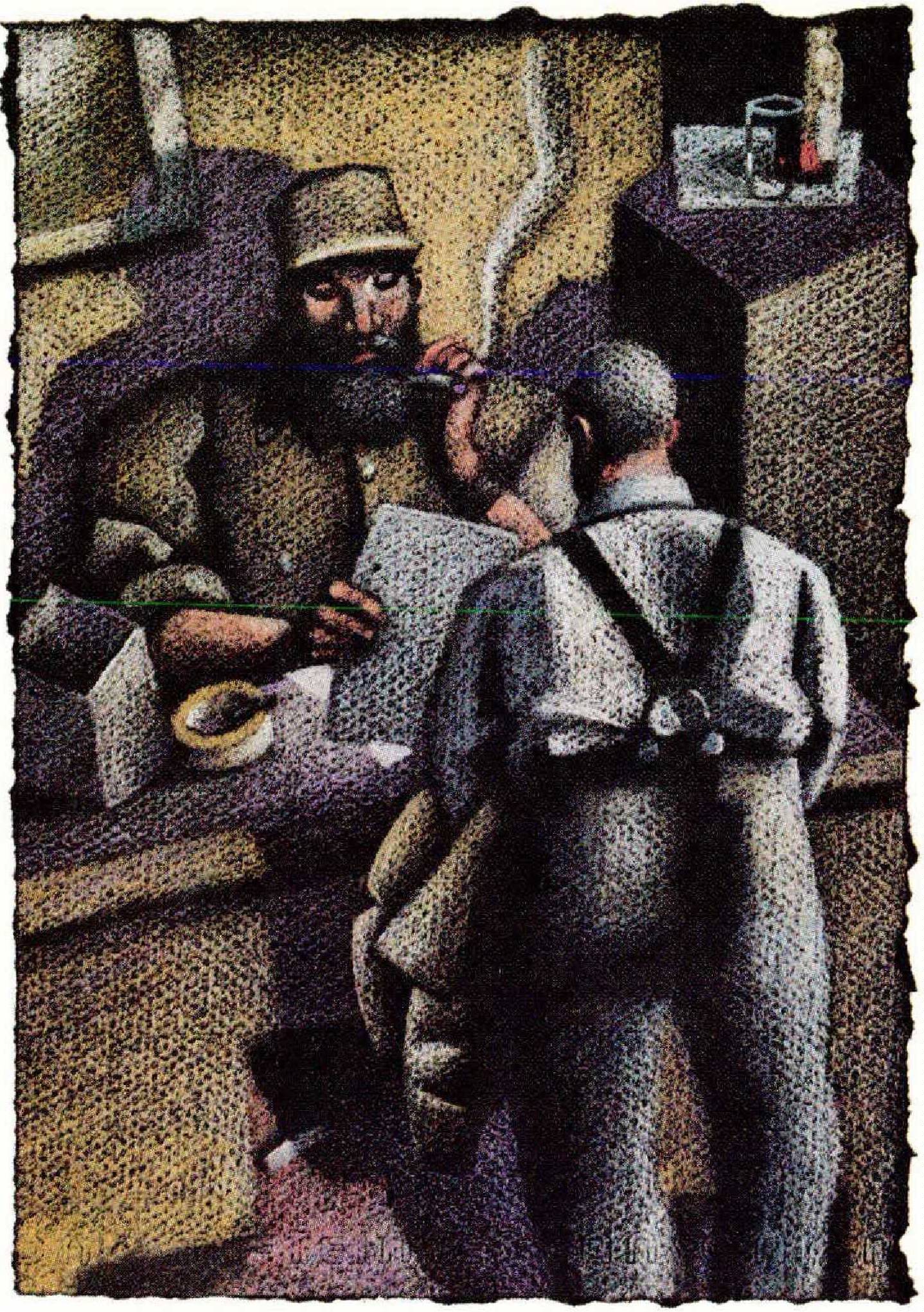
Seeing the major bristle, he began again. “Sir, not everybody has such interesting and valuable work as yours. My company, where I have been for thirty years, has been bought by strangers who live in another city. They have somebody who does the same work I do. I will be disposed of in a month or two. I am nobody to them, a name that can be struck off a payroll. I am not at a good age to feel that I have earned no place in the world.” He heard a slightly operatic cadence in his voice and approved it as appropriate to a dialogue in a Latin country. “I became despondent. I thought to give flavor to my life with a rumor that I am in the CIA. This is not easy for me to say, sir.”
His disclosure progressed from nonsense to nonsense. “I concocted this plan, to denounce myself as a CIA spy and then enter your country and be expelled. I would acquire notoriety. People to whom I had meant very little would have a certain wary respect for me. That’s the whole of it. That’s why I am here.”
Had his peers from work and church been sitting there, he might have chosen to die before admitting such idiotic vanity, as a savage might choose to die before giving a stranger magic power over him by telling his name. Now, having heard himself say it—who could believe it!
“That’s all,” the major commented.
“That’s the whole truth.” “You come from the United States for the purpose of denouncing yourself so you will be expelled? Your reward is to have a shady reputation? You guarantee yourself with pinholes in letters? If I may borrow a word from you—it is perhaps too preposterous to be a lie.”
“Yes.”
“You are a lunatic.”
Lunatics, certainly, were under protection in a country that pretended to be civilized.
The major returned the page to the folder, got up, and came around to Greither’s side of the desk. Greither supposed he should stand also and was halfway up when the major struck him with the flat of his hand on the cheek and then struck him again as the hand swung back.
Tasting the salt of tears and blood from his lip, bewildered and frightened, he shuffled along the cementwalled passage as the guards directed him.
THIS ROOM WAS WHITEWASH CLEAN, WITH ONLY one cot and a closet that closed with an oilcloth curtain. The light was no better than in the other, but it could be switched on and off with a string. Again, the only decor was a portrait of the youthful colonel supporting his hat. A clean pot, paper, a washbasin with a cold faucet, a cotton towel that rolled on a spindle, a table, and a chair.
In the early afternoon of the fourth day his son arrived, pushing a flop of brown hair back where it belonged, dropping his striped gym bag on the floor to free a hand for shaking. His face wore a broad look of inquiry.
“What the hell’s going on, Dad? Are you okay?”
“David! Okay, fine, yes.”
David saw the blistered lip and put his finger toward it in inquiry. “Nothing. Accident.”Greither signaled bugs. What they said should be circumspect.
“We’ll talk about that. Yeah. You’re in the newspapers —you’re famous. I’ve been in a hotel here for three days trying to get to you. Get packed. We’re outta here. We fly at four-thirty.”
“How did that happen?”
“Crank it up. The army jeep I came in is waiting. The comandante says to get you out of here. We don’t need two invitations, do we?”
Had the comandante left the CIA legend intact? Had he told Dave about the pinholes? Had he ridiculed him to his son?
“You talked to the comandante? The major with the beard?”
“He talked to me. I was in his waiting room. He came out of his office and said, ‘Take that man out of my country on the next plane. We have had enough of him here.’ A lieutenant took over. He asked me if I had airplane money. Hell, yes—they wouldn’t give me the visa to come in until I showed them Express checks for two thousand dollars. Let’s go—walk and chew gum.”
Greither tried to catch up with the take-charge manner of this young man who got on a plane in what he happened to be wearing: chinos, blue shirt, yellow socks, loafers. Two thousand dollars in his pocket, heading a rescue mission, telling his father to move it, move it. He had always been an uncertain quantity, a boy without ground to stand on, without a trade or profession, his only firm ambition a desire to be out west. Behind the scenes they seemed to have exchanged places, and the father had become the uncertain quantity.
“How is your mother taking this? Did you see her?”
“She’s all right, but she’s in a fog. I didn’t see her. We talked. It made more sense to shoot down here from Tucson without going east. The first I knew was when Mom called. A reporter from the Post-Gazette had been after her. They had a tip you were doing something for the CIA down here.”
“What did she tell them?”
“She said that was crazy.”
“That’s your mother.”
“She said you were in Florida inspecting roofs. I called your company office. They said the same thing. I called the CIA. They said they had had press inquiries but that they didn’t know anything—you didn’t belong to them. I wouldn’t expect them to tell me if you did. I got back to the Post-Gazette. They seemed to be the source. They faxed me a copy of an anonymous letter. They had been bound to follow it up. After all, Dad, you are disappeared.”
David was reaching for a denial or an affirmation that Greither did not want to give. He could tell a bug a story it already knew. “The bottom line is that I had a free weekend. I had been reading about this country. A newspaper story said they were promoting visits by Americans, and I had an impulse. I flew to Mexico City, where I knew I could get a visa, and then came here, where they socked me into this jail.”
“No reason?”
“They thought I was CIA.”
“You didn’t tell anybody you were leaving the country?”
“I thought I would be in and out in a couple of days. I didn’t want your mother to worry about my being in a place where a revolution was in progress.”
The story was sufficiently unconvincing. The legend would be nourished by ambiguity.
“You didn’t want her to worry? Okay. All set? Let’s get this show on the road.”
At the terminal the lieutenant went inside to order that the norteamerieanos be boarded without a lot of queuing and paper-shuffling. The familiar flight attendant greeted him with her anxious, simpatico smile. He was recognized. “You see?” he said to her. “No problema.”
They took their carry-ons to seats on the twin side. For the first time, they felt free to talk. Dave slapped his lather on the knee.
“Our man from Pittsburgh. So what’s going on?”
“Nothing’s going on. I got here at the wrong time. They think the CIA stashed machine guns and bombs somewhere. They were sure I was an agent, here to pass the word to locals.”
“And you’re not. Right?”
“Now, David, why would you even entertain such a question?”
David unzipped his bag and took a newspaper clipping from an envelope. “I told you you were famous.”
Over two columns was the report that Lowry F. Greither, an executive of GRM Inc., a resident of the Shadyside district of Pittsburgh, had been detained in a Central American country. He was said to be connected with the Central Intelligence Agency. An agency spokesman denied that the CIA knew anything about Mr. Greither or the reason for his presence in a country to which travel by U.S. nationals was discouraged.
That it was a front-page story was impressive. A few inches on page eight was more like what he had had in mind. No amount of denying would ever quite kill a story like this. Years later people would say, “Greither. Isn’t he CIA?”
“Why would they print anything as irresponsible as that? It could get a man killed.”
David unfolded another page. “This is what got the newspaper on it. They faxed me.”
Greither felt his face being watched while he read the letter he had sent to the Post-Gazette from Mexico City. He held it to the light casually. It was a good fax. The pinholes had printed as dots.
“I don’t know what they’re talking about. I can’t imagine why anybody would send a letter like this. Some nut must be loose in Mexico City.” He handed it back. “I don’t know how to begin to deal with it. Let’s forget it. How is your wife? Tell me about your business.”
“Janice is fine. We just opened our fifth branch. One thing I didn’t know about the West: You see those photos of geologic strata, like seven-layer cakes. They don’t tell you that one of those layers is termites. The whole Southwest is underlaid with termites. You keep the oil. I’ll take the termites.”
Greither learned about the pest-control business while the airplane took off and climbed through overcast onto a surf of white clouds. The engines throttled down until the plane was cruising at a speed that seemed no more than that of a car looking for a parking space. The attendant came down the aisle on no particular mission. The norteamericano raised a finger for her attention.
“Par favor, señorita. ”
“Yes, sir.”
“Is the crew all from Mexico?”
“Some. The capitán is Costa Rican. I live just near Ciudad Linares.”
“Do you know the village Quetalorba?”
“A small place. Over the mountains.”
“Do you know the village Ayotla?”
“Ayotla del Rio. St, señor. I have never been there. You visit there?”
“No. I know people there I would like to send something to.”
“You could send a letter maybe?”
“What was that all about?” David asked, when his father released the señorita to her other duties.
Greither told him of the prisoners and the responsibility that weighed on him. He was forming a plan. He would put traveler’s checks and a letter in an envelope intended, eventually, for Deriba and Olmo and entrust them to the girl, whose face he had confidence in. He knew the names of their villages. He would give her, say, fifty dollars for her trouble. If she couldn’t do it, she could get somebody to do it.
“You want to send American traveler’s checks into those villages?”
“It could be cash. We could get pesos in Mexico City.”
“You would have to tell the girl everything. She would be a CIA courier as far as they’re concerned.”
“Of course I would tell her everything. She would go in with her eyes open.”
“You think she would do that?”
“I don’t know.”
“You think you should ask her? She could go right to the police.”
“No, I don’t think she’s the type.”
“Lotsa luck.”
Greither thought he had said enough. He heard himself sounding unprofessional. David would expect a CIA agent to go about his schemes in a more resourceful way.
After an hour in the air Greither decided against asking the girl to carry money and a message to the families of Deriba and Olmo. The mission was too dangerous. He had no right to enlist her in anything like that. And to send money—even to put a letter with a foreign stamp in the mail—to the family of a man already in custody as an enemy of the state would be mindless. Maybe in five years peace would be declared and he would make a trip. He could rent a car and show up in Quetalorba and ask for Juan Deriba, who had an orchard, who trimmed trees.
They dipped into the acrid air of Mexico City. He closed his briefcase and thought about what he was going back to. He might not have a job. On the other hand, the new owners might in some way be intimidated by this affair and delay a decision that had ramifications involving the government. Someone might have a job for him in Washington—one of those ambiguous jobs like “government relations.”
They were disembarking. He said good-bye to the señorita who did not know of the adventure for which she had almost been enlisted. Walking from the end of the ramp, David touched his father’s arm and said again, perhaps in amusement, perhaps to keep the question in play, “Our man from Pittsburgh. Wonderful.”
David would never quite know, nor would Greither’s grandchildren, when they came, or Nina or anybody in the church. Only the CIA knew, and nobody believed them. Nobody else anywhere would know, but many would have heard something, and people who spread rumors didn’t think of innocence as an option. He looked forward to being met by reporters and putting their questions aside.
“Preposterous. What do you expect me to say? I won’t even dignify anything like that with a denial”—walking on, like any man too busy to deal with nonsense. All conditions—even despondency, even if he were rejected by his class—were endurable for a man sustained by such a legend.