Washington for Beginners: Seeing Our Capital as Others See It
by James Fallows
TOURISTS hit Washington in two great waves. In the springtime come the high school students, for their class trips and civics programs. They jam the fast-food restaurants; they form unruly lines outside the Capitol and the White House; they buy souvenir T-shirts. In the summer come the families—the Americans by van and station wagon, the foreigners in mammoth tour buses lumbering through the main streets. I find myself smiling when I see the students. Some are goggle-eyed at the monuments and famous buildings. Most are flirting with each other and disobeying their teacher-chaperones. The town’s spring foliage looks fresh at this time of year, and so do the kids.
I try not to notice the families, because when I do, I wince. They may later tell themselves that they had a great time in the capital, but most of them look miserable. The city is hot, they are hot, and they move around in sweating herds. The foreign tourists (you can pick them out instantly by their nicer clothes) move in organized groups—Japanese groups following tour guides with flags, Europeans clustered around guides speaking German or French. The Americans—dad and mom in tank tops, junior in backwards baseball cap—form one great mass trudging from the White House to the Air and Space Museum across the dusty Mall.
I sometimes wish I could take some families aside and say, “Look, this doesn’t have to be so hard.” Often my wish comes true, when friends from Europe or Asia visit my family in Washington and ask for advice on sightseeing. In return for our help we get a vicarious sense of what is surprising, impressive, and alarming in a city whose quirks we rarely notice anymore. Occasionally we’re jolted into seeing Washington through foreign eyes.
When the visitors are Japanese, we beg them to come in the spring. That is the best time for anyone to visit Washington, despite the teenagers’ assault, because the flowering trees make the city into one big arboretum. It is especially important for Japanese visitors because of the cherry blossoms. The blossoms that count are not on the famous trees along the Tidal Basin, near the Jefferson Memorial. Those trees were donated by the Japanese government before the First World War and are the stars of the annual Cherry Blossom Festival, but somehow that festival never works out. It’s too cold and the buds freeze off, or it has been loo warm and the blossoms are gone, or a big wind has roared through and blasted the petals into the Chesapeake.
The special cherry blossoms are several miles away, in the ritzy district of Bethesda called Kenwood. This is the kind of district that has its name on a plaque by the entrance gate, and an accompanying country club. Also, William Safire lives here. But I forgive Kenwood a lot because of its dense stands of sakura, Japanese flowering cherry trees. The trees are so old, so large, and so thickly planted that when they bloom, in March or April, their branches form a pinkish-white canopy over the road, obscuring the sky. In several seasons of o-hanami, or “blossom-viewing,”in Japan, I saw nothing as breathtaking. Two springs ago, while hav, ing a tedious argument about trade policy with a visiting Japanese official. I said, “Let’s not spend the day this way. I’ve got something to show you.” We drove out to Kenwood, and I let him walk for an hour under the trees. As I had hoped, he felt both comforted (about this bond that transcended politics) and overwhelmed (by America’s power—even to produce cherry trees!). “We—we do not have this,”he finally said.
MY family has not yet had visitors from rural China, but when we do, I will take them to the downtown and suburban avenues that are lined with gingko trees. In the fall thousands of gingko fruits litter the ground near each tree. Most Washingtonians hate the trees then, because when trod underfoot, the fruits reek like vomit. Early in the morning these same trees are surrounded by peasantlooking Asians, collecting fruits (their hard kernels are apparently a delicacy) from the branches and ground before they can be squashed. Visitors from Germany perk up when sent on healthful Sunday walks in Glover-Archbold Park, with trails that run for miles through northwest Washington. The better-known walking routes, on the C&O Canal towpath and in Rock Creek Park, are less enjoyable, because they are also jammed with bikes. If I could identify a group of Swiss mountain folk among the tourist throngs, I would urge them to escape the Mall and drive fifteen miles up the Potomac to Great Falls. This is a surprisingly scenic gorge, with trails on both the Maryland and Virginia sides. A “Billy Goat Trail,”on the Maryland side, takes several hours of jumping from rock to rock to negotiate.
Visitors from Northern Europe should arrive in the dead of winter. The weather is mild by their standards, but every two or three years it is cold enough in Washington to freeze the same C&O Canal into a marvelous Brueghelian skating course that leads for some twenty miles alongside the Potomac, from Georgetown well past Great Falls. I rarely think of Washington as charming, but it is exactly that on bitter February mornings by the canal. As we sit on the bank lacing up our skates, the only sounds are the click, click of long speed skates and the bursts of chatter in Dutch or Russian from happy groups whooshing by.
These attractions are ways of showing foreigners transplanted versions of cultures they already know. Of course, it is also valuable to show them slices of life quite different from what they would see at home. Even a city as display-conscious as Washington offers several unselfconscious revelations about American ways.
EVERYONE comes to Washington prepared for one of these revelations: the clichéd contrast between power and misery, with drug pushers operating in the shadow of the Capitol. Actually, most visitors see less of this contrast than they expect. The worst areas of New York and Chicago look terrible. The poorest and most dangerous areas of Washington, like those of Los Angeles, don’t look as ominous as they are.
Movies and TV documentaries have prepared most foreigners to see bombedout neighborhoods. Nothing has prepared them for vast middleand professionalclass African-American neighborhoods, like those of upper Sixteenth Street and Rhode Island Avenue. Washington’s most interesting sociological journey is a drive (or long walk) straight up Sixteenth Street, starting at Lafayette Park and the White House and ending at the very northern tip of the District of Columbia. The mansions and civic buildings along the way are virtually a fossil record of successive ethnic and religious waves— the huge Masonic temples, the synagogues, the enormous African Methodist Episcopal churches. On either side of northern Sixteenth Street is perhaps the most extensive mainly black luxury-housing area in America. (As a bonus, the Walter Reed Army Medical Center is also just off Sixteenth Street. Its National Museum of Health and Medicine contains an amazing assortment of ghoulish specimens and displays, the sight of which you may try to forget but never will.)
Some white residential areas of Washington also surprise many visitors. (Only a few of the city’s neighborhoods are integrated.) Suburbs like Potomac and Chevy Chase, in Maryland, and McLean, in Virginia, fit a pre-existing picture of what nice suburbs are like. The big houses on leafy streets off Foxhall Road—white Washington’s more bucolic counterpart to upper Sixteenth Street—are surprising because they are less than three miles from the White House. I was driving an intense European scholar through these areas at a time when politicians in Washington had just taken an unusually frivolous step. “This is why Americans cannot be serious,”the European exclaimed as he saw a mansion in Spring Valley, surrounded by graceful tulip poplar trees. “You live in a park!" In fairness, these same sylvan dwellings have housed many Americans notable for their seriousness, from Richard Nixon to Ira Magaziner.
Another surefire source of fascination for foreign visitors is found thirty miles south of Washington, off Interstate 95. The famous U.S. Marine Corps training site at Quantico is in this area, but few foreigners care about that. They are drawn instead by Potomac Mills, one of the biggest outlet and discount malls on the East Coast. Every store in America looks like a bargain center to European and Asian visitors. Malls like this, where prices are low even by U.S. standards, first stun the visitors and then send them into a buying frenzy. Just as lazy babysitters set children in front of the TV rather than try to entertain them, when we feel tired we ship foreigners off to Potomac Mills, knowing that they will return loaded with new possessions and grateful for this travel tip.
HAVING done my share of guiding visitors around town through the years, I thought recently that I should let myself be guided by them. I signed up to join two groups of foreigners as they went on Gray Line’s special multilingual tour buses. One group was Europeans and West Africans who listened to French as they rode around town. The other was visitors from Japan. I was hoping to overhear some embarrassingly biased narration— bragging about Lafayette and l’Enfant, for instance, in front of the French-speakers. In this I was disappointed; the narrations were faithful translations of Gray Line’s English tour. But the tours showed me the city in a completely new way.
The Gray Line tours, which leave from Union Station, near the Capitol, are either four-hour or all-day bus rides through Washington and Arlington. A four-hour tour on the multilingual bus, which has headsets with a choice of narration in English, French, German, Spanish, Italian, Japanese, Chinese, or Korean, costs $28 for adults. As a resident, I had long resented the huge buses, preferring the more picturesque Old Town Trolleys that take visitors around the Mall and embassy areas. (The trolley trip takes about two hours and costs $16. Also, the National Park Service operates a Tourmobile, which stops at all the major monuments and costs $9.)
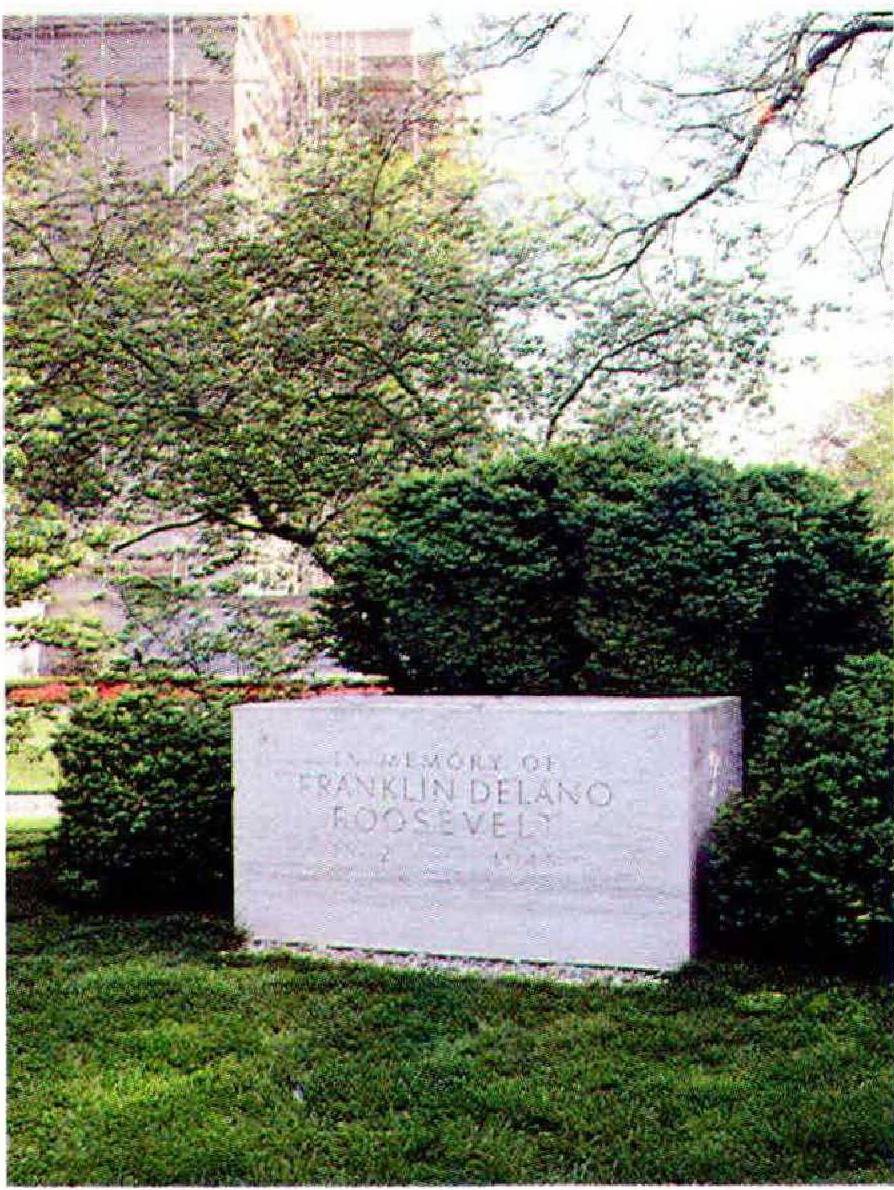
My attitude changed once I climbed aboard a bus. Inside, it was spacious, cool, and comfortable. Most important, it was high. I could see over the tops of jammed-up cars and the heads of bustling pedestrians, straight to the buildings and monuments. The tours pointed out only one thing I had never seen before—a tiny monument to Franklin Roosevelt near the ugly headquarters of the FBI. But for the first time in years I looked at the city’s famous structures and the story they were telling foreign visitors.
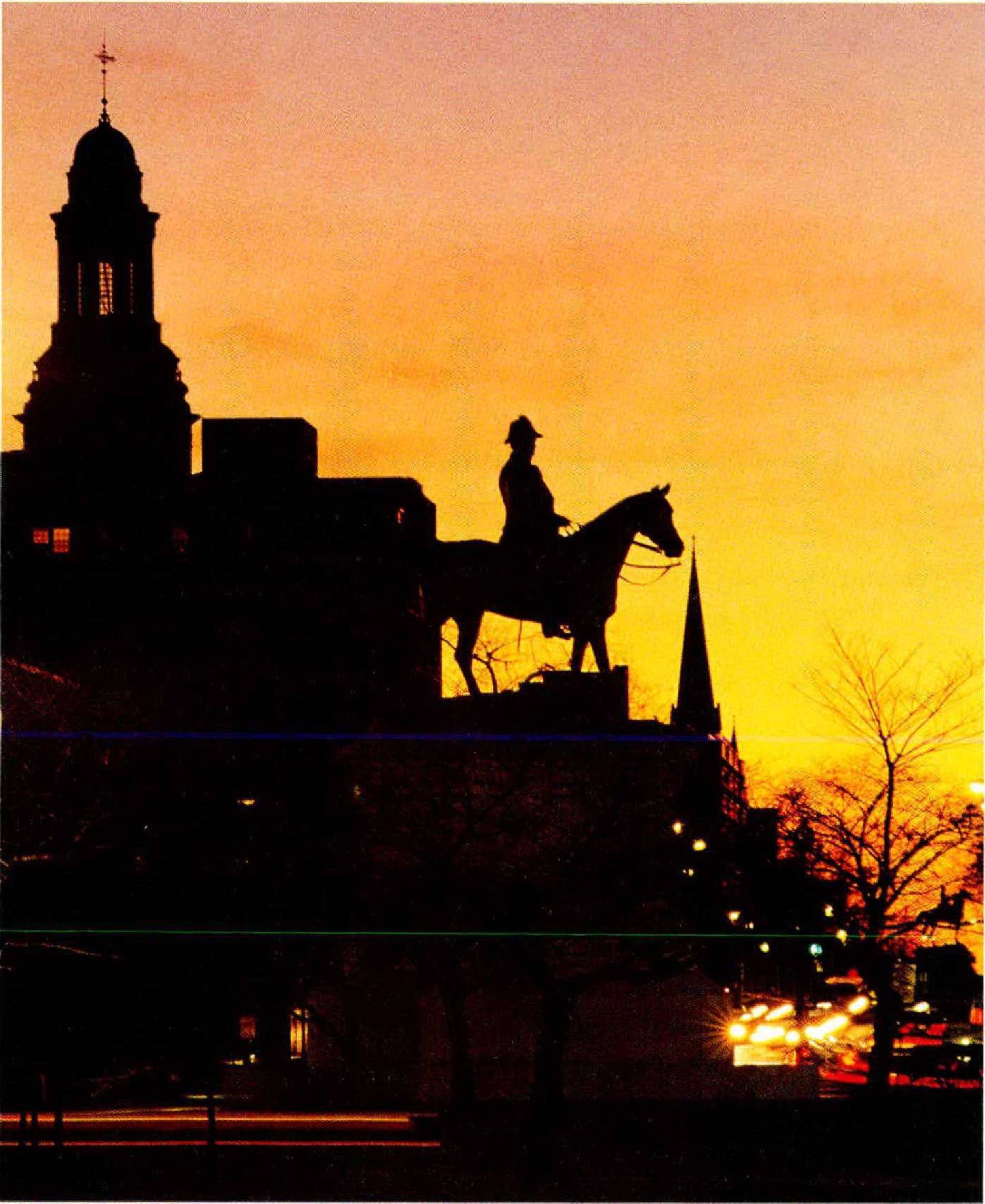
Much of the story, as with any set of monuments, concerns war. Washington has many equestrian statues, nearly all of generals. The U.S. Marine Corps War Memorial, better known as the Iwo Jima monument, lists all the campaigns in which leathernecks have fought—followed by an impressive amount of empty space. (The French-speakers talked as if they were impressed. The Japanese visitors took pictures of each other with the monument and the Potomac in the background.) Maya Lin’s design for the Vietnam Veterans Memorial seems more a work of genius with each passing year. Monuments—it becomes clear, when you see dozens in a day—are touching attempts to grant immortality, by preserving names to be seen when their bearers are dead. The Vietnam memorial is the only one to immortalize all who died for their nation on the battlefield.
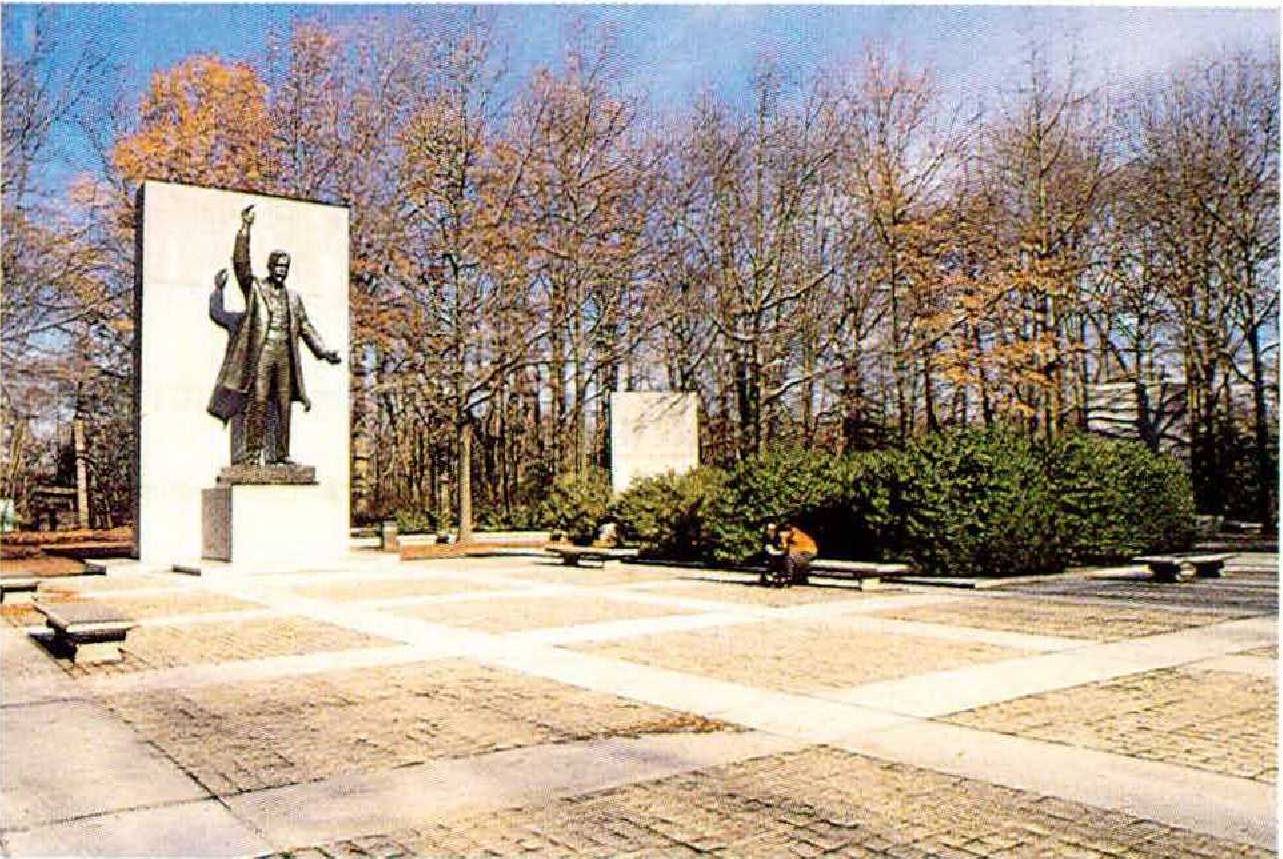
Yet the message that struck me more, as I tried to see what the foreigners were seeing, was how much work over how many years has gone into holding the country together. The challenge that faced Lincoln during the Civil War is only the most extreme example. Apart from the generals, almost everyone honored with a plaque, a statue, or a building in Washington devoted his or her life to building the institutions through which self-government operates. The institutions didn’t grow by themselves. The statue of Albert Gallatin outside the Treasury, of A. Philip Randolph inside Union Station, of Teddy Roosevelt on Roosevelt Island, in the Potomac—these and dozens of other symbols on the tour were reminders of architects and builders whose best efforts had allowed a functioning national structure to arise. Perhaps the new congressmen arriving in Washington should take an outsiders’ tour of the city, to get an idea of the structure’s history before they begin taking the thing apart.