February 1995
In This Issue
Explore the February 1995 print edition below. Or to discover more writing from the pages of The Atlantic, browse the full archive.
Articles
Street Scene
Minor heroism in a major metropolitan area
Green Fields
A Prophet Without Honor
Poetry Contest $24,000 in Prizes
A Feather on the Breath of God
Family Secrets
The Back Book
The Back Book
Great Woman of the Bible
The Hippopotamus
Noah's Choice: The Future of Endangered Species
The History of the Blues
The Puzzler
Word Watch
A selection of terms that have newly been coined, that have recently acquired new currency, or that have taken on new meanings, compiled by the executive editor of The Americ an Heritage Dictionary of the English Language. Third Edition.
The February Almanac
The Great Profile
A Portrait of the Artist in Motion
Hell to Pay in the Windy City
Radical Legacy
Resurgent Saxes Make the Scene
Invoking an "Alternative" Muse
In a Global Groove
Sound Sensation
A Prince, His Brother, His Wife, and Her Lover
The Long Good Bye
Washington for Beginners: Seeing Our Capital as Others See It
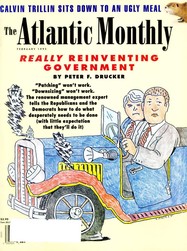
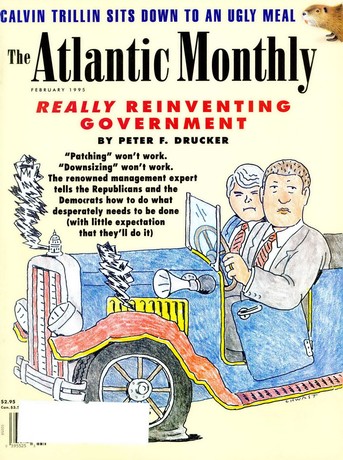
Really Reinventing Government
Both parties promise to reinvent government. We asked the father of corporate restructuring to show them how.
745 Boylston Street
Contributors
Who Was Shostakovich?
To his fellow citizens he was a great artist and a patriot. In the West he was seen first as an anti-fascist hero, then as a Soviet toady, and later as a dissident. To critics and musicians he was either a keeper of the symphonic flame or a clumsy provincial who was debasing musical values. To our author he is not only the greatest Soviet composer but the greatest Soviet artist of all, and the creator of what may turn out to be the twentieth century’s most precious artistic legacy—precisely because his music can never be fully understood
Changing Seasons
After Viewing the Bowling Match at Castlemary, Cloyne (1847)
Died and Gone to Vegas
“That story’s sadder’n a armless old man in a room full of skeeters,” Raynelle said. “You sorry sons of bitches tell the depressingest lies I ever heard.”
The Diphtheria Zone
On Responsibility and Punishment
Consider the following propositions: First, because human behavior is ultimately determined by outside factors, human beings cannot be held responsible for their actions. Second, punishment doesn’t work anyway. These propositions are legacies of modern psychology. And, the author argues, they are nonsense
Works
Bridge Between Cultures: Chinese Bridge Players Are Ready to Take on the World
A Voice for the Underdog
Studs Terkel’s vanishing kind of decency is on display in a taped sampling of his radio show