December 1955
In This Issue
Explore the December 1955 print edition below. Or to discover more writing from the pages of The Atlantic, browse the full archive.
Articles
New Books for Children
MARGARET FORD KIERAN was Children’s Page Editor of the Boston Herald for twentythree years. She is the author of a juvenile, David and the Magic Powder, and coauthor with her husband, John Kieran, of John James Audubon.
Accent on Living
Toyland Revisited
CHARLES EINSTEIN is the author of many articles and three novels. He lives in Ardsley, New York, where he devotes his full time to writing.
Lament of the Wife of a Psychoanalyst
Marta the Dog-Lover
This is the third and regrettably the last account of Marta, the great irordseramblcr. hy JOSEPH HENRY JACKSON, whose death earlier this year ended, his long and distinguished, career as literary editor of the San Francisco Chronicle.
Hitchhiking in Europe
LOUIS MCINTOSH is a young Londoner who has developed the subtle art of being a motorized pedestrian on many a Continental trip.
Wonder Fabrics Make Me Wonder
Renewals if Needed
JOHN M, CONLYis a former New York and Washington newspaperman, now editor of High Fidelity Magazine. “ They Shall Have Music" is a quarterly feature in the Atlantic.
Record Reviews
Australia
Science and Industry
Competition in Transportation
There is tumult in transportation circles today arising out of proposals by a Cabinet Advisory Committee recommending major changes in national transportation policy. Only the railroads, among all forms of transport, are actively campaigning for these recommendations which are the outcome of a request made by them. Here is the viewpoit on competition in transport held by a leader in one of the newer forms of transportation.
Letters to and From the Editors
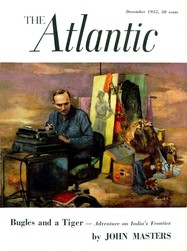
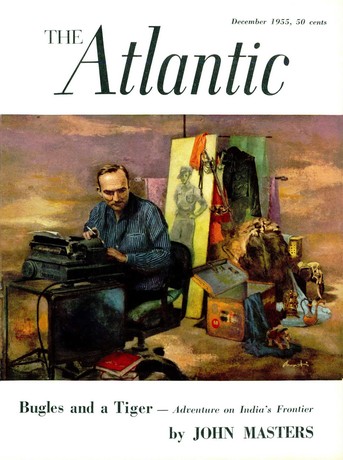
Bugles and a Tiger: Adventure on India's Frontier
An Englishman whose family has lived in India for four generations, JOHN MASTERS was born in Calcutta and Observed the family tradition by srvting for fourteen years in the British Army, in the course of which he was awarded the DSO. In 1948 he moved to this country and made his first appearance in the Atlantic— he says. ” which encouraged me to persevere ” With his first novel. Nightrunners of Bengal, he took command of a large audience, and each new book thereafter has added to his popularity. This is the first of two installments from Bugles and a Tiger, which Viking will publish early in the new year. An autobiographical volume, it is the story of his early years in the Indian Army, and it gives the clue to the writer who was to be.
Tropical Africa
The Way the New India Thinks
The son of an Irish mother and an Indian father, AUBREY MENEN is an English writer who makes his home in Amalfi. While still an undergraduate at University College. London, he was “discovered" by the late H. G. Wells. Mr. Menen began by writing plays for the Experimental Theatre in London. During the war he rose to be the leading radio personality in India, and since 1947 he has devoted himself almost exclusively to his novels, which have been published with steadily increasing interest in this country.
Christmas Eve at Chartres
Billingsley's Bird Dog
A Houston lawyer who served in the Middle East and on the War Department General Staff during the War and who last year succeeded Robert Cutler as Special Assistant to the President on National Security Affairs, DILLON ANDERSON, like all Texans, has a special fondness for poker and bird dogs. Occasionally he goes quail shooting with a good friend, Billingsley, and Billingsley’s Old Ruff is a bird dog which has to be seen to be believed.
The Bounds of Space and Time
A leading, astrophysicist, DONALD H. MENZEL,Director of the Harvard Observatory, is the author of several books in the field of physics, radio propagation, and astronomy, and his book debunking flying saucers attracted wide attention. In the following paper, adapted from a lecture given at Birmingham-Southern College, Dr. Menzel discusses the current theories about the end of the world and then draws his own picture of the future.
The Blue Image
CRARY MOORE is the pen name of a former Bostonian who moved to Cambridge after her marriage two years ago. ”Here" she writes, ”YOU see. and marvel at, the everyday doings of tremendous intellects. You also meet their wires.” Her story of an anniversary gift, and of haw it catalyzed mind and heart, is one to remember. It marks Miss Moore’s fourth appearance in the Atlantic.
Hark, Hark, the Lark
Creating a School
WILLIAM ERNEST HOCKING was called to teach at Harvard, his alma mater, in 1914. He had married Agnes Boyle O’Reilly in 1905; she was already a teacher, endowed with much of the humane fervor of her father. Toward the end of their first soring in Cambridge she embarked with his backing and aid on a parent-teacher experiment from which was to emerge the school now nationally known as Shady Hill. The spirit which they and their associates imparted to the instruction, and the principles which they evolved as they went along, deserve most thoughtful appreciation at this moment when so many classrooms in America are bursting at the seams. Perhaps once again it is a time when parents can help.
The Army Invades the Wichita Mountains
Sportsman, author, and conservationist, CLARK C. VAN FLEETis a native Californian who for more than four decades has roamed the forests and fished the streams of the West Coast. Like every true lover of wildlife, he is appalled by the carelessness with which politicians and government officials invade national parks and game sanctuaries which were thought to be inviolate. In the case he is describing, the Pentagon is to blame.
Dr. Flesch's Cure-All
The Spoiled Honeymoon
The Peripatetic Reviewer
Books: The Editors Like
Reader's Choice
The Fabulous Originals
The Inmost Leaf
From Van Eyck to Botticelli
Historical Inevitability