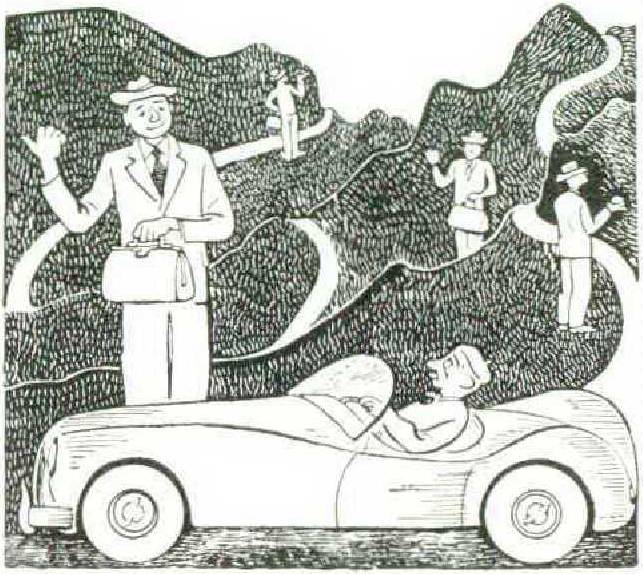
Hitchhiking in Europe
LOUIS MCINTOSH is a young Londoner who has developed the subtle art of being a motorized pedestrian on many a Continental trip.
by LOUIS McINTOSH
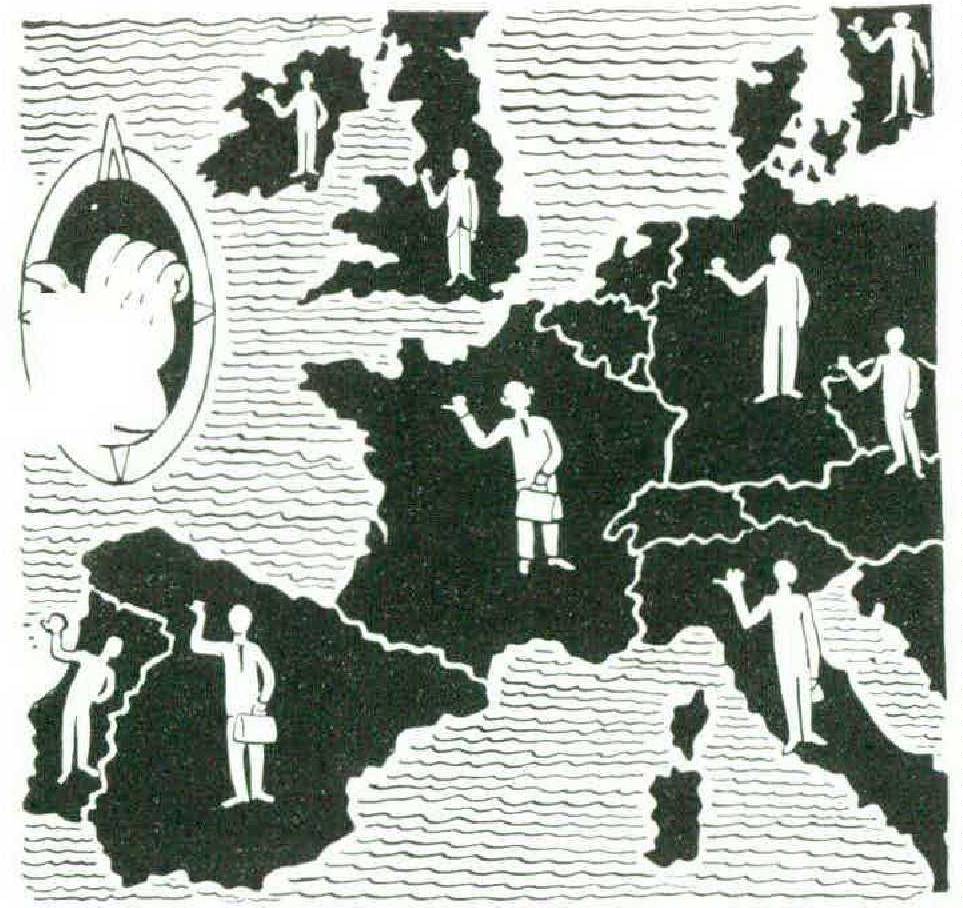
TO HITCHHIKE intelligently in Europe, it is necessary to know something about the different attitudes which the various nationalities adopt toward it.
In England the practice still has, like begging, a slight disrepute. English car-drivers will excuse the infrequency and expense of their country’s public transport for having caused you to travel in such a humiliating manner. Lorry drivers are not allowed to give lifts, but do so to have someone wake them up when they go to sleep at the wheel. They suspect foreign girls of being immoral, but are invariably disappointed to find that they are not. English women under forty-five never give lifts—not for fear of what hitchhikers might do, but for fear of what other people might say.
The French take such delight in explaining to foreigners the qualities of their country and the defects of their countrymen that they are very ready to give lifts. Thus in France it is most important to look foreign, but not so foreign as not to understand French; the French do not speak English, least of all when they try to. French motorists are proud of their driving, which looks dangerous but isn’t, like a moon rocket at a fair. When they are giving anyone a lift, all their exhibitionism comes out, and one is liable to be deafened by the screech of the tires and the rant of the horn, which in some French cars can be switched on — and left on.
Italy is the most enjoyable country to hitchhike in, though not the easiest. Italian cars go so fast (by my slow-moving British standards, anyway) that it must be difficult enough for the driver himself to slop them, let alone the hitchhiker. But once you do succeed in stopping an Italian motorist, he will take charge of you in the most charming way. He will treat you to one of those bitter aperitifs (such as Caprino, whose name suggest some inscrutable link with goats) to whet your appetite for the huge lunch which he will spring on you in the next big town. After lunch, he will take your photograph and show you the sights. Of course he expects you to do the same for him when he comes to your country, but then he never does come. (One day I shall have to give lunch to twenty Italian traveling salesmen in an Oxford College Hall — they will insist on this setting — followed by a visit to the St at ue of M it liras.)
Hitchhiking in Germany is a form of public transport and will probably be nationalized one day. German hitchhikers form trade unions, and foreigners are made to feel that they lack a work permit. But if you take your place in the queue on the . Autobahn, there is no difficulty in getting a lift. Once at Stuttgart I found that the next man in the queue was a professor on his way to Augsburg to deliver a lecture on the history of art.
Only Moroccans hitchhike in Spain, because it is impossible. In any case there would be little point in it, as the railways are very cheap and possess all the romance and uncertainty of hitch hiking.
Swiss motorists once read in a newspaper that a hitchhiker robbed and killed a motorist. Since then they have not given lifts. Swiss hitchhikers once read in a newspaper that a motorist robbed and killed a hitchhiker. Since then they have not hitchhiked.
The Belgians love to show off their cars — especially if they are American cars — as opposed to the French, who show off their driving, which is often a personal triumph over the car. I shall always remember the corpulent Belgian industrialist who offered me a cigar and, as the conversation became more intimate, asked with a sly leer:
“Et les jeunes filles anglaises—elles out le sex appeal?” I told him he would probably meet some hitchhiking and be able to judge for himself. Hitchhiking provides pleasant surprises for motorists as well as for hitchhikers.