




Onion Soup with Parmigiano-Reggiano and Mixed Cracked Pepper
Marinated Radishes with Parsley
Sweet Glazed Carrots
Slow-roasted Zucchini with Balsamic Vinegar
Red Snapper Sautéed with Fennel Seeds, Tomato, and Vermouth
March 3, 1999
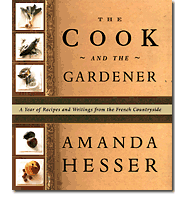 Amanda Hesser writes lovely, limpid prose about the garden and the gardener she
encountered during a year spent at a chateau in Burgundy cooking for the owner,
Anne Willan -- a teacher, author, and mentor to many young cooks and writers.
I suspect that Willan recognized the talent of Hesser, a young woman who my
esteemed colleague Nancy Harmon Jenkins says may be the closest the new
generation of writers on food comes to M.F.K. Fisher.
Amanda Hesser writes lovely, limpid prose about the garden and the gardener she
encountered during a year spent at a chateau in Burgundy cooking for the owner,
Anne Willan -- a teacher, author, and mentor to many young cooks and writers.
I suspect that Willan recognized the talent of Hesser, a young woman who my
esteemed colleague Nancy Harmon Jenkins says may be the closest the new
generation of writers on food comes to M.F.K. Fisher. The Cook and the Gardener, the book Hesser wrote about her experience, may not have the bittersweet theme of love gained and lost that runs through all of Fisher's books, but its finely observed style and unostentatious elegance are certainly reminiscent of the woman who has become a cult. Like Fisher, Hesser knows and loves food. My taste differs from hers, occasionally (I can't make myself want to cook rabbit terrine or any kind of confit, for instance), but I would cook most of her recipes with pleasure. They have the sure sense of someone who at the local market turns a blind eye to imported and out-of-season ingredients. "Why buy something that's not grown in the area?" she writes. "It just confuses my cooking." Her strict adherence to what she could find month by month -- the book is divided into chapters for each month -- means that her food feels right.
Previously in Corby's Table:
Selections from a new guide to the universal grain's many flavors.
Two books that will have you dreaming of the perfect holiday dessert.
A look at the new book by Barbara Kafka, a cook who takes a fearlessly original approach to soup.
A trip to Abruzzo with Anna Teresa Callen, whose new book draws on culinary memories of this less-traveled Italian region.
Paula Wolfert's latest Mediterranean explorations.
The ultimate guide to eating your vegetables.
Jasper White gets up close and personal with lobster claws, tails, and tomalley.
A rare book that shows Italy unromanticized -- and more appetizing.
New reasons not to get out of bed in the morning.
In Ruth Reichl's new memoir, Tender at the Bone, food is about more than eating.
More by Corby Kummer in Atlantic Unbound
 |
| Amanda Hesser |
The recipes are full of great tips, like rubbing one's onion-scented hands on stainless steel to "neutralize the odor," storing salad greens by rolling them in towels that can be wedged "between bowls and bottles, unlike a bulky plastic container," and keeping herbs in jars by the sink, like bouquets, so they will not "go bad before you remember to use them." Have I mentioned that I think this is a charming, evocative, useful book?
Perhaps these recipes will show you why. Onion Soup with Parmigiano-Reggiano and Mixed Cracked Pepper might make you reconsider an abused dish -- Hesser's recipe uses a brightly flavored stock and simple, subtle seasoning. Snapper with fennel seeds, tomato, and vermouth shows the value of first sautéeing white fish fillets and then finishing them in the oven, and is an easy way to impress guests. Of course, the lion's share of recipes are given over to vegetables, and they are where Hesser shines. Many single-vegetable recipes will become my default preparation. Super-fine slices of radish are marinated in excellent olive oil and then tossed with parsley, to make a gentle yet authoritative salad. Sweet Glazed Carrots show the glossy, intense flavor that glazing with butter, sugar, and salt can produce -- a miracle that takes little but forty-five minutes in the oven to prepare. Slow-roasted zucchini with balsamic vinegar uses a technique lately fashionable for tomatoes and shows that sticks of zucchini can become soft, powerfully flavored batons that you'll keep popping into your mouth.
It will come as no surprise that the Milberts developed a fondness (if ever so unspokenly French) for the young cook -- serving her homemade cassis liqueur, opening up a bit about their lives, making clear that they respected her -- and that Hesser left Burgundy changed and educated. I greatly enjoyed reading this book. I loved discovering a voice I'll want to hear and see deepen with time.
Here, in closing, are words from Hesser I think every young cook should live by:
"Have faith in good ingredients, and treat them with dignity. I keep these two rules as a lasso in my mind, to round up and govern that itch to let creativity run wild in the kitchen."
-- Corby Kummer
Excerpts from The Cook and the Gardener, by Amanda Hesser (Norton)
March
Onion soup has suffered so much abuse by cooks. I hope this recipe will change your mind about it, because I, too, dislike a soggy raft of bread tied to the bowl with bad cheese.
| 2 tablespoons butter | 5 black peppercorns |
| 4-5 tablespoons olive oil | 3 white peppercorns |
| 8 medium onions, thinly sliced | 3 coriander seeds |
| Coarse or kosher salt | Pinch freshly grated nutmeg |
| 5 cups low-sodium canned chicken stock | 4 slices dry crusty bread |
| 1/2 cup freshly grated Parmigiano-Reggiano cheese | 1 clove garlic |
1. In a large pan, warm the butter and 2 tablespoons of the olive oil over low heat. Add the onion and a bit of salt and cook slowly until the onion is meltingly soft and unctuous, 12 to 15 minutes.
2. Add the stock. Taste and adjust seasoning. Bring to a boil, then simmer for 10 minutes.
3. Meanwhile, sprinkle the cheese in the bottom of four soup bowls. Crack the peppercorns and coriander seeds: Place them in a plastic sandwich bag or in a piece of waxed paper folded in a square. Use the base of a heavy pan or a meat mallet to finely crush the peppercorns and coriander. Sprinkle this over the cheese, along with the nutmeg.
4. Rub the garlic clove over the slices of bread and brush them with the remaining olive oil on both sides. Heat a dry sauté pan over medium heat until very hot. Add the slices of bread and brown on both sides. Break the bread into small pieces.
5. Ladle the soup into the bowls and serve each with a small plate filled with bread pieces, which should be added to the soup like crackers.
Serving Suggestions This is enough for lunch, but for dinner, have this as a first course and follow with Veal Chops with Sage-Cream Sauce with salad.
May
This recipe was taught to me by an Italian restaurateur. He loved radishes so much, he made a point of having them for every evening meal during their season.
The thinner you slice the radishes the better, so if you have a mandoline, by all means use it; if not, resign yourself to practicing your knife skills. Aside from the slicing, this is the world's easiest recipe. It is also one of the prettiest salads around.
In Europe the radishes are milder than those grown in the United States. They are eaten younger as well, so the taste is naturally milder and the skin is whiter, as most of the growth takes place underground. If you can find baby radishes with their leaves still attached, snap them up and get slicing.
Parsley is young in May, not yet callused by the summer's rays. It adds color and sweetness to the snow-white radishes. The beauty of this dish is its simplicity, so the quality of each ingredient is crucial. Use your best olive oil.
Once radishes are harvested they get flabby pretty quickly. To crisp up radishes, float them in a bowl of iced salt water for about 20 minutes.
Note that this salad needs at least 2 hours' marinating time.
| 1 large bunch baby or small radishes (about 1-1/2 pounds, trimmed and washed) | Fresh cracked black pepper |
| 1 tablespoon chopped flat-leaf parsley leaves (about 3 sprigs) | Coarse or kosher salt |
| 3 tablespoons best-quality olive oil | 1 tablespoon lemon juice |
Using a mandoline or a very sharp knife, slice the radishes thin enough so that they are translucent. If using a knife, you may want to cut a slice off one side of the radish before slicing crosswise so it will lie flat. In a medium bowl mix the radish with the parsley, olive oil, and pepper. Let marinate for up to 24 hours. Season with salt, add the lemon juice, stir again, and transfer to a serving bowl. If the salt is added earlier, it purges water from the radishes and makes the salad watery.
Serving Suggestions Create an antipasti plate: a bowl of these radishes, a plate of Baby Leeks Marinated in Olive Oil and Herbs, Marinated Goat's Milk Cheese Salad with Basil, and thinly sliced meats such as prosciutto, saucisson sec, and sopressata.
May
Carrots spring up at different times of the year. Or at least they can. Monsieur Milbert usually does just two plantings -- one at the beginning of spring and one at the beginning of summer. He leaves them in the ground forever so they always seem to be in season.
Leaving vegetables in the ground is really just an old way of storing them. Gardening books from the eighteenth century note it as a way of storing root vegetables that couldn't fit in the root cellar. When bad weather came, they would just cover up the row with straw or sometimes even dirt to protect the vegetable.
Plain glazed carrots are exceptional, but if you want an alternative, try adding mint -- it is still young this time of year. The tender leaves of two or three sprigs, chopped and added at the end of cooking, are delicious with the young sweet carrots in this recipe.
| 20-24 baby or small carrots, trimmed and washed | 3 tablespoons butter |
| Sea salt | 1 tablespoon sugar |
| Coarse or kosher salt |
1. Rinse and drain the carrots. Place them in a bowl with a few tablespoons of sea salt and rub the carrots between your hands to loosen the dirt in their creases and wrinkles. Rinse again. You can also peel them if you like or just scrape down their sides with the dull edge of a knife to remove their delicate exteriors. Fill a small bowl with ice water and stand the carrots, stems down, in the water for 20 minutes to let the dirt and grit fall to the bottom. Just be careful not to break off the stems when doing this.
2. Lay the carrots in a large sauté pan so they are all touching the base. A large pan is necessary so the liquid will boil off rapidly, becoming a glaze just as the carrots become tender. Sprinkle the carrots with the sugar; add the butter and a little salt. Pour in 2-1/2 cups of water -- it should just cover the carrots. Bring the water to a boil. Lower the heat to medium and keep at an active simmer until all the liquid has evaporated, and the carrots are tender but still slightly firm in the center when poked with the tines of a fork, and are glazed with a coating of butter. This should take 40 to 45 minutes. If the carrots are still too crisp, add more water and continue cooking a few minutes longer. Serve hot.
Serving Suggestions Glazed carrots are wonderful with roasted chicken or pork.
June
Zucchini, yellow summer squash, and gourds grow together in the garden. Monsieur Milbert plants them in neat, trim, rows and by the time they're full-grown, their vines have crept over and under one another, forming a tangled quilt of green leaves and vegetables. The vegetables grow at the bases of the plants under the cover of the spade-shaped leaves. First, the flowers bloom in glowing yellows and oranges. As they wilt the bases of the flowers bulge at the stems and quickly burgeon into squash. Because the plants cannot devote energy to all their fruits at once, they develop in a staggered order, offering one or two each day during the height of the season.
Zucchini are fairly sensitive. Faced with uncertainty, whether it be a spell of dry weather or the trauma of being left out on the kitchen counter, they panic. Too much rain and they will immediately absorb it all; too much sun and they wilt and get flabby; a little negligence in the kitchen and they turn to rubber. A firm, fleshy zucchini demands the perfect combination of nurturing sun and rain, preferably in that order.
In the kitchen, they want simple, if not delicate, treatment. Choose a few the same size and slice them in shapes you like -- circles, quartered logs, half-moons, or match sticks. Coax them to relax with long, slow cooking, as in this recipe, or soften them on the edges by sautéing them lightly in olive oil, just enough to coat them as they cook. Season with salt to enhance their natural sweetness, then sprinkle on balsamic vinegar or lemon juice. I love them served warm -- as warm as an uncooked zucchini is when harvested from the sun-drenched garden.
| 4 medium or 2 large zucchini (about 2 pounds), trimmed and cut into quarters lengthwise | 2 1/2 tablespoons best-quality olive oil |
| Coarse or kosher salt | 1/2 tablespoon balsamic vinegar |
1. Heat the oven to 325° F.
2. Purge the zucchini: Lay the zucchini quarters, skin side down, on paper towels and sprinkle salt over the flesh. Roll each quarter up in the paper towel. It's easiest to reassemble the zucchini by covering the salted surfaces with paper towel and wrapping each tightly so it holds together and draws the water from it. Let sit for 20 to 30 minutes.
3. Unwrap the zucchini and wipe off the salted surfaces. There is no need for further seasoning. Brush the zucchini with 2 tablespoons of the olive oil and place on a non reactive roasting pan, preferably a heavy-based one. Roast in the oven for 1 to 1-1/2 hours, turning once or twice to brown them on all sides. The cooking time will vary greatly, depending on the thickness of the zucchini strips as well as the zucchini's age. Some young zucchini will resist the heat and take a long time to wilt, while older zucchini can be pithy and may cook quite quickly. Keep a close eye on it. As the zucchini cooks, it will shrink, giving up yet more of its moisture until it darkens and wrinkles on the edges. It will intensify in flavor, just as tomatoes do (see Slow-roasted Tomatoes). The strips are cooked when they are golden-brown on the cut surfaces and the flesh is a very soft pulp.
4. Remove the roasting pan from the oven and transfer the zucchini to a serving plate, arranging the strips in rows. Sprinkle over the remaining 1/2 tablespoon olive oil and the balsamic vinegar. Serve. Any leftovers are great cold on sandwiches or with salads.
Serving Suggestions Serve with grilled lamb or steaks. The zucchini is also delightful when served as a small dish with other June vegetables: Marinated Artichoke Salad or Pea-and-Radish Salad.
Shopping for zucchini Inspect zucchini carefully. It should feel firm, not flabby. The skin of a healthy zucchini will have a waxy feel and should be unblemished. I generally look for zucchini between 5 and 8 inches long and, as with all vegetables, try to buy ones the same size so the cooking times will be even.
When cutting into a good zucchini, you will notice the cut flesh beading up with a slippery juice. If the zucchini is old and pithy, this juice will not appear, and when you cook it, the zucchini will absorb much more cooking fat. When a zucchini is 10 inches long, you can be pretty sure it has reached maturity. The seeds inside may be well-developed and large. Scrape them out with a thin-edged spoon.
September
I was taught that fish should never be sautéed directly on the flesh, but rather skin side down, then either covered or transferred to a hot oven to finish cooking. That is the reason behind the cooking method in this recipe. The fennel seed infuses the butter in which the fish cooks, and later, the tomato and vermouth are added to blend the flavors in the gentle, licorice-scented sauce.
| 3 tablespoons butter | Coarse or kosher salt |
| 1 1/2 teaspoons fennel seeds, crushed lightly | 4 tomatoes, cored, peeled, seeded, and diced (about 1/4 inch) |
| 4 red snapper filets (about 1 1/2 pounds) with the skin | 1/4 cup dry vermouth or dry white wine |
1. Heat the oven to 375° F.
2. In a cast-iron skillet large enough to fit the fillets without cramping, heat the butter to foaming over medium heat. Sprinkle in the fennel seeds. Lay the fillets in the pan, skin side down, and season lightly with salt. Sauté over medium heat for 4 to 5 minutes. When the fish skin becomes brown and crispy and the meat turns white around the edges, transfer the fish with a spatula to an oven-proof plate or pan and finish in the oven, 3 to 4 minutes longer.
3. Meanwhile, add the tomato to the skillet and soften, boiling off most of the liquid so it gets slightly pulpy, absorbing the butter and fish juices in the pan. Add the vermouth, bring to a boil for 30 seconds to cook off the alcohol, and reduce slightly. Taste for seasoning, adding more salt if necessary.
4. Test the fish by lifting a layer of the flesh with the tip of a knife. As the fish cooks, its flesh turns from opaque to white. If it is ready to be served, it should have just a thin opaque line in the center of the flesh. This way it will finish cooking on the way to the table without being overcooked. Transfer the fillets to a serving plate, spooning the pulpy sauce around the fillets.
Serving Suggestions Have Tomato Consommé to start and either potatoes, boiled and then sliced, or White Beans with Pistou with the fish. If there is room for dessert, try Double-crusted Peach Pie.
Corby Kummer is a senior editor at The Atlantic Monthly and the author of The Joy of Coffee.
More by Corby Kummer in Atlantic Unbound
Copyright © 1999 by Corby Kummer.
Recipes from The Cook and the Gardener by Amanda Hesser. Norton: New York, New York, 1999. Hardcover, 608 pages. ISBN: 0-393-04668-0. $29.95. Copyright © by Amanda Hesser. Photographs by Rita Maas.
 |
 |
 |
 |
 |
 |