Over the course of World War II, countless challenges made basic transportation difficult, costly, and dangerous. The need for fast, efficient, and quiet ways of moving people from A to B—despite fuel shortages, damaged roads, and ongoing battles—led many soldiers and civilians to take advantage of bicycles as transport. Troops in some areas became more nimble, refugees used bikes to carry their family and belongings to safety, air-raid wardens could cover more ground on two wheels, and many civilians had no other options available. Gathered below are a handful of images of some of the many ways people put bicycles to use during the Second World War.
The Bicycles of World War II
Hints:
View this page full screen.
Skip to the next and previous photo by typing j/k or ←/→.
-
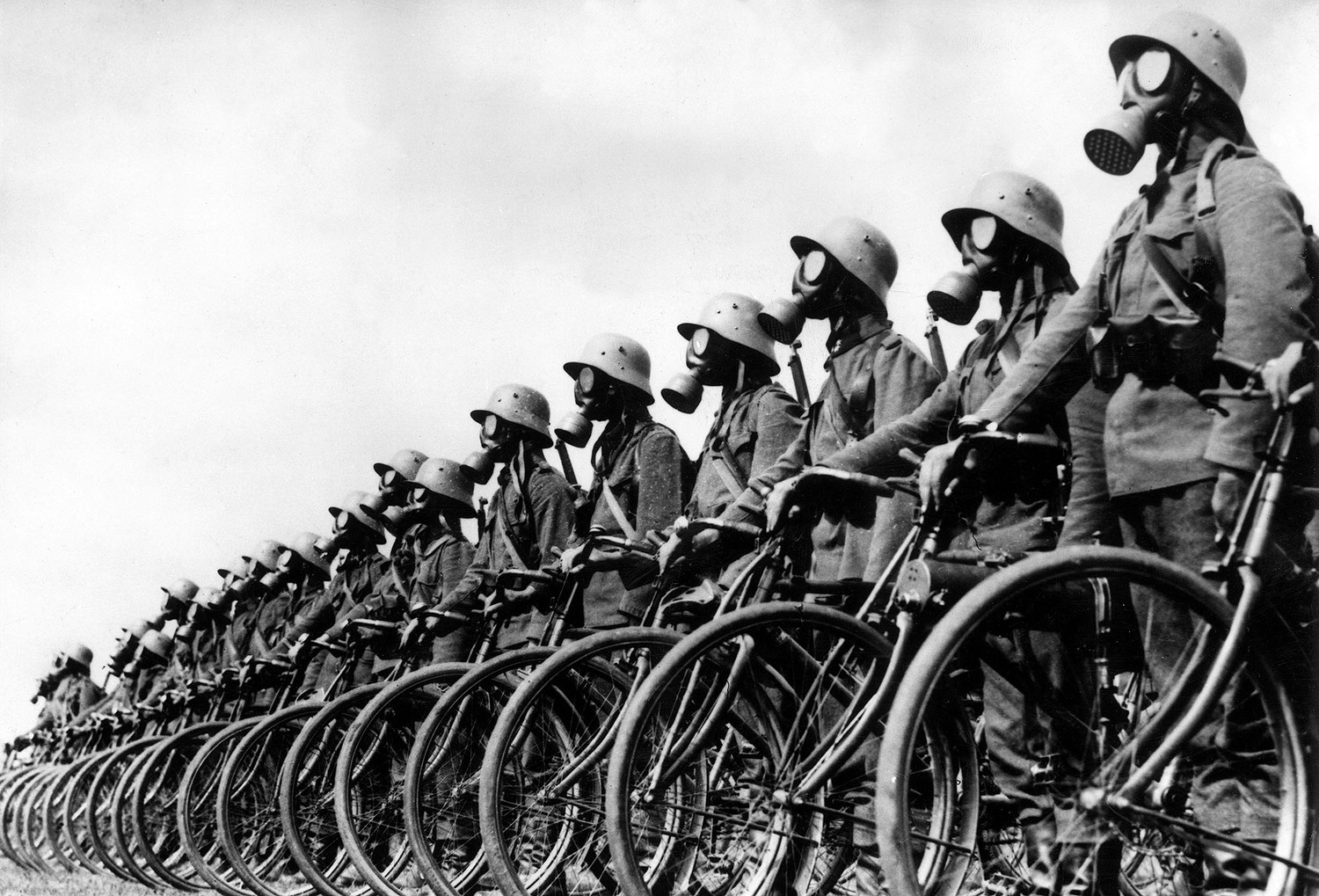
![A line of German soldiers wearing gas masks and standing beside their bicycles]() Read more
Read moreMembers of the German light-machine-gun bicycle corps wear gas masks while standing beside their bicycles in a lineup in Austria, circa 1939. Note the machine gun attached to one of the bicycles at lower right. #
Hulton Archive / Getty -
-
![Soldiers in uniform ride bicycles on a path past a forest.]() Read more
Read moreOriginal caption: "Headed west through a forest somewhere in France, these French bicycle troops are making their way toward the front, on September 25, 1939." #
AP -
![Civilians wearing military helmets ride bicycles together in a street.]() Read more
Read moreCyclists volunteer as ARP (Air Raid Precautions) messengers in Liverpool, England, in 1939. Original caption: "Many of Merseyside's club cyclists are showing the way in volunteering for the new corps of cyclist ARP messengers. There are now 500 members in the ARP messenger corps." #
Hulton Archive / Getty -
![A soldier pedals a modified bicycle with a covered stretcher attached to the front, carrying a person inside.]() Read more
Read moreOriginal caption: "A one-man anti-gas ambulance and resuscitator, designed and made for use by the Home Guard." Photographed in England on July 29, 1941. #
Fox Photos / Getty -
-
![Rows of German soldiers ride bikes in a military parade.]() Read more
Read moreMembers of the German bicycle corps participate in a parade past Adolf Hitler, which was held in celebration of his 50th birthday, on April 20, 1939. #
Hulton Archive / Getty -
![A family of four rides a tandem bicycle, carrying a few belongings.]() Read more
Read moreA Belgian family of four rides a tandem bicycle with some of their belongings strapped to their backs as they flee from the advancing Nazis into France, on June 14, 1940. #
AP -
![Dozens of soldiers stand ready in a field, each beside a bicycle or motorcycle.]() Read more
Read moreOriginal caption, from April 11, 1940: "The famous Dutch bicycle regiment at attention, ready to speed toward the German frontier should danger from the Nazis threaten Queen Wilhelmina's kingdom. The low countries now fear a blitzkrieg like the one that has just been visited upon Norway and Denmark." Photographed outside of Amsterdam. #
Bettmann / Getty -
-
![A policeman rides a bicycle down a street, wearing a sign on his chest that reads "Raiders Passed."]() Read more
Read moreOriginal caption: "A policeman cycles through London’s streets with a 'raiders passed' notice, on September 3, 1939, after the first air raid warning of the war." #
AP -
![A unit of German cyclists walks over a hastily built roadway made of logs.]() Read more
Read moreIn the area near the Dnieper river, on the Russian front, a unit of German cyclists passes over a gangway of logs built by engineers in August 1941. #
Heinrich Hoffmann / Mondadori / Getty -
![A 1940s-era photo of Japanese soldiers riding bicycles across a road bridge in Saigon.]() Read more
Read moreJapanese troops enter Saigon on September 15, 1941. #
Roger Viollet / Getty -
-
![Onlookers watch as two pedal-taxis carry passengers in small carriages towed behind them.]() Read more
Read moreOriginal caption: "The most universal form of transport in Paris on June 1, 1941, under Nazi rule, is the bicycle taxi. In the old day Paris taxis were famous the world over for the furious way in which they were driven, but all that is now at thing of the past owing to the tremendous scarcity of petrol, which has all been requisitioned for the Nazi war machine. The Paris taxi-drivers now pedal their fares around in these quaint contraptions, the one on the left holds three travelers." #
AP -
![Three soldiers ride bicycles with cardboard wings attached to the handlebars, practicing flying in formation.]() Read more
Read moreThree Air Cadets from the Royal Air Force's Coulsdon and Purley Squadron practice flying in formation, using bicycles with wings over the handlebars, on September 29, 1942. #
Hulton Archive / Getty -
![Four members of the Hitler Youth sit on a brick wall and repair several bicycles.]() Read more
Read moreOriginal caption: "Members of the Hitler Youth who are trained to report airstrikes repair their bicycles." Published in 1942. #
Herbert Hoffmann / Ullstein Bild / Getty -
-
![About a dozen young women in coats pedal bicycles on a road on a college campus.]() Read more
Read moreOriginal caption: "There's a sharp upswing in the use of bicycles. Restrictions on automobiles, gasoline and rubber tires to conserve materials for the waging of war have college kids finding alternative ways of getting around. Wellesley College freshmen are two-wheeling their way over the campus in Wellesley, Massachusetts, March 20, 1942." #
GH / AP -
![A few dozen U.S. Air Force pilots ride bicycles down a long runway.]() Read more
Read moreU.S. Air Force pilots at a bomber command station in England use bicycles to travel the mile-long tarmac from their headquarters to their giant planes, on June 8, 1942. #
AP -
![A half-dozen soldiers walk beside their bicycles through a partially snow-covered mountain pass.]() Read more
Read moreOriginal caption, from 1943: "Soldiers of the Bicycle Patrol push their vehicles along a partly frozen lake on an alpine pass. Switzerland's narrow, hilly passes make bicycles the most practical means of transportation." #
Bettmann / Getty -
-
![Five women soldiers ride bicycles past a Quonset hut.]() Read more
Read moreMembers of the Women Army Corps (WAC) that were stationed at a U.S. medium-bomber station in England ride bicycles on their way to work on December 22, 1943. #
AP -
![A Civil Defense air-raid warden stands beside a street sign and his bicycle.]() Read more
Read moreA Civil Defense air-raid warden stands beside a street sign during a blackout, circa 1943. #
Harold M. Lambert / Getty -
![American servicemen ride a five-seater bicycle through a village.]() Read more
Read moreAmerican servicemen ride a five-seater bicycle in England on May 19, 1944. #
Maeers / Fox Photos / Getty -
-
![Several U.S. soldiers rest, sitting on a rail cart, while one poses on a bicycle.]() Read more
Read moreFrom left: Corporal Willis T. Anthony, Private First Class Emmitt Shackelford, Private First Class Eugene Purdy, and Private First Class Horace Boykin (on bicycle), all members of the U.S. Marine Corps, take time out from supplying ammunition to the front line in Saipan, Northern Mariana Islands, in June 1944. #
National Archives -
![Soldiers wade from landing craft to a nearby beach, some carrying bicycles as well as weapons and packs.]() Read more
Read moreOriginal caption: "Canadian soldiers from the 9th Brigade land on June 6, 1944, with their bicycles at Juno Beach in Bernieres-sur-Mer during D-Day, while Allied forces were storming the Normandy beaches." #
AFP / Getty -
![Soldiers carry bicycles as they disembark from several landing craft along a beach.]() Read more
Read moreOriginal caption: "Down the gangway of an LCI of the Royal Canadian Navy, troops from Canada scramble into the surf near a town on the coast of Normandy on June 12, 1944, with their bicycles in the invasion of Europe." #
AP -
-
![A crowd of French civilians, many on bikes, watch a parade of U.S. soldiers in vehicles pass by.]() Read more
Read moreThousands of American troops and armored vehicles took part in a grand parade in Paris on August 29, 1944. American troops paraded down the Rue de la Paix, watched and cheered for by Parisians, many of whom rode to the scene on their bicycle. #
Harry Harris / AP -
![A crowd celebrates, buying small French flags from a seller with a box of flags attached to his bicycle.]() Read more
Read moreParisian people buy French flags on August 26, 1944, to celebrate the liberation of Paris. #
AFP / Getty -
![Sailors carry bicycles with them as they disembark from a submarine.]() Read more
Read moreAt a submarine-refitting station in the United Kingdom, members of the British, French, Dutch, and Norwegian navies were able to rest and refit their submarines between long tours of duty. Here, French sailors disembark with bicycles they brought along in case they docked a long distance from their quarters, seen on on August 31, 1942. #
AP -
-
![An American soldier holds a pistol as a German soldier walks out of a cellar nearby.]() Read more
Read moreOriginal caption: "First Lt. John W. Upchurch, right, of Chicago, Illinois, points pistol at German soldier leaving hiding place in the cellar of a house in Oiselay, France, near the Swiss border, on September 14, 1944. In the center are bicycles which were stolen from the French and used by the fleeing Germans." #
AP -
![A line of German soldiers walk their bikes down a forest road.]() Read more
Read moreOriginal caption: "Nazi cycle troops, still carrying their arms, arrive for their surrender on September 19, 1944, in France." #
AP -
![Several people examine a pile of abandoned bicycles near a bridge.]() Read more
Read moreOriginal caption from September 23, 1944: "A group of Dutch men sort through a pile of bicycles abandoned at one end of a bridge in Nijmegen by retreating German troops after its capture by Allied forces." #
Keystone / Getty -
-
![A soldier holds onto a bicycle while looking over a war-damaged city square.]() Read more
Read moreA Soviet soldier looks across a war-damaged square in Budapest, Hungary, in 1945. #
Fortepan / Fortepan -
![A soldier pulls on the front wheel of a bicycle as a civilian woman pulls back on its handlebars, while a crowd looks on.]() Read more
Read moreOriginal caption from 1945: "A Russian soldier involved in a misunderstanding with a German woman in Berlin, over a bicycle he wished to buy from her." #
Keystone / Getty -
![A civilian pushes a bicycle, carrying a bundle, on a cleared path through a destroyed city, following the atomic bombing of Nagasaki, Japan.]() Read more
Read moreOriginal caption from Nagasaki, Japan, on September 13, 1945—just five weeks after the city was struck by an American atomic bomb: "A Japanese civilian pushes his loaded bike down a path which has been cleared of rubble. On either side of the path, debris, twisted metal, and gnarled tree stumps fill the area. This is in the center of the devastated area." #
Bettmann / Getty -


We want to hear what you think about this article. Submit a letter to the editor or write to [email protected].