

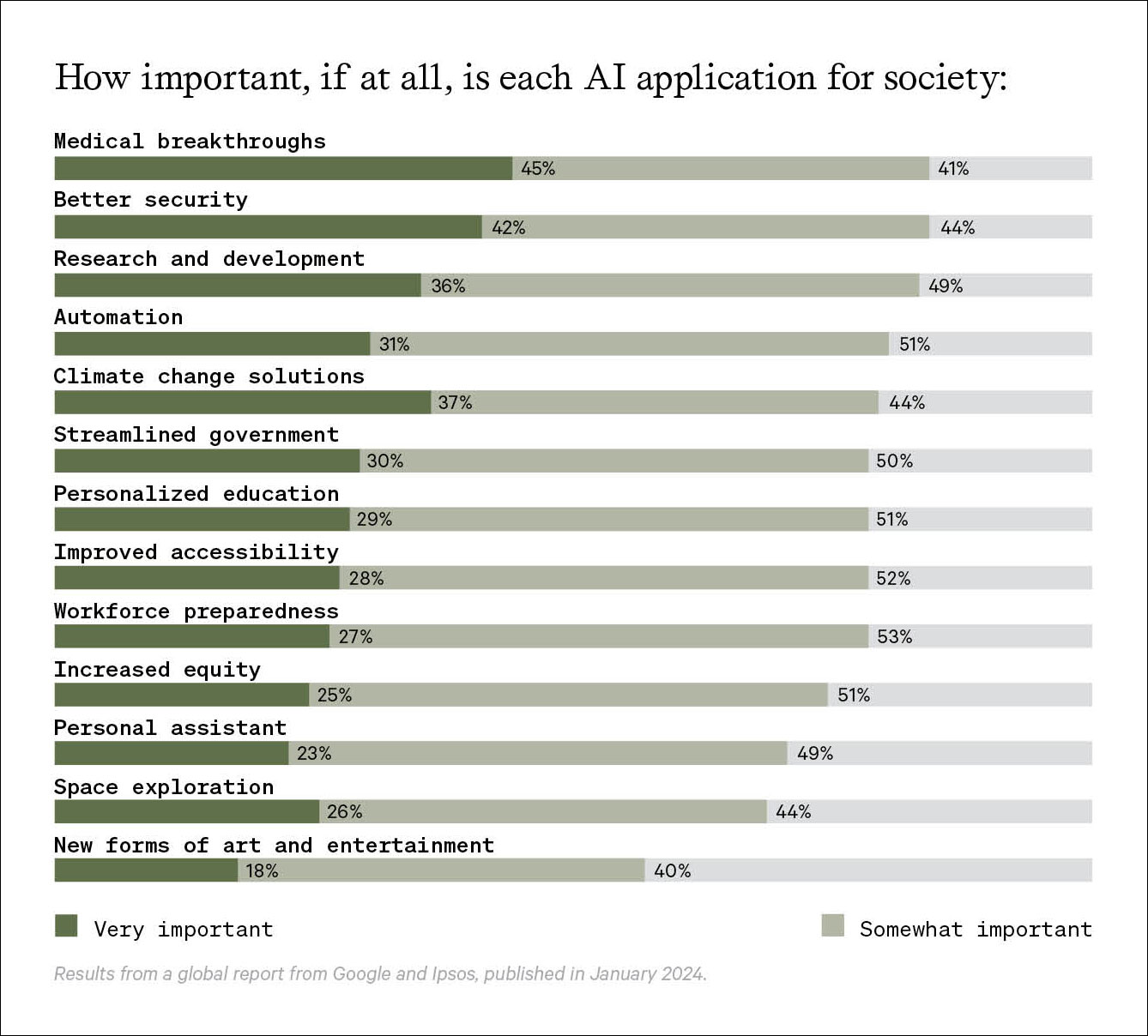
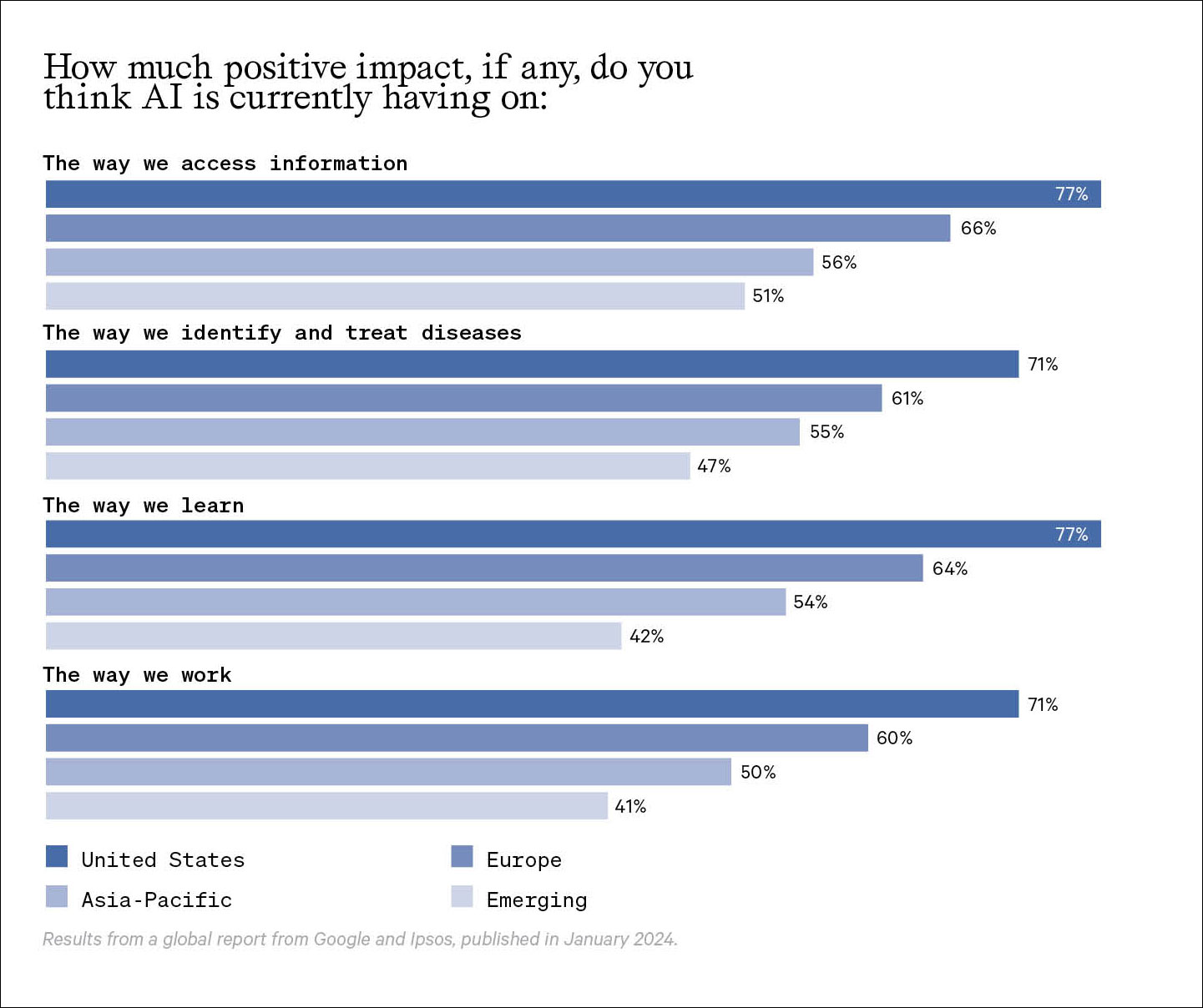
The history of science is the history of eureka moments, from Newton’s apple to Oersted’s compass needle to Fleming’s petri dish. For many people in and around the field of AI research, the past decade or so has been a succession of such moments, many of them described in this issue of Dialogues—from revelatory research on protein folding to promising approaches to mitigating global warming (for a sense of the technology’s influence on the way we learn, work, govern, and more, see the accompanying infographics).
Fr. Paolo Benanti
Theologian; adviser to Pope Francis on AI and computer ethics; member, High-Level Advisory Body on Artificial Intelligence, United Nations
Country of origin: Italy
Currently based: Italy
One day, I returned to my convent and overheard a 90-year-old friar in the next room conversing with the smart speaker. The natural way in which he spoke to it, and the fact that he had found someone who was not bored with his repetitive questions about the weather, history, and current events, turned a light on in me: If AI could so easily enter the life of a man from the last century—who does not even really know what this technology is, but who can interact usefully with computational power in a cloud thousands of miles away—well, then, yes, AI was ready to change our daily lives.
Tilman Becker
Director, RICAIP Centre for Advanced Industrial Production at the Czech Institute of Informatics, Robotics, and Cybernetics (CIIRC)
Country of origin: Germany
Currently based: Czech Republic
For me, there’s been more than one eureka moment: The first was 40 years ago when I was starting to learn about AI as a student, then some 30 years ago, when I spoke in German into an early prototype of the Verbmobil system I worked on at DFKI [a German research center] and got a spoken English translation seconds later (spooky at the time, even though I knew exactly what the system was doing). Then again over 10 years ago, when I realized that AI technology had become so pervasive that it is an important tool in the fourth Industrial Revolution. And finally, one day in late 2022, when using ChatGPT for the first time: Even with all its limitations, seeing a system generate flawless, eloquent language left me flabbergasted.
Lila Ibrahim
Google DeepMind, Chief Operating Officer
Country of origin: USA
Currently based: United Kingdom
In 2020, Google DeepMind achieved a seemingly impossible scientific breakthrough: our advanced AI system, AlphaFold, could now accurately predict protein structures in minutes, not years.
I still remember that moment—when I realized that all of our investment, iteration, and patience had delivered so much benefit for the world.
Proteins are life’s building blocks. Understanding their structure is key to advancing drug discovery, food security, treatments for neglected diseases, and more. We’ve used AlphaFold to map over 200 million proteins and made this knowledge freely available. Today, 2.2 million researchers across 190 countries use AlphaFold to tackle some of the biggest problems facing our world.
AlphaFold is proof of AI’s ability to advance scientific discovery, and we’ve only scratched the surface of its extraordinary potential to benefit humanity.
Seydina Moussa Ndiaye
Senior Lecturer at Cheikh Hamidou Kane Digital University; member, High-Level Advisory Body on Artificial Intelligence, United Nations
Country of origin: Senegal
Currently based: Senegal
When I first discovered the methods of artificial intelligence during my first year of my master’s degree, in 1994, I immediately realized that this was in fact the ultimate goal of computer science. My eureka moment came to me when, in 1997, during my doctoral thesis, I obtained results that were more accurate than those obtained by agronomic experts for the cultivation of winter wheat, by applying reinforcement learning methods combined with a genetic algorithm.
Saška Mojsilovic
Google, Senior Director, Researching Engineering AL/ML
Country of origin: Belgrade, Serbia
Currently based: USA
Thirty-five years ago, as a college junior, I took an introductory computer vision class. We scanned a black-and-white photograph and then coded an algorithm that analyzed the image and outlined objects in it. This made me think about how everything around us—speech, music, written word, molecules, X-rays, weather, traffic—can be understood as patterns. I realized that if we could teach computers to see, we could teach them to sense, hear, read, and reason; to identify cancer and diagnose disease, weave new molecules, predict crop yields and natural disasters…Back then, computers were slow, data was scarce, and algorithms were simple, but I was in awe of what might one day be possible.
Ayanna Howard
Dean of Engineering, The Ohio State University; member, National AI Advisory Committee
Country of origin: USA
Currently based: USA
In the early 2000s, I worked on developing a neural network approach to enable future Mars rovers to navigate long distances over hazardous terrain. After countless field trials on Earth, during which my robot would sometimes exhibit quite strange, if not erratic, unsafe driving behavior, I finally thought, Why should a robot learning to drive be so different from teaching a teenage driver? That was my eureka moment. I realized that AI’s value proposition should be centered around its synergistic and symbiotic relationship with humans and that if it continued to be designed around this fundamental concept of people first and foremost, it would change the world.
Richard Zhang
Distinguished Professor of Computer Science, Simon Fraser University
Country of origin: China
Currently based: Canada
The world’s leading machine learning conference, NeurIPS, recently accepted more than 4,000 papers. This is in addition to well over 5,000 top-tier papers in computer vision and graphics, all in my fields of research. Even if only 1 percent of these papers are closely related to my work, I’ll have to sift through a sea of publications to find and read them. There cannot be that much truly innovative research out there, being produced at this volume and pace—much of it must be “artificial,” or at least superficial. While I still cannot fathom ever using AI to write one of these papers, it suddenly occurred to me that I may have to rely on AI to find, read, and summarize the latest research results to stay well informed.
Virginia Dignum
Professor of Computer Science, Umeå, Sweden; member, High-Level Advisory Body on Artificial Intelligence, United Nations
Country of origin: Portugal
Currently based: Sweden
I realized AI was not going to change life as we know it when existential risks became a central issue in discussions about its future. AI will not fundamentally change life; instead, it will push us to recognize the importance of our human existence. AI capabilities highlight the irreplaceable value of human creativity, empathy, and moral reasoning. The responsibility for AI’s impact rests with us, not with the technology. AI doesn’t happen to us—we make it happen.
Alondra Nelson
Harold F. Linder Professor at the Institute for Advanced Study; former acting director of the White House Office of Science and Technology Policy in the Biden-Harris administration; member, High-Level Advisory Body on Artificial Intelligence, United Nations
Country of origin: USA
Currently based: USA
In developing what would become the White House’s 2022 Blueprint for an AI Bill of Rights, we spent nearly a year meeting with any member of the American public with a perspective to share on AI’s impact on society. This included a multiracial group of high-school students from across the country who called themselves Encode Justice and advocated for human-centered, responsible uses of AI. These students spoke with a remarkable urgency about their concern that facial recognition technology would soon be required for them to access their school buildings, their classrooms, and parts of their curriculum. As policy makers, we had been thinking about the impact of social media and algorithmic amplification on young people’s mental health. But for these students, AI enabling a state of persistent surveillance was top of mind. The generation that is the most likely to see the greatest harms or gains from AI is flashing a yellow warning light for us.
Sayan Chakraborty
Co-President, Workday; former member, National AI Advisory Committee
Country of origin: India
Currently based: USA
I first built artificial neural networks (ANNs) in 1989, during my graduate work at MIT: I wanted to apply ANNs to robots designed to repair satellites. However, the neural network I trained to control a robotic arm failed miserably, and I set aside ANNs as an interesting curiosity. But by 2012, deep-learning ANNs, more sophisticated than those I had worked with, were winning competitions in image recognition and hinting at greater potential. Graphics processors (GPUs) designed for gaming were being used to radically improve performance. But it wasn’t really until late 2020, after a discussion with a friend about the Google paper titled “Attention Is All You Need,” that everything clicked. The missing puzzle pieces—powerful GPUs, the attention-transformer approach, cloud computing, the availability of vast training datasets on the internet—were finally all here, and I knew that this revolution was happening now.
Justin Tranter
Songwriter
Country of origin: USA
Currently based: USA
I had two big wow moments while getting to play with Music AI Sandbox, from Google DeepMind and YouTube. The first was a fear—the fear that if this was not handled properly, it would be yet another thing in our industry that harms songwriters. The second was hope: The tools are so magical that not only can it help human songwriters be more creative with new works, when done correctly it should also create a further revenue stream for songwriters’ past work. There is a world where this is a win-win for songwriters.
Mira Lane
Google, Senior Director of Technology & Society
Country of origin: Canada
Currently based: USA
I’ve always believed that technology has the potential to change the world. Yet, as both an artist and technologist, I once thought the creativity industry might be immune to the massive types of disruption technology often brings. But when I saw AI being used in the role of a collaborator—co-creating scripts, generating new imagery, and creating music—I realized storytelling was also being transformed. The real magic happens when AI and human creativity combine across disciplines, allowing us to explore narratives in new and unexpected ways. What might happen when we can all express our inner creativity more easily? The world might suddenly open to new and amazing possibilities. Interdisciplinary collaboration between technologists, artists, and storytellers is now pushing the boundaries of what’s possible, reshaping how we engage with the world through art and imagination.
Rahaf Harfoush
Digital anthropologist and author; member, High-Level Advisory Body on Artificial Intelligence, United Nations
Country of origin: Syria/Canada
Currently based: France
I was experimenting with AI’s ability to change the way we interact with ideas and was testing different personas, each one pulling expertise from various domains to answer my questions. During that process, I ended up accidentally creating what I started calling a “super partner”—a blend of the wisdom and compassion of a Zen monk, the sharp mind of a strategist, the frameworks of a therapist, and the practical ability of a coach, who could help me put it all into practice. I was shocked by how well it worked.
It wasn’t just giving me answers; it was synthesizing advice in a way that felt personal and multidimensional. This was a completely new way for us, as humans, to not just access knowledge, but to interact with it, remix it, and blend it in ways that sparked new connections. That’s what really lit up my brain—the realization that AI could help us create, think, and problem-solve by using the breadth of human intellect in a way that simply wasn’t possible before.
Phil Venables
Google Cloud, Vice President, TI Security & Chief Information Security Officer (CISO)
Country of origin: United Kingdom
Currently based: USA
I realized AI had the potential to change the world when I saw how it could revolutionize cybersecurity. While attackers may use AI to their advantage, we are seeing firsthand how it is transforming defenders’ capabilities. Traditionally, cybersecurity has faced the so-called defender’s dilemma, where attackers only need to succeed once, while defenders must be vigilant every time. But now, with AI, we’re seeing an increasing shift toward the defender’s advantage. AI provides defenders with an invaluable edge, allowing them to analyze threats, detect vulnerabilities, and respond with unprecedented speed and scale. Like other groundbreaking technologies throughout history, AI brings both remarkable benefits and unforeseen risks—but it ultimately empowers us to stay one step ahead, building a safer, more resilient digital world.
Craig Ramlal
Head of the Control Systems Group, University of the West Indies at St. Augustine; member, High-Level Advisory Body on Artificial Intelligence, United Nations
Country of origin: Trinidad & Tobago
Currently based: West Indies
I remember being taken aback when I learned that language models could construct rational sentences. It meant that, for the first time in human history, there was another entity, one that was not human, capable of creating (approximating) logical thought across many domains. It also occurred to me that we may greatly rely on these systems at some point in the future, giving them more autonomy and trusting their decisions—fundamentally altering how humanity interacts with and thinks about technology. I remain hopeful that the minds behind AI’s success, the original thinkers, will guide its research, utility, and adoption toward the greater good.
Holger Hoos
Alexander von Humboldt Professor of AI, RWTH Aachen University (Germany); Professor of Machine Learning at Universiteit Leiden (the Netherlands); Adjunct Professor of Computer Science at the University of British Columbia (Canada)
Country of origin: Germany
Currently based: Germany
Around 2013, I was working with a team within a large electrical utility in Canada that was struggling, because of the immense computational cost involved, to set prices for their surplus of 100 percent renewable energy. My research team and I had started to develop AI methods for reducing the computational effort involved in solving this kind of formal-reasoning problem, but never at scale. With their experts, we ultimately were able to combine methods from automated reasoning, machine learning, and optimization that solved the energy-pricing problem at scale, literally overnight, without the use of a large compute cluster. I realized what a difference AI could make, not merely economically, but also in terms of tackling the grand challenges of our time—in this case, a problem closely related to climate change.
Paula Goldman
Chief Ethical and Humane Use Officer, Salesforce; member, National AI Advisory Committee
Country of origin: USA/Singapore
Currently based: USA
It was the holiday season in 2022, and while I expected most of my conversations with friends to revolve around the festivities, I was surprised when they all wanted to talk about AI—how it might impact their law practice or their journalism career. While tracking AI milestones, like detecting early signs of cancer and testing self-driving cars, is second nature for me, I knew something had tipped when friends who had never expressed interest started asking questions. We are at the precipice of a profound shift in how we interact with technology at work, seeing it evolve from a tool to a dynamic partner. While we all know this shift comes with both promise and peril, it can’t be overstated how crucial it is to keep people at the helm of this transformation.
Lerrel Pinto
Assistant Professor of Computer Science, Courant Institute of Mathematical Sciences, New York University
Country of origin: India
Currently based: USA
Meaningful change in life requires physically unburdening people from mundane, laborious, or simply undesirable tasks, allowing us to focus on what truly matters. While robotics has traditionally lagged behind other AI fields like natural language processing, the past year has brought a breakthrough in what we call zero-shot capabilities for robots: A robot can now be placed in an unfamiliar environment, such as your home, and successfully perform complex tasks—like moving small objects or opening cabinet doors—with encouraging accuracy, despite never having been specifically programmed for that setting. This quiet robot revolution will revolutionize our daily lives, bridging the gap between virtual intelligence and a more physical, real one.
Connor Coley
Associate Professor of Chemical Engineering, Electrical Engineering, and Computer Science, MIT
Country of origin: USA
Currently based: USA
Around 2017, I was compiling the results of a human-benchmarking comparison to evaluate a new neural network model for organic chemistry: This model correctly predicted the experimentally confirmed product of a chemical reaction where 10 Ph.D.-level chemists could not! Given how quickly we were able to reach that level of performance, although it was not as significant of a milestone as AlphaFold would be several years later, I could then see the path to evermore capable AI helping us navigate the scientific process.
Jimena Sofía Viveros Álvarez
Member, High-Level Advisory Body on Artificial Intelligence, United Nations; Commissioner at the Global Commission on Responsible Artificial Intelligence in the Military Domain; AI Expert at the Organization for Economic Co-operation and Development
Country of origin: Mexico
Currently based: Mexico
Since the development of the Blue Brain Project in 2005, I’ve been both fascinated by and concerned with technological developments and their legal and ethical implications. I realized then that—like the discovery of gunpowder and the splitting of the atom—artificial intelligence was going to be the defining technology of our generation and those to come. Based on my experience in peace and security, I foresaw AI would pose grave, perhaps even existential, risks to humankind in these domains if not properly and globally governed, which is why I am truly committed to this endeavor. Ultimately, our common goal must be to ensure that we can harness AI’s opportunities fairly and equitably while mitigating its risks for the benefit and protection of all of humanity.