



Chilled Fresh Green Pea Soup
Scallop Chowder with Lime Juice
Radish and Cucumber Salad with Green Herb Dressing
Cornmeal Popovers
Big Buttermilk Biscuits
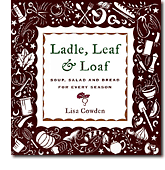 Once the farmer's market opens on the brick plaza surrounding the brutalist Boston City Hall, I lose all interest in cooking anything besides vegetables and start rooting (sorry) through new cookbooks for vegetable-based recipes. Last week the first lovage, a sure sign of summer bounty to come, turned up at a stand selling mostly flowering plants and herb pots -- all that's in season yet, except for asparagus, which much to my dismay hasn't surfaced at the market. I actually swiped two sprigs of lovage from a jar full of them which a local chef had reserved, being fairly sure he would forgive me (he did).
Previously in Corby's Table:
Tuscany, Reluctantly -- April 26, 2000
Corby Kummer is tired of Tuscany, but he likes Pino Luongo's new cookbook, Simply Tuscan.
Matzoh Makeover -- March 22, 2000
Corby Kummer on Jayne Cohen's The Gefilte Variations, a new cookbook offering multiple versions of Jewish holiday classics.
Ham and Beans to the Rescue -- February 16, 2000
Weary of the Boston winter, Corby Kummer serves up "one of history's great couplings."
How to Cook (and How It Should Look) -- January 20, 2000
Corby Kummer on James Peterson's Essentials of Cooking, a kitchen primer that should fascinate beginners and old pros alike.
Encyclopedia Gastronomica -- December 22, 1999
Corby Kummer makes his way through The Oxford Companion to Food -- and still finds Room for Dessert.
Italian Soul Food -- October 14, 1999
Corby Kummer serves up selections from Lynne Rossetto Kasper's The Italian Country Table.
Countercultural Cooking -- September 15, 1999
Corby Kummer on Chez Panisse -- the influential Berkeley, California, restaurant that started as a countercultural collective -- and the new Chez Panisse Café Cookbook.
Charmed by Chile -- August 18, 1999
A new collection of home-style recipes reflects the Chilean way of life.
Hail to the Chef -- July 15, 1999
A tribute to Patrick Clark, a chef who was a model for many young African-Americans and an inspiration to other chefs.
Persian Appeal -- June 3, 1999
A look at Najmieh Batmanglij's A Taste of Persia, and the subtle yet persistent spices of Iranian cuisine.
More by Corby Kummer in Atlantic Unbound
 Yet many of the recipes are both simple and right. Chilled Fresh Green Pea Soup, for instance, has just enough ingredients -- sweet onions (which come into season in early summer along with peas), mint, a hint of garlic, and green peppercorns -- to underline the incomparably delicate flavor of fresh peas. This is the most elegant first course imaginable, far more elegant than caviar to my mind. Guests will get little more than a tiny cup, given how long it takes to shell peas (be sure to make clear how much work it took, and how worth it friends and family are). The minted yogurt cheese the author recommends in place of sour cream will add beautiful white swirls to the emerald green soup.
 Come mid-summer, fresh sea scallops will be available up and down the East Coast. Cowden suggests a potato-based chowder with lime juice that uses the ingredients of a seviche to ensure a sweet, fresh flavor. I'm interested in her technique of thickening with bread crumbs rather than the usual cream: this is, in fact, a dairy-free yet hearty white seafood chowder, and it can easily be adapted to other fish.
Radishes and cucumbers are reliably cooling and elegant; I often base salads on each one, but never thought to pair them as the author does, dressed with chives, parsley, dill, and tarragon. Like the pea soup, this salad is a seemingly casual but very elegant way to dress up an outdoor summer supper.
Given my aversion to high amounts of yeast and small amounts of flour, I'd bypass the yeast-risen breads in this book in favor of two appealing variations on favorite quickbreads: Cornmeal Popovers and Big Buttermilk Biscuits. The popovers can be mixed in minutes and baked quickly in muffin tins; they will surely disappear quickly, too. So will the biscuits, the recipe for which offers an ingenious way around the large challenge small biscuits present the hot-handed: make only a few oversized biscuits rather than dozens of small ones, so that the dough won't be overhandled and overheated. One of these will practically make a meal in itself, with perhaps some of that minted yogurt cheese as a spread, and perhaps some fresh sliced strawberries for an impromptu shortcake. You'll think of many other variations based on what you can find at the market -- and that's as inspiring as a summer cookbook needs to be.
-- Corby Kummer
Excerpts from Ladle, Leaf, & Loaf by Lisa Cowden
| 1 tablespoon olive oil | 1/8 teaspoon crushed green peppercorns |
| 1 cup thinly sliced Vidalia onion | 3 1/2 cups chicken stock or canned broth |
| 1 garlic clove, sliced | Minted Yogurt Cheese |
| 2 cups shelled fresh green peas | Chopped fresh chives |
| 1/2 tablespoon minced fresh mint | Kosher salt to taste |
Heat the oil over medium heat in a 4 1/2-quart soup pot. Add the onion and garlic, stirring to coat with the oil. Cover and cook until they soften, 3 to 4 minutes. Stir in the peas and mint, and add 1 cup of the stock and the peppercorns. Cover and cook for 5 minutes.
Transfer the mixture to a food processor and purée thoroughly. Force the purée through a sieve into a medium bowl, adding 1/2 cup of the stock to the mixture in the sieve when it starts to become dry. Blend in the remaining 2 cups stock into the purée and adjust the seasonings. Refrigerate the soup until thoroughly chilled. Serve, garnished with a dollop of the yogurt cheese and a sprinkling of the chives.
Minted Yogurt Cheese
| 1 cup Plain Yogurt Cheese | 1 1/4 teaspoons minced fresh mint |
| 1 teaspoon honey |
To make yogurt cheese: Use a sieve with a very fine mesh, or line a colander with paper towels. Suspend the sieve or colander over a medium bowl. Spoon one cup of nonfat yogurt into the sieve. Cover with plastic wrap, refrigerate, and allow the whey to drain from the yogurt for a minimum of 5 hours. The cheese is done when it has been reduced in volume by half. It keeps refrigerated for 1 week.
In a small bowl, stir the yogurt cheese and mint together. Add the honey and mix well. To enhance the flavors, refrigerate for at least one hour before serving.
| 2 tablespoons olive oil | 4 cups bite-sized pieces of peeled red-skinned potatoes (4 medium) |
| 1 medium yellow onion, thinly sliced | 1/4 cup minced fresh parsley |
| 5 1/4 cups vegetable consommé or canned vegetable broth | 1/4 cup freshly squeezed and strained lime juice |
| 4 fresh basil leaves, chopped | 1 1/4 teaspoon crushed green peppercorns |
| 1 pound fresh scallops | Slivers of fresh lime |
| 3/4 cup dried bread crumbs |
Heat 1 tablespoon of the oil over medium heat in a 4 1/2 quart soup pot. Add the potatoes, onion, and parsley. Add the consommé or broth. Bring to a boil and reduce the heat to medium. Cover and continue cooking for 10 minutes, or until the potatoes are tender.
Meanwhile, heat the remaining 1 tablespoon oil, lime juice, basil, and peppercorns in a large skillet over medium heat. When the mixture simmers, add the scallops. Cover and cook for 3 to 4 minutes, until the scallops are just tender; do not overcook. Stir the bread crumbs into the soup pot and cook, uncovered, for 10 minutes. Add the scallops and their liquid to the soup and cook for 2 or 3 minutes more to reheat. Garnish each bowl with a sliver of the fresh lime.
Hot radishes and cool cucumbers in a dressing packed with fresh green herbs -- the perfect simple salad for warm summer days.
| 1 1/2 cucumbers, peeled, halved lengthwise, seeded, and sliced (about 2 cups) | 3/4 cup sliced radishes |
| 2 scallions, trimmed and thinly sliced | Green Herb Dressing |
Mix the vegetables together in a medium bowl. Cover and refrigerate until thoroughly chilled. Toss with the dressing and serve.
| 1 garlic clove, pressed | 4-5 medium fresh basil leaves, chopped |
| 2 tablespoons minced fresh chives | 1 heaping tablespoon fresh parsley leaves |
| 1 tablespoon chopped fresh dill | 1 teaspoon chopped fresh tarragon leaves |
| 1/4 cup olive oil | 3 tablespoons white wine vinegar |
| 2 tablespoons Plain Yogurt Cheese | 1/4 teaspoon kosher salt |
Combine the garlic and herbs in a small food processor or blender
and blend thoroughly. Add the oil, white wine vinegar, and yogurt cheese one at a
time, mixing after each addition. Add the salt. Transfer the dressing to a small,
tightly lidded jar and refrigerate. Shake well before using. The dressing will
keep in the refrigerator for up to 1 week.
Cornmeal adds a slight crunch and sweet flavor to this variation of the classic popover -- the perfect bread to serve with light soups and salads. Try them with Red and Yellow Tomato Soup with Broiled Tomatoes and Goat Cheese Salad for a summer meal.
| 3/4 cup all-purpose flour | 1/4 cup yellow cornmeal |
| 1/4 teaspoon kosher salt | 2 large eggs |
| 1 cup skim milk | 1 tablespoon canola oil |
Preheat the oven to 450 degrees. Lightly butter a muffin or popover pan.
In a medium bowl, combine the flour, cornmeal, and salt. In a separate bowl, beat the eggs with the milk and oil, using an electric mixer. Heat the muffin pan in the oven for several minutes. Meanwhile, add the liquid ingredients to the dry ingredients and beat with the mixer until smooth.
Remove the muffin pan from the oven. Fill 11 of the muffin cups with the batter. (Traditional cast-iron popover pans are made with 11 cups.) Bake for 20 minutes. Remove the popovers from the pan, place them in a basket lined with a clean napkin, and serve immediately.
There's nothing new under the sun, so why try to reinvent the wheel? Those are fighting words when tossed in my direction and have the opposite effect of discouraging me. I prefer clichés like "Necessity is the mother of invention" and "Nothing ventured, nothing gained." What do you mean, potato-leek soup has been done? I say, Hang on to your apron and press forward, regardless, if you have ideas for improving a recipe or want to concoct something unusual.
Where there's a will, there's a way, provided you keep in mind that you are engaged in a balancing act. The creative part of cooking may be an art, but cooking is more than alchemy; it's chemistry! Salad dressings are suspensions; leavening agents like yeast produce gas; and mixing buttermilk with baking soda combines an acid with a base. The reduction of soup stock by evaporation and melting a solid dollop of butter in a skillet are both basic chemical reactions.
 Biscuits are a case in point. Biscuit dough can only withstand so much tweaking because of the almighty forces governing food chemistry. But when it comes to biscuit size, it's liberty hall! It occurred to me that if a recipe for biscuits would serve four people, assuming everyone would eat at least three biscuits (or would like to), instead of cutting out many little biscuits, why not cut to the chase? How about fewer larger biscuits, each one four inches wide? They were an instant hit with my dinner guests, who appreciated the convenience of having a decent quantity of biscuits all in one go.
Furthermore, I discovered that by making large biscuits, I did not work the dough very much, and my big biscuits were light and tender. When you are committed to getting at least a dozen biscuits out of a recipe, you often have to recycle the scraps of dough from the cutting operation, gathering them together and rolling them out several times, exciting the gluten in the flour. The goal is to distribute the particles of fat evenly throughout the flour, stick it together with liquid, and roll out the dough with a minimum of kneading to keep that gluten under control. If you handle the dough too much, you can end up with some pretty tough customers in the biscuit department.
I have found these sorts of culinary chemical revelations helpful, being the type of cook who appreciates understanding how and why things succeed or fail in my kitchen. Knowledge is power, and faced with uncharted waters (or biscuits), every little bit helps.
Serve these big and tender biscuits hot from the oven and watch them disappear. You will need a circular cookie cutter 4 inches in diameter. Serve with Lemon Honey Butter.
| 2 cups all-purpose flour | 1 tablespoon baking powder |
| 1/2 teaspoon kosher salt | 1/4 cup canola oil |
| 1 cup nonfat buttermilk |
Preheat the oven to 450 degrees. Lightly oil a baking sheet with vegetable spray and set aside.
In a large bowl, combine the flour, baking powder, and salt. Drizzle the oil over the mixture and blend it in with your fingers. Add the buttermilk, stirring to form a stiff dough. Use a little additional flour, if necessary, to prevent the dough from sticking.
On a lightly floured surface, roll the dough out so that it is large enough to be cut into 8 biscuits. Cut out the biscuits and place them on the baking sheet. Bake for 12 minutes and serve hot from the oven.
Corby Kummer is a senior editor at The Atlantic Monthly and the author of The Joy of Coffee.
More by Corby Kummer in Atlantic Unbound.
Copyright © 2000 by Corby Kummer.
Recipes and illustrations from Ladle, Leaf, & Loaf by Lisa Cowden. Houghton Mifflin: New York, New York, 2000. Paperback, 272 pages. ISBN: 0395967155 $16.00. Copyright © by Lisa Cowden.
 |  |  |  |  |  |