



Previously in Politics & Prose:
McCain and the "Bloody Chasm" (December 30, 1999)
Christopher Caldwell explains why the liberal press loves John McCain.
A New Deal for the New Economy (December 8, 1999)
Is this the best economy in years? It depends on whom you ask, Jack Beatty argues, and where in the world they live.
Is W. Inevitable? (November 17, 1999)
It looks like George W. Bush has the nomination in the bag. Christopher Caldwell offers a scenario of how Bush could become a loser.
Step Right Up (October 15, 1999)
Scott Stossel asks, What does the Reform Party's cast of odd characters suggest about the state of American politics? Think Fellini. Think David Lynch.
The Billionaire's Curse (September 22, 1999)
Jack Beatty wonders why we should feel sorry for Jim Clark, who founded Silicon Graphics and Netscape and epitomizes "capitalism's hurricane of progress."
More Politics & Prose in Atlantic Unbound.
Join the conversation in the Politics & Society conference of Post & Riposte.

Are people who work on the street a sign of a neighborhood in decay? Not according to Mitchell Duneier, who in Sidewalk describes the carefully ordered, moral world of street vendors in Greenwich Village
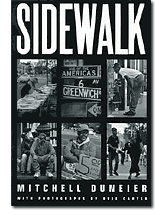 Mitchell Duneier, in his new book, Sidewalk, recounts the story of Robert F. Kennedy Jr., a black man arrested for disorderly conduct on the street a few years ago in New York City. As the police were taking Kennedy into custody they asked for his name. Upon hearing him state that his full name was Robert F. Kennedy Jr., the officers assumed him to be unstable or insane and took him to Bellevue Hospital. Since this experience Kennedy has called himself "John Smith" or "Kenny" when dealing with the police in order to avoid confusion and hassle. In part this anecdote reveals the negative stereotypes that burden people who work on the street -- a disorderly man claiming to be Robert Kennedy must necessarily be crazy or high, and he's probably dangerous. In Sidewalk -- a study of the people who work and sometimes live on the sidewalks of Sixth Avenue in Greenwich Village -- Duneier, a sociologist who teaches at the University of Wisconsin and the University of California, Santa Barbara, does more than simply provide a critique of racial and class stereotypes. He examines how people commonly stigmatized by and excluded from traditional society on the basis of their race and class struggle to define moral standards and to live according to those standards. Duneier took as his primary subject the vendors who sell books and magazines from their tables on the sidewalk. He set up his own table among them, working as a book vendor intermittently over a period of six years in the hope of shedding (or at least tempering) his biases as an outsider and of coming to a better understanding of the people he observed.
According to Duneier's account, the prevailing attitude toward people on the street is that if they look like trouble, they are trouble. Many politicians, with the support of their constituencies, believe that they can eliminate such "troublesome" people working on the sidewalk simply by enacting more and more laws that make it difficult for these individuals to earn a living. The impulse is to crack down on panhandlers, reduce sidewalk space available to vendors, and criminalize homelessness. The obvious weakness of this approach is that it punishes effects rather than working to understand their causes. But Duneier believes that this approach fails on a less evident plane. In describing the years he spent observing sidewalk life, Duneier deftly demonstrates that the economic and social culture arising around Sixth Avenue enables a member to develop "positive relations with ... customers and the self-direction that comes from being his own boss" and helps him "feel the self-respect that also comes from knowing that he is earning 'an honest living.'" Duneier argues that the life of the sidewalk ought not to be thwarted but rather encouraged as a means of social cohesion and order.
But there are differing interpretations of what qualifies as an "honest living." Duneier himself admits that he's been guilty of questioning the honesty of the people he saw selling their merchandise on Sixth Avenue. Browsing through the books on a table of a black vendor, Duneier came across his own book, Slim's Table. He wondered if it had been stolen and asked the vendor, Hakim Hasan, how he came by his copy. Hasan, a well-educated, articulate man who opted to leave the corporate world to make his living on the sidewalk, understood the implications of the question and chose not to respond. Duneier could have decided to forget his assumption and the uneasy exchange it provoked with Hasan, but he was compelled to consider the consequences of such assumptions being made day after day across the entire culture. Duneier points out that people working on the street are often believed to create a climate conducive to crime. According to James Q. Wilson and George Kelling's influential "Broken Windows" theory -- one that Duneier pillories in Sidewalk -- an unrepaired broken window in the neighborhood creates the sense that no one cares. And once this belief takes hold, serious crime will certainly arise. Some see the people working the sidewalk as a sign of the sort of disorder Wilson was talking about.
Duneier, however, didn't stumble into a neighborhood where no one cared. Instead he encountered men and women who were trying to improve themselves. He observed a highly organized economy that created and maintained a sophisticated moral order in which individuals were held strictly accountable for their actions. That accountability stemmed in part from the sophisticated organization of sidewalk culture. Its members were all interrelated in some way, and they watched out for one another. Duneier recounts the difficulty he had gaining access to such a deeply reticulated culture. He differed from most of the people he met on the sidewalk in race and religion, and was perceived to be an outsider seeking to collect and sell the stories of the streets for his own profit. To even approach the men and women of the sidewalk he needed a sponsor, a role that Hasan eventually agreed to play. Initially Duneier was only allowed to observe the vendors at work at their tables, occasionally being sent out on errands for them. Only after serving a term of apprenticeship -- during which he learned how to scavenge for his own books and magazines and how to deal with other vendors, customers, and the police -- was he permitted to set up his own table. In 1996 he spent the entire summer selling books and magazines on the street, and after that returned to vending a few times to supplement his research.
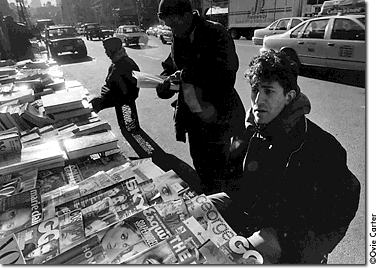
Mitchell Duneier (seated) on Sixth Avenue
Sidewalk makes clear the failure of legislators and the citizenry to understand the situation of the people who make their living on the street. Increasing the number of laws punishing what amounts to the failure to comport oneself according to the dictates of middle-class respectability will necessarily fail to address the greater problems that plague the people on the margins of society. Harassing people on the street won't remedy housing segregation, high concentrations of poverty, the after-effects of Jim Crow, or failed drug-reform policy. Duneier asserts that the people on Sixth Avenue, in their struggle to lead respectable, moral lives in a world that's fundamentally hostile to them, are part of the solution to social evils, not the root of the problem.
Duneier presents a clear and compelling argument, but his study has one significant limitation. One wonders whether or not the lessons to be learned from this unique Sixth Avenue neighborhood will hold up for other locales. Hasan and the other vendors of print material have a convenient market for their merchandise -- the area, after all, has more than its share of universities and wealth. Duneier tells of professors who stop by the tables looking for the latest issues of expensive academic journals or people on the hunt for recent copies of Paris Elle. Does the economy that springs up around the selling of printed material have the same opportunity to arise in South Central L.A., or in inner-city Detroit?
But Duneier doesn't claim to offer a panacea for the problems of the American city. Ultimately his message is that the symptoms of social problems must be evaluated separately from their causes and that the problems of society must be understood before they can be addressed. Duneier's immersion in the life of Sixth Avenue and his penetrating observations about the experience contributes immensely to that understanding.
Join the conversation in the Politics & Society conference of Post & Riposte.
More on politics and society in Atlantic Unbound and The Atlantic Monthly.
Charles Davis is a writer living in Boston.
Copyright © 2000 by The Atlantic Monthly Company.
 |
 |
 |
 |
 |
 |