




June 3, 1997
When social historians a century hence come to write the story of our times -- the story of America in the waning decades of the twentieth century -- they will have no better lens for viewing the present than the one provided by the AIDS epidemic. Acquired immune deficiency syndrome has not, of course, struck all segments of our society equally, but the disease has provoked strong political and emotional reactions across the board in a manner that is socially diagnostic. As a result the AIDS epidemic encapsulates a record of sexual mores and sexual practices; of drug abuse and drug policy; of medical science and medical bureaucracy; of urban, religious, and celebrity politics; of the problems of the underclass; of the shifting currents of national psychology; and of issues such as immigration, health insurance, job discrimination, and the viral threat from increasingly accessible parts of the world beyond our shores. It is nearly impossible to think of an element of our society, be it garbage disposal or the arts, kindergarten education or the military, in which AIDS has not somehow figured during these past fifteen years.
Managing editor, The Atlantic Monthly
Chandler Burr
Burr is the author of A Separate Creation: The Search for the
Biological Origins of Sexual Orientation (1996) and the creator and
moderator of The Gay Gene, a
Web site devoted to the biological research of sexual orientation. His
argument for reinstating traditional rules of public health for fighting
AIDS, "The AIDS Exception: Privacy vs. Public Health" appears in the June, 1997, issue of The
Atlantic.
Winnie Stachelberg
Stachelberg is the legislative director of the Human Rights Campaign, the
nation's largest lesbian and gay political organization. She leads a team
of professional advocates in formulating and advancing HRC's legislative
agenda on Capitol Hill.
Tom Coburn
Coburn represents Oklahoma's 2nd Congressional District in the U.S. House
of Representatives. He recently introduced the HIV Prevention Act of 1997
which, if it passes, would require more HIV reporting and partner
notification. He is also a practicing family physician who specializes in obstetrics.
Joel Gallant
Gallant is an assistant professor of medicine in the Division of
Infectious Diseases at the Johns Hopkins University School of Medicine and
is the director of the Moore HIV Clinic at the Johns Hopkins Hospital.
For more on the HIV/AIDS epidemic, visit The Body, a comprehensive multimedia source for information on HIV and AIDS.
Visit our previous roundtables:
"Welfare: Where Do We Go From Here?" (March, 1997)
"Immigration: One Nation, Inhospitable?" (November, 1996)
 It is hardly surprising that an issue that cuts so relentlessly and
obliviously across lines of social demarcation has aroused deep passions.
Those
passions have been stirred with special vigor by the fundamental question of
how dogged, not to mention intrusive or coercive, should be the steps taken by
public-health authorities in finding cases of HIV infection -- and
in dealing subsequently with those people discovered to be infected. Should
we have been using from the outset more of the "traditional" public-health
measures employed against other diseases, such as aggressive attempts to
identify infected people (name reporting) and the people with whom they've
been in contact (partner notification)? Or do the special circumstances of
AIDS -- an incurable illness that initially infected a particular
demographic subset -- justify "exceptionalist" new approaches that
veer away from established measures but that may in fact help us to deal
more effectively with future epidemics?
It is hardly surprising that an issue that cuts so relentlessly and
obliviously across lines of social demarcation has aroused deep passions.
Those
passions have been stirred with special vigor by the fundamental question of
how dogged, not to mention intrusive or coercive, should be the steps taken by
public-health authorities in finding cases of HIV infection -- and
in dealing subsequently with those people discovered to be infected. Should
we have been using from the outset more of the "traditional" public-health
measures employed against other diseases, such as aggressive attempts to
identify infected people (name reporting) and the people with whom they've
been in contact (partner notification)? Or do the special circumstances of
AIDS -- an incurable illness that initially infected a particular
demographic subset -- justify "exceptionalist" new approaches that
veer away from established measures but that may in fact help us to deal
more effectively with future epidemics?Some "traditional-minded" authorities have set teeth on edge among AIDS activists and civil libertarians with statements (regarding AIDS) like the following: "Detention and quarantine are legitimate and important measures for the community to have in reserve." (The quotation is from Dr. Stephen C. Joseph, New York City's former health commissioner.) At the same time, some "exceptionalist" activist groups have set other teeth on edge by seeming to regard issues of privacy and lifestyle as paramount and non-negotiable.
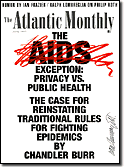
How different is AIDS from other public-health threats? How different, therefore, should be our public-health response? These are the questions that lie at the heart of Chandler Burr's article "The AIDS Exception: Privacy vs. Public Health" and they are questions on which health professionals increasingly disagree.
Now, a few more questions to begin the discussion:
- We are all accustomed to issues in which principle and pragmatism collide.
But it might be said that where public-health strategies are concerned the
only
"principle" is pragmatism itself. Bearing in mind that, according to the
Centers for Disease Control and Prevention (CDC),
half of the nearly one million people thought to be infected with the HIV
virus
aren't aware of their infection, have our current public-health approaches to
AIDS been a pragmatic success? By what measure?
- One of the main objections to making more strenuous systematic efforts to
test more people for HIV -- and to find and contact the sexual and
needle-sharing partners of people who test positive for HIV -- is
that these efforts will prove counterproductive: fear of
the health-care system will drive infected people underground. What reason
is there to believe that this would happen? Alternatively, what reason is
there to believe that it
would not?
- To traditionalist-oriented respondents: What is the most telling insight
of the exceptionalist argument? To the exceptionalist-oriented respondents: What is the most telling insight of the traditionalist argument?
Introduction and opening questions, by Cullen Murphy
Round One -- posted on June 3, 1997
- Chandler Burr: Opening Remarks
- Winnie Stachelberg: Opening Remarks
- Tom Coburn: Opening Remarks
- Joel Gallant: Opening
Remarks
Round Two -- posted on June 19, 1997
- Reader Responses
- Chandler Burr -- Concluding Remarks
- Winnie Stachelberg -- Concluding Remarks
- Tom Coburn -- Concluding Remarks
- Joel Gallant -- Concluding Remarks
Copyright © 1997 by The Atlantic Monthly Company. All rights reserved. - Reader Responses
 |
 |
 |
 |
 |
 |