




Baked Empanadas
Twenty-Hour Apples
Lemon Tart
Sweet Tart Dough
Lemon Curd
Lemon Cream
December 17, 1998
 Obsession is a trait I value highly in cooks who write about food. The
quality is perhaps most appropriately applied to baking, and there is no more
obsessed baker than Rose Levy Beranbaum, author of The Cake Bible and
now its long-awaited sequel, The Pie and Pastry Bible. Being a veteran
of a marathon quest to perfect a recipe or two myself (my "Unbeatable
Biscotti," in The Joy of Coffee, for which I made
eighteen separate batches before being satisfied with quite a simple
formulation), I am agog at the number of pie crusts and pastries -- from simple to
tricky and complicated -- that Beranbaum has perfected.
Obsession is a trait I value highly in cooks who write about food. The
quality is perhaps most appropriately applied to baking, and there is no more
obsessed baker than Rose Levy Beranbaum, author of The Cake Bible and
now its long-awaited sequel, The Pie and Pastry Bible. Being a veteran
of a marathon quest to perfect a recipe or two myself (my "Unbeatable
Biscotti," in The Joy of Coffee, for which I made
eighteen separate batches before being satisfied with quite a simple
formulation), I am agog at the number of pie crusts and pastries -- from simple to
tricky and complicated -- that Beranbaum has perfected. As her many readers know, Beranbaum is a model of precision in guiding anyone through each step of her sometimes controversial techniques. In The Cake Bible (1988), for example, she advocated a one-bowl form of mixing that went against established wisdom on how to achieve the lightest texture; but the technique made life easier for the fearful apprentice, and produced fine results. In The Pie and Pastry Bible, Beranbaum embraces the food processor, something many pastry makers think can only toughen pastry. I tend to trust the many, many appearances of the word tender in the early chapter on basic crusts, however. And I plan to try her method to avoid overhandling the dough -- mixing pie crust in a Ziploc bag, more efficient than the unreliably sealed, folded-over sheets of plastic wrap I have used (but not admitted to) in the past. This is one of many ingenious, hints-from-Heloise ways Beranbaum comes to the aid of a cook not necessarily born with a "pastry hand" -- a hand both firm and gentle and cold by nature (low blood pressure is an asset for piemakers).
Previously in Corby's Table:
A look at the new book by Barbara Kafka, a cook who takes a fearlessly original approach to soup.
A trip to Abruzzo with Anna Teresa Callen, whose new book draws on culinary memories of this less-traveled Italian region.
Paula Wolfert's latest Mediterranean explorations.
The ultimate guide to eating your vegetables.
Jasper White gets up close and personal with lobster claws, tails, and tomalley.
A rare book that shows Italy unromanticized -- and more appetizing.
New reasons not to get out of bed in the morning.
In Ruth Reichl's new memoir, Tender at the Bone, food is about more than eating.
South America's well-traveled cuisine.
Just in time for the holidays, a look back over the year's best.
More by Corby Kummer in Atlantic Unbound
I'm more drawn to the crust as used for empanadas, meat turnovers with a ground-round filling spiced with garlic, paprika, cumin, and ancho chile powder. Optional but desirable additions are raisins, onions, and olive oil or lard. Please try lard. It's the great undiscovered baking fat. Beranbaum rightly points out that once she realized how to use it -- and render it at home, an important secret -- she understood why no other fat can make as flaky, light, and flavorful a crust.
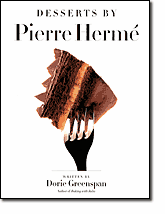 Another trove of potential recipes for the holidays is Desserts by Pierre
Hermé, written by Dorie Greenspan. Greenspan is an exceedingly talented and
clear writer on baking, whose organization and clarity made Baking with
Julia (1996) a bestseller, and whose book on making waffles
and pancakes I treasure. Pierre Hermé has for the past few years been the cult Parisian
pastry chef. After making his name at Fauchon, the
Parisian food-market-as-jewelry-store and general shrine to gastronomy, he
remade the pastries at another sacred haunt, Ladurée -- the most beautiful
tea room in Paris, with perhaps the world's best hot chocolate and croissants.
Now he is rumored to be coming to New York, to collaborate with the famed chef
David Bouley.
Another trove of potential recipes for the holidays is Desserts by Pierre
Hermé, written by Dorie Greenspan. Greenspan is an exceedingly talented and
clear writer on baking, whose organization and clarity made Baking with
Julia (1996) a bestseller, and whose book on making waffles
and pancakes I treasure. Pierre Hermé has for the past few years been the cult Parisian
pastry chef. After making his name at Fauchon, the
Parisian food-market-as-jewelry-store and general shrine to gastronomy, he
remade the pastries at another sacred haunt, Ladurée -- the most beautiful
tea room in Paris, with perhaps the world's best hot chocolate and croissants.
Now he is rumored to be coming to New York, to collaborate with the famed chef
David Bouley. Hermé's imagination and Parisian chic, married with Greenspan's understanding of the American kitchen, has resulted in a uniquely useful cookbook that will set novices to dreaming and will send even the most jaded bakers straight to the kitchen.
Here are two original and easy pastry items to enrich any baker's repertory. "Twenty-Hour Apples" shows a new way to make something between baked apples and apple butter. The apples are baked ten hours and chilled for another ten, to create a texture "so compacted they can be unmolded" and a flavor so intense that you won't miss the time a few months ago when apples first came off the tree. (Slow baking also works miracles with tomatoes, as cookbook writers all over the country discovered seemingly en masse four years ago.)
Then there is my favorite tart -- lemon, the kind I try first when I eat at any new pâtisserie. The Hermé lemon cream uses an unusual technique that gives it, Greenspan says, "exquisite, silky texture and true lemon flavor." The sweet tart dough (pâte sucrée), fully baked before being filled, is especially appealing for its use of ground almonds and vanilla-bean pulp.
As a bonus, I include Beranbaum's notes on lemon curd. She shares my passion for it, and, as is her way, gives explanations for what makes the strongest flavor and best texture, and offers several citrus variations. If you're as obsessed as I (it would perhaps be impossible to be as obsessed as she), you will want to try several of these, and the Hermé version too -- even if you don't go as far as Beranbaum once did on a trip to Boston, when she brought me a box of lemon bars made with lemon curd containing duck eggs. It was one of those unforgettable tastes. It turned me forever into a Beranbaum -- and duck-egg -- disciple.
-- Corby Kummer
Excerpts from The Pie and Pastry Bible, by Rose Levy Beranbaum (Scribner) and Desserts by Pierre Hermé by Dorie Greenspan (Little, Brown)
Flaky Cheddar Cheese Pie Crust
Crisper than a cream cheese crust, this crust is just as flaky and tender. The flavor of Cheddar is further enhanced by cayenne pepper, which stays in the background as a nice bite. This crust is so delicious, I bake the scraps to eat by themselves as snacks. This is the crust for a meatloaf or the Roasted Red Pepper and Poblano Quiche.
| 8 tablespoons unsalted butter, cold | 1/4 teaspoon cayenne pepper |
| 1 1/3 cups bleached all-purpose flour | 3/4 cup, medium packed sharp Cheddar cheese, grated, cold |
| 1/4 + 1/8 teaspoon salt | 2 1/2 tablespoons ice water |
| Optional: 1/8 teaspoon baking powder (if not using, double the salt) | 1 1/2 teaspoons cider vinegar |
Food Processor Method
Cut the butter into small (about 3/4-inch) cubes. Wrap it in plastic wrap and freeze it until frozen solid, at least 30 minutes. Place the flour, salt, optional baking powder, and cayenne pepper in a reclosable gallon-size freezer bag and freeze it for at least 30 minutes.
Place the flour mixture in a food processor with the metal blade and process for a few seconds to combine. Set the bag aside. Add the Cheddar cheese and process for about 20 seconds or until the mixture resembles coarse meal. Add the frozen butter cubes and pulse until none of the butter is larger than the size of a pea. (Toss with a fork to see it better.) Remove the cover and add the water and vinegar. Pulse until most of the butter is reduced to the size of small peas. The mixture will be in particles and will not hold together. Spoon it into the plastic bag.
Holding both ends of the bag opening with your fingers, knead the mixture by alternately pressing it, from the outside of the bag, with the knuckles and heels of your hands until the mixture holds together in one piece and feels slightly stretchy when pulled.
Wrap the dough with plastic wrap, flatten it into a disc, and refrigerate for at least 45 minutes, preferably overnight.
Hand Method
Place a medium mixing bowl in the freezer to chill. Cut the butter into small (about 3/4 inch) cubes. Wrap it in plastic wrap and refrigerate it for at least 30 minutes.
Place the flour, salt, optional baking powder, and cayenne pepper in a medium bowl and whisk to combine. Add the Cheddar cheese and rub the mixture between your fingers to blend it into the flour until it resembles coarse meal. Spoon the mixture, together with the cold butter, into a reclosable gallon-size freezer bag. Expel any air from the bag and close it. Use a rolling pin to flatten the butter into thin flakes. Place the bag in the freezer for at least 10 minutes or until the butter is very firm.
Transfer the flour mixture to the chilled bowl, scraping the sides of the bag. Set the bag aside. Sprinkle the ice water and vinegar onto the mixture, tossing it lightly with a rubber spatula. Spoon the loose mixture back into the plastic bag.
Holding both ends of the bag opening with your fingers, knead the mixture by alternately pressing it, from the outside of the bag, with the knuckles and heels of your hands until the mixture holds together in one piece and feels slightly stretchy when pulled.
Wrap the dough with plastic wrap, flatten it into a disc, and refrigerate for at least 45 minutes, preferably overnight.
Store refrigerated, up to 2 days; frozen, up to 3 months.
Pointers for Success
This dough needs to be kneaded until stretchy so that it is strong enough to use for wrapping around a freestanding meatloaf and not tear during baking.
Baked Empanadas
My editor, Maria Guarnaschelli, insisted that I include a recipe for this Latin American specialty because it is such a popular savory pastry. When she described the filling, I suspected that my Miracle Flaky Lard Pie Crust, with its crisp, flaky texture and wheaty meat flavor, would be the perfect wrapping for a spicy meat filling.
These spicy meat turnovers give definition to the word savory. Their subtle but tantalizing piquancy comes not only from herbs and spices but also from the occasional sweet/sour zing of raisins, accented by the mild brininess of chopped olives.
I love these empanadas so much they will now appear with great regularity at my table.
As with all spicy mixtures, these empanadas are possibly even more delicious as leftovers.
| 1 1/2 recipes Miracle Flaky Lard Pie Crust or Flaky Cheddar Cheese Pie Crust | 12 ounces ground round |
| Optional: 2 tablespoons raisins | 1/2 teaspoon salt |
| 2 teaspoons lard or olive oil | 1/4 teaspoon freshly ground black pepper |
| 1 heaping cup chopped onion | 3/4 teaspoon ancho chile powder (see note) or 1/2 teaspoon chili powder |
| a pinch of sugar | 1/2 teaspoon dried thyme |
| 1 medium clove garlic, minced | 1/4 teaspoon dried oregano |
| 1/2 teaspoon paprika | Optional: 7 green olives stuffed with pimientos, coarsely chopped, about 2 tablespoons |
| 1/4 teaspoon ground cumin | 1/2 cup whole wheat flour |
| 1 large egg white, lightly beaten |
Equipment
A cookie sheet or inverted half-sheet pan
Make the Filling
In a small bowl, place the optional raisins with 1 tablespoon of water and allow them to sit for at least 20 minutes; drain.
Heat a medium skillet over low heat until hot. Add the lard or oil and the onions, sprinkle with the sugar, and fry the onions, stirring occasionally, for about 10 minutes or until they become deep golden. Add the garlic and sprinkle with the paprika and cumin. Cook, stirring constantly, for about 2 minutes, just to bring out the flavor of the spices without burning them. Add the ground beef and sprinkle with the salt, pepper, chili powder, thyme, and oregano. Raise the heat to medium and cook, stirring often, for 3 to 5 minutes or until the meat is no longer pink.
Remove the pan from the heat and stir in the optional drained raisins and chopped olives. Allow the filling to cool to room temperature. (It must not be warm when placed on the dough, or it will soften the pastry.) To speed cooling, you can transfer it to a baking sheet or piece of aluminum foil laid on the counter.
Shape the Empanadas
I prefer to roll the dough rounds one at a time so that there is no need to reroll the scraps.
Process the whole wheat flour for a few minutes in a food processor with the metal blade.
Divide the dough into 12 equal pieces. Work with one piece at a time and keep the rest refrigerated. On a counter well floured with the whole wheat flour, or between two sheets of plastic wrap well floured with the whole wheat flour, roll the piece of dough into a circle about 1/16 inch thick and large enough to cut out a 6-inch circle. Use a template and a sharp knife to cut out the circle. Alternatively, roll the dough into a large rectangle or, working with half the dough at a time, 2 large rectangles, and cut out 6-inch circles. Then lay the scraps side by side, slightly overlapping and in a few layers. Roll them between plastic wrap, folding the piece of dough in thirds like a business letter, and cut out more circles; you should have 12 in all. Refrigerate the dough for at least 15 minutes before you shape the empanadas.
Transfer each dough circle to the bottom end of a 9-inch-long piece of plastic wrap. Brush the bottom half of it with the egg white. Spoon 3 tablespoons of the filling onto this section, leaving a 1-inch border. Using the plastic wrap if the dough is at all sticky, fold the top part of the dough over the filling, so that the edges are flush. With your fingers, firmly press the 1-inch border to seal it. Fold the edge up over itself, a little at a time, pleating it as you go and pressing again to seal it. (There is no need to cut vents, because the filling is precooked, so there will be no steam or bubbling juices to burst the seams of the empanadas.)
Lap the top piece of plastic wrap over the dough and lift the empanada onto the baking sheet. Repeat with the remaining empanadas and refrigerate them for at least 30 minutes.
Preheat the oven to 425°F. at least 20 minutes before baking. Set an oven rack at the middle level and place a baking stone or inverted baking sheet on it before preheating.
Unwrap the empanadas and space them evenly on the sheet. Place the sheet directly on the stone and bake for 20 to 25 minutes or until the pastry starts to turn golden. Place the empandas on serving plates and allow them to cool for 10 minutes before eating. They are also delicious at room temperature.
Store unbaked, frozen, up to 3 months. (To bake from frozen, bake in a preheated 400°F. oven for 30 to 35 minutes or until golden.) Baked, refrigerated, up to 5 days. (Reheat, if desired, in a 300°F. oven for 5 minutes.)
Note
To make your own ancho chile powder, on a small baking sheet, toast an ancho chile in a preheated 350°F. oven for 5 minutes or just until it puffs up and becomes crisp, turning it halfway through. (Overtoasting will make it bitter.) Remove and discard the stem and seeds. Process it in a food processor or spice blender until it turns into a fine powder. Store any leftover powder in an airtight jar.
Understanding
Ancho chiles are dried poblano peppers. These are the chiles that give the distinctive flavor to commercial chili powder. Freshly roasted and ground, they are more aromatic than chili powder. Ancho chiles are sold in Spanish markets and by mail order from Balducci's.
Rolling out the pie dough on whole wheat flour gives it extra texture and flavor. To prevent the coarse bran from breaking through the dough, process it first for a few minutes in a food processor with the metal blade.
Twenty-Hour Apples
Slow cooking and equally slow cooling turn out deeply satisfying, soft, sweet, buttery apples. Although you start with a mound of fruit in the baking dish, you finish with a mere two inches or so of juicy pommes confites. Don't skimp on the ten-hour chill -- it's as important as the ten-hour bake in giving you a perfect texture: apples so compacted they can be unmolded, yet so thoroughly "candied" that each thin slice is completely infused with butter, sugar, orange zest, and its own juice.
The measurements for this recipe are approximate, which is unusual in baking but appropriate here, where you brush the apples with butter and sprinkle them with sugar. A little more, a little less, no matter -- these apples are foolproof.
I adapted this recipe from Edouard Nignon's L'Heptaméron des Gourmets, a cookbook from the early twentieth century. It yields more than you'll need for any one recipe, but the cooking method works best with large quantities and extras aren't a problem. With a little cream, the apples make a simple dessert; with yogurt, they're nice for breakfast. -- P.H.
| 4 to 4 1/2 pounds (about 8 to 10 large) apples, such as Golden Delicious, Fuji, Granny Smith, or other tart-sweet apples | Zest of 1 orange -- removed with a zester |
| 4 to 6 tablespoons unsalted butter, melted | about 1/2 cup sugar |
1. Position a rack in the center of the oven and preheat the oven to 175°F. (If your oven doesn't have markings for as low as 175°F, preheat it at its lowest setting.) Line a jelly-roll pan with parchment or aluminum foil (to facilitate cleanup), and butter an 8 by 8-inch baking dish (ovenproof glass or ceramic is ideal); set aside.
2. Peel the apples, cut them in half from stem to blossom end, and remove the core with a melon bailer. Working with the apples cut side down, cut each half crosswise into very thin slices, about 1/16 inch thick, keep the slices in place to retain the form of each apple half. Working with one half-apple at a time, press the apple between your palms to fan the slices; lay the slices in the pan. Continue fanning and arranging apple halves until you've covered the bottom of the pan. (If there are holes here and there, just fill them with apple slices. You want to get as even a layer as you can, but it doesn't make any difference if the apples are in a line, perpendicular to one another, or just helter-skelter.) Brush the layer generously with butter, sprinkle evenly with a thin layer of sugar, and toss on a few strands of orange zest. Continue making layers until you have used all the apples, at which point the ingredients may mound above the top of the pan.
3. Double-wrap the pan with plastic film, stretching the plastic around the pan, top and bottom, to make certain that it is well sealed. Prick the plastic on the top in 6 to 8 places with the point of a knife, and weight the top with a couple of ovenproof plates or bowls, taking care not to cover all of the air holes you've created. Nesting two soufflé dishes on top of the pan is a perfect arrangement -- it's OK that a portion of the surface won't be weighted. Place the weighted pan on the lined jelly-roll pan and bake for 10 hours. (Don't be concerned -- the oven temperature is so low there's no danger of the plastic wrap melting or burning.) Remove the apples from the oven to a cooling rack and, keeping the plastic wrap and weights in place, cool to room temperature.
4. Chill the apples, still wrapped and weighted, for at least 10 hours before using them. When you are ready to use the apples, unmold or spoon them from the pan.
The apples can be kept wrapped airtight in the refrigerator for about 5 days.
Lemon Tart
Lemon tarts sparkle from every pastry shop window, but tarts with sparkle that's more than glaze-deep are rare. Here's that rarity, a glorious lemon tart with fearlessly intense fruit flavor and a texture that's smooth, sensuous, and silken. It is a model of simplicity, composed merely of a sweet crust and Pierre's impeccable lemon cream, the one that's easy to make, hard to resist, and impossible to improve upon. The tart is an ideal do-ahead dessert; a good finisher for dinners plain or fancy, hearty or light; and a good sport -- you can play around with it, changing its size or adding fruits to its base. For variety, try lining the crust with colorful fresh berries.
If you're new to tart making, start here. Not only is success guaranteed, but everyone, amateur or pro, finishes with a tart that looks shop-window perfect.
If you'd like, this tart can be topped with an Italian meringue. Pipe rosettes of meringue over the surface of the tart, making sure to cover all of the lemon cream, dust with confectioner's sugar, and caramelize with a blowtorch. Or put the tart under a broiler or in a 475°F oven for a few minutes, just until it's nicely browned. -- P.H.
The Crust
Keep the cooled crust, in its ring, on the baking sheet or transfer it to a cardboard cake round. (You can make the crust up to 8 hours ahead and keep it in its ring at room temperature.)
To assemble
1. Spoon the lemon cream into the crust and use a long metal offset spatula to smooth the top. If the cream is hot, put the tart in the freezer for half an hour to cool it; if not, proceed with the glazing.
2. Heat the jelly in a microwave oven or a small saucepan over low heat until it liquefies. Pour or spoon the glaze evenly over the top of the tart, reserving a little of the glaze if you'd like to finish the tart with a slice of lemon or a small cluster of berries. Brush the fruit with a little hot glaze or jelly to give it a shine. The tart can be chilled until needed or served immediately.
3. At serving time, slide the tart onto a decorative platter and remove the tart ring.
The tart is meant to be served cold and can be kept loosely covered in the refrigerator for about 2 days.
Sweet Tart Dough
This sweet cookie-like dough, pâte sucrée, used for dessert tarts and tartlets, benefits from Pierre's untraditional addition of ground almonds, vanilla, and confectioner's sugar and is at once crunchy and melt-in-your-mouth smooth. Like pâte brisée, it can be made in a very large capacity food processor or a mixer, and it needs a long refrigerated rest. Also as with pâte brisée, you'll get the best results if you make a larger quantity than you might need at the moment -- the crust's consistency depends on this; you can cut the dough into portions and freeze the extras.
Work this mixture as little as possible so that you'll get a nice, crumbly texture. If everything seems mixed but you still have a few large pieces of butter, it's best to leave them. It's preferable to have pieces of butter rather than an overworked dough. -- P.H.
| 2 1/2 sticks (10 ounces) unsalted butter, softened | 1/2 teaspoon vanilla bean pulp or 1/4 teaspoon pure vanilla extract |
| 1 1/2 cups confectioner's sugar, sifted | 2 large eggs, at room temperature, lightly beaten |
| 1/2 cup (lightly packed) ground blanched almonds | 3 1/2 cups all-purpose flour |
| 1/2 teaspoon salt |
To make the dough in a mixer:
Place the butter in the bowl of a mixer fitted with the paddle attachment and beat on low speed until creamy. Add the sugar, almonds, salt, vanilla, and eggs and, still working on low speed, beat to blend the ingredients, scraping down the paddle and the sides of the bowl as needed. The dough may look curdled -- that's all right. With the machine still on low, add the flour in three or four additions and mix only until the mixture comes together to form a soft, moist dough -- a matter of seconds. Don't overdo it.
To make the dough in a large-capacity food processor:
Place the butter in the work bowl of a food processor fitted with the metal blade and pulse and process, scraping down the sides of the bowl as needed, until creamy. Add the confectioner's sugar and process to blend well. Add the almonds, salt, and vanilla and continue to process until smooth, scraping the bowl as necessary. Add the eggs and process to blend. Add the flour and pulse until the mixture just starts to come together. When the dough forms moist curds and clumps and then starts to gather into a ball, stop! -- you don't want to overwork it. The dough will be very soft, pliable, and Play-Doh-ish, more like your favorite butter-cookie dough than traditional pie dough -- that's just the way it should be.
To shape and chill:
No matter the method you used to make the dough, gather it into a ball and divide it into three or four pieces: three pieces for 10 1/4-inch tarts, four for 8 3/4-inch tarts. (Of course, you can press the dough into one large disk and cut off as much as you need at the time that you need it.) Gently press each piece into a disk and wrap each one in plastic. Allow the dough to rest in the refrigerator for at least 4 hours or for up to 2 days before rolling and baking. (At this stage, the dough can be wrapped airtight and frozen for up to a month.)
To roll:
1. For each tart, place a buttered tart ring on a parchment-lined baking sheet and keep close at hand. Work with one piece of dough at a time; keep the remaining dough in the refrigerator.
2. Working on a lightly floured surface (marble is ideal), roll the dough into a round between 1/16 and 1/8 inch thick, lifting the dough often and making certain that the work surface and the dough are amply floured at all times. (Because this dough is so rich, it can be difficult to roll, but a well-floured surface makes the job easier. If you are a novice at rolling, you might find it easier to tape a large piece of plastic wrap to the counter and to roll the dough between that and another piece of plastic. If you do this, make sure to lift the top sheet of plastic wrap from time to time so that it doesn't crease and get rolled into the dough.) Roll the dough up and around your rolling pin and unroll it onto the tart ring. Fit the dough into the bottom and up the sides of the ring, then run your rolling pin across the top of the ring to cut off the excess. If the dough cracks or splits as you work (as it may, since it is so fragile), don't worry -- patch the cracks with scraps (moisten the edges to "glue" them in place), and just make certain not to stretch the dough that's in the pan. What you stretch now will shrink later. Prick the dough all over with the tines of a fork (unless the tart will be filled with a runny custard or other loose filling) and chill it for at least 30 minutes in the refrigerator or freezer. Repeat with the remaining dough, if necessary.
To bake:
When you are reedy to bake the crust(s), preheat the oven to 350°F. Fit a circle of parchment paper or foil into each crust (cut the paper large enough to extend above the top of the tart) and fill with dried beans or rice. To partially bake the crust(s), bake for 18 to 20 minutes, or until lightly colored. If the crust needs to be fully baked, remove the parchment and beans and bake for another 5 to 7 minutes, until golden. Transfer the crust(s) to a rack to cool.
Fruit Curds
(Lime, Juice Orange, Blood Orange, Bitter Seville Orange,
and Passion Fruit)Fruit curd is actually a custard that depends on the high acidity of the fruit, in combination with egg yolks and butter, to achieve its gloriously silken texture without the addition of a starch thickener. This results in an utterly uncompromised purity of liltingly bright flavor.
Fruit curd is one of the most delightful and useful components in the dessert kingdom. Lemon has always been the queen of curds, described as capturing sunshine in a jar. But I've discovered that passion fruit takes curd to new heights, difficult to describe other than to say it brings to mind words like tropical and tantalizing and addicting. The lime and orange curds are like pure concentrations of these often illusive flavors. They taste the way one hopes for the best variety of this fruit to be at its peak of ripeness and freshness.
Fold whipped cream or meringue into curd and you have a lighter and more mellow filling or topping that is an unrivaled partner for fresh fruit. A little curd folded into plain yogurt does wonders to enliven it. Curd also serves as the base for the most creamy, flavorful chiffon pie and ice creams.
Different citrus fruits vary in flavor intensity and acidity, thereby requiring differing amounts of sugar. The stronger the acid and the less sugar used, the sooner the curd thickens (the lower the finished temperature). Each one of these fruit variations has been worked out carefully, taking these factors into consideration and resulting in the most intensely pure flavor of each fruit.
It is rare that I would recommend a commercial product to replace a homemade one, but, when time is a factor, it's helpful to know that Tiptree makes an exceptionally high quality lemon curd (very close to homemade) with no additives (and the same yield as this recipe), and it can be used in any recipe calling for lemon curd.
Classic Lemon Curd
| 2 teaspoons finely grated lemon zest | 6 tablespoons lemon juice, freshly squeezed and strained (about 2 1/2 large lemons) |
| 4 large egg yolks, or 1/4 liquid cup | 4 tablespoons unsalted butter, cut into pieces or softened |
| 3/4 cup sugar (use 10 tablespoons if pairing the curd with something very sweet, such as meringue) | A pinch of salt |
Have ready near the range a strainer suspended over a medium bowl that contains the lemon zest.
In a heavy nonreactive saucepan, beat the yolks and sugar until well blended. Stir in the lemon juice, butter, and salt. Cook over medium-low heat, stirring constantly (be sure to scrape the sides of the pan), until the mixture is thickened and resembles hollandaise sauce; it should thickly coat a wooden spoon but still be liquid enough to pour. The mixture will change from translucent to opaque and begin to take on a yellow color on the back of the spoon; it must not be allowed to boil, or it will curdle. Whenever steam appears, remove the pan briefly from the heat, stirring constantly to keep the mixture from boiling. When the mixture has thickened (196°F. on an accurate thermometer), pour it at once into the strainer. Press with the back of a spoon until only the coarse residue remains. Discard the residue (or enjoy it as a treat -- it tastes great). Gently stir in the zest and allow it to cool.
Variations
For all variations, the amount of fruit juice and sugar varies but the yolks, butter and salt remain constant.
Lime Curd
Lime is one of the most difficult flavors to describe and yet it has a strong and irreplaceable hold on flavor memory. It has a fresh sour tartness that is just right. Though often thought of as a less interesting cousin to lemon, in a drink and in certain flavor combinations, lemon would overpower instead of blend and is simply not its equal. Though lime juice is really pale yellow, it somehow tastes as if it is green. This curd captures lime's essence. It blends perfectly with both blueberry and kiwi -- it serves as the cream base for the kiwi tart and can be used to replace the lemon curd in the blueberry tart.
Replace the lemon zest with an equal amount of lime zest and the lemon juice with an equal amount of freshly squeezed lime juice (from about 3 small limes). Decrease the sugar to 1/2 cup. The finished temperature is 185°F. If desired, for a pale green color, gently stir 2 drops of liquid green food color into the finished curd. (Makes 1 cup.)
Bitter Seville Orange Curd
Orange juice always seems to lose its flavor when combined with other ingredients, except when it's from a Seville variety. This is the orange used to make marmalade. It makes an orange curd with the truest orange flavor, sweet-sour like a sour ball. In fact, the flavor seems to bounce around in your mouth, it is so alive and vibrant. Seville oranges are very thick skinned and the zest would produce a horrid taste in the curd, so be sure to use navel orange zest. The curd is a beautiful bright gold flecked with orange zest. Seville oranges have a short season, but the juice freezes perfectly for several months.
Replace the lemon zest with 4 teaspoons navel orange zest and the lemon juice with an equal amount of bitter Seville orange juice (from about 1 1/2 oranges). Use the same amount of sugar for a more tart curd or decrease it to 2/3 cup . The finished temperature is 185°F. (Makes 1 cup plus almost 2 tablespoons.)
Blood Orange Curd
Blood oranges are delicious, but they are not as intensely flavored, or acidic, as Seville oranges. Reducing the juice by half concentrates the flavor and intensifies the color. This curd can vary in color from deep rose to purple. The darker the blood orange skin, the deeper the color of the flesh. Blood oranges from Sicily have the most delicious flavor. Balducci's has frozen blood orange juice available all year around.
Use the same amount of zest as for lemon curd, but start with 1 cup of juice (from about 4 oranges) and reduce it to 1/2 cup (see Pointers below). Decrease the sugar to 1/2 cup. The finished temperature is 185°F. (Makes 1 cup plus 2 tablespoons.)
Juice Orange Curd
This orange has a lovely flavor but is far less intense than blood or bitter oranges, so the juice must be reduced by three quarters and the curd requires more orange zest. A touch (about 1/4 teaspoon) of fine-quality orange oil does wonders to intensify the flavor.
Use navel orange zest and increase the zest to 1/4 cup. Start with 2 cups of juice (from about 8 juice oranges) and reduce it (in two batches if using the microwave) to 1/2 cup (see Pointers below).
Decrease the sugar to 2/3 cup. Add the zest before cooking the curd and do not strain it. If desired, gently stir in 1/2 teaspoon of fine-quality orange oil at the end. The finished temperature is 180°F. (Makes a scant 1 1/2 cups.)
Passion Fruit Curd
Passion fruit has an aromatic, tropical, and near-addictive aroma and flavor. The king of all curds, passion fruit curd is wonderful in a tart and beyond sublime in ice cream, particularly served with peach pie.
Replace the lemon juice with 10 tablespoons of passion fruit juice (from 6 to 7 passion fruit). Add 6 tablespoons with the yolk mixture and gently stir the remaining 4 tablespoons into the strained curd. (Uncooked, it offers more aromatic vibrancy.) Decrease the sugar to 2/3 cup. The finished temperature is 190°F. (Makes 1 cup + 6 tablespoons, or 1 cup + 2 tablespoons, if using concentrated juice.)
Store refrigerated in an airtight container, up to 3 weeks. (Longer storage dulls the fresh citrus flavor.)
Pointers for Success
Understanding
An (unlined) aluminum pan should not be used, because it reacts with the egg yolks, turning them chartreuse.
Sugar raises the coagulation point of the egg yolks. It also protects them from premature coagulation during the addition of the acidic fruit juice. If the juice were added directly to the unprotected yolks, the yolks would partially coagulate and, when strained, a large percentage of them would be left behind in the strainer.
Straining the curd after cooking produces the silkiest texture because it removes any coagulated bits of egg. The zest is therefore added after straining, except for the juice orange curd. In order to maximize the elusive orange flavor, the zest must be heated with the yolk mixture and left in after cooking.
Except for bitter Seville oranges, oranges require concentration of their juices for adequate flavor impact. Reducing fruit juices in a microwave results in the purest fruit flavor without any of the slight browning, or caramelization, of the fruit sugars that often takes place using the cooktop.
Lemon Cream
Although it contains the same ingredients as those used to make lemon curd, and is used in much the same way as curd, this cream's exquisite silky texture and true lemon flavor set it apart. Its splendid texture is achieved by cooling the cream significantly before adding the butter, and then giving the cream a high-speed finish in a blender. While it is sublime in crepes, tarts, and desserts, and stunning paired with chocolate mousse in the Riviera, just a spoonful spread on a piece of toast is a simple but special pleasure.
The crucial moment in this recipe is when you add the butter to the lemon cream -- you must cool the cream to 140°F before adding the butter. (Indeed, butter should never be added to any mixture that's over 140°F.) If the cream is too hot and the butter melts too much, you won't get the smooth texture this lemon cream should have. Finally, it's the beating in the blender that helps to incorporate the butter thoroughly and make the cream airy. -- P.H.
| 1 cup sugar | 3/4 cup freshly squeezed lemon juice (from 4 to 5 lemons) |
| Zest of 3 lemons -- removed with a zester and finely chopped | 2 sticks plus 5 tablespoons (10 1/2 ounces) unsalted butter, cut into tablespoon-sized pieces, softened |
| 4 large eggs |
1. Put a saucepan of water over heat and bring the water to the simmer. Place the sugar and lemon zest in a large metal bowl that can be fitted into the pan of simmering water. Off the heat, rub the sugar and zest together between your fingers until the sugar is moist, grainy, and very aromatic. Whisk in the eggs and then the lemon juice.
2. Fit the bowl into the pan of simmering water (making certain that the water doesn't touch the bottom of the bowl). Cook, stirring with the whisk, until the cream thickens and reaches 180°F, as measured on an instant-read thermometer. As you cook the cream, whisking all the while to keep the eggs from overheating and scrambling, you'll see that at first the cream is light and foamy, then the bubbles get larger, and finally, as the cream starts to thicken, the whisk leaves tracks. Pay particular attention at this point -- the tracks mean the cream is almost ready. Keep whisking, keep checking the temperature, and keep your patience -- depending on how much water you've got simmering beneath the bowl, it could take as long as 10 minutes for the cream to reach 180°F.
3. Pull the cream from the heat as soon as it is cooked and strain it into the container of a blender or food processor, or into a clean bowl large enough in which to beat it with an immersion blender. Let the cream rest at room temperature, stirring occasionally, until it cools to 140°F, about 10 minutes.
4. Working with the blender on high speed, or using a food processor or immersion blender, beat the cream while adding the pieces of butter, about five at a time. Scrape down the sides of the container or bowl as needed. When all the butter has been incorporated, continue beating the cream for another 3 to 4 minutes -- extra insurance for a light and perfectly smooth lemon cream. (Depending on your blender's power, you may need to adopt a beat-for-a-minute-wait-for-a-minute pattern to keep your machine from overheating. Check the manufacturer's instructions.)
Lemon cream can be used as soon as it is finished or it can be packed airtight and refrigerated for up to 4 days or frozen for a month.
Corby Kummer is a senior editor at The Atlantic Monthly and the author of The Joy of Coffee.
More by Corby Kummer in Atlantic Unbound
Copyright © 1998 by Corby Kummer.
Recipes from The Pie and Pastry Bible by Rose Levy Beranbaum. Scribner: New York, New York, 1998. Hardcover, 692 pages. ISBN: 0684813483. $35.00. Copyright © by Rose Levy Beranbaum.
Additional recipes from Desserts by Pierre Hermé by Dorie Greenspan. Little, Brown & Company: Canada, 1998. Hardcover, 287 pages. ISBN: 0316357200. $35.00. Copyright © by Societé de Créations Patissiéres-Socrepa and Dorie Greenspan.
 |
 |
 |
 |
 |
 |