 |
JANUARY 1997
THE ARTS & ENTERTAINMENT PREVIEW Classical | By Austin Baer |
|
|
JANUARY 1997
THE ARTS & ENTERTAINMENT PREVIEW Classical | By Austin Baer |
Copyright © 1997 by The Atlantic Monthly Company. All rights reserved.
ART FOR OPERA'S SAKE
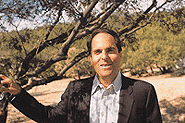
Against the high-concept machinery of so much contemporary opera production, the faux-naïf clarity of David Hockney's designs stands as a bracing antidote. When first unveiled, back in the eighties, at the Los Angeles Music Center Opera, the jewel-toned decor of Richard Wagner's Tristan and Isolde ranked with the artist's most attractive achievements: part Classic Comics, part Book of Hours. For lack of a congenial director, however, the show foundered. In fairness, the opera is long on rapture but short on action--a paean to a forbidden love that transcends life itself--and in abstract surroundings, emotionally charged stasis is a viable option. But there is a story here, and Hockney's setting implied that it would be told. This season the artist has elected, for the first time in his career, to take up the reins as director. The new role is risky: in the main, opera singers are neither the most pliant nor the most imaginative actors in the world. Still, Hockney's manifest passion for the work should prompt the cast's most willing efforts, and if the reality falls short of the production Hockney sees in his head, we are unlikely ever to get closer (January 29-February 18; 213-972-8001).
The multi-talented David Hockney
Photo: Jim McHugh
AN ASIAN INVASION
Pianists have no shortage of concertos to choose from. Still, the appearance of a significant new one is no everyday affair. Daniel Asia's, commissioned by a consortium of seven regional American orchestras and given its premiere in Grand Rapids in 1995, aspires to a place in the grand tradition. Like the standard classical concerto, it is in three movements, and like a handful of supreme exemplars, it runs long. Commissioned at thirty minutes, the Asia Piano Concerto clocks in at nearly forty, to the first presenter's frank dismay. "They're Beethoven and Brahms," one conductor, unappeased by precedent, needlessly pointed out to the composer. "You're Asia." Critics and audiences are giving the piece a warmer welcome. The fast, angular outer movements, built on rhythmically charged cells of melody, have the energy of the fashionable minimalists without their impoverished imagination. The unusual, slow inner movement begins in a grippingly sustained crescendo that seems destined either to reverse itself or to explode. Instead it gives way to a seductive meditation of a distinctly Middle Eastern cast, tinged with a richer chromatism, which spills over into the high-voltage finale. This month the pianist Jonathan Shames, with the all-Asia disc Ivory to his credit (on the Koch label), assays the concerto with the Chattanooga Symphony Orchestra (January 23 and 24; 423-267-8583). A New Zealand Symphony Orchestra recording with André-Michel Schub, who chose Asia for the commission, is due this spring (also on Koch). Exposure by the box-office virtuosi with America's Big Five orchestras is overdue.
Daniel Asia
Photo: Carolee Asia
A BICENTENNIAL SCHUBERT CELEBRATION
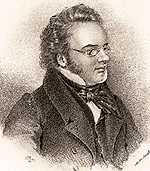
Whether a genius is honored more by splendid isolation or by placement within a context is a question impossible to settle. It comes to mind in connection with the bicentennial of the birth of Franz Schubert, who achieved immortality in a mere thirty-one years. At home and at Carnegie Hall, Christoph von Dohnányi and the Cleveland Orchestra celebrate with imaginative programs featuring three of Schubert's most glorious symphonies along with a selection of his songs; Berio's Rendering, which fuses fragments of authentic Schubert in a strange but wonderful postmodern frame; and music of Mahler, who for all his idiosyncrasies owes to Schubert a debt beyond reckoning. (For dates and tickets in Cleveland call 216-231-1111; for Carnegie Hall call 212-247-7800.) At Lincoln Center's Avery Fisher Hall, Kurt Masur and the New York Philharmonic contribute a straight-ahead all-Schubert program (January 30-February 1; 212-721-6500). The birthday itself falls on January 31, when both Carnegie and Avery Fisher Halls resound to the astral strains of the C-major symphony deservedly known as "The Great." Many encores follow. In February at Carnegie Hall the Ensemble Wien puts forward Schubert at his most sociable, in the company of other Viennese purveyors of ballroom dances (February 7); and Emanuel Ax provocatively juxtaposes Schubert and Liszt, offering (among much else) four of Liszt's so-called transcriptions of Schubert songs--in actuality, bewitching virtuoso fantasias that wrap Schubert's soulfulness in the magic cloak of Liszt's Mephistophelean dazzle (February 21).
The birthday gentleman
Photo: Bettmann Archive
Austin Baer is a writer based in New York.Discuss this feature in the Arts & Literature conference of Post & Riposte (First-time users enter here).
| January 1997 Cover Page | Film | Dance and Theater |