 |
JANUARY 1997
THE ARTS & ENTERTAINMENT PREVIEW Dance and Theater | By Austin Baer and Nancy Dalva |
|
|
JANUARY 1997
THE ARTS & ENTERTAINMENT PREVIEW Dance and Theater | By Austin Baer and Nancy Dalva |
Copyright © 1997 by The Atlantic Monthly Company. All rights reserved.
THARP'S TROUPE REDISCOVERS HER ROOTS
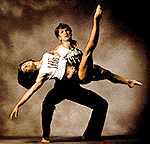
The ever mettlesome and dynamic Twyla Tharp ushers in 1997 with a month of nonstop terpsichorean barnstorming that in its scope and potential influence on new audiences recalls the pioneer days of American dance, when divas like Ruth St. Denis and Ballet Russes primas like Alexandra Danilova shared their farm-town dressing rooms with chickens. Although the stops on the touring event called Tharp! are considerably more up-to-date, and Tharp herself has left the stage, the feeling is marvelously similar: Twyla has set out to conquer the continent. Hers is a formidable accomplishment: in a time when dance seems to be diminishing in terms of support, in terms of attendance, and in terms of taste, Tharp has bucked the trend. Her new company is brilliant--gutsy and game, gamin and gallant, and the genuine article: every move is authentic Tharp. The choreographer puts these newcomers through their paces in three new dances, all very different. Two will feel familiar to her fans: 66 (as in Route 66) is in the choreographer's lightest, her Broadway, mode. Heroes once again pairs Tharp with the composer Philip Glass, in a dark and glamorous technical razzle-dazzle. The result is reminiscent of Tharp's great Fait Accompli and In the Upper Room (though not their equal). Thus for the aficionado the pleasure in these works lies not so much in the territory as in watching the dancers make it their own. The program opener, Sweet Fields, is simply and truly breathtaking. Using traditional American choral music of the previous two centuries--deeply felt, harmonious, and resonant, and surprisingly evocative of Gregorian chant--Tharp has made a wonderfully clear work that, without any fuss at all, returns dance to its sacred roots, here sunk deep in American soil, sublimated and sublime. It will make believers of us all. (Philadelphia, January 7-12; Princeton, New Jersey, 14-15; Hanover, New Hampshire, 17-18; Burlington, Vermont, 20; Pittsburgh, 24-25; Durham, North Carolina, 27; Sarasota, Florida, 29; Nashville, January 31-February 1.) --N.D.
The choreogrpaher, Twyla Tharp, and her dancers
Photos: Greg Gorman
THE ATLANTA ENIGMA
Drama, being drama, has nothing equivalent to the so-called unreliable narrator of prose fiction, but Horton Foote's Pulitzer Prize-winning play, The Young Man From Atlanta, brings to mind all the veils of ambiguity that tricky device implies. In an introduction to the published script Foote lets us know that the titular young man from Atlanta will not appear. But a second one does, ringing changes (we may suspect) on what seems to be the first's well-oiled confidence game, telling hard-luck stories and eliciting charity. The setting is Houston, where the aging Will and Lily Dale Kidder are coping as best they can with the loss of their only child, a thirty-seven-year-old son they loved but hardly knew, who lived far away, worked a job they could never figure out, and one day, although he could not swim, walked into a lake and drowned. Why did he do it? Was it heartbreak? Blackmail? His roommate, the first young man from Atlanta, seems crushed with grief, but is he? And who is the second? A copycat con artist? A rival? An accomplice? By curtain fall it looks like the Atlanta triangle is a place where the narcotic illusion of love costs a man his bottom dollar and the real thing does not exist. This month Robert Falls stages this instant American classic at Chicago's Goodman Theatre with Rip Torn and Shirley Knight (January 10-March 2; 312-443-3800). Hope that the production is definitive: in late March it transfers to Broadway. --A.B.
Did he drown?
Photo: Tom Herzberg
A RESTORATION GENIUS RESTORED
Fistorians of British drama remember Thomas Otway (1652-1685) for a handful of plays, among which Venice Preserv'd is probably his finest. Against her father's will the senator's daughter Belvidera has married the honorable Jaffeir. Maintaining her in the style that befits her lineage, Jaffeir is soon bankrupt. Rebuffed in his attempt to effect a reconciliation with the senator, he is recruited by his friend Pierre for a plot against the state. Implausible though the premise may be, Otway's blend of traditions native (Shakespeare) and foreign (Racine) heats up to a pitch of rhetorical extravagance seldom equaled on our stage. Well into the nineteenth century the most thrilling actors of each succeeding generation vied for the star parts. Today the revival by Manhattan's tiny but daring Pearl Theatre Company qualifies as the very rarest of curios (January 24-March 8; 212-598-9802). By an odd twist of fate the company performs in space leased from a family by the name of Otway--lineal descendants of Thomas, whose spirit is surely beaming in the flies. --A.B.
A high tragedy
Photo: Murell Horton
Austin Baer is a writer based in New York.
Nancy Dalva is working on a series of essays on Merce CunninghamDiscuss this feature in the Arts & Literature conference of Post & Riposte (First-time users enter here).
| January 1997 Cover Page | Film | Classical |