 |
JANUARY 1997
THE ARTS & ENTERTAINMERNT PEVIEW Film | By Ella Taylor |
|
|
JANUARY 1997
THE ARTS & ENTERTAINMERNT PEVIEW Film | By Ella Taylor |
Copyright © 1997 by The Atlantic Monthly Company. All rights reserved.
THE THIEF, THE NURSE, HER PATIENT, AND HER LOVER
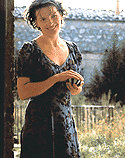
Set in the Sahara Desert and in an abandoned Tuscan villa in the final days of the Second World War, Michael Ondaatje's 1992 Booker Prize-winning novel, The English Patient, is stuffed with cinematic images, many of which find their way into this good-looking adaptation, written and directed by Anthony Minghella (Truly, Madly, Deeply). Less easy to adapt is Ondaatje's linguistic style, which resembles a long prose poem and works better on the page than as spoken dialogue. This may be why the first half of the movie feels careful and supine, like the patient (Ralph Fiennes) who lies in the villa, burned beyond recognition, and tells the story of his desert love affair with a colleague's wife (Kristin Scott Thomas) to Hana, a young Canadian nurse (Juliette Binoche) who tries to patch over her own wartime trauma by caring for him until his inevitable death. The English Patient cuts back and forth between the disastrous events in the desert that explain how the patient was burned and the villa, where a ragged and temporary but sustaining community of war-damaged people has formed around Hana, including Caravaggio (Willem Dafoe), a Canadian thief and spy whose thumbs were torn off by the Nazis and who knows more about the patient than he lets on, and a young Sikh army engineer (Naveen Andrews), who defuses the region's many mines and brings comfort to Hana. Although the cast is uniformly good and the directing competent, it's not until the last hour that the movie picks up and becomes the heart-stopping David Lean-style epic it was meant to be.
Binoche heals the wounded
Photo: Phil Bray
ALL IN THE FAMILY
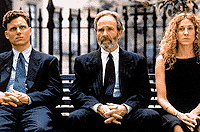
It's not easy to bring a play as talky and cerebral as Jon Robin Baitz's acclaimed The Substance of Fire to the screen. But Baitz, who wrote the screenplay, and director Daniel Sullivan collaborate just as well on film as they did on the stage, bringing several members of the original cast with them. Ron Rifkin gives an electric performance as Isaac Geldhart, a Holocaust survivor and old-school publisher who's about to wreck his ailing family business--and his family--by publishing a gorgeously mounted but unmarketable multi-volume tome on Nazi medical experiments. Obsessed with his traumatic past, the aging tyrant bullies into submission his three children--gay Aaron (Tony Goldwyn), the company accountant, who has a nose for best sellers; Sarah (Sarah Jessica Parker), a lively young woman relegated to the role of family bimbo; and Martin (Timothy Hutton), a solitary landscape designer. When the children finally wrestle the business away from their father, he turns his rage inward and declines dramatically, forcing the whole family to face up to what it has become. Wisely, Baitz and Sullivan avoid crude causal links to the Holocaust, which serves as an appropriately shadowy backdrop to this riveting family drama, as hilarious as it is lacerating and poignant. The movie's power lies in Baitz's willingness to let his characters run to their extremes without judging them--especially Isaac, a man so irascible that until tragedy strikes, he's incapable of imagining what it feels like to be somebody else, even his own repressed self.
Tony Goldwyn, Ron Rifkin, and Sarah Jessica Parker
(Bottom) Director Daniel Sullivan
Photos: Bill Foley
FROM MEAN STREETS TO THE COURTROOM
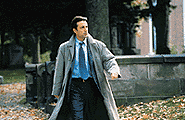
Although it begins with a violent set piece that's all the more chilling for its low-key execution, Sidney Lumet's Night Falls on Manhattan proceeds as a character movie that plumbs the shallows of power-mongering and moral equivocation in American public life. Young Sean Casey is a street cop turned Manhattan prosecutor who's so free of moral blemish that if he weren't played by super-hunk Andy Garcia, you might want to punch him. After he secures the high-profile conviction of a murderous drug lord (Shiek Mahmud-Bey), Sean's career soars, which snags him a glamorous love interest (Lena Olin) but also draws him deep into the rotting heart of the criminal-justice system, flanked by conniving politicos (Ron Leibman does a great turn as the outgoing district attorney who grooms Sean as his successor) on one side and by corrupt cops on the other. When Sean's policeman father (Ian Holm, wonderful as always) becomes a suspect in an investigation of cops on the take, the young idealist is forced to choose between loyalty and professional integrity. This might be interesting if the limb that Sean goes out on to protect his father were anything more than a twig. Without serious political and ethical stakes, the movie has nowhere to go but deeper into pious platitude and faux drama. Richard Dreyfuss, bafflingly got up like Alan Dershowitz, is nonetheless charming as a William Kunstler-like defense lawyer who ends up mentoring Sean from the sidelines.
Clean-cut Garcia cleans up the streets
Photo: Adger W. Cowans
Ella Taylor is a film critic for LA Weekly.Discuss this feature in the Arts & Literature conference of Post & Riposte (First-time users enter here).
| January 1997 Cover Page | Classical | Dance and Theater |