
Return to the June 1997 A&E Preview Cover
|
Arts & Entertainment Preview -- Jun 1997


B Y A U S T I N B A E R

Lifestyles of the Rich and Infamous

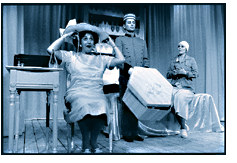
If word gets out, there will be no hotter ticket at this year's Aspen Music Festival than the Aspen Opera Theater Center's American stage premiere of Powder Her Face (July 25,
28; 970-925-9024). At the center of the web glitters the insatiable sexual
predator Margaret, Duchess of Argyll, whose lurid real-life career peaked in
perhaps the most notorious divorce trial of the century. It sounds like the
latest instantly forgettable tabloid-opera, but it's not at all. Powder Her
Face is to all that as a vintage Dom Pérignon is to André's
Cold Duck.
 | She's the top, the Duchess of Argyll
|
Written to a sharp, literate, yet singable libretto by Philip
Hensher, this first opera by the prodigiously gifted Englishman Thomas
Adès (born 1971) unfolds with a vitality and assurance that proclaim a
born master. Nothing follows received formula, yet all is exhilaratingly
clear -- clear and in some sense unfathomable. With a cast of four (many roles
are doubled) and a chamber orchestra of fifteen, Adès conjures up a
world of scintillating corruption. Infectious cabaret rhythms and threads of
silken melody woven through the score bring to life a whole society. The
writing is fiendishly skillful, extravagantly beautiful. Not a gesture is
thrown away. Some passages are romantic, sleazy, and cheeky all at once.
Elsewhere strings tickle the ear like mosquitoes' wings, or shimmer, still
audible, over the infernal ruckus of drums. Many theorists deny that music
possesses moral qualities, yet Adès's virtuosity conspires with
Hensher's words to keep false pieties at bay: the hypocrisy and vanity of the
Duchess's antagonists and of the scandal-hungry public are stripped away as
ruthlessly as her own. No one mends his ways. She, at least, has the class not
to apologize, not to explain.
Festive Finale -- One Night in Paris
Quietly but steadily the New York Festival of Song has been building a loyal
following. Festivity in this case is a function not of scale but of approach.
The venues -- the 92nd Street Y and Weill Hall, upstairs at Carnegie Hall -- are intimate, as befits the programming, which celebrates the art of song in all its infinite variety. The artistic directors Steven Blier and Michael Barrett (both pianists, Barrett also a conductor) draw no needless distinctions between classical and popular material. 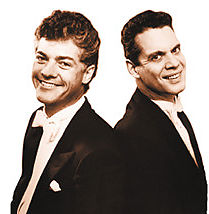 |
Barrett and Blier
|
Jerome Kern and Kurt Weill are as much a part of the family as Dmitri Shostakovich and Richard Strauss. Sophisticated
enjoyment is the goal, pursued so far this season in five concerts with an
inviting potpourri of themes: the lyrics of Ira Gershwin, contemporary life
in America, the progress of love, Russian romance and politics, and witty
Brits. In these recitals the vocal duties are always shared, by at least two
artists and often by more, which creates a convivial air -- as does Blier's
frequent impromptu commentary from the stage. A few of the artists each season
enjoy high name recognition (Tyne Daly, Claire Bloom); most do not, though some
are plainly stars in the making (Audra McDonald, Cyndia Sieden, Rodney Gilfry).
The season finale, "Paris at Night," fields, among others, Frederica von Stade
and the Leonard Bernstein protégé Kurt Ollman performing cabaret
material associated with the likes of Edith Piaf and Jacques Brel
(June 4; 212-996-1100). Secrets like this are hard to keep, and tickets
will be hard to come by. If shut out or otherwise unable to attend,
call now to get on next season's mailing list.
Dawn of Creation
For all but historicists Claudio Monteverdi's L'Orfeo (1607) is the first
opera that matters. You know the story. Orpheus descends to the underworld to
bring back his beloved Eurydice, but turns back to see her before regaining the
light, thus losing her forever. 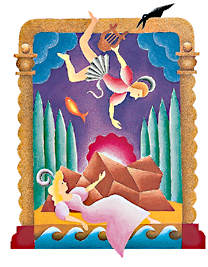 For our ears (as, surely, for Monteverdi's
original audiences) the most "modern" passage, which is to say the one most
spiked and fractured with intensity and surprise, comes with a messenger's
narrative of the heroine's death. More "antique" is Orfeo's appeal to the
ferryman for the dead, a burst of vocalism staggering in its virtuosity yet
full of heart-felt pathos, too. Of course the full magic unfolds only when the
words carry as potent a charge as the music. Unlike the many companies that now
resort to supertitles, Opera Theatre of Saint Louis performs exclusively in
English, putting its faith in the diction of the singers. The title role in
Orfeo has been entrusted to Gregory Turay, a young tenor and just the
sort of artist to realize Monteverdi's aims (June 17-27; 314-961-0644). For our ears (as, surely, for Monteverdi's
original audiences) the most "modern" passage, which is to say the one most
spiked and fractured with intensity and surprise, comes with a messenger's
narrative of the heroine's death. More "antique" is Orfeo's appeal to the
ferryman for the dead, a burst of vocalism staggering in its virtuosity yet
full of heart-felt pathos, too. Of course the full magic unfolds only when the
words carry as potent a charge as the music. Unlike the many companies that now
resort to supertitles, Opera Theatre of Saint Louis performs exclusively in
English, putting its faith in the diction of the singers. The title role in
Orfeo has been entrusted to Gregory Turay, a young tenor and just the
sort of artist to realize Monteverdi's aims (June 17-27; 314-961-0644).
Austin Baer is a writer based in New York.
Go to ...
 
Copyright © 1997 by The Atlantic Monthly Company. All rights reserved.
|