
Return to the June 1997 A&E Preview Cover
|
Arts & Entertainment Preview -- June 1997


B Y E L L A T A Y L O R

Baring It All at the Country House

Other than to showcase a lovely
Victorian country house, there was no compelling reason to bring Terrence
McNally's talky hit play, Love! Valour! Compassion!, to the big
screen. Still, Joe Mantello, who directed both the stage and the screen
version, has fashioned a funny and affecting, if visually undemanding, film out
of a work that's 90 percent banter and 10 percent philosophy.
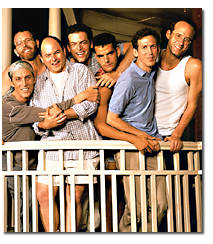 | Alexander and the original cast
|
(McNally himself
wrote the screenplay.) The original off-Broadway cast returns, with the
addition of Seinfeld's Jason Alexander, to play a group of gay men who
gather for three Chekhovian weekends at the idyllic home of a choreographer
friend. At least two of the men have AIDS, yet Love! Valour! Compassion!
is more a rumination on the quandaries of love and friendship than a disease
movie. Love in the shadow of AIDS, McNally suggests through the struggles of
these men, is as fraught with human frailty as love outside it, though the
disease compels a special inventiveness of the human spirit. McNally is candid
about the specifics of gay culture--Alexander in particular gives a wonderfully flamboyant performance without ever lapsing into cliché--while
underscoring the universality of the men's troubles. Granted, the playwright
creates a rather pat moral universe with a well-worn conceit of twin
brothers (both played by Tony Award-winning actor John Glover), one good, one
bad. The evil twin is a direct descendant of the tortured men in The
Boys in the Band, one of the first openly gay mainstream movies. Yet the
pride and sympathy with which McNally treats his characters reminds us how
far gay life and gay film have come since that bitterly self-lacerating
film.
Gold Standard
Several years ago the director Victor Nunez made Ruby in Paradise, a
small pearl of a film starring Ashley Judd as a young working-class Florida
woman trying to make her way in the world. Nunez's latest film, Ulee's
Gold, doesn't quite achieve the serene, elliptical assurance of that movie,
but it comes close. Set in the tupelo marshes of the Florida panhandle, the
movie stars Peter Fonda (lined, stooped, balding, and a far cry from Easy
Rider) as Ulysses Jackson, a righteous but unforgiving beekeeper who's far
happier among his honeycombs than around people.  | Ulee at peace tending his beehives
|
Still, Ulee cares for his two
granddaughters, Casey (Jessie Biel) and Penny (Vanessa Zima), who were left
alone when their father, Jimmy (Tom Wood), went to jail and their mother, Helen
(Christine Dunford), ran off with Jimmy's fellow thugs. When Ulee is called
upon to retrieve the doped-up Helen from Jimmy's former accomplices, who have
their own agenda for Ulee, his orderly, hermetically sealed life falls apart.
Ulee's Gold doesn't need the heavy plotting or the symbolic Greek names
(Ulysses, Penny, Helen) to prop up its project, which is to observe the density
of Ulee's temperament in what he says and doesn't say, and what he does and
doesn't do. In Nunez's work character is all, and though his people are always
troubled, a deep repose that slows the heart works its way into his stories
(there is real joy in watching Ulee move about his beehives) and brings to the
moviegoer the same equivocal peace achieved by the characters. Ulee's
Gold is a lovely film about a family repairing itself, and about the
dignity of labor.
Stayin' Alive, Japanese Style
More often than not, dance movies are morality plays about the extraneous
passions--love, lust, the drive to win--that people invest in performance, and
how those involved are brought to love the activity for its own sake. 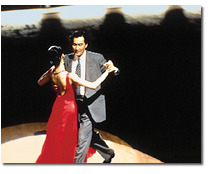 | The dancing duo
|
So it is
with Japanese writer and director Masayuki Suo's Shall We Dance?, a
quietly goofy film (no Strictly Ballroom, this) about a suburban married
accountant with a severe case of midlife ennui who signs up for
ballroom-dancing classes in order to get closer to a beautiful but remote
teacher with troubles of her own. You can see the crisis and the redemption of
each coming a mile off (both must learn that life is with people, not with
fantasies), but it hardly matters. The strength and charm of Shall We
Dance? lie in its details--Suo's wry and puckish observation of the
incongruities (and similarities) between the restrained formality of Japanese
culture and the garish formality of ballroom dancing and its underlying
commentary on the corrosive role of shame and embarrassment in Japanese life,
both private and public.
Ella Taylor is a film critic for LA Weekly.
Go to ...
 
Copyright © 1997 by The Atlantic Monthly Company. All rights reserved.
|