
Return to the June 1997 A&E Preview Cover
|
Arts & Entertainment Preview -- June 1997


B Y A U S T I N B A E R & N A N C Y D A L V A

The Puckish Delight of Fairies and Sprites

Thirty-five years ago George
Balanchine was on a romantic roll. Just two years before, he had choreographed
his sublime, melting Liebesleider Walzer. Now, using the same perfect
design team (unsurpassed for candle-lit, moonlit, nacreous effects) of David
Hays (decor) and Karinska (costumes), the great Mr. B. made Shakespeare's A
Midsummer Night's Dream into a two-act story ballet, notable for any number
of marvelous elements.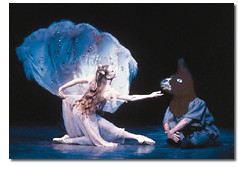 | The spirit of the play in dance
|
Among them: the Mendelssohn score (pieced together
by Balanchine from a variety of works), which conjures up exactly the fireflies
and fairies Balanchine makes material; the swiftly paced narrative, which tells
the entire tale without a scintilla of old-fashioned mime -- every effect is
danced, and with nary a moment of longueur; the original cast, which included
Arthur Mitchell as Puck, and also Jillana, Edward Villella, Francisco Moncion,
Patricia McBride, Bill Carter, Violette Verdy, and Conrad Ludlow (some playing
the fairies and some the mortals, but each immortal in the dance world); and,
perhaps most important and telling, a deep feeling for the language of the
original, here alchemically transformed into the poetics of ballet. As a child
Balanchine not only saw the play but appeared in it, as an elf in a production
at the Mikhailovsky Theatre, in St. Petersburg, when he was eight. Many of its
lines stayed with him, and as an adult he could recite (in Russian) many of the
speeches. (He seemed particularly to like Oberon's "I know a bank where the
wild thyme blows, Where oxlips and the nodding violet grows....") He said of
his work, "I think it is possible to see and enjoy the ballet without knowing
the play. At least that was my hope in creating the piece." So, also, is it
possible to see and enjoy the ballet while already loving the play. The New
York City Ballet offers Midsummer at Lincoln Center the week of June
24-29, bringing Shakespeare's green world to the big concrete city; then,
wonderfully, the green world will remove to the countryside, to Saratoga,
New York, where one can revel in its magic on July 15, 17 (matinee and
evening), and 18. (Tickets for Lincoln Center, 212-870-5570; for Saratoga,
518-587-3330.) Casting will be announced one week in advance and posted
on the company Web site: www.nycballet.com.
--N.D.
Method Barking
Watching The Two Gentlemen of Verona is like riffling through early
drafts of Shakespeare's later and better comedies, from mellow masterpieces
(Twelfth Night, As You Like It)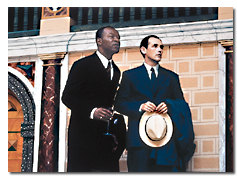 | The Globe's production of Two Gents
|
and harsh "problem plays"
(All's Well That Ends Well, Measure for Measure) to
valedictory romances (Cymbeline, Pericles). One scene, though,
bears the paw print of genius: the diatribe of the servingman Launce against
his dog, Crab, who sees his master hounded by misfortune yet sheds not a single
compassionate tear. The monologue is a comic jewel but a tricky one for the
actor. Last winter, when the new Anglo-American ensemble Shakespeare's Globe,
London, paid its first visit to New York, the mutt walked away with the
reviews.  Whether he sat and scratched himself or cocked an ear or wandered off
to make a friend in the first row, it all had the glow of fresh inspiration.
Wily thespians beware beasts (and children), whose naïveté will
blow away hardworking professionalism every time. The point will surely be
borne out this summer when Two Gentlemen shows up in a new production at
the Oregon Shakespeare Festival. Crab will again seem an Olivier among canines,
whereas in truth the genius is the playwright, whose lines miraculously
anticipate and accommodate animal behavior of any kind (June 12-October 11;
541-482-4331). --A.B. Whether he sat and scratched himself or cocked an ear or wandered off
to make a friend in the first row, it all had the glow of fresh inspiration.
Wily thespians beware beasts (and children), whose naïveté will
blow away hardworking professionalism every time. The point will surely be
borne out this summer when Two Gentlemen shows up in a new production at
the Oregon Shakespeare Festival. Crab will again seem an Olivier among canines,
whereas in truth the genius is the playwright, whose lines miraculously
anticipate and accommodate animal behavior of any kind (June 12-October 11;
541-482-4331). --A.B.
The Girl Who Cried "Woof"
The title character of A. R. Gurney's Sylvia, originally portrayed by
Sarah Jessica Parker, in all her leggy, kooky beauty, wanders off the street
into the apparently stable marriage of two Manhattan professionals and resets
the course of their lives. 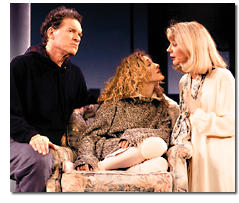 | Parker as man's best friend
|
A ménage à trois? Yes, but the
homewrecker is a dog, endowed with the unconditional love, territorial
animosity, and undomesticated biological needs of her species. Luckily for
actress and audience, she dresses like a human being and speaks English, though
inevitably communications entail a good deal of mutual misunderstanding.
Those spectators who harbor pets no doubt draw different conclusions from those
who don't, but both persuasions seem to recognize Gurney's generous comic
vision as poetically true to life. After making the rounds of numerous regional
stages, Sylvia now moves in at the Unicorn Theatre, the company that
brings up-to-date titles to Kansas City (June 4-19; 816-531-7529).
--A.B.
Austin Baer is a writer based in New York.
Nancy Dalva is working on a series of essays on Merce Cunningham.
Go to ...
 
Copyright © 1997 by The Atlantic Monthly Company. All rights reserved.
|