|


Return to the April 1998 A&E Preview Cover |
Arts & Entertainment Preview - April 1998
   
 There are more recondite things to say about the music of Lou Harrison (born
1917), but the simple truth is that it's lovely to listen to. His hallmark is
melody -- "the audience's take-home pay," he has called it. One floats down his
scores as if rafting broad, balmy streams spangled with sunlight, ajangle with
sensuous, not-quite-human song. Harrison's life and travels -- someday to be told at length in an interminably delayed biography from the Oxford University
Press -- should make colorful reading. Getting by variously as a florist, a
dancer, a critic, a veterinarian's assistant, a music copyist, a professor, and
heaven knows what else, Harrison crossed paths with a motley crew of teachers,
mentors, and colleagues, from the fanatically systematic Arnold Schoenberg to
the chance-happy John Cage. Ethnic music (of the Americas, of the Far East) has
always fascinated him. In search of new timbres, he has scoured inner-city
junkyards and circled the globe. His Symphony No. 4 (subtitled "Last Symphony")
makes a radiant summation of a bewitching, utterly personal style that over the
decades has kept remarkably true to itself. The piece runs forty-odd minutes,
concluding with three Native American tales of the coyote, narrated in a
disarming singsong. Since 1990 Harrison's Fourth has seen some fine-tuning, and
this month the National Symphony Orchestra gives the East Coast premiere of the
now definitive version at the Kennedy Center (April 23-25; 202-467-4600). Home
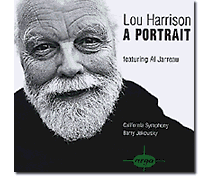
listeners can hear it now on the superb CD Lou Harrison: A Portrait (Argo), featuring the California Symphony under its industrious founder and
music director, Barry Jekowsky, who navigates Harrison's currents perfectly; in
the coyote tales Al Jarreau is the hip, graceful vocalist. Happily, both are on
hand in the capital.
There are more recondite things to say about the music of Lou Harrison (born
1917), but the simple truth is that it's lovely to listen to. His hallmark is
melody -- "the audience's take-home pay," he has called it. One floats down his
scores as if rafting broad, balmy streams spangled with sunlight, ajangle with
sensuous, not-quite-human song. Harrison's life and travels -- someday to be told at length in an interminably delayed biography from the Oxford University
Press -- should make colorful reading. Getting by variously as a florist, a
dancer, a critic, a veterinarian's assistant, a music copyist, a professor, and
heaven knows what else, Harrison crossed paths with a motley crew of teachers,
mentors, and colleagues, from the fanatically systematic Arnold Schoenberg to
the chance-happy John Cage. Ethnic music (of the Americas, of the Far East) has
always fascinated him. In search of new timbres, he has scoured inner-city
junkyards and circled the globe. His Symphony No. 4 (subtitled "Last Symphony")
makes a radiant summation of a bewitching, utterly personal style that over the
decades has kept remarkably true to itself. The piece runs forty-odd minutes,
concluding with three Native American tales of the coyote, narrated in a
disarming singsong. Since 1990 Harrison's Fourth has seen some fine-tuning, and
this month the National Symphony Orchestra gives the East Coast premiere of the
now definitive version at the Kennedy Center (April 23-25; 202-467-4600). Home
listeners can hear it now on the superb CD Lou Harrison: A Portrait (Argo), featuring the California Symphony under its industrious founder and
music director, Barry Jekowsky, who navigates Harrison's currents perfectly; in
the coyote tales Al Jarreau is the hip, graceful vocalist. Happily, both are on
hand in the capital.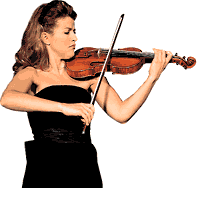 Recognized as a grand master of the violin for more than two decades,
Anne-Sophie Mutter, now thirty-four, is of course an old hand at the Beethoven
violin sonatas. This season, for the first time, she tackles all ten in
chronological order. Along with the pianist Lambert Orkis, she traverses the
set in three-concert series at Carnegie Hall (April 14, 22, 30;
212-247-7800), Chicago's Orchestra Hall (April 19, 26, 29; 312-294-3000), and
San Francisco's Davies Hall (May 3 and 4; 415-864-6000). One-evening programs
of selected Beethoven sonatas are offered in Dallas, Washington, Philadelphia,
Boston, and Los Angeles). The performances are part of an eleven-month world
tour exclusively devoted to this repertoire, recorded live by Deutsche
Grammophon. Preparations for the marathon took Mutter to the archives in the
house of Beethoven's birth, in Bonn. "The paper of the manuscripts is almost
transparent in places -- Beethoven corrected and scratched through so much," she said on a recent swing through New York after a vacation with her children in the Rockies. "Seeing the handwriting completes the picture you have from the
printed scores. It shows the conflict in his character." Playing the ten violin
sonatas as a group, she has discovered, throws new light on the material as
well. "Beethoven needed contrast. I used to feel that No. 5, the `Spring
Sonata,' was too innocent, too harmless. It's not when you see it in the
context of No. 4, which is so dark. It's like at Yellowstone: a cold day makes
you long for sunshine."
Recognized as a grand master of the violin for more than two decades,
Anne-Sophie Mutter, now thirty-four, is of course an old hand at the Beethoven
violin sonatas. This season, for the first time, she tackles all ten in
chronological order. Along with the pianist Lambert Orkis, she traverses the
set in three-concert series at Carnegie Hall (April 14, 22, 30;
212-247-7800), Chicago's Orchestra Hall (April 19, 26, 29; 312-294-3000), and
San Francisco's Davies Hall (May 3 and 4; 415-864-6000). One-evening programs
of selected Beethoven sonatas are offered in Dallas, Washington, Philadelphia,
Boston, and Los Angeles). The performances are part of an eleven-month world
tour exclusively devoted to this repertoire, recorded live by Deutsche
Grammophon. Preparations for the marathon took Mutter to the archives in the
house of Beethoven's birth, in Bonn. "The paper of the manuscripts is almost
transparent in places -- Beethoven corrected and scratched through so much," she said on a recent swing through New York after a vacation with her children in the Rockies. "Seeing the handwriting completes the picture you have from the
printed scores. It shows the conflict in his character." Playing the ten violin
sonatas as a group, she has discovered, throws new light on the material as
well. "Beethoven needed contrast. I used to feel that No. 5, the `Spring
Sonata,' was too innocent, too harmless. It's not when you see it in the
context of No. 4, which is so dark. It's like at Yellowstone: a cold day makes
you long for sunshine."Austin Baer is a writer based in New York.  
Copyright © 1998 by The Atlantic Monthly Company. All rights reserved. | ||||||||||||
| |||||||||||||