
Return to the April 1998 A&E Preview Cover
|
Arts & Entertainment Preview - April 1998


B Y B O B B L U M E N T H A L & C H A R L E S M. Y O U N G

Finland's Finest

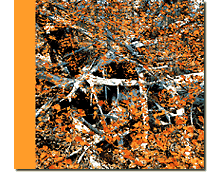 | Troka's eponymous release
|
For most of the nineties Scandinavia has had one hot folk-rock music scene that
isn't getting enough appreciation in the rest of the world. NorthSide, a small
label out of Minneapolis (www.noside.com), has been trying to rectify this
injustice by releasing the albums of such brilliant bands as Garmarna and
Hedningarna in the United States. Now NorthSide's list includes Troka's first
album, conveniently titled Troka. Three of the five members of the group
have studied in the folk-music department of the Sibelius Academy, in
Kaustinen, Finland; the others have been students at the Kokkola Conservatory,
in Stockholm, and at the University of Jyväskylä, in Finland. Their
training shows. They play richly complicated arrangements of catchy folk
melodies, some eerie and some joyous, all propelled by a relentless beat
maintained with almost no percussion. Instead of drums, Troka's rhythm section
consists of a double bass and a harmonium, which create a warm, droning
resonance that is both easy on the ears and an aid to digestion. The melodies
are carried by various combinations of fiddle, viola, mandolin, and accordion,
all played with invigorating dexterity. The songs have titles like "Aamu
Seksmanninkankaala" ("A Morning in Seksman's Meadow"), but nobody's singing and
there's nothing obscure about the music, which draws its influences from
Finland, the Balkans, and Kentucky, among other places. Recorded in 1993,
Troka deserves a wider audience for its historic meld of ancient
substances with just enough contemporary recording technique that purists and
impurists alike will find themselves cranking up the volume and dancing a jig
around the living room. --C.M.Y.
Troka, Troka, Copyright 1998 East Side, Inc.
"Balkan," AU, Real Audio 28.8
"Sekvenssipolka / Sequence Polka," AU, Real Audio 28.8
"Aamu seksmanninkankaala / A Morning in Seksman's Meadow," AU, Real Audio 28.8
A Drummer From the Heartland
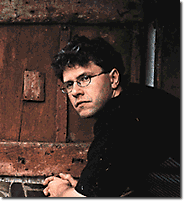 | In the lead, Matt Wilson
|
Notwithstanding its reputation as America's music, jazz rarely reflects
all facets of the national experience. Matt Wilson, one of the most
singular drummers and bandleaders in the emerging jazz generation, comes from
Knoxville, Illinois, and his music argues that midwestern prairie soil can be
as fertile as New Orleans Delta loam. Wilson's 1996 debut disc as a band leader, As Wave Follows Wave (Palmetto), included "Sweet Betsy
From Pike" and a free-form setting of Carl Sandburg along with joyously
eloquent improvisation. Going Once, Going Twice, his sequel, assembles a
different band yet conveys the same heartland audacity. As a drummer, Wilson is
keenly attuned to sonic weight. Equally willing to pump out backbeats and raise
quieter clatters, he is well served by original compositions that embrace
exotic scales, folk melodies, and roadhouse raves with matching fervor. As a
bandleader, Wilson savors the competitive heat of a two-reed front line, and
extracts a rainbow of colors plus expressionistic solos from Andrew D'Angelo
(on alto sax and bass clarinet) and Joel Frahm (on soprano and tenor
saxophones). Going Once, Going Twice does not avoid loose-limbed swing,
especially on "Andrew's Ditty," yet has a wealth of moods to offer, from
languid on a cover of "Turn, Turn, Turn" to quietly free-form on the standard
"Hey There" to colloquial on the title track, which is built around a banjo and
an auctioneer. And "Schoolboy Thug," Wilson's maniacally gleeful nod to rock
with arena-sized drumming and a punk-vocal refrain, may even have created a new
genre -- garage jazz. --B.B.
Going Once, Going Twice, Matt Wilson, Copyright 1998 Palmetto Records
"Going Once, Going Twice," AU, Real Audio 28.8
"Andrew's Ditty," AU, Real Audio 28.8
"Schoolboy Thug," AU, Real Audio 28.8
Bebop, Ballads, and Exotic Rhythms
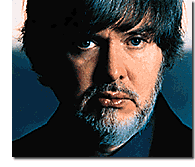 | Tom Harrell
|
Musicians have known about the expansive talents of Tom Harrell for more than
twenty years. For much of that time the trumpeter has enhanced the music of
Woody Herman, Horace Silver, Phil Woods, and countless others while creating
few recordings under his own name. Harrell's time in the spotlight was long
overdue, and his recent affiliation with RCA Victor finally shows the wider
world an instrumental giant who composes and arranges as creatively as he
plays. The Art of Rhythm summarizes the music that currently captures
Harrell's fancy. Spanish, Brazilian, Caribbean, and Indian influences appear
alongside bebop and balladry, in ten original compositions that Harrell has
scored for an ever-shifting ensemble drawn from two dozen of his friends and
peers. Although diverse percussionists are used extensively, the arrangements
reveal more than a penchant for exotic beats. The samba "Petals Danse" is
indicative, featuring three string players and no drummers and recalling both
Villa-Lobos and Jobim. Having so much talent to draw on, including the
saxophonists Dewey Redman, David Sanchez, and Greg Tardy and the guitarists
Romero Lubambo and Mike Stern, Harrell is generous with the improvisational
spotlight. There is not a single track, in fact, on which he opens the soloing;
but when his turn arrives, Harrell plays with the same mixture of curiosity,
lyricism, and surprise that characterizes his writing. The overall effect is in
the tradition of the Gil Evans-Miles Davis collaborations, realized here by one
supremely gifted musician. --B.B.
Bob Blumenthal is a jazz critic for The Boston Globe.
Charles M. Young reviews popular music for Playboy, Musician, and other publications.
Go to ...
 
Copyright © 1998 by The Atlantic Monthly Company. All rights reserved.
|