
Return to the April 1998 A&E Preview Cover
|
Arts & Entertainment Preview - April 1998


B Y E L L A T A Y L O R

Flowers and Gunfire

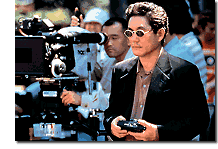 | The director and star Takeshi Kitano
|
In Japanese cult director Takeshi
Kitano's strange and beautiful new film, Fireworks, the director plays
Yoshitaka Nishi, a taciturn former police detective who, when he's not calmly
whacking the mobsters responsible for wounding his partner (Ren Osugi),
cheerfully devotes himself to his terminally ill wife, Miyuki (Kayoko
Kishimoto), in her last days. Winner of the Golden Lion Award at the 1997
Venice Film Festival, and the toast of the Toronto Film Festival,
Fireworks is an oddly convincing blend of action thriller and quiet ode
to the pleasures of mature marriage. Kitano's screenplay amounts to no more
than a few pages; his characters' complexities are established through
strategic shifts of pace, from immobility to frantic action, that compel the
viewer's attention away from narrative to visual cues flagging the film's spare
but intense emotionality. Staring into a florist's window, Nishi's paralyzed
and depressed partner finds solace in flowers that he will later paint. (The
paintings are the director's own.) We see Nishi flashing back on the gruesome
shooting that fuels his own bloody actions, and then giggling with his wife as
they take a final trip to Mount Fuji. By turns goofy, brutal, and ecstatic, the
director's eccentric style flouts the rules of conventional filmmaking to
create a mood at once droll and wistful, its elegiac tone heightened by Joe
Hisaishi's lovely acoustic score. Kitano's earlier gangster comedy,
Sonatine, will also be released (under Quentin Tarantino's supervision)
this spring, by Miramax's Rolling Thunder Films.
Slaughterhouse Life
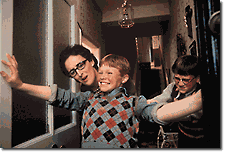 | Eamonn Owens (center)
as Francie
|
Neil Jordan has taken his crack at big Hollywood pictures (Interview With the Vampire, Michael Collins), but the Irish director has done his
finest work in small-scale films such as The Miracle and The Crying
Game. The Butcher Boy is his best film yet. Adapted in a wonderfully
wicked screenplay by Jordan and Patrick McCabe from McCabe's novel,
the movie is set in rural Ireland in the 1960s and tells the story of a young
boy who, dogged by inconstancy and abandonment, retreats into a fantasy world
of adventure fed by television and Cold War images. Left to his own devices by
his manic-depressive mother (Aisling O'Sullivan) and his drunken ruin of a
father (Stephen Rea), and hounded by the town busybody (a very funny Fiona
Shaw), young Francie (played, in an astonishingly vibrant performance, by
first-time actor Eamonn Owens) spirals into madness and rage in a cycle of
explosive episodes that alienate even his faithful best friend. When the
comfort he draws from a vision of an earthy Virgin Mary (a maliciously cast
Sinead O'Connor) turns sour, Francie seals his fate with an act of breathtaking
vindictiveness. For all its somber themes, there's nothing in the least mawkish
about The Butcher Boy. Shot in quick, febrile takes, the movie builds
with its cocksure tone and jaunty score to a pitch of menace laced with
sadness, mimicking Francie's erratic inner state and his gift for
self-destruction.
A Struggle With the Sect
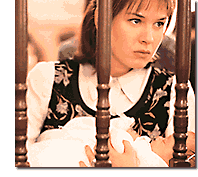 | Renee Zellweger
|
Nothing if not timely, Boaz Yakin's second film,
A Price Above Rubies,
takes on the conflict between religious and secular visions of living in modern
America. Unlike Yakin's first feature, Fresh, a wonderfully nuanced
study of a black boy trying to survive in a drug-infested inner city, A
Price Above Rubies mauls its subject with an unhappy mixture of ignorance
and disingenuousness. Though she's jarringly cast against type, Renee Zellweger
(Jerry Maguire) acquits herself well as Sonia, a restless young Orthodox
Jewish matron who gradually slips away from the New York Hasidic enclave that
both shelters her from and stifles her daring spirit. Equally incongruously
cast, British actor Christopher Eccleston (Jude) plays the unscrupulous
brother-in-law who, in exploiting her head for business and her untapped
sexual appetite, sets her free in ways he could never have envisioned. Troubled
by protests from New York Hasidim during the location shoot, the movie will
undoubtedly -- and understandably -- draw fire from the Jewish community upon its release. In the service of a bland, pandering message about freedom and
multicultural tolerance, Yakin barely attempts to comprehend this hermetic sect
on its own terms. With the exception of a throwaway final scene in which
Sonia's pious husband acknowledges the legitimacy of worlds beyond his own, the
religious characters range from rigidly unforgiving to cravenly hypocritical,
while Yakin corrals all our sympathy for the black sheep and her rescuers.
Ella Taylor is a film critic for LA Weekly.
Go to ...
 
Copyright © 1998 by The Atlantic Monthly Company. All rights reserved.
|