
Return to the January 1998 A&E Preview Cover
|
Arts & Entertainment Preview - January 1998


B Y N A N C Y D A L V A & J O H N I S T E L

America at the Turn of the Century

January is typically a somnambulant month on Broadway. Not
this year. Two of the most anticipated musicals of the season will open:
The Capeman, Paul Simon's longawaited theater debut (January 8;
212-307-4100), and Ragtime, a musical version of E. L. Doctorow's
picaresque historical novel (January 18; 212-307-4100).
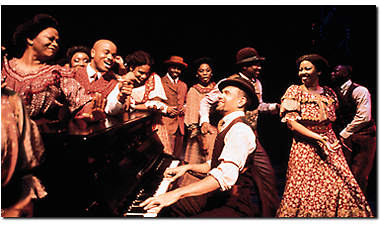
Ragtime music captures the spirit of the age
Ragtime's score, by Stephen Flaherty and Lynn Ahrens, has been
available on CD since the show premiered in Toronto. It's a triumph. The first
piano noodlings suddenly give way to tubas, a brass section, fifes, penny
whistles, triangles, and cymbals, all jostling for attention. What an apt
metaphor for the American dream. Thus energized, this classy production, under
the director Frank Galati's sure hand, marches bravely into American history to
examine the interlocking fate of blacks and WASPs, immigrants and entertainers.
Waves of refugees arrive just in time to stock Henry Ford's new assembly lines,
while Harry Houdini and "moving pictures" offer balm for crushed spirits. In
this age of prosperity, Ragtime evokes the downside of the Industrial
Revolution, stabbing at audiences' serenity before ushering them into the
street, humming. --J.I.
Troll Story
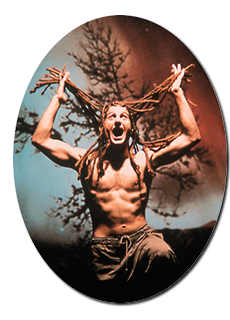 | Darby Jared Leigh as Peer
|
How does one explain the three major productions on view this month of Peer
Gynt, Henrik Ibsen's fantastical five-act Norwegian folk-poem? Perhaps Peer
is the perfect hero for 1990s America: flamboyant and fabulous, saucy and
sensual, dangerous and detached. He runs off to cavort with mountain trolls,
monkeys, madmen, milkmaids, and millionaires. He returns home only to meet
Death in the form of a Button Molder (Edward G. Robinson played the role in the
1923 Theatre Guild production). The sprawling verse play is a theatrical Mount
Everest, attracting only intrepid adventurers.
Enter stage left: Trinity Repertory Company, in Providence, Rhode Island
(January 30-March 8; 401-351-4242); the National Theatre of the Deaf, touring
sixty-three cities through March (860-526-4971, 860-526-4974 TTY); and The
Shakespeare Theatre of Washington, D.C. (January 20-March 8; 202-393-2700).
Trinity artistic director Oskar Eustis commissioned a new adaptation from David
Henry Hwang (M. Butterfly) and the acclaimed Swiss director Stephan
Müller. Eustis suggests that America is ripe for Mr. Gynt: "Peer shows the
consequences of individualism run amok." Meanwhile, the Tony Award-winning
National Theatre of the Deaf stages a two-hour Peer Gynt, mixing
American Sign Language, spoken word, and a visceral physical production
co-directed by Robby Barnett, of the Pilobolus Dance Company, and Will Rhys.
Darby Jared Leigh, a deaf actor, takes on the title role. Coincidentally, it
plays D.C. only ten days after The Shakespeare Theatre opens its production,
the first Ibsen in that venerable company's history; Michael Kahn directs and
Wallace Acton plays the irrepressible Peer. --J.I.
Seven Companies Under One Aegis
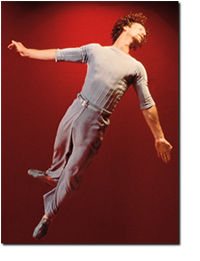 | Kevin O'Day
|
The part of the dance experience we share when we go to the theater is -- take
your choice -- the tip of the iceberg or the frosting on the cake. For a dancer,
the day is filled with warming up, class, rehearsal, costume calls, and
warming up yet again, with a nibble of this or that and some insider chitchat
for sustenance. But for a choreographer, particularlya young one who is still
performing, the day is even more daunting. He or she does everything that
dancers do and a lot that they aren't trained to do. Willy-nilly, an
independent choreographer today is a front person, organizing a company,
attracting financial support, juggling production elements and demands, and
finding an audience. Sometimes the hardest part -- actually making a dance -- seems the least of the choreographer's tasks, when in truth it is the
most, and essential to the art. Since 1991 the Joyce Theater Foundation
has supported such artists in a program called Altogether Different
(January 6-25; 212-242-0800), providing behind-the-scenes advice, production
support, and audience feedback in an annual program of commissioned work.
This year the series presents seven companies, five in their debuts at the
theater (known simply as The Joyce, and designed for dancing and seeing dance),
one in its world debut. O'Day Dances, with Kevin O'Day the eponymous artistic
director and John King the music director, is an eight-dancer ensemble
(including the former American Ballet star Johann Renvall and Alexander Kolpin,
of the Royal Danish Ballet) that is in effect a mini ballet company. This
is something different for Altogether Different, and a
mark of the crossover now so common between the barefoot and toe-shoed
branches on Terpsichore's tree. (O'Day danced, with great distinction, with the
headmistress of the mixed form, Twyla Tharp herself.) The rest of the Joyce
roster gives New Yorkers a chance to see, over a short time, some companies
they have been meaning to catch up with and some they want to see again: Wally
Cardona Ensemble, Nai-Ni Chen Dance Company, Mark Dendy Dance &
Theater, ronald k. brown/evidence, Iréne Hultman, and Joy Kellman
& Company, performing on a rotating schedule.
--N.D.
Nancy Dalva is the author of Dance Ink: The Photographs.
John Istel is a senior editor at Stagebill.
Go to ...
 
Copyright © 1997 by The Atlantic Monthly Company. All rights reserved.
|