
Return to the January 1998 A&E Preview Cover
|
Arts & Entertainment Preview - January 1998


B Y E L L A T A Y L O R

A Pair of Hearts

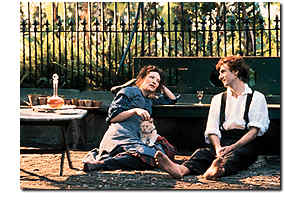 | Cate Blanchett and Ralph Fiennes
|
Toward the end of Oscar and Lucinda come some ravishing moments in which
an exquisite glass church sails down an Australian river and then comes to
grief in a spectacular way, embodying all the drama and emotional intensity
that's missing from the rest of the film. Although director Gillian Armstrong
(Little Women, The Last Days of Chez Nous) has a fine sense of
composition and of period, her adaptation of Peter Carey's Booker Prize-winning
epic novel about two lonely square pegs falling in love in nineteenth-century
Australia (the screenplay is by Laura Jones, who scripted Jane Campion's
Portrait of a Lady) is so sluggishly paced that not even a dash of
comedy can save it. Ralph Fiennes plays Oscar, a timid redhead with a calling
to the ministry and a bottomless capacity for guilt, along with a gambling
habit that endears him to the similarly handicapped Lucinda (newcomer Cate
Blanchett, in a jaunty performance strongly reminiscent of Judy Davis's in
Armstrong's My Brilliant Career), a spirited young heiress and the owner
of a Sydney glass factory. Oscar and Lucinda will bet on anything but their
love for each other, until finally Oscar, believing his beloved to be enamored
of her exiled friend, the Reverend Hasset (Ciaran Hinds), stakes his life on an
act that he hopes will prove his devotion. It's a wonderfully romantic story,
but the movie's comedy is too labored, its drama too muted, to sustain the
viewer's sympathy. Though it's a relief to see Fiennes for once in a role that
doesn't require chronic depression, comedy is not his strong suit. Rubbing and
wringing his hands and grimacing like a clown in overdrive, Fiennes tries too
hard and comes on disconcertingly like a Dickensian caricature, a cross between
Bob Cratchit and Uriah Heep.
Portrait of a Girl as a Young Boy
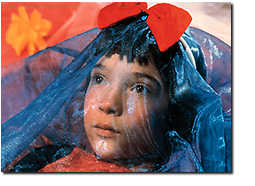 | Georges du Fresne as Ludovic
|
"I don't want to change, but I want them to love me." That's the dilemma of
seven-year-old Ludovic (Georges du Fresne) in Ma Vie en Rose, a charming
yet tough-minded feature debut by Belgian director Alain Berliner which won the
hearts of audiences at the 1997 Toronto Film Festival. Though the elfin Ludovic
eagerly accepts that he's a girl born into a boy's body, he endures resistance
and hostility from almost everyone around him in the prosperous Brussels suburb
where he lives. Eventually even his loving parents (Michele Laroque and
Jean-Philippe Ecoffey) capitulate and subject their baffled son to a barrage of
remedies. Nothing works: not therapy, not cropping the boy's hair, certainly
not rage. As the family begins to fall apart, Ludovic takes solace in
fantasies -- sanctioned by his bohemian grandmother and inspired by a children's
television show -- that give free rein to his fashion sense and his love for the
boy next door. Berliner's deft visual juxtaposition of the bright colors of
Ludovic's inner life and the shadowier hues of the outer world signals an
intelligent compassion both for the boy and for his parents, bludgeoned into
submission by the smug hypocrisy of a bourgeois community until they find their
own solution.
Husbands and Wives, Lives Intertwined
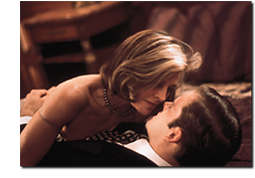 | Julie Christie and Jonny Lee Miller
|
In Afterglow, a wonderfully dreamy new movie by Alan Rudolph (Mrs.
Parker and the Vicious Circle), two troubled Montreal couples, each in its
way haunted by a phantom child, each drifting further and further apart, cross
paths in a series of coincidences that in any hands but Rudolph's would appear
preposterous. Julie Christie makes a vibrant return as Phyllis, a former
B-movie actress who now languishes in her bathrobe, watching her old films and
tolerating the many affairs of her contractor husband, Lucky (Nick Nolte), whom
she has kept at arm's length since they quarreled years ago. When Lucky becomes
involved with Marianne (the alabaster Lara Flynn Boyle, doing a splendid
imitation of Julie Hagerty), the young wife of an icy corporate climber,
Jeffrey (Jonny Lee Miller, unrecognizable from his wild turn as Sick Boy in
Trainspotting), both couples must confront the gulfs that threaten to
destroy their marriages. Backed by Mark Isham's lovely saxophone score,
Rudolph's camera tracks slow minuets around his characters, as if to protect
them from their own follies, and as if he, like us, were discovering the story
as he went along. Rudolph's spry screenplay undercuts the wistful sorrow of
these four wounded souls with often hilarious dialogue, as they talk past one
another, and ends on a goofy note of hope.
Ella Taylor is a film critic for LA Weekly.
Go to ...
 
Copyright © 1997 by The Atlantic Monthly Company. All rights reserved.
|