|


Return to the June 1998 A&E Preview Cover |
Arts & Entertainment Preview - June 1998
    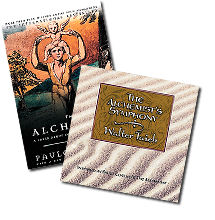 "You've read the book; now hear
the symphony." If not unprecedented, the pitch is certainly rare. The
Alchemist's Symphony, by the twenty-nine-year-old French composer
Walter
Taieb, takes off from The Alchemist, by the Brazilian author
Paulo
Coelho. The novel, published ten years ago, has sold 17 million copies and been
ranked as the No. 1 best seller in sixteen countries. Taieb's symphony is
in eight brief movements (keyed to specific moments in the book),
punctuated with improvised interludes on such folk and ethnic instruments as
the darbuka, the nay, and the oud. A whiz kid whose other credits include
chart-topping pop songs and 3-D computer graphics, the composer thinks that too
many influential movements in twentieth-century classical music have been
dominated by concepts, in analogy to the visual arts. "I feel music needs to
speak and tell stories and develop emotions," he explained recently over the
phone from his home on Long Island. Like many others, he has rediscovered
tonality: "an international language," he insists, "a universal language,"
suitable for telling stories. He calls his style "neo-melodism." If the
uninitiated think of movie music, Taieb politely disagrees. "I love movie
music, but it's not a free form of art. Listen to a movie score without
pictures, and generally it's terrible: a potpourri of little things of two
minutes, not a composition to be heard on its own. I think my music is
sufficient alone. For forty-five minutes the music makes you travel. You don't
waste any time. You get a theme with a short development, and then right away
you jump. It's a lot of work to write this way!" The Alchemist's
Symphony receives its first live performance on June 5 at a gala in the
ancient Spanish town of Tarifa, which in the book is where the hero's journey
begins. Fortunately for those with other plans that night, a polished recording
on BMG reveals how evocative the score is of the novel's exotic locales. The
movement "The Oasis," with its drowsy melody and lopsided African rhythm, is
especially fetching. "You've read the book; now hear
the symphony." If not unprecedented, the pitch is certainly rare. The
Alchemist's Symphony, by the twenty-nine-year-old French composer
Walter
Taieb, takes off from The Alchemist, by the Brazilian author
Paulo
Coelho. The novel, published ten years ago, has sold 17 million copies and been
ranked as the No. 1 best seller in sixteen countries. Taieb's symphony is
in eight brief movements (keyed to specific moments in the book),
punctuated with improvised interludes on such folk and ethnic instruments as
the darbuka, the nay, and the oud. A whiz kid whose other credits include
chart-topping pop songs and 3-D computer graphics, the composer thinks that too
many influential movements in twentieth-century classical music have been
dominated by concepts, in analogy to the visual arts. "I feel music needs to
speak and tell stories and develop emotions," he explained recently over the
phone from his home on Long Island. Like many others, he has rediscovered
tonality: "an international language," he insists, "a universal language,"
suitable for telling stories. He calls his style "neo-melodism." If the
uninitiated think of movie music, Taieb politely disagrees. "I love movie
music, but it's not a free form of art. Listen to a movie score without
pictures, and generally it's terrible: a potpourri of little things of two
minutes, not a composition to be heard on its own. I think my music is
sufficient alone. For forty-five minutes the music makes you travel. You don't
waste any time. You get a theme with a short development, and then right away
you jump. It's a lot of work to write this way!" The Alchemist's
Symphony receives its first live performance on June 5 at a gala in the
ancient Spanish town of Tarifa, which in the book is where the hero's journey
begins. Fortunately for those with other plans that night, a polished recording
on BMG reveals how evocative the score is of the novel's exotic locales. The
movement "The Oasis," with its drowsy melody and lopsided African rhythm, is
especially fetching.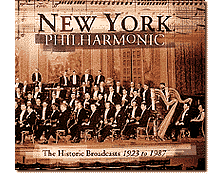 The New York Philharmonic has just wrapped up an eventful, often brilliant
season that was remarkable, too, for its reach. Through the largesse of Time
Warner, nine of the best programs aired on more than 200 radio stations. Such
exposure, rare these days, was once common. The Philharmonic reminds music
lovers everywhere how thrilling live performances on the air can be with its
ten-CD package The Historic Broadcasts 1923 to 1987. The roster of
maestros includes legends like Willem Mengelberg, Otto Klemperer, Arturo
Toscanini, Bruno Walter, Dimitri Mitropoulos, and Fritz Reiner. The composer
Francis Poulenc is dazzling in the piano part of his own Concert
champêtre, and Igor Stravinsky forges links to tradition with an
idiosyncratic but illuminating account of Tchaikovsky's Symphony No. 2
(the Little Russian). Listeners unused to archival material may blanch
at the sound quality of some of the earliest entries, but the verve of the
performances offers rich compensation. Of related interest: a CD of
Leonard
Bernstein's historic New York Philharmonic debut, as a last-minute replacement
for the revered Bruno Walter. Unlike the big box, this single disc documents
the entire concert, announcements and all. The music is electrifying--and
knowing what we know now, the sense of occasion is breathtaking. (For the
former call 800-557-8268; for the latter 800-99-MUSIC.) The New York Philharmonic has just wrapped up an eventful, often brilliant
season that was remarkable, too, for its reach. Through the largesse of Time
Warner, nine of the best programs aired on more than 200 radio stations. Such
exposure, rare these days, was once common. The Philharmonic reminds music
lovers everywhere how thrilling live performances on the air can be with its
ten-CD package The Historic Broadcasts 1923 to 1987. The roster of
maestros includes legends like Willem Mengelberg, Otto Klemperer, Arturo
Toscanini, Bruno Walter, Dimitri Mitropoulos, and Fritz Reiner. The composer
Francis Poulenc is dazzling in the piano part of his own Concert
champêtre, and Igor Stravinsky forges links to tradition with an
idiosyncratic but illuminating account of Tchaikovsky's Symphony No. 2
(the Little Russian). Listeners unused to archival material may blanch
at the sound quality of some of the earliest entries, but the verve of the
performances offers rich compensation. Of related interest: a CD of
Leonard
Bernstein's historic New York Philharmonic debut, as a last-minute replacement
for the revered Bruno Walter. Unlike the big box, this single disc documents
the entire concert, announcements and all. The music is electrifying--and
knowing what we know now, the sense of occasion is breathtaking. (For the
former call 800-557-8268; for the latter 800-99-MUSIC.)
Austin Baer is a writer based in New York.  
Copyright © 1998 by The Atlantic Monthly Company. All rights reserved. | ||||||||||||
| |||||||||||||