
Return to the June 1998 A&E Preview Cover
|
Arts & Entertainment Preview - June 1998


B Y E L L A T A Y L O R

Suspicious Mind

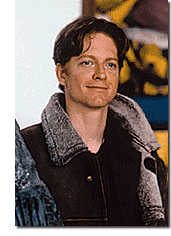 | Eric Stoltz as
a man obsessed
|
Mistrust, all but done to death as a
movie theme, receives a fresh coat of paint in Mr. Jealousy, a
deceptively light romantic comedy from Noah Baumbach, the very young director
with a very old head who made the 1995 art-house hit Kicking and
Screaming. Eric Stoltz stars as Lester, a thirty-ish Manhattan substitute
teacher and aspiring novelist who, after a formative experience with his first
girlfriend, seems doomed to ruin all subsequent romances with his possessive
behavior. When his soon-to-be-married friends Vince (a very funny Carlos
Jacott) and Lucretia (Secrets and Lies's Marianne Jean-Baptiste,
sporting a seamless American accent) introduce him to the free-spirited Ramona
(Annabella Sciorra), the apparently reasonable Lester soon becomes obsessed
with his new girlfriend's past lovers, especially the slick Dashiell (Chris
Eigeman), author of a best-selling novel, The Sensualist. Joining
Dashiell's therapy group under Vince's name to soak up data about his "rival,"
Lester mires himself in a thickening tissue of lies that threaten to destroy
his relationships with those he cares for most. Baumbach's gracefully
constructed screwball plot keeps doubling back on itself, expanding the
boundaries of time and place to sustain a chronic instability that mirrors both
the young man's insecurity and the ambivalent thrashing about that is modern
love. The characters happen to be the same age as the director, but Mr.
Jealousy is no Gen-X sitcom. In his precocious wisdom and the assurance of
his touch, Baumbach recalls both Truffaut and early Woody Allen.
Keep the Satire Flying
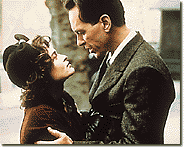 | Carter and Grant
|
Robert Bierman's film version of George Orwell's novel of 1930s London, Keep
the Aspidistra Flying, blandly retitled A Merry War for American
moviegoers who may be stumped by the name of the houseplant that epitomizes
lower-middle-class English respectability, is nevertheless a wickedly clever
piece of satirical fun. Wearing his customary air of barely contained
middle-class fury, Richard E. Grant plays discontented advertising copywriter
Gordon Comstock, who, after a favorable review in the London Times of
his slender volume of poetry, recklessly dumps his steady job to live out his
idea of the artist's life. Despite all kinds of support from his level-headed
girlfriend, Rosemary (played with rueful wit by Helena Bonham Carter), his
long-suffering sister (Harriet Walter), and his patient publisher (Julian
Wadham), a champagne socialist who loves the working class from a safe
distance, Gordon's literary career fails to ignite. Convinced that success
eludes him because he isn't moneyed or homosexual or a Communist, Gordon
disgraces himself in a posh restaurant and flounces off to dwell among the
glorious proletariat, until bedbugs and Rosemary return him to sanity and his
assigned place in the order of things. Crisply adapted by the television writer
Alan Plater, A Merry War is a handsome period piece that does full
justice to Orwell's scorn for the pretensions and hypocrisies of England's
hidebound class structure.
One Last Look at Life
 | Mastroianni (left)
and Oliveira
|
Marcello Mastroianni gave his last performance in Voyage to the Beginning of
the World, a beautiful new film by the renowned and endlessly prolific
Portuguese director Manoel de Oliveira, who will turn ninety this year. Frail
but entirely in command, Mastroianni plays Manoel, an aged film director who
accompanies a half-French, half-Portuguese actor and two others to the village
in Portugal where the actor's father was raised. As the four drive though the
lovely countryside (the scenery achieves an intense life of its own), Manoel,
by turns puckish, crusty, flirtatious, and wistful, reminisces about his own
privileged youth in the same region. Moved by a roadside statue of a lonely man
bearing a wooden beam on his back, Manoel reflects on how, with age and the
passing of time, memory dominates a man's experience, yet without allowing him
to grasp the past. "I know my own history, as if it belonged in another life,"
he tells his companions. As they reach the village, the focus shifts
to the life of another Manoel--the actor's troubled father, whose story
is told by an austere aunt, herself a relic of a dying rural world. In his
connection with a blood relative, the actor makes peace with the father who
died when he was young. For his part, the director, wandering among
gravestones, achieves a more equivocal serenity. "A long life is a gift from
God," he says. "But it has its price."
Ella Taylor is a film critic for LA Weekly.
Go to ...
 
Copyright © 1998 by The Atlantic Monthly Company. All rights reserved.
|