
Return to the June 1998 A&E Preview Cover
|
Arts & Entertainment Preview - June 1998


B Y N A N C Y D A L V A & J O H N I S T E L

Written on the Body

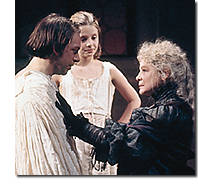 | Scene from
One Flea Spare
|
The award-winning poet and playwright Naomi Wallace writes dramas with the
no-holds-barred, bowie-knife sensibility of a better-known Kentuckian, Daniel
Boone. A thirty-something mother of three, Wallace scouts out the ways our body
politic is reflected in the politics of the body. In Slaughter City, for
instance, set in a Louisville meat-packing factory, she shows how late-stage
capitalism consumes the bodies of its laborers like the slabs of meat they
butcher. In a scene from In the Heart of America a Gulf War soldier
recalls slitting open an Iraqi soldier, stepping into his rib cage, and
proclaiming, "Hey, boys, now I'm really standing in Iraq." In One Flea
Spare, Wallace demonstrates the artificiality of class distinctions when
the aristocratic Mrs. Snelgrave (played off-Broadway by Dianne Wiest last
season) rides out a seventeenth-century London plague quarantined with a scurvy
sailor who reignites her sensuality. Last year Wallace's stage adaptation of
William Wharton's novel Birdy (which Alan Parker made into a 1984 film
with Matthew Modine and Nicolas Cage) opened in London's West End, starring Rob
Morrow, of Northern Exposure fame. It now receives its U.S. premiere
thanks to the Philadelphia Theatre Company (May 29-June 28; 215-735-0631).
Jumping back and forth in time, Wallace's adaptation focuses on the shrapnel
embedded in two Second World War buddies' psyches. Again Wallace finds images
to make her ideas physical: at one point Al feeds his psychotic would-be
feathered friend by masticating food and spitting it into his mouth. In
Birdy, Wallace again reminds us that our common humanity may be grounded
in other parts of the body as well as the heart. --J.I.
Under This Monarch Inclusion is the Rule
In Virgil's Aeneid, Dido, the Queen of Carthage, promises her lover,
Aeneas, that she will make no distinction between his people and hers. No
wonder the choreographer Mark Morris cast himself as Dido in his own Dido
and Aeneas. He is Dido! In his movement world he makes no distinctions.
Story ballet, Graham, Balanchine; sign language, clogging, flamenco; tableaux
vivants, country western; church processionals, the laying on of hands, the
simple sight of people turning in their sleep -- all this, and more, Morris
embraces. The Morris philosophy is also expressed through the catholicity of
his musical taste, and in his choice of dancers.
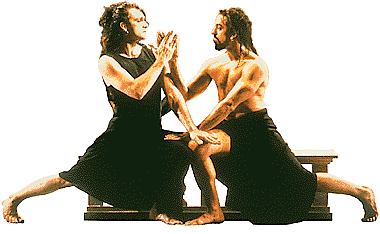
Morris as Dido (left)
Within
the Mark Morris Dance
Group there is a continuum of color and corpus, with men and women ranging from
sinuous to sturdy, and all considered beautiful. With his work and with his
presence, Morris crosses the boundaries we tend to impose on time, on identity,
on the nature of people and the nature of things. His own visage is
confounding: winged-browed, craggy-chinned, snaggle-toothed, moon-pale. His
physique is contrary: large-boned, bulky, buoyant, precise. You never know
whether Morris is getting ready to bourrée or to belch. Nowhere do you
realize this great comprehensiveness, as it were, more than in his Dido and
Aeneas (set to a glorious Purcell opera of the same name). Morris plays
both the noble, love-besotted Carthaginian Queen and her nasty sorceress
nemesis in a star turn that is arguably either a very grand theatrical
transformation or a very potent personal revelation. Or, perhaps, both (June
24-27, BAM Opera House; 718-636-4100). Earlier in the month you can catch
the American premiere of Morris's weirdly enchanting version of
Jean-Philippe Rameau's Platée (June 10-13, Zellerbach Hall,
Berkeley; 510-642-9988). --N.D.
Manhattan: The Greenberg Variations
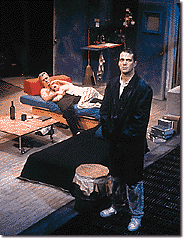 | Three Days of Rain
|
Richard Greenberg's characters barely seem to possess bodies. In breezy comedies like Eastern Standard, The Maderati, and The Extra Man they resemble paroxysms of verbosity. With WASPy, petlike names, they
pontificate and postulate, berate and bellyache, wheedling and whining with
rare wit. Then there are the ones to be pitied--poor saps who can't pun
with the rest of them, who stutter, sputter, and mumble or, heaven forbid,
heap cliché upon cliché. In other words, Greenberg is the closest
America can come to producing another Noel Coward. His latest, Hurrah at
Last, at South Coast Repertory in Costa Mesa, California (May 22-June 28;
714-957-4033), caps a triple-crown season for the playwright. His haunting
family drama Three Days of Rain explored two generations of aristocratic
New Yorkers and ran to critical acclaim last fall at the Manhattan Theatre Club
after its debut at South Coast. In March the McCarter Theatre in Princeton, New
Jersey, premiered Greenberg's Safe as Houses. Hurrah at Last
finds Greenberg again amid the East Coast elite, focusing on a privileged,
assimilated Jewish family (with typical Greenbergian names like Thea, Lawry,
and Sumner) that gathers to celebrate Christmas Eve in a swank New
York City loft. Following in the footsteps of literary forebears such as
Thornton Wilder and A. R. Gurney Jr., Greenberg's comedy promises to be the
perfect antidote to a long Christmas dinner. --J.I.
Nancy Dalva is the author of Dance Ink: Photographs.
John Istel is a senior editor at Stagebill.
Go to ...
 
Copyright © 1998 by The Atlantic Monthly Company. All rights reserved.
|