Rex Tillerson confirmed for secretary of state, Trump lambasts refugee deal with Australia, U.K. lawmakers vote to trigger Brexit, and more from the United States and around the world.
—Rex Tillerson was confirmed to head the Department of State. More here
—President Trump took to Twitter to lambast an Obama-era deal with Australia that would send 1,250 refugees staying in Pacific island camps to the U.S. More here
—Members of Parliament voted 498-114 to grant Prime Minister Theresa May approval to trigger Brexit, a process to launch two years of talks with the European Union on the U.K.’s future relationship with the bloc. More here
—We’re tracking the news stories of the day below. All updates are in Eastern Standard Time (GMT -5).
President Trump took to Twitter Wednesday night to lambast an Obama-era deal with Australia that would send 1,250 refugees staying in Pacific island camps to the U.S.
Do you believe it? The Obama Administration agreed to take thousands of illegal immigrants from Australia. Why? I will study this dumb deal!
The tweet came soon after a report from The Washington Post that described an intense phone call on Saturday between Trump and Australian Prime Minister Malcolm Turnbull. After Trump reportedly ended the phone call only 25 minutes into a planned hour-long conversation, he said that “this was the worst call by far” he’s had with foreign leaders.
Violent Protests Against Milo Yiannopoulos Erupt at UC Berkeley
Ben Margot / AP
The University of California, Berkeley campus is on lockdown after violent protests broke out in response to an event hosting alt-right activist Milo Yiannopoulos. As a result of the protests, the event was canceled and there’s a shelter-in-place order. Protesters started fires, threw rocks, and tore down barriers. In a statement on Facebook, Yiannopoulos, who serves as an editor at conservative website Breitbart, said he had to be evacuated from the campus. In his usual defiant tone, he continued by saying that “the Left is absolutely terrified of free speech and will do literally anything to shut it down.” Police fired tear gas in the crowds, as well.
Dozens of Dakota Access Pipeline Protesters Arrested
Terray Sylvester / Reuters
Police in North Dakota arrested 76 protesters on Wednesday demonstrating against the Dakota Access oil pipeline. The protesters, authorities say, refused to leave the “Last Child” camp set up on private land owned by the pipeline developer. Protesters say the land rightfully belongs to Native Americans. Police have made nearly 700 arrests in the last six months, as protesters continue to object to a proposed pipeline they say may contaminate the drinking water of the nearby Standing Rock Sioux reservation. The pipeline goes under a section of the Missouri River. On January 24, President Trump signed an executive order paving the way for the Army Corps of Engineers to approve the pipeline within days. The crude oil pipeline will cost $3.8 billion and span 1,200 miles from North Dakota to Illinois. Trump, in a recent executive order, also gave new hope to the Keystone XL Pipeline, which would bring tar sands oil from Canada.
U.S. Military Confirms Civilians Were 'Likely Killed' in Yemen Raid
Fawaz Salman / Reuters
The U.S. military confirmed Wednesday that civilians were “likely killed” in a raid against al-Qaeda militants on Sunday in southern Yemen. William “Ryan” Owens, a Navy Seal, was also killed in the raid, becoming the first service member killed in combat during the Trump administration. Three other service members were injured. In a statement, the United States Central Command said the raid, which included heavy firefight, said that “casualties may include children.” Civilians, the U.S. military says, may have gotten “caught up in aerial gunfire,” which was called in when service members were “receiving fire from all sides.” Combatants, which included armed women, had small arms and grenades. The U.S. military, though, says they successfully obtained intelligence. Previous reports indicate that as many as 10 civilians and 14 militants may have been killed in the operation. On Wednesday afternoon, Trump visited Dover Air Force Base in Delaware to “honor the remains” of Owens.
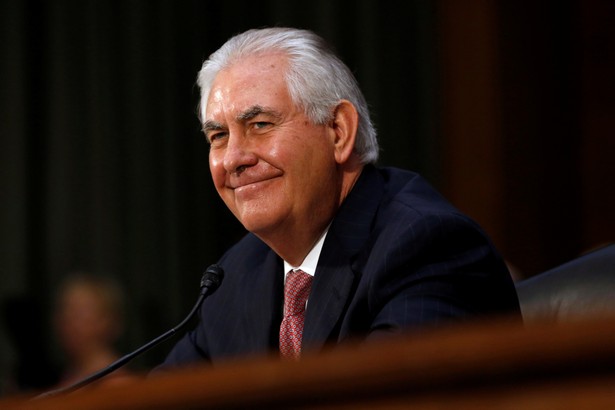
Senate Confirms Rex Tillerson as Secretary of State
Jonathan Ernst / Reuters
Rex Tillerson was confirmed Wednesday to head the Department of State. The Senate voted largely on party lines, handing the 64-year-old former Exxon Mobil CEO a final vote of 56 to 43, well above the 51 votes he needed. Doubt over Tillerson’s confirmation was laid to rest last week after Florida Senator Marco Rubio pledged to support him despite some reservations. Still, as my colleague Russell Berman notes, “the vote was closer than for any secretary of state in decades, reflecting a polarized political environment that is playing out in the Capitol on a daily basis.”
U.K. MPs Criticize May Over Response to Trump's Travel Ban
Neil Hall / Reuters
British Prime Minister Theresa May faced harsh criticism Wednesday for her initial silence on President Trump’s executive order banning travelers from seven Muslim or predominately Muslim countries from entering the U.S. for 90 days. Jeremy Corbyn, the head of the opposition Labour Party, led the charge during the weekly Prime Minister’s Questions, first quoting May’s previous commitment to “speak frankly” to Trump before asking, “What happened?” Other members of Parliament joined in. “The leaders of Canada and Germany were able to respond robustly,” Jonathan Reynolds, a Labour MP, said. “Your response was to jump on a plane as soon as possible and to hold his [Trump’s] hand.” In response, May said she did eventually release a statement on the executive order Saturday night, a day after it was signed, which read, in part: “[W]e do not agree with this kind of approach and it is not one we will be taking.” May also stressed the importance of the U.K. maintaining a close relationship with the United States, citing Trump’s commitment to NATO as an important outcome of her visit. This did little to quiet her detractors, who want her to strongly condemn both the U.S. president and his actions.
President Trump flew to Dover Air Force Base in Delaware Wednesday afternoon to “honor the returning remains” of a U.S. Navy Seal killed earlier this week, reports the Associated Press. William “Ryan” Owens, 36, of Peoria, Illinois, was the first combat casualty of Trump’s nascent presidency. He died in Yemen, in a raid targeting an al-Qaeda affiliate group called al-Qaeda in the Arabian Peninsula. Thirty other people were killed in the raid, including an 8-year-old American girl.
According to a White House pool report, first daughter Ivanka Trump traveled to Delaware with her father on Marine One, and for a brief time their destination was unknown. Trump had previously offered gratitude and condolences to Owens’ family. “The sacrifices made by the men and women of our armed forces, and the families they leave behind, are the backbone of the liberty we hold so dear as Americans, united in our pursuit of a safer nation and a freer world,” he said in a statement Sunday. Three of Owens’ fellow service members were wounded in the operation.
U.S. Says It's Putting Iran 'On Notice' for Missile Test
(Mike Segar / Reuters)
Michael Flynn, President Trump’s national-security adviser, said Wednesday the U.S. is “officially putting Iran on notice” for the Islamic republic’s recent missile test, as well as an attack on a Saudi vessel by Tehran-backed Houthi rebels in Yemen. In a statement, which he read at the White House, Flynn said Iran’s missile launch violated UN Security Council Resolution 2231. In Yemen, a proxy war between Saudi Arabia and Iran pits the Iran-backed rebels against the Saudi military and its allies. Flynn said the Obama administration had “failed to respond adequately to Tehran’s malign actions,” and cited President Trump’s view that the nuclear deal struck between Iran and global powers, including the U.S., was “weak and ineffective.” It’s unclear what Iran being put “on notice” means. Sean Spicer, the White House spokesman, said the comment meant “We aren't going to sit by and not act on those actions.”
UPDATE: Israel to Build First New Settlement in 20 Years
A pro-settlement activist argues with an Israeli policeman during an operation by Israeli forces to evict settlers from the Amona in the occupied West Bank on February 1. (Baz Ratner / Reuters)
Updated at 1:52 p.m.
Israeli Prime Minister Benjamin Netanyahu has established a panel to build an entirely new settlement in the West Bank—the first in more than two decades—to house those evicted from the Amona outpost, which the Israeli Supreme Court labeled illegal because it was set up on private Palestinian land. Haaretz reported that the panel would include representatives of Amona's residents, the Israeli defense minister’s adviser on settlements, and the chief of staff of the Prime Minister's Office. It’s unclear where the new settlement would be built. The announcement, which is likely to prove controversial, came after Israel announced late Tuesday it’s building 3,000 new homes in the occupied West Bank. The dismantling of the Amona settlement, which is also in the West Bank, was been met with protests by Jewish settlers who believe the West Bank and Gaza, which they refer to by their biblical names, Judea and Samaria, belongs to them in their entirety. Palestinians, who control Gaza and much of the West Bank, want the areas to be part of a future state with east Jerusalem as its capital. Israel claims all of Jerusalem. The Israeli government’s announcement comes just days after Israel approved 2,500 new homes in the West Bank and 550 units in east Jerusalem. The status of Jerusalem, the settlements on occupied land, and the contours of a future Palestinian state are all subject to negotiations between Israel and Palestinians as part of the two-state solution. But those talks have been dormant for years, the peace process itself is all but dead, and the Israeli government now has a sympathetic ally in the White House, making a resumption of negotiations appear unlikely.
As Cease-Fire Violations Flare, NATO Chief Urges Calm in Eastern Ukraine
(Alexander Ermochenko / Reuters)
Updated at 3:02 p.m. ET
NATO’s chief says there have been more than 5,600 violations of the fragile cease-fire in eastern Ukraine where pro-Russian rebels are battling the Ukrainian government. Jens Stoltenberg, NATO’s secretary general, called it the “most serious spike in violations in a long time.” He urged Russia to use its influence with the rebels to reduce tensions, and urged the sides to abide by the Minsk agreement, which was signed in September 2014 to stop the fighting in Ukraine’s Donbass region. The fighting has prompted Ukrainian authorities to prepare to evacuate the government-controlled town of Avdiivka, which is now without water or electricity. The town has come under heavy shelling from the rebels, leading to civilian casualties. In Moscow, Dmitry Peskov, the Kremlin spokesman, said the escalation is “probably just another reason for a swift resumption of a dialogue and cooperation between Russia and the United States.” Relations between the two countries had been frosty after Russia’s invasion of Ukraine’s Crimea in 2014, but President Trump has said he’s willing to work with Russia and has previously praised its leader, Vladimir Putin. Sean Spicer, the White House spokesman, said Wednesday: “The president has been kept aware ... of what's going on in Ukraine.”
900 State Department Officials Reported to Have Signed Dissent Memo
(Joshua Roberts / Reuters)
Nine-hundred officials at the U.S. State Department have reportedly signed a memo that protests President Trump’s executive order on immigration. The order stops travelers from seven Muslim or predominantly Muslim countries from entering the U.S. for 90 days; stops all refugees from entering for 120 days; and bars all Syrian refugees from coming until further notice. Trump says the order is meant to keep the U.S. safe from potential terrorists. As I reported Monday, the memo signed by the State Department officials questions the order’s effectiveness, adding “this ban stands in opposition to the core American and constitutional values that we, as federal employees, took an oath to uphold.” The memo, Reuters reported, has been submitted to Tom Shannon, the acting secretary of state, through the State Department’s “dissent channel,” which was established in 1971 during the Vietnam War as a venue for diplomats to freely express their concerns with U.S. policy, and has been used frequently since then to express opposition to an administration’s policies. When asked Monday about the memo, Sean Spicer, the White House spokesman, said of the officials who signed it: “They should get with the program or they should go.”
Congresswoman Tulsi Gabbard to 'Personally Reimburse' Her Trip to Syria
Brian Snyder / Reuters
Representative Tulsi Gabbard said she will “personally reimburse” the cost of her trip to Syria last month, which included a visit with Syrian President Bashar al-Assad. In a statement Tuesday, the Hawaii congresswoman said she would repay the Cleveland-based Arab American Community Center for Economic and Social Services (AACCESS-Ohio) for the cost of the trip “because it became a distraction,” adding she is “beholden to no one in the region, her views on the situation are her own, and her determination to seek peace is beyond question." The trip caused controversy after Gabbard revealed she met with Assad. Gabbard said the meeting was unplanned. Still, it could constitute a violation of the Logan Act, which prohibits U.S. lawmakers from meeting with foreign governments that are in dispute with the U.S., like the longtime Syrian leader. (No one has ever been prosecuted under the law.) Gabbard did not reveal how much the trip cost—only that it was financed by Bassam and Elie Khawam, AACCESS members who organized several trips to Syria for former Representative Dennis Kucinich. AACCESS has been linked to the Assad government and a controversial Syrian political party—charges Bassam Khawam has denied in an interview with The Atlantic.
Members of Parliament voted 498-114 Wednesday to grant Prime Minister Theresa May approval to trigger Brexit, a process to launch two years of talks with the European Union on the U.K.’s future relationship with the bloc. The approval came despite vocal opposition from some MPs from the Labour Party, who defied their leadership with the vote, as well as from the Liberal Democrats and the Scottish National Party. May’s Conservatives voted in favor. May is expected to unveil her strategy for Brexit on Thursday. Britons voted last summer to withdraw from the EU, but the country’s Supreme Court ruled MPs must have a say before Article 50 of the Lisbon Charter, the formal trigger for Brexit, is invoked.
The shooting at the correspondents’ dinner made clear who gets saved first.
This article was featured in the One Story to Read Today newsletter. Sign up for it here.
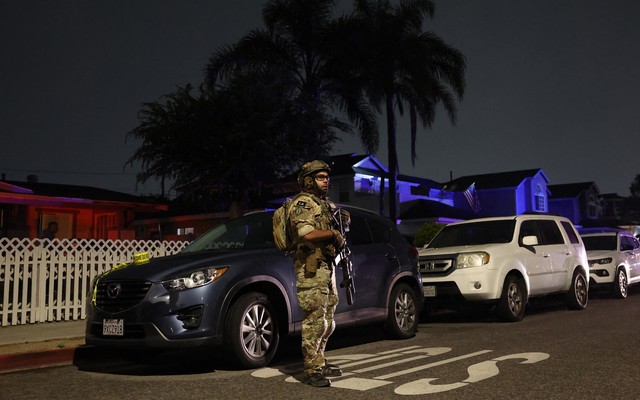
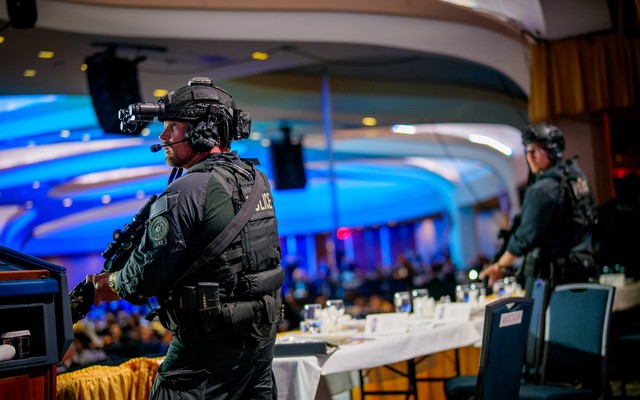
On one level, the system worked. The perimeter held. A would-be assassin was tackled in the hallway outside the White House Correspondents’ Association’s annual dinner. The one bullet that found a human target—a U.S. Secret Service agent—was halted, in part, by the officer’s phone and bulletproof vest, according to a law-enforcement summary report that we reviewed. A counterassault team promptly swarmed the stage with assault rifles and night-vision equipment in case the lights were cut. The government’s top leaders—president, vice president, Cabinet officials, speaker of the House—were ushered to secure locations in a matter of minutes. No one died in the attack.
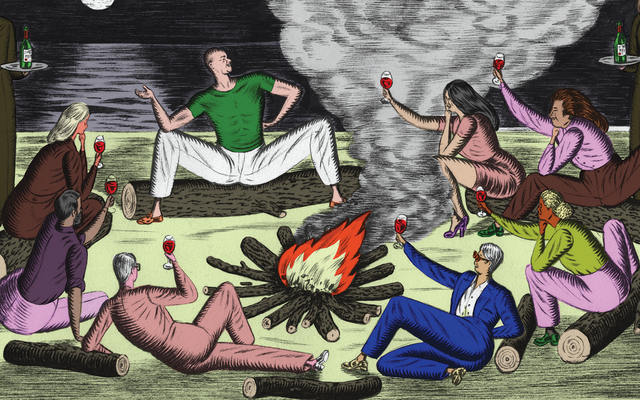
For the richest men on Earth, everything is free and nothing matters.
At the end of Paul Thomas Anderson’s 2007 movie, There Will Be Blood, Daniel Day-Lewis’s oil-baron character, old now and richer than Croesus, beats Paul Dano’s preacher to death with a bowling pin. Dano’s Eli Sunday, a nemesis of Day-Lewis’s Daniel Plainview during his seminal, wealth-building years, has come to sell Plainview the oil-rich land that he once coveted. But Plainview doesn’t need the land anymore, because—as he explains in one of the most famous monologues in modern cinema—he has sucked out all the oil hidden beneath it from an adjoining property, like a milkshake.
Desperate for money, Eli begs for a loan. Instead, Plainview chases him around a bowling alley and murders him with great enthusiasm. Once it’s over, a butler comes to see what all the noise was about. “I’m finished,” Plainview yells.
Instead of a crackdown on his enemies, Trump wants his ballroom.
When an assassin murdered Charlie Kirk in September 2025, the MAGA movement seized the moment to demand a campaign of repression. Vice President Vance called for an ambitious program to “go after the NGO network that foments, facilitates, and engages in violence.” He named the Ford Foundation, Open Society Foundations, and The Nation magazine as examples of candidates for the retaliation he had in mind. The people who faced consequences after the killing almost universally did so for things they had written or said, not for acts of violence. In November, Reuters counted some 600 cases of people who were fired, suspended, or otherwise disciplined for their speech about Kirk’s life and death.
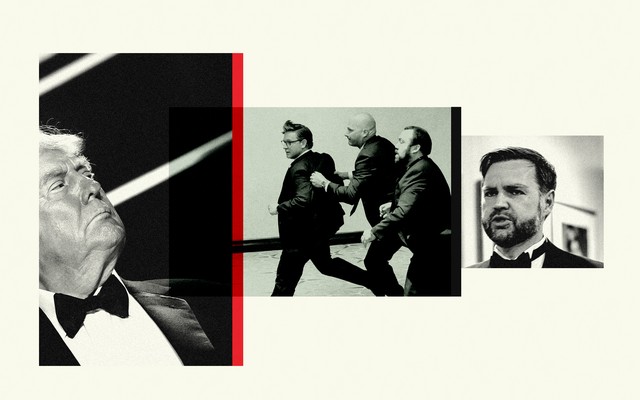
Now another gunman has attacked political targets. At the White House Correspondents’ Association dinner, a man discharged a firearm in the vicinity of hundreds of people from the worlds of politics, media, and business—among them, the president and vice president of the United States. Although much about the event remains unclear, the available evidence suggests that the gunman was motivated by an anti-Trump agenda. Yet this time, MAGA’s immediate response to political violence has been much less aggressive. At his press conference after yesterday’s attempted shooting, President Trump cited the attack as proof of the need for his wished-for White House ballroom. Social-media accounts that take their cues from the White House promptly echoed the message.
A manifesto-like email allegedly sent by the dinner shooter suggests a murderous obsession with Trump’s politics.
The line “I experience rage thinking about everything this administration has done” could probably have been written in an email to friends by any number of the attendees at last night’s White House Correspondents’ Association dinner. But the line was apparently written by a man who showed up with a shotgun and pistol and was ready to kill “most everyone” there to get to Donald Trump and assassinate him and his Cabinet. In a manifesto-like email that he reportedly sent to family minutes before allegedly shooting, Cole Tomas Allen wrote that the assembled journalists and machers “chose to attend a speech by a pedophile, rapist, and traitor, and are thus complicit.” Allen never came near the president or the gala floor. A Secret Service agent was shot in the vest before Allen was tackled and arrested.
This weekend’s failed attack highlighted a risk that often goes unspoken.
In the chaotic swirl of events after President John F. Kennedy’s assassination, doctors feared that Vice President Lyndon B. Johnson had suffered a heart attack upon arrival at Parkland Memorial Hospital in Dallas. The signs were ominous: Johnson’s face was ashen, and he was clutching his chest. “There was the real possibility that the No. 3 in the line of succession would become president,” the historian Michael Beschloss told me. Johnson was reportedly examined and a heart attack ruled out—but not before then–House Speaker John McCormack was told that he might be the next president. The declaration prompted a severe bout of vertigo in the 71-year-old.
Few moments in history have so starkly exposed the vulnerabilities of the presidential line of succession—or the lack of clarity about how it is protected. Last night provided another illustration of them. If events at the White House Correspondents’ Association Dinner had gone differently, a gunman who breached security at the Washington Hilton could have reached a ballroom containing an unusually dense cluster of American power. The president and the vice president were seated a few feet apart. Congressional leadership and many Cabinet secretaries were also on hand. In other words, much of the presidential line of succession was in the same spot—and subject to the same vulnerabilities.
Tragedy was averted at a Washington hotel, but such moments will happen again.
Except for what appears—thank God—to be only a minor injury to a Secret Service officer who was shot near a security checkpoint, no one was hurt at the White House Correspondents’ Association dinner last night. News reports are reassembling the mosaic of the attacker’s movements; he apparently took a train and transported some weapons with him, checked into the hotel, and then made his run at the event.
These are the basic contours of all that we know, and it will take time for more credible information to emerge. In the meantime, the vacuum of facts has been filled by a certain amount of hysteria and the usual conspiracy theories, as well as understandable demands to make changes so that such a thing can never happen again.
Priests and theologians want to shape the future of AI. Big Tech is listening.
In 1633, Galileo Galilei stood in the convent of the Santa Maria sopra Minerva church in Rome, where a tribunal of Catholic authorities forced him to “abjure, curse, and detest” his belief that the sun—not Earth—was the center of the universe.
Almost four centuries later, in 2016, the Vatican invited a group of the world’s most prominent technologists to the same church to discuss AI ethics. That was the start of the Minerva Dialogues, annual closed-door conferences in Rome that have become the centerpiece of a decade-long exchange between Silicon Valley and the Catholic Church.
The Valley and the Vatican seem like strange bedfellows: The oldest institution in the world meets secular upstarts bent on creating godlike technology. When the venture capitalist Reid Hoffman first attended the dialogues, he told me he was struck by the portraits lining the walls that depicted Catholic inquisitors like those who persecuted Galileo. “It feels a little bit weird to be walking in voluntarily past these,” he remembers thinking.
James Talarico is trying to sell a novel brand of Christian politics in a deep-red state.
Updatedat 11:25 a.m. ET on April 24, 2026
While some might pray for hope or peace in such dark times, others are praying for the death of Texas Democrat James Talarico, who is running for the U.S. Senate. During a recent episode of the right-wing Protestant podcast Reformation Red Pill, host Joshua Haymes told the pastor Brooks Potteiger that he prays that “God kills” Talarico, given that the politician seems to be possessed by demons. Potteiger agreed, offering that Talarico should be “crucified with Christ.” Both Haymes and Potteiger later insisted that their remarks were not sincere expressions of violent intent, but rather metaphorical calls for Talarico, a Presbyterian seminarian, to find salvation in their brand of Christianity. Talarico shrewdly responded by offering forgiveness: “You may pray for my death, Pastor, but I still love you. I love you more than you could ever hate me.”
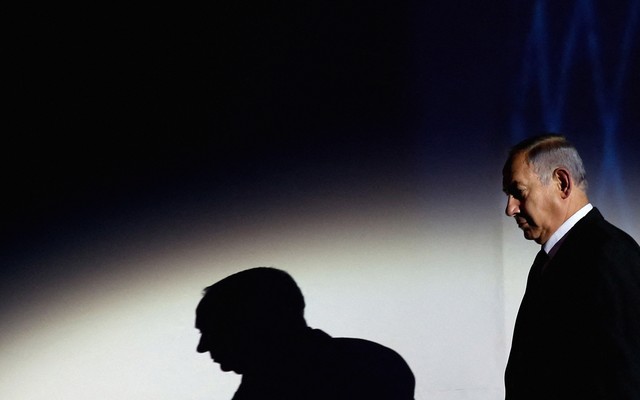
The Israeli prime minister’s focus is, as always, on himself and his near-term political needs. The plight of American Jews is simply not his concern.
The relationship between the United States and Israel is in crisis. Six in 10 Americans have a negative view of Israel, and a majority of those under 50 in both major parties view Israel as well as its prime minister, Benjamin Netanyahu, negatively. After the brutal Gaza war, a large percentage of liberal-leaning Generation Z considers Israel a pariah state. Democratic candidates are scrambling to distance themselves from Israel and its controversial leader; earlier this month, 40 of the 47 Democratic senators voted against a military aid package for the country. And hostility toward Israel is spilling over into hostility toward Jews. Liberal influencers, activists, podcasters, and even politicians are invoking age-old anti-Semitic tropes with frightening regularity.
A New York Times podcast hosted Hasan Piker and a New Yorker staff writer for a discussion of lawbreaking, which they both endorsed as resistance to tyranny.
The late political scientist James C. Scott endorsed what he called “anarchist calisthenics”—the regular practice of small acts of lawbreaking and disobedience. Jaywalk at an empty intersection. Have a beer in the park. Smuggle a pudding cup past the TSA agents. The point, Scott said, was to keep the civic muscles strong. Without constant reinforcement, these muscles will atrophy, and when real tyranny arrives, the flabby citizen will be powerless to resist. Scott particularly enjoyed telling Germans to get their reps in, because their grandparents had not.
On Wednesday a New York Times podcast hosted the Twitch streamer Hasan Piker and the New Yorker staff writer Jia Tolentino for a discussion of lawbreaking, which they both endorsed not as a habit of mind but as resistance to actual tyranny, today. They agreed that shoplifting from grocery stores such as Whole Foods is laudable, because (as Tolentino says, without evidence) “every major grocery chain” steals from workers and customers. Streaming services—they specifically name Spotify, which carries the Times podcast—are bad for creators and, they say, worthy of being ripped off. Piker said he would steal cars, “if I could get away with it.” Channeling Abbie Hoffman, Tolentino encourages people to steal from her own employer, The New Yorker, but does not explain which high crimes David Remnick has committed to earn this comeuppance.