Cow Pasture Golf
By WALTER PRICHARD EATON
THE term “cow pasture golf” has almost vanished from memory, so long has it been since the turf of any American golf course was clipped by ruminants. Powerful five-unit tractor mowers have ironed out the fairways, chugging little machines have manicured the greens, power-driven machines have trimmed the rough. Machinery, gasoline, and manpower have been required in large quantities, and at a high price. Confronted with a shortage of all three, at any price, we are told that many golf clubs will have to close up and let their expensive fairways go back to hay— a completely unmarketable commodity these days. It is a gloomy picture, especially for the middle-aged men among us who rely on the game to keep us fit.
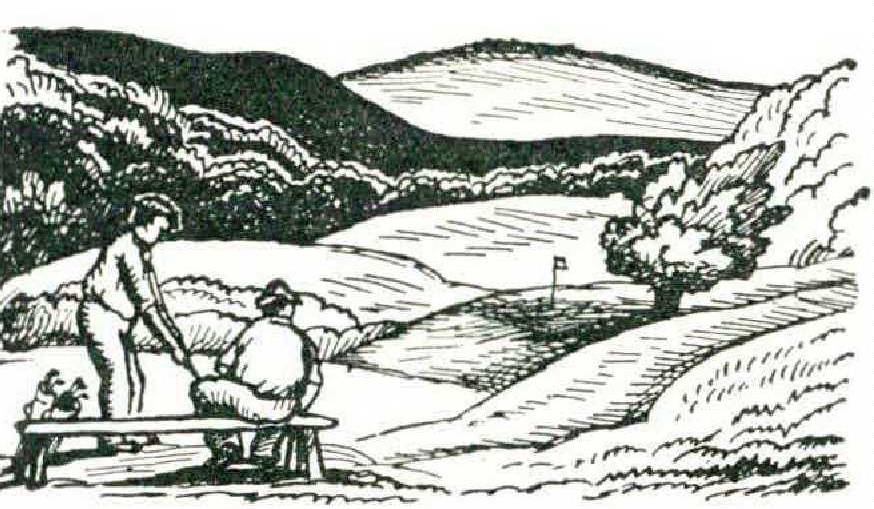
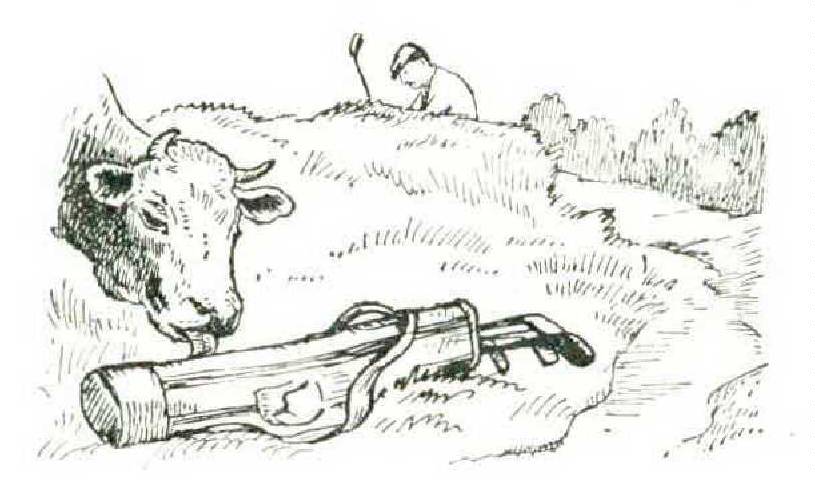
Put many a man of my generation can remember when we played cow pasture golf quite literally, and enjoyed it. There were certain drawbacks, to be sure. But the advantages far outweighed them. In the ‘90’s I was one of a group who rented a pasture from a farmer not far from Boston, and laid out thereon a nine-hole course. The greens were placed in natural hollows where the turf did not burn, and were fenced around with two strands of wire on driven stakes. This kept the cows off—theoretically. If you hit a wire on your approach, you could try again without loss. One man, with a four-blade mower, kept the greens cut. The rest of the course was mowed by the cows.
As our greens took such a small area out of past image, the farmer charged a ridiculously low rent and threw in the harness room of his barn for a clubhouse and the family pump for bar and washroom. Our annual dues were five dollars. The best ball cost thirty-five cents. Anybody who paid more than two dollars for even a wooden club was putting on airs. And the first National Women’s Amateur was played on that course, though then the cows may have yielded, at least temporarily, to a horsedrawn mower.
It was in the ‘90’s, too, that I used to go out to what must have been one of the first municipal courses in the United States, at Franklin Park, Boston. Caddies on such a course were then almost unknown, and the small boys’ participation consisted either of jeering at the players or hiding
behind a bush down the fairway and making off with any balls which came their way. I seem to recall that these links then boasted a flock of sheep, under the guidance of a shepherd. In fact, I see them plainly, but of course what I see may be the sheep which used to crop the west meadow in Central Park.
2
By the time I joined the Westchester Golf Club shortly after the turn of the century, both cows and sheep were out of the golfing picture, but our clubhouse was a dilapidated old country mansion, our lockers were pegs along the walls of the bare chambers, and the dues were so low that even newspaper reporters could pay them. We reached the club by the Third Avenue El, a trolley, and then a half-mile walk. And we had fun.
Since those incredibly simple days I have spent fifteen years of my life and thousands of other people’s dollars as chairman of first one and then another greens committee, and then fifteen more years enjoying the luxury of pecking fault at my successors. I have seen the demand for luxury in clubhouse appointments and facilities steadily increase beyond all reasonable requirements of the game. And I have seen the cost of course maintenance increase to what we in the ‘90’s would have considered astronomical figures.
For this there are many reasons. One is the modern ball and club, which necessitate increased length up to 1500 yards — or nearly a mile of added fairway. Another is the competition among clubs. Another is the influence of so-called “ golf architects who work out ideal holes on paper and then construct them at great expense, often regardless of the natural terrain. They build up target greens cleverly guarded by abysmal traps, which are undoubtedly very sporting to play but which call for elaborate water systems to maintain the turf, and stalls of men to care for the traps.
The power machinery to mow the courses costs thousands of dollars, requires constant expert care, burns up quantities of fuel, and makes no manure. There must be trailers, too, to haul sand and fertilizer. An eighteen-hole course which meets modern standards in design and upkeep and which can bo maintained for $20,000 a year, irrespective of clubhouse maintenance, is probably a rarity. As far back as 1916 it cost us over $12,000 a year to keep up a course of less than 6000 yards, on river-bottom soil that needed no water system and little fertilization.
Boiled down to essentials, the predicament in which golf clubs find themselves today is caused by the conversion of the clubhouses, on the one hand, into elaborate country clubs having nothing to do with golf, and the conversion of the natural terrain, on the other hand, into artificial tees and greens and hazards which require expensive maintenance. Such clubs can only be supported in periods of plentiful labor and financial prosperity. So now we must wail, and wring our hands, and wistfully watch the rust corrode our matched irons.
3
Nonsense. All we have to do is to buy a flock of sheep. They know that already in England
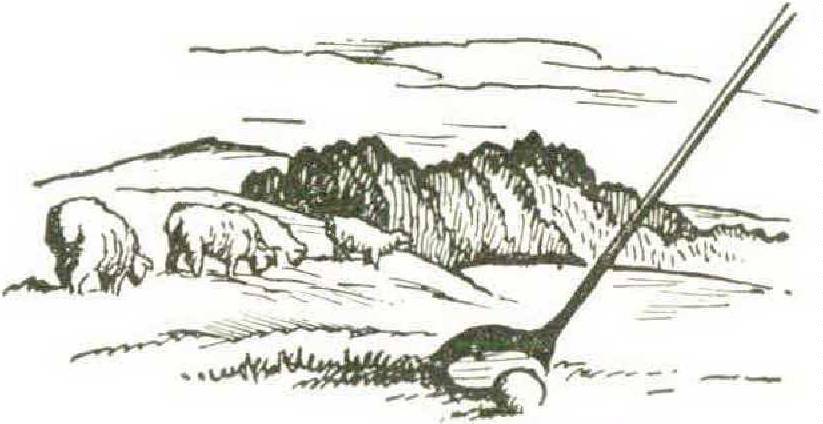
I used to play on a course cropped by sheep, and not in Scotland or England, but Vermont. The course was along one shore of a beautiful lake, and from the other shore rose the noble pyramid of Ascutney. Each of the nine greens had two cups, so that, you played back from another set of tees to the starting point with quite different problems. The terrain was uneven, with sleep slopes and gulleys, and there were no artificial hazards but the sheep, and they seldom bothered. The turf was excellent and tight. And there was no rough! Sheep make no distinctions. Unless you pulled into the lake, you could always find your ball.
Do I hear sniffs of derision? Not, I am sure, from anyone who ever enjoyed the hospitality of that private course in Vermont; but no doubt from those who have shot for the eighth green at the Yale Golf Club, with its forty-foot-deep trap to the left, or who have hopped from oasis to oasis of fairway amid the Sahara of sand at Pine Valley, or climbed the hill amid the bunkers on the superb long sixth at Hob Nob, or delicately tapped a putt fifty feet oxer almost any expanse of rolled and manicured creeping bent. What, say the sniffers, if the sheep leave a hoof print to spoil your lie? What if the greens are too slow or uneven to make perfect putting possible? What if, in the absence of rough, the man who slices has as good a chance as you ?
My answer is that you, Mr. Sniffer, are probably the man who slices, and in your heart you’d be extremely happy to find that you didn’t have to lose three strokes three feet off the fairway. My answer is that actually it wouldn’t make enough difference in your score to be detected by a certified public accountant, even if you got six bad lies. My answer is that nobody’s putting was ever perfect on any
green, not exen Walter Travis’s, and you aren’t Walter Trax is. You can count, on the fingers of one hand all the rounds you’ve ever played in which you took thirty-six putts or less, and you’d actually do better on a slow green which you could hold with your approach. You are no Bobby Jones.
You are not even a member of the Yale goll team, and you can’t, lash out a drive three hundred yards. You can’t get over those traps to the left, so the hole is opened wide for your second shot. (A clever man, that golf architect!) No, you have to keep to the right, and play your second shot over an artificial Grand Canyon and land it on a postage stamp, if you hope to putt for a three. Once, in 1931, you did just that, and got delusions of grandeur. But to this day you don’t know how you did it.
You are merely one of the great majority who pay the bills and keep up the courses so that the slashing youngsters can boast of playing a 450-yard hole with a drive and a number 7, and so that the pros will give your course their haughty approval, and maybe so that tournaments can be played there (in which case you’ll be kept off the links for their duration). You don’t have so much fun as you used to when holes were shorter, golf was simpler, and you didn’t live a subterranean existence in sand traps. And now you’ve got to give it all up because there are no men to rake out your footprints, or run the power mowers, or patch the elaborate tees,
or manicure the target greens; and no gasoline for the machines if the men were available; and no week-end revenue from transients and house guests, either, to help foot the bills. Silly, isn’t it?
It certainly is when a flock of sheep, an ancient shepherd, and a good dog would keep the course going. Not well enough to please the slashing youngsters — who won’t be there. Not well enough to please the professionals, who have become publicity boosters for winter resorts rather than teachers. Not well enough to attract the tournament crowd — for which you should be thankful. But well enough to keep your course open and give you wholesome sport and exercise and tide your club over until peace and prosperity come again, and again the greens can be made too difficult for you to hold with your approaches and the traps too soft with sand for you to blast out of.
4
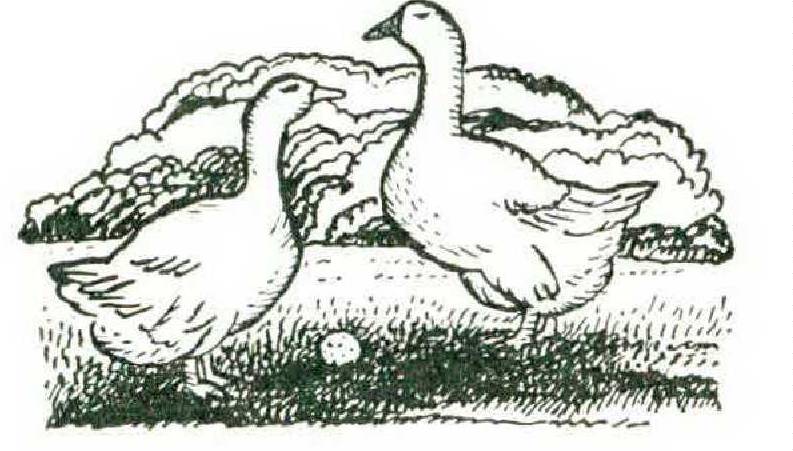
In England, where a sheep is not so much of a curiosity as here, many courses are now kept going by cropping. Clubhouse maintenance was never so much of a problem there. An American visitor to Westward Ho! often mistook the clubhouse for the professional’s shop. But so far, on the home front, we have heard of few recourses to sheep. Curiously enough, though, the Augusta National planned in the spring to experiment with geese, which are supposed to thrive on grazing and not to mind hot weather. If geese once saved Rome, why not a golf club? But somehow we prefer sheep in the landscape, and would feel more certain of their efficiency as mowers.
Perhaps we shouldn’t mention the landscape, since the best courses generally look as if a fleet of bombers had just strafed God’s green acres, and men are generally seen preserving the destruction. The late Ring Lardner was once trying to explode out of a deep crater on Long Island. He had made ten attempts and paused for his niblick to cool, when his opponent, peering over the rim. remarked, “You’d better come out now, Ring. They’ll think you work here.”
A year of erosion and perhaps a little seed scattered in the traps (by night if need be) might restore some semblance of nature to many a course, and the unhappy golfer would not be mistaken for a workman. Time can heal many scars, even those made in the landscape by a golf architect.
We have said nothing about shearing the sheep, but obviously the wool is a source of potential revenue to the club. As for the excess meat stock, if some way can be found to distribute it to members without ration cards — say as a stock dividend — there should be no difficulty about resignations. And how about goose eggs? But these are minor details. The point is that golf can be played, and played with great enjoyment, on sheep-cropped turf, and in the process the game can be given back for a time to the great army of duffers who, whether they confess it or not, find most modern courses too difficult for real satisfaction and too expensive for a reasonable apportionment of their incomes.