The Radio and the Election
By“THE LISTENER”
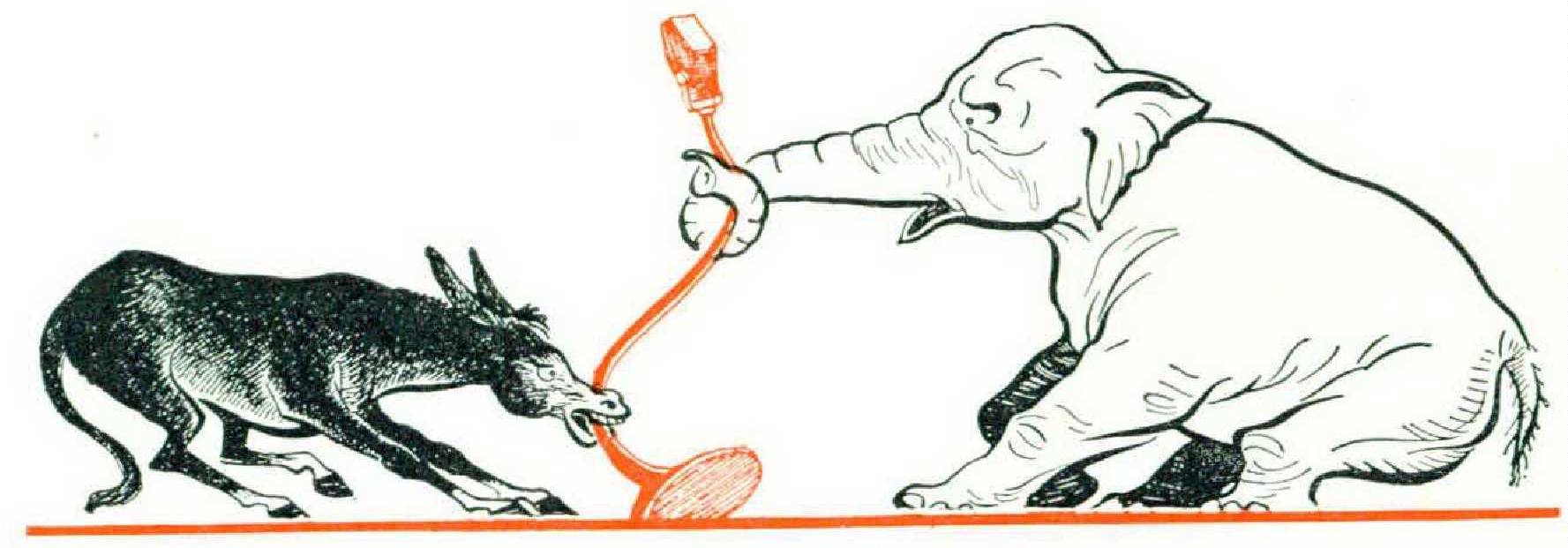
DEMOCRATS are very well satisfied, and Republicans are somewhat annoyed, with the fact that Franklin D. Roosevelt has been on the air as President about 250 times, without charge.
Neither party can tell where the weight of the office leaves off and the weight of the man Roosevelt begins when he tells all four networks he wishes to speak, and they sweep the air clean, and he speaks.
For a few days after Pearl Harbor he was heard by nearly 80 million people. Only 29 million paid attention to his Christmas Tree ceremonies fifteen days later. In August and September of 1942 the best audience he could get for two radio speeches was 20 million. The average of his measured audiences throughout 1943, as compared to those of 1942 and 1941, was roughly this: —
1941 ( 5 speeches) 60 million
1942 (10 speeches) 43 million
1943 (12 speeches) 38 million
“Another downward trend,” cry the Republican partisans.
“Ho, ho, ho!” cry the Democratic partisans. “Since when was 38 million listeners hay? And we can get the time free any time we want it! We can just push any of them off the air — Hope, Fibber, Benny. Ho!”
Subject matter may have a good deal to do with the Roosevelt audience, for on six occasions in the past two years the President has spoken on the air to audiences only one-fourth the size of his greatest of all. But t welve years is a long radio life for any performer, his average is the all-time highest, and we may come back later to subject matter. Let us make our own diagrams on the tablecloth.
The Census Bureau says that next year our population will number about 135 million and that, of them, about 80 million will be 25 years old or more, and therefore potential voters.
Of course they won’t all vote, because they never do. But a conservative guess puts the popular vote this year at 55 million — a full 6 million above 1940 — not counting the mass of the soldiery.
So let us guess that 10 per cent of this increased poll may very well prove the margin of victory.
Put that in numbers. Margin of victory: 5,500,000. Balance of power: 2,750,001. On the basis of that guess, one voter out of twenty can decide the election. By running up the plank of the seasaw and throwing his weight on the other side, he can turn out the New Deal and replace it with a newer.
The stargazers in both parties know that the problem of getting votes this year is greater in numbers than it has ever been before, and that it may very well be decided by a smaller margin.
And that turns them to radio.
For today there are some 65 million American men and women of voting age at the receiving end of radio. Both parties know they are ready to listen, that they spend something like four hours a day listening. So the party men reason: —
“All the earnest persuasion we can pour on them through the press, as we used to in the calm twenties, won’t do the job alone. It’s good, and it’s essential, because so many voters want an editor to make up their minds in print. But it isn’t enough. We’ve got to make the campaign interesting enough to rouse a safe margin of new voters and chase them out to the polls.”
From studies of listening they learn that a crucial margin of 2,750,001, for instance, is no more than the total of those who listen voluntarily to an ordinary daytime serial — a daytime serial which is by no means the most popular. When you realize that there are on the radio each week a hundred or more regular programs which command larger audiences than 2,750,001, you see why the partisans are taking radio seriously, not to say tensely.
For with a high percentage of our population sitting with its ear cocked, attentive and eager for the contest to begin, now is really the first time when almost all good men could truly come to the aid of their party.
The best radio candidate will win the election simply because he will persuade more voters more emotionally and more convincingly.
Of what is a radio candidate made?
The wise men in both parties look backward for clues. They recall that Al Smith made a strong showing against Herbert Hoover because, despite his handicaps, every time the man spoke he had earnestness, humor, fire, and color. To be sure, in certain areas his accent was anathema, but in others it was music. A naturally gifted speaker, Smith spoke for a seen audience, but he was eavesdropped and endorsed by a surprising part of his wholly new and strange radio audience listening across America. The time was not yet quite ripe for a radio “performer” to become President. Mr. Hoover, on the other hand, as he was heard on the radio, projected a dogged sincerity, but he had the aural attraction of a bulldozer at work on a stone highway.
Looking further for case records in political radio, men remember that in 1936 a favorite son from the grass roots was nominated on a wave of classic inducements as savory as any ever offered to the electors. But from the moment Alf E. Landon went on the air he started to lick himself. His partisans realized it, but instead of taking him off the air, they let him go on doing it, and said: “Yes, but wait till you meet the man!” By election day a substantial company of Republicans had decided they just couldn’t take him even if he was a Republican. So they took the Golden Voice again: the man who had in bountiful measure the basic essential of any radio program — attraction. And in 1940, Mr. Willkie’s microphone delivery was not his greatest asset. All he had to do to get his Gallup down was talk.
The farsighted men in both parties know that the radio will play a decisive part in the election, depending on: —
1. The basic common sense and sincerity of the candidate’s offer to the voter.
2. The manner of its presentation.
The candidate’s offer is of course the platform of his party. Having been written, it must be rewritten for the speaker, into the clearest and most dramatic form for the radio public. The public will tune out an Edward Everett to tune in Sinatra, whether you deplore it or not. No preacher in his right mind talks for more than twenty-five minutes; no candidate has a right to put himself above a preacher. Radio time is limited, like the dimensions of a trunk. If the candidate can pack no more than one platform plank into his allotted radio period, lei him engage a series of periods, and let him plan his serial with the utmost skill to be drafted, and talk about one plank per program, in ascending climax, to the eve of the first Tuesday after the first Monday in November. The voter would eat up an orderly series like that. Let the candidate study the news reporters who put the shocking report of the world into fifteen minutes, and let him be as clear as they are, and as informative and moving.
Let him study, too, the artifice of those who produce drama on the air, and if he is talking tolerance let him talk it as well as Columbia’s Open Letter. If he is offering the plank on foreign policy, let him offer it as movingly as Corwin’s Long Name None Can Spell. If he wishes to advance his beliefs and promises on home-front duties, let him do so as eloquently as NBC did in Assignment, U.S.A.
Let him recall that a seasoned playwright has been a major factor in writing sincerity into state papers even before an attractive voice took them to the microphone.
Let him sharply avoid crude and obvious devices which are out of character and insincere (overdone audienceapplause is one), but let him manifest his sincerity by using every radio construction-technique which enables him to get the truth straight to the people fast and hard. An audience that will pay out 108 million dollars in one day for War Bonds in answer to the simple radio voice of one woman will subscribe to any equally probable security offered by any candidate. Radio has proved that the American people are at least not so abominably stupid as the speechwriting of most radio politicians in the past would have us believe.
The instant the candidate hits the air he’s on his own. He’s out of reach of his party managers from then on; he swims or he sinks. His manner on the air will make him or ruin him.
It is conceivable that the American people of a later generation will elect a mute, from sheer relief, but that is not true today. For one reason, we like the personal contact of our humble ear against the voice of our chieftain. For another, we commonly test the honesty of other men by their voices and their mannerisms. The test is, of course, not infallible, but you can’t keep the public from making it. The likeliest candidate is the one who will speak most nearly in the voice which we might call Basic American, which is neither Amurr’kn nor Ah-maira-con. The unlikeliest candidate is the one who has learned nothing from the professional announcer or the successful actor.
If this analysis and this forecast sound a mite petulant, we might as well confess that we believe that a basic reason why the canny American voter holds politics so cheap is that by and large its speaking mannerism is so wholly and completely phony. If a candidate were to call in person on a voter and pronounce to him, in his living room, the sonorous rubbish of the plat form speech, and were to bawl it in his best platform manner, the householder would propel him across the lawn, and there isn’t a jury in the land that would convict the propeller. The artificial convention of the political speaker is not much worse than the artificial rumpus raised by the heelers at a rally, but each foments the other, and neither the one nor the other has the slightest bearing on the qualifications of a party or a man to run a nation, state, county, city, township, or ward.
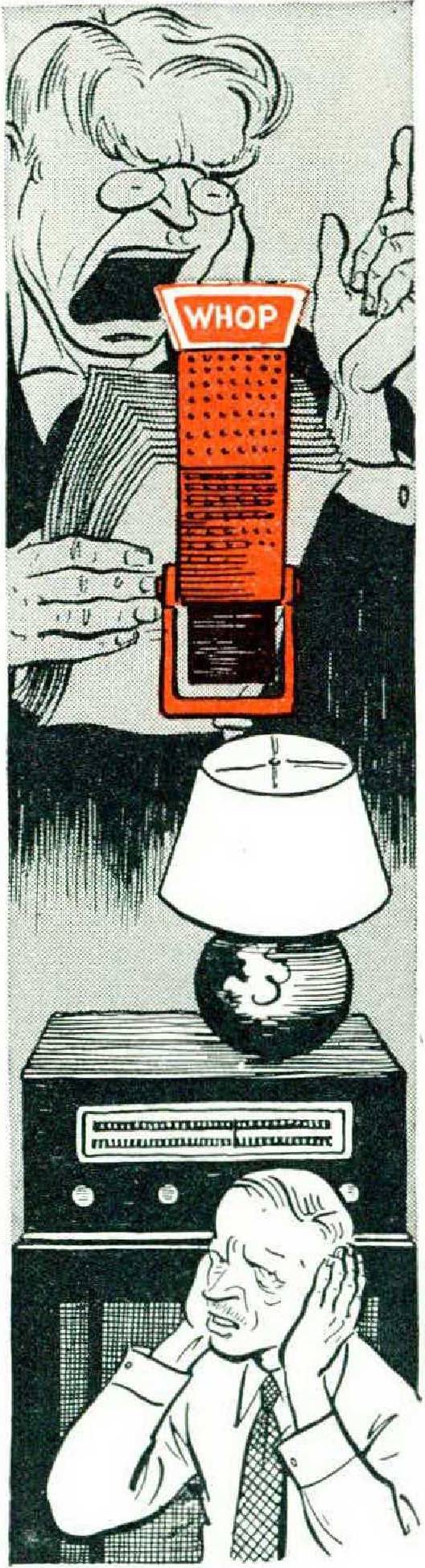
The drab fact of it is that to the nature of the average candidate the howling-ape mannerism of the political platform is uncomfortable and foreign; it is a rigid conventional uniform which they put on with unbecoming awkwardness. Let the quick brown fox of a candidate put it off, just this once. If he does, two things will happen: a good riddance, and he will be elected.
There is no reason to believe that any of these general reforms will be accomplished in the process of the next violent contest. Not even with a war on. The circus must have its bands and its sawdust and without them it would not be the circus — or so we think. The campaign must have its cliques and its free-ride delegates and its drunks, its dull hairtrigger “demonstrations,” its convention, and its back-platform nonsense.
But the wise partisans know that the once essential torchlight parade has vanished, too. They know that cotton for bunting is going into uniforms, that back-platforms are carrying troops, that gasoline is scarce, and that most people spend their evenings not down at the Union Depot but over at the movie house or home at the radio. Yesterday’s town meeting, once the glory of our democracy, burgeoned into the Presidential convention, but today it is a withered travesty. The wise politicians who are our real leaders know that the real town meeting is the front room of the home.
There a man and a woman sit and listen to a candidate, and then the woman says, “What’d you think of him?” and the man says, “O.K., I’m for him,” and the woman says, “When do we register?”
That’s how the highest officer in the world is about to be elected. And he may well be elected by the listening that goes on in only one home out of twenty or thirty. If he sounds phony he will get the ticket to obscurity he will richly deserve. For he has been duly warned.