Travel Is Broadening
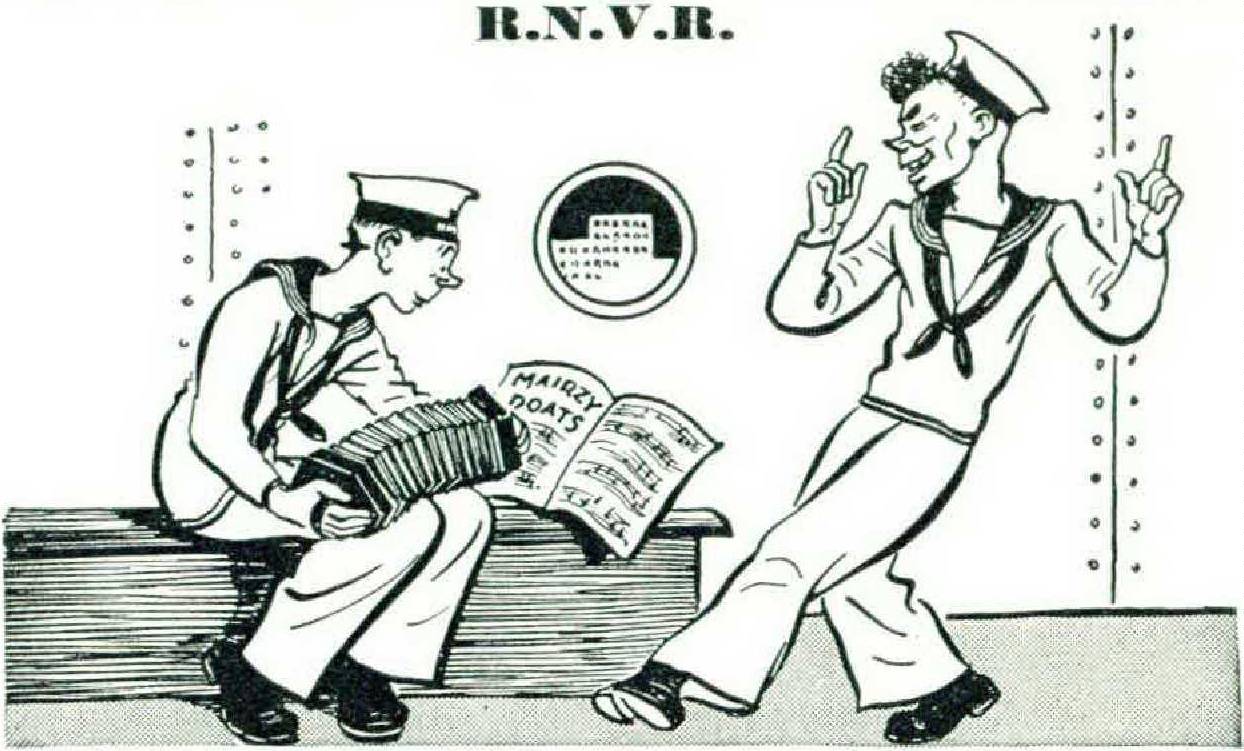
To BRING a British warship’s crew to America and expect them to remain entirely British during the process of taking over a new ship here is perhaps asking too much of human nature. But until one has observed the operation at close quarters, the penetrative power of the American way of life remains unsuspected.
It has recently been my experience to have my whole crew stationed here, at first in barracks ashore and later on board ship, and to observe, with interest and a certain amount of concern, the impact on them of new habits and customs. It’s not that I necessarily dislike these new habits: some of them, indeed, are most attractive; but I feel I have a responsibility to the parents and families of my crew, who may reasonably expect to have them back in roughly the same state as when they left home. It has been a losing fight, however: clearly they find America altogether too insidious, and, their resistance weakened by long months in the North Atlantic, they fall an easy prey to the wiles of the New World.
The American accent and idiom, confusing at first, have already made their mark: we have found it necessary to take on a lot of the local color in this respect, simply in order to stay alive. I myself had the greatest difficulty in making myself understood, particularly when ordering meals, during my first week or so, until in self-defense I reorganized my vocabulary and fell into line. Most of us have done the same: it can be justified as an emergency measure, though it may cause some confusion back home when we start asking for things by odd names, in accents which have covered an almost sensational amount of ground during our travels. But there are other attributes, newly developed, which the “war emergency” excuse will not cover.
Chewing gum, for instance. I began by taking a firm stand on chewing gum. Literally. It was on the deck, and I became anchored to it. Forthwith, orders went out that spent chewing gum was to be disposed of over the side, and nowhere else. But I had underestimated the power of this national habit. The first time I found some gum “ parked ” up on t he bridge after this order was issued, I was extremely annoyed. The second time, I was slightly despairing. The third time, it was my own gum.
The American brand of entertainment is another thing which has made its effect felt. Sing-songs in the messdecks, after working hours, used to have a rather staid British air. They might include harmonica solos and a chorus of “ Rule, Britannia!” but that was about all. Now it is different. Snatches of cross-talk, lifted wholesale from a current and none too refined vaudeville show, drift up to the wardroom. The tunes which are now popular concern Basin Street, Choo Choo Baby, and mares eating oats, and they seem to have an urban quality which is, to say the least, a long way from the sea-shanty of tradition. An embryo jitterbug class has already given the ship’s doctor some extra work, and will probably be in full and acrobatic session by the time we leave.
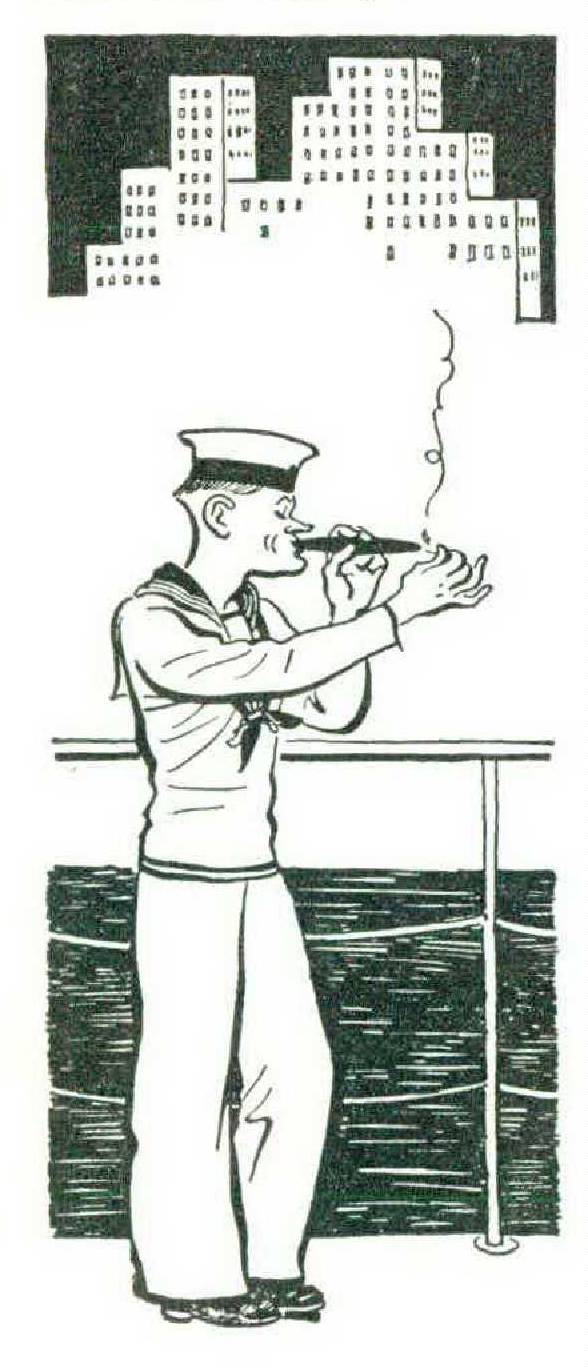
Cigars are so readily available here, by contrast with England, that they were bound to become popular. At home, they are still sufficiently scarce and expensive to have a millionaire touch about them: here, they seem to be a permanent facial characteristic with fully three quarters of the population. At any rate, their abundance has enabled many of the crew to catch the habit: the atmosphere in the messdecks recalls, agreeably, one of the richer London clubs, and the fact that a seaman, given permission to smoke, may light up the father and mother of all cigars, without batting an eyelid, imparts a distinctly prosperous tone to the ship. Indeed, those of my officers who still smoke mere cigarettes are tending to become quite self-conscious about it.
But sometimes the effect of America is more fundamental than this, as this final story, which seems to propound all our problems in one glorious example, will show.
A little while ago, my ship celebrated her commissioning by giving a party. In charge of the checkroom we placed two men who were “under punishment” — that is, they were due for some hours of extra work each day, and this was one form which it took. It was thought that it would be a sufficiently irksome fatigue.
Owing, however, to the generosity of our American guests, and their misunderstanding of the true position, the men under punishment made just over twenty-two dollars in tips.
As one of them remarked, not quite out of my hearing: “I can take punishment like that any time! ”